How Bus Driver Fatigue Causes Accidents & Who Is Liable


Every article on this site is researched by our internal team, reviewed for legal accuracy against current Texas law, and held to State Bar of Texas advertising standards before publication. We do not publish content that overstates outcomes or makes promises about results.
Learn more about our
editorial standards .
Key Takeaways
- Federal law caps bus drivers at 10 hours of driving within a 15-hour duty window.
- A bus company can be liable for fatigue through scheduling, hiring, and its driver's acts.
- Government bus claims require written notice within six months or the claim is barred.
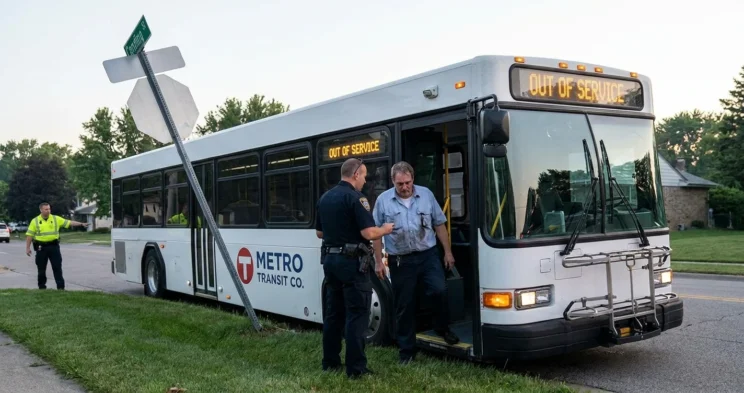
You were riding the bus home through Oak Cliff after a long shift when the driver drifted across the lane and clipped the car beside you. The driver looked exhausted, maybe like he had been behind the wheel far too long. Now you are hurt, the bills are piling up, and you are wondering whether anyone can be held responsible.
How Fatigue Impairs Bus Driver Performance
Fatigue slows a driver’s reaction time, narrows what he notices at the edges of the road, and can trigger microsleep. Microsleep is a brief, involuntary lapse in consciousness that can last several seconds, long enough to cover the length of a football field at highway speed.
A tired driver is a dangerous driver, and the danger builds quietly. Cumulative fatigue is different from simply feeling sleepy after one bad night.
A driver can feel alert while carrying a multi-day sleep deficit that still dulls his judgment and slows hazard recognition. He may believe he is fine right up until the moment he misses something he should have seen.
Night routes and rotating shifts make this worse. They push a driver’s body against its natural sleep rhythm, so the risk climbs higher than the hours on any single shift would suggest.
This pattern shows up in the crash data. Federal researchers have identified driver fatigue as a contributing factor in a meaningful share of serious commercial bus crashes, a connection laid out in the agency’s large truck and bus crash statistics.
Federal Hours-of-Service Rules for Bus Drivers
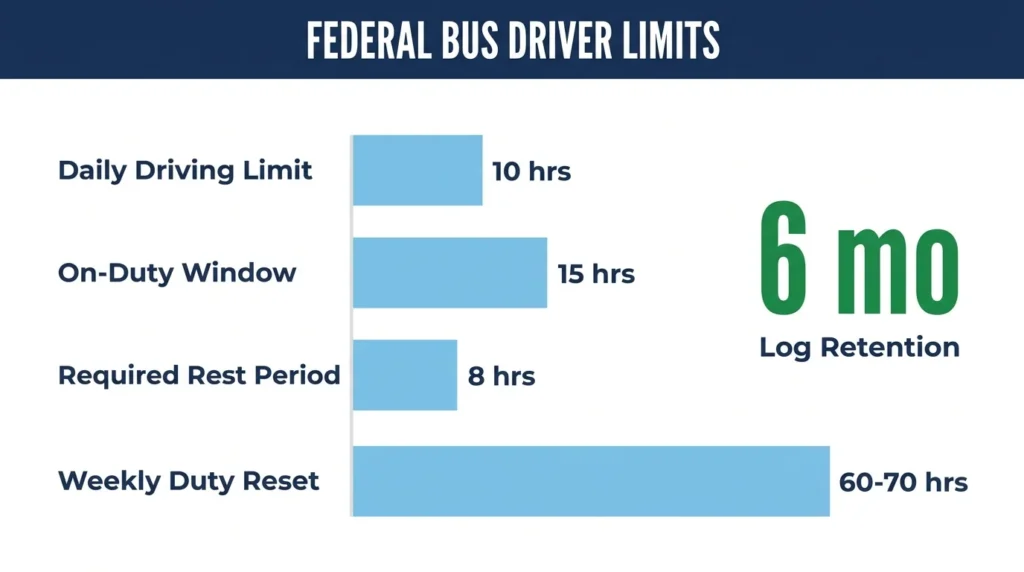
Federal law sets hard limits on how long a bus driver can stay behind the wheel. Drivers of passenger-carrying commercial vehicles face a 10-hour daily driving limit and a 15-hour on-duty window, set out in 49 CFR § 395.5.
After that window, a driver must take 8 straight hours off before driving again. The rule exists for one reason: a rested driver makes better decisions than an exhausted one.
The daily limits are only part of the picture. The full hours-of-service framework also limits weekly hours, forcing a rest reset after 60 or 70 hours of duty across 7 or 8 days.
Most commercial buses must track these hours automatically. The electronic logging device mandate requires equipment that records driving time and produces records that are hard to fake.
This is where many people are surprised. The duty to comply does not fall on the driver alone.
A bus company that builds a schedule no rested driver could meet shares the blame, and it can face direct regulatory trouble on top of any injury claim. The same pressure that pushes truck drivers past safe limits drives bus schedules too.
Federal guidance also spells out which passenger vehicles must use electronic logs and the narrow cases that are exempt. If a carrier claims an exemption, that claim can be checked.
Who Is Liable in a Fatigue-Related Bus Crash?
When fatigue causes a bus crash, responsibility often reaches well beyond the person driving. The company that hired, scheduled, and dispatched that driver can be on the hook too, and so can a government agency if it ran the bus.
Who you can hold responsible depends heavily on who owned and operated the bus.
Private Bus Company Liability
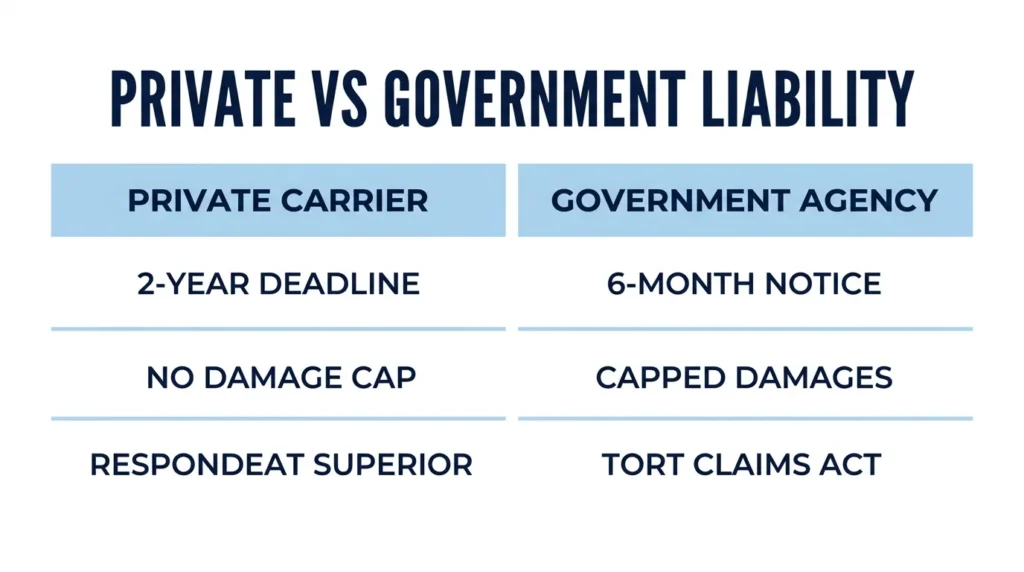
A private carrier can be held responsible for its driver’s fatigue through several legal paths. The first is respondeat superior, a rule that makes an employer liable for an employee’s negligence when the employee was on the job at the time.
So if a fatigued driver was working his route when he hurt you, his employer answers for that conduct. The company cannot hide behind the fact that the driver was the one steering.
A broken safety rule strengthens your position even more. When a driver or carrier violates federal hours-of-service limits and a crash follows, that violation becomes evidence of negligence on its own, a theory lawyers call negligence per se.
The company can also be at fault for its own choices, separate from the driver. Negligent scheduling means it created the conditions for fatigue, and negligent entrustment means it put an unfit driver on the road it knew or should have known about. Neither theory depends on blaming the driver personally.
Government Transit Authority Liability
When a city, county, or regional transit agency runs the bus, different rules apply, and they are strict. Texas gives immunity for certain negligent acts by government bus operators, but the Texas Tort Claims Act limits your compensation and demands fast action.
You must send a written notice of your claim to the government entity within six months of the crash.
That requirement comes from Texas Civil Practice and Remedies Code Chapter 101, and missing it ends your claim no matter how strong your evidence is.
The damage limits under this law also run lower than a private case allows. The type of bus and the agency operating it decide which cap (limit) applies.
If you are not sure whether a government agency operated your bus, talk with an attorney before the six-month notice deadline passes, because missing it ends the claim regardless of fault.
Proving Bus Driver Fatigue in a Claim
Proving a driver was too tired to drive safely comes down to records, and the most important ones disappear fast. Carriers keep electronic logs for only about six months, so the clock on your evidence starts the day of the crash.
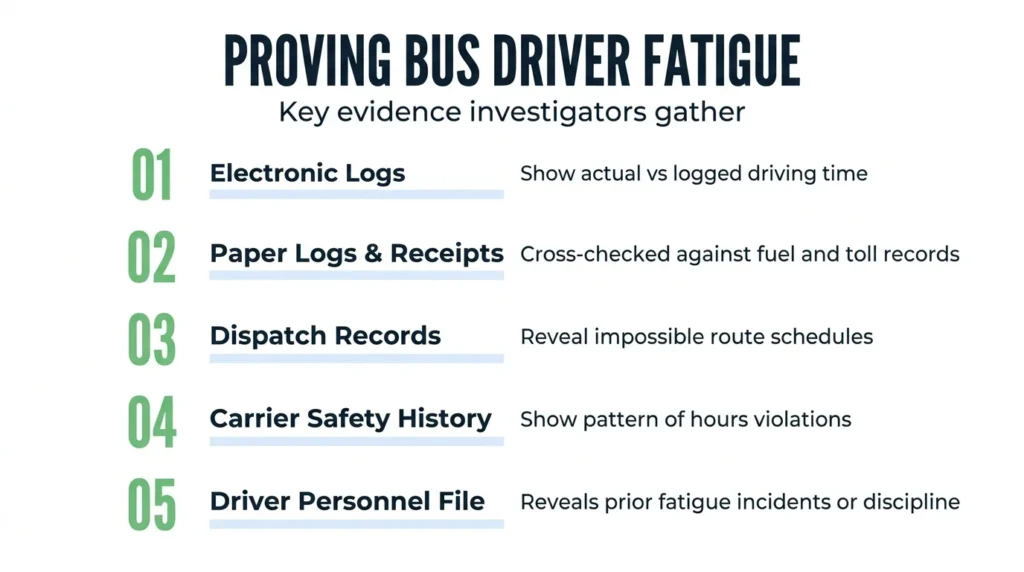
Here is what an investigation typically gathers:
- Electronic log data: Automatically generated records show actual driving time against logged time. Carriers hold them for roughly six months, so prompt legal action matters.
- Paper logs and receipts: For vehicles exempt from electronic logs, paper records cross-checked against fuel receipts, toll records, and GPS data can expose falsified driving entries.
- Dispatch and scheduling documents: These reveal whether the carrier handed the driver a route impossible to finish without breaking hours-of-service limits.
- Carrier safety history: Federal hours-of-service inspection records and past citations can show a pattern of cutting corners.
- Driver personnel file: Prior discipline, earlier fatigue incidents, or medical fitness records can surface in discovery to show what the carrier knew.
One more rule can affect your recovery. Under Texas Civil Practice and Remedies Code Chapter 33, if the carrier convinces a jury you were more than 50% responsible, you cannot recover money at all.
That history of how a carrier treats its drivers often becomes the heart of a case. An attorney can send a preservation letter within days of taking your case, locking down electronic logs and dispatch records before the carrier’s routine schedule erases them.
Texas Filing Deadlines & Next Steps
Your deadline depends on who ran the bus, and one path is far shorter than the other. For a private carrier, you have two years from the date of injury to file under Texas Civil Practice and Remedies Code § 16.003, and a claim filed late is gone for good.
A government transit claim moves faster. You must give written notice within six months of the incident, and that clock runs from the crash date, not from when your treatment ends or your injury is fully diagnosed.
Because the two paths split so sharply, knowing which one you are on shapes everything that follows.
If you have not taken any formal action yet, a few early moves protect your case. Save your medical records, gather names and numbers for any witnesses, and avoid giving a recorded statement to the carrier’s insurer.
Work with an Experienced Attorney Today
Bus fatigue claims rank among the more tangled personal injury cases in Texas. They pull in federal regulations, carrier records you have to fight to obtain, and sometimes the Texas Tort Claims Act and its short deadlines.
Angel Reyes & Associates has guided injured Texans through cases like these for over 30 years. We work on contingency, which means no fee unless we win, and your first consultation costs nothing.
We have more than $1 billion recovered for clients across the state, and we can review where your case stands and what your options are. Reach out to us for a free consultation, and ask us about our results in past cases and the attorneys who would handle yours.
Past results do not guarantee future outcomes.
Bus Driver Fatigue-Related Accident FAQs
Are school buses covered by the same federal hours-of-service rules as commercial buses?
School buses operated by public school districts are generally exempt from FMCSA hours-of-service rules. A for-hire contractor operating a school bus across state lines for a field trip or athletic event must comply fully with federal HOS regulations.
Can the bus driver be held personally liable, or does liability fall only on the company?
A driver can be named personally in a lawsuit, but most recoveries in fatigue cases target the company because the driver was on the job when the crash occurred. The company typically carries the deeper insurance coverage and bears the broader legal exposure under respondeat superior.
Does it matter if the bus company labeled its driver an independent contractor?
Texas courts look past the label and examine how much control the company actually had over the driver’s schedule, route, and daily conduct. If that control was close enough to an employment relationship, the company can still be held liable even if the contract called the driver a contractor.
What kinds of losses can I recover in a Texas bus accident case?
Texas allows victims to seek economic losses such as medical bills, lost wages, and future care costs, as well as non-economic losses such as pain and suffering, mental anguish, and physical impairment. If a private carrier showed a pattern of ignoring safety rules, punitive damages may also be available, though they are not available against government transit agencies.
About the Authors

Angel Reyes
Writer
Angel L. Reyes, III is the Founder and Managing Partner of Angel Reyes & Associates. A nationally recognized trial attorney and business leader, Angel has helped over 70,000 injury victims recover more than $1 billion since founding the firm in 1993. Named to the Texas Super Lawyers list annually since 2008, Angel brings Wall Street experience, Ivy League education, and a deep commitment to client advocacy. He is a frequent legal commentator and published author with extensive contributions to legal scholarship, trial strategy, and consumer protection.

Kyle Nicolas
Editor
Kyle Nicolas is the Web Content & SEO Manager at Angel Reyes & Associates. He has more than 10 years of experience as a marketing co...

Angel Reyes
Reviewer
Angel L. Reyes, III is the Founder and Managing Partner of Angel Reyes & Associates. A nationally recognized trial attorney and business...