Filing a Claim Against DART, METRO, VIA, or CapMetro: How Texas Transit Claims Differ


Every article on this site is researched by our internal team, reviewed for legal accuracy against current Texas law, and held to State Bar of Texas advertising standards before publication. We do not publish content that overstates outcomes or makes promises about results.
Learn more about our
editorial standards .
Key Takeaways
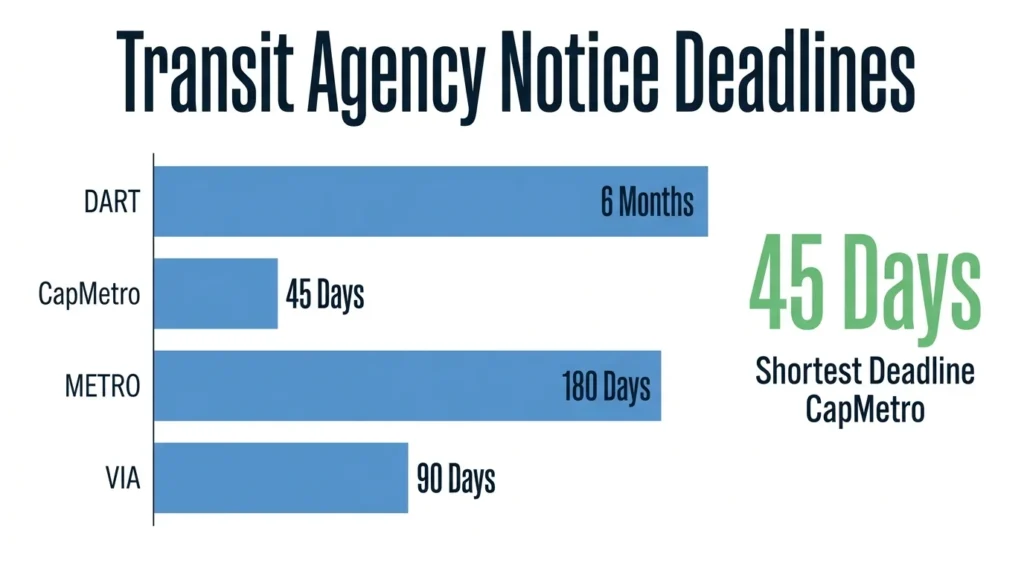
- DART gives you six months to file written notice, and CapMetro requires notice within 45 days under Austin's city charter.
- METRO requires notice within 180 days, and VIA requires notice within 90 days under San Antonio's city charter.
- Texas caps transit injury recovery and prohibits punitive damages against the agency.
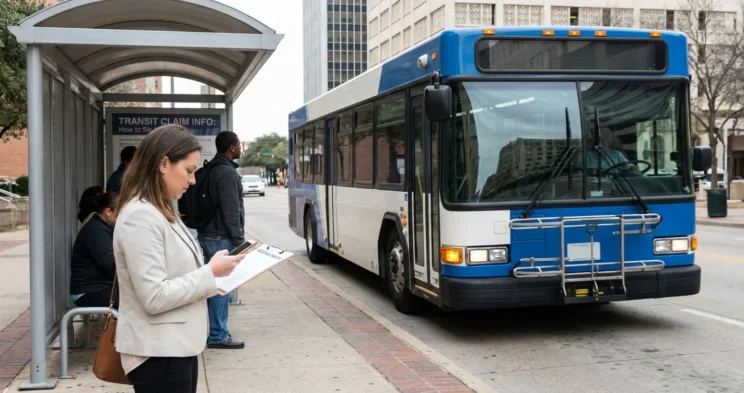
You were riding the bus home from work when the driver braked hard, and you hit the seat in front of you. Now, you are dealing with a hospital bill, missed shifts at work, and a growing worry that the agency running the bus is a government entity.
A claim against a public transit agency does not work like a regular car accident claim. The rules are stricter, the deadlines are shorter, and the path forward depends on which agency was behind the wheel at the time of the crash.
How the Texas Tort Claims Act Applies to Transit Claims
Public transit agencies in Texas have what is called “sovereign immunity.” This means you cannot sue them like you would a private company.
However, the Texas Tort Claims Act allows for a narrow exception if a government-operated vehicle was involved in the crash, including buses and rail cars. Under Texas Civil Practice and Remedies Code (CPRC) § 101.021, sovereign immunity does not apply for injuries caused by government employees while operating a vehicle.
All four major transit agencies in Texas fall under this rule. DART operates as a regional transit authority under Texas Transportation Code Chapter 452, while METRO in Houston, VIA in San Antonio, and CapMetro in Austin operate as metropolitan rapid transit authorities under Chapter 451.
These agencies are government-operated, so the rules for a private bus company or a rideshare driver do not apply. This means you must satisfy pre-lawsuit notice requirements, and your recovery is subject to statutory damage caps.
The rules for filing a claim against a government agency are strict and time-sensitive, so talking to an attorney early will protect your right to recover damages. For an explanation of how sovereign immunity works in these cases, see our overview of how to sue public transportation in Texas and our guide on Texas bus accident claims.
Claim Notice Deadlines for DART, METRO, VIA, and CapMetro
The Texas Tort Claims Act requires written notice to the responsible agency within six months from the date of the crash. This notice must describe your injury, the time and place of the crash, and the nature of the damages you are claiming. Missing this deadline generally dismisses your claim. An incident report filed at the scene does not count as written notice, because the law treats it as a separate document.
Here is where it gets confusing for injured riders: two of the four transit agencies follow a much shorter deadline than the others, so assuming they are all the same is a costly mistake.
DART’s Six-Month Notice Window
DART follows the standard six-month notice window set by CPRC § 101.101. Written notice must describe the injury, the time and place of the crash, and the nature of the damages claimed.
For a DART claim, you submit a written notice to the agency through its official contact channel at DART’s website. DART is a regional transit authority under Transportation Code Chapter 452, so it counts as a unit of local government in this case.
CapMetro’s 45-Day Notice Window
For a CapMetro claim, the deadline is much shorter. Austin’s city charter imposes a 45-day notice requirement for claims against city entities, including Capital Metro. You can submit a written notice to CapMetro through CapMetro’s website, but that notice must go out within 45 days of the crash to preserve your claim.
METRO’s 180-Day Notice Window
For a METRO claim in Houston, you must use the agency’s internal Notice of Claim form and submit it within 180 days of the crash.
Mail it to:
METRO/Claims Division
P.O. Box 61429
Houston, TX 77208-1429
Or deliver it in person to the METRO RideStore. The Houston METRO notice of claim instructions describes exactly what the form requires.
VIA’s 90-Day Notice Window
For a VIA claim, you must file notice within 90 days under the San Antonio charter. You can confirm current filing details through VIA Metropolitan Transit, which operates as a political subdivision under Transportation Code Chapter 451.
If you wait six months to file your claim because you assume every agency works the same way, you may lose the right to recover anything. Submit your notice as early as you can to preserve evidence, leave time for investigation, and ensure that your claim is not dismissed.
Damage Caps on Texas Transit Claims
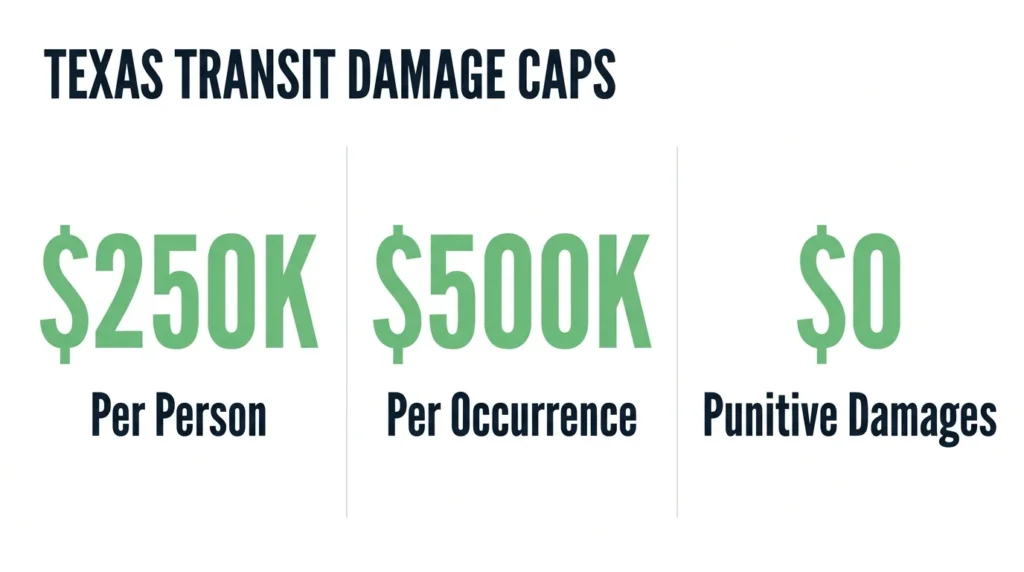
The Texas Tort Claims Act caps what you can recover from a public transit agency, no matter how serious your injuries are. Under CPRC § 101.023, personal injury limits are set at $250,000 per person and $500,000 per occurrence for cities, with even lower caps set for local government agencies. Determining which cap applies and how much money you’re allowed to recover depends on whether the agency is classified as a city, county, or other local agency.
You also cannot recover punitive damages. Under CPRC § 101.024, you cannot recover punitive (or exemplary) damages against a government entity, regardless of how reckless its conduct was. You can recover only actual damages up to the cap laid out in the Texas Tort Claims Act.
When a transit accident is fatal, surviving family members may file a wrongful death claim. However, the same caps apply, so families should understand how much the law will allow them to recover.
For a closer look at how these limits play out in real cases, see our guide on TTCA bus accident limits.
Steps to File a Texas Transit Injury Claim
The filing process starts on the day of your injury and may become a lawsuit if the agency will not resolve your claim fairly.
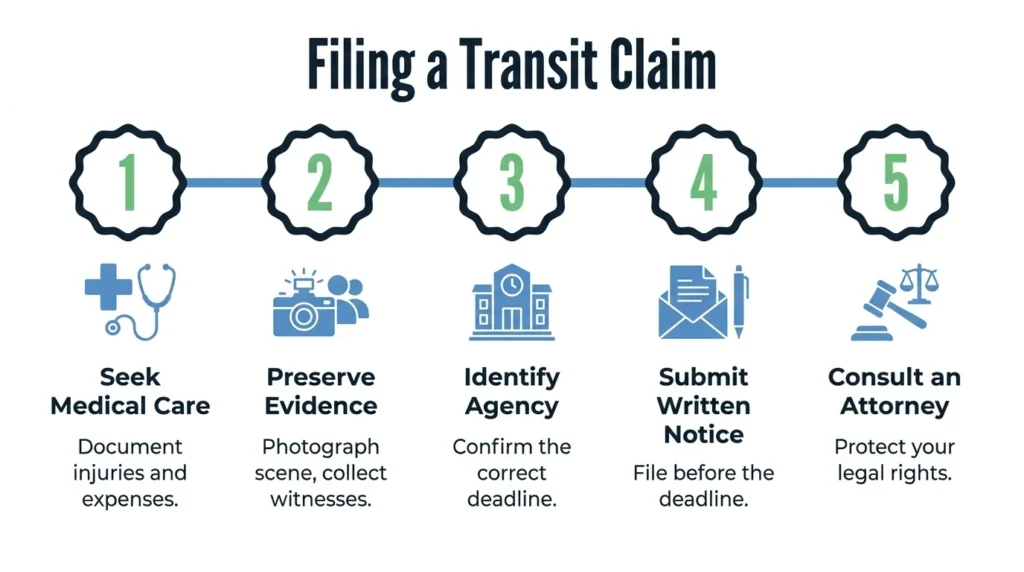
Follow the steps to protect your health and your right to recover:
Step 1: Seek medical care immediately and document everything. Keep records of every treatment, diagnosis, and out-of-pocket expense. Medical records are the foundation of a transit injury claim.
Step 2: Preserve evidence at the scene and afterward. Photograph the vehicle, the location, and your visible injuries. Collect names and contact information from witnesses, and request a copy of any incident report the agency files.
Step 3: Identify the correct agency and its notice deadline. Determine whether DART, METRO, VIA, or CapMetro operated the vehicle. Confirm the deadline that applies: 45 days for CapMetro, 90 days for VIA, 180 days for METRO, or six months for DART. Do not assume that all agencies share the same deadline.
Step 4: Prepare and submit written notice before the deadline. Your notice must describe the injury, the time and place of the crash, and the damages that are being claimed. For METRO, use the official Notice of Claim form. For DART, VIA, and CapMetro, send written notice to the individual agency.
Step 5: Talk to an attorney whether the agency responds to or ignores your claim. An attorney can evaluate any offer or prepare a lawsuit within the two-year deadline set by CPRC § 16.003. Working with our personal injury attorneys early will give you the best chance to meet every deadline correctly.
Our guide on how to file a bus accident claim in Texas covers what to expect from there.
Work With an Attorney on Your Transit Injury Claim in Texas
A claim against DART, METRO, VIA, or CapMetro comes with strict deadlines and government-specific rules. One missed notice can end an otherwise strong case.
Angel Reyes & Associates has guided injured Texans through claims like these for over 30 years. We have recovered more than $1 billion for clients, and we work on contingency, which means you pay no fee unless we win your case.
If a transit accident has left you with bills and questions, reach out to us for a free consultation.
Past results do not guarantee future outcomes.
Claims Against DART, METRO, VIA, and CapMetro FAQs
What if I was partially at fault for the transit accident?
Texas follows proportionate responsibility rules, so your recovery will be reduced by your percentage of fault. If you are found more than 50% responsible, you cannot recover any compensation from the agency at all.
Does the Texas Tort Claims Act cover a slip-and-fall accident at a bus stop, or does it only cover injuries that occur inside the vehicle?
A slip-and-fall accident at a bus stop is not covered by the motor vehicle waiver in the Texas Tort Claims Act. Instead, it may fall under the Texas Tort Claims Act’s premises liability waiver, which requires the government to meet a lower legal standard of care than motor vehicle cases.
What if the bus was driven by a private contractor instead of an agency employee?
The Texas Tort Claims Act motor vehicle waiver applies only when a government employee causes the injury while operating a government vehicle. If a private contractor drove the bus, the Texas Tort Claims Act immunity rules may not apply, and your claim will be filed against the contractor directly under standard negligence law.
Can I file a claim if I was a pedestrian hit by a transit bus, not a passenger on it?
Yes. The Texas Tort Claims Act waiver covers personal injuries caused by the operation of a government vehicle, regardless of whether the injured person was inside or outside the bus at the time of the crash. Pedestrians, cyclists, and other drivers hit by a transit vehicle can all file claims under the same law.
Does filing my notice of claim start a settlement negotiation with the agency?
Not automatically. Notice is a required procedural step before you can file a lawsuit, but the agency is not obligated to respond or settle immediately. You still have two years from the date of the crash to file a lawsuit if the agency does not resolve your claim themselves.
About the Authors

Angel Reyes
Writer
Angel L. Reyes, III is the Founder and Managing Partner of Angel Reyes & Associates. A nationally recognized trial attorney and business leader, Angel has helped over 70,000 injury victims recover more than $1 billion since founding the firm in 1993. Named to the Texas Super Lawyers list annually since 2008, Angel brings Wall Street experience, Ivy League education, and a deep commitment to client advocacy. He is a frequent legal commentator and published author with extensive contributions to legal scholarship, trial strategy, and consumer protection.

Graham Griffin
Editor
Graham Griffin is the Web & Content Manager at Angel Reyes & Associates, where he oversees content strategy, AI-powered workflows, a...

Angel Reyes
Reviewer
Angel L. Reyes, III is the Founder and Managing Partner of Angel Reyes & Associates. A nationally recognized trial attorney and business...