Damage Categories in a Texas Bus Accident Claim (& How Caps Limit Each)


Every article on this site is researched by our internal team, reviewed for legal accuracy against current Texas law, and held to State Bar of Texas advertising standards before publication. We do not publish content that overstates outcomes or makes promises about results.
Learn more about our
editorial standards .
Key Takeaways
- Government bus claims add all damages together, then cut the total to one TTCA cap.
- Municipal bus caps limit recovery to $250,000 per person and $500,000 per crash.
- You must give the government written notice within six months or lose the claim.
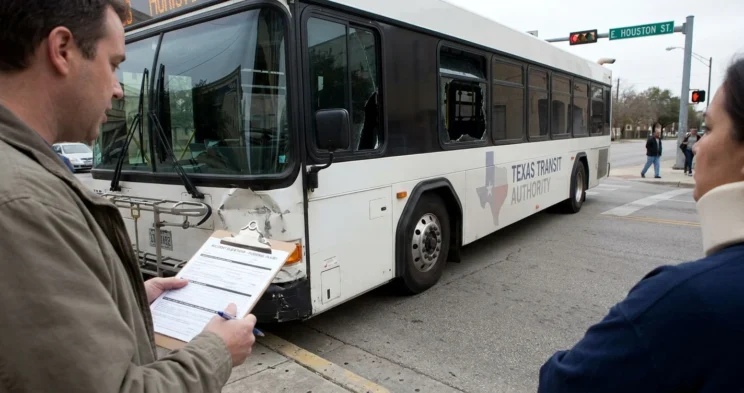
You were riding a Metro bus down Westheimer Road in Houston when the driver ran a light and got broadsided. Now you are stacking up medical bills and missing work, and someone mentioned a “damage cap” you have never heard of. What money can you actually recover, and how much of it will the law let you keep?
Who Operates the Bus Changes Everything
The single biggest factor in your claim is who owned the bus. A government owner triggers a special set of limits on what you can financially recover. A private company does not.
Government entities that run buses include city transit systems, school districts, and state agencies. They are protected by sovereign immunity, which the state waives only through the Texas Civil Practice and Remedies Code (CPRC) § 101.021. That waiver comes with strict dollar caps.
Private charter companies and commercial carriers are different. They face no statutory cap on your economic or non-economic losses, and they can be hit with punitive damages, or damages relating to gross negligence, under Texas Civil Practice and Remedies Code (CPRC) Chapter 41.
An attorney answers the ownership question first because it shapes everything after it. The caps, the filing deadlines, and the strategy all flow from that one fact.
Economic & Non-Economic Damages in a Bus Crash
Your compensation falls into two buckets: economic damages and non-economic damages. Readers mix these up constantly, but they carry different proof rules and “behave” differently under the cap.
Economic Damages
Economic damages are your out-of-pocket financial losses, the kind you can prove with a paper trail. They form the concrete floor of your claim.
Your medical expenses are usually the largest piece. That covers emergency care, hospitalization, surgery, and physical therapy, plus any future treatment tied to the injury.
Lost income is the second major category. You can recover wages lost while you heal. If the injury is permanent, you can also claim the reduced value of your future earning capacity.
Smaller costs count too, as long as the crash caused them. Think of rides to medical appointments, home modifications, and medical equipment you had to buy.
Non-Economic Damages
Non-economic damages cover harms that never generate a bill. This is where the government cap often bites hardest.
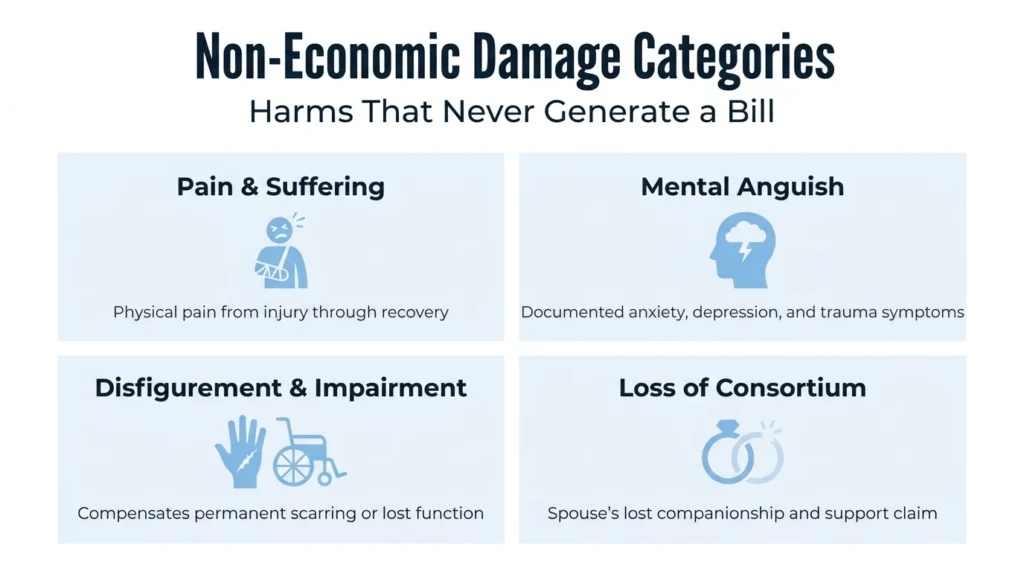
Pain and suffering compensates you for the physical pain you endured, from the moment of injury through recovery. When the injury is permanent, that pain reaches into your future as well.
Mental anguish covers the psychological toll. Documented anxiety, depression, and trauma symptoms from the crash all belong here.
Disfigurement and physical impairment are separate items under Texas law. They compensate you for permanent scarring or the loss of a physical function.
Loss of consortium is its own recoverable claim in a bus accident or any other personal injury claim. A spouse can seek compensation for the companionship and support they lose because of your injuries.
How TTCA Caps Constrain Each Category
The Texas Tort Claims Act does not limit each damage category on its own. It sets one ceiling across both categories combined, and everything you recover has to fit under it.
The caps depend on which kind of government owned the bus. Here is how the tiers break down under Texas Civil Practice and Remedies Code (CPRC) § 101.023.
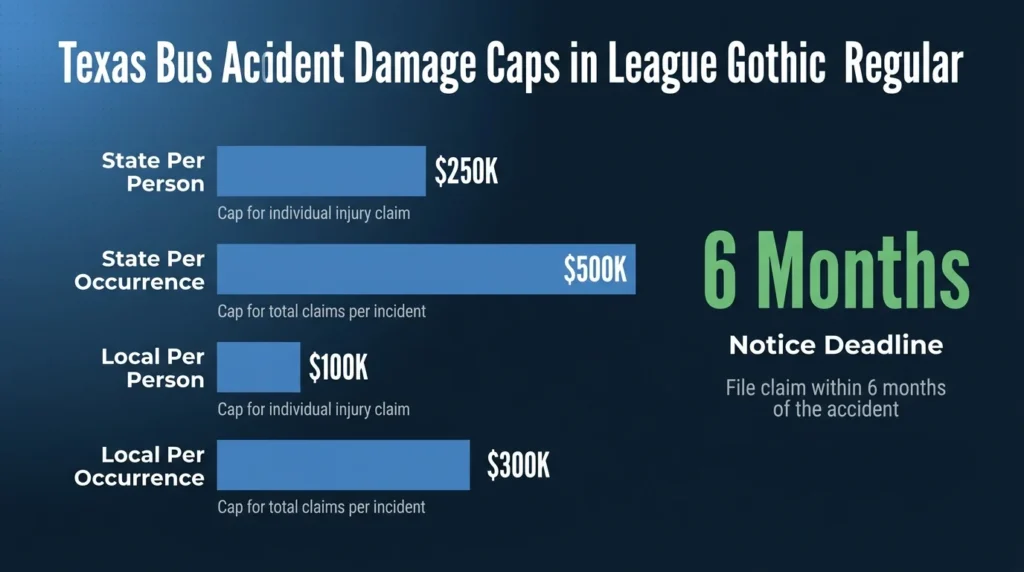
- State agencies and municipalities: $250,000 per person and $500,000 per occurrence.
- Units of local government: $100,000 per person and $300,000 per occurrence.
- Aggregate application: economic and non-economic damages are added together, then the combined total is cut to the ceiling.
The aggregate rule has a harsh effect. A large pain and suffering award can crowd out your economic recovery, and a large medical bill can crowd out everything else.
Say you documented $180,000 in medical bills and a jury awarded $200,000 for pain and suffering. Against a municipality, that combined $380,000 gets cut to $250,000. How you split that $250,000 between the two categories becomes its own fight.
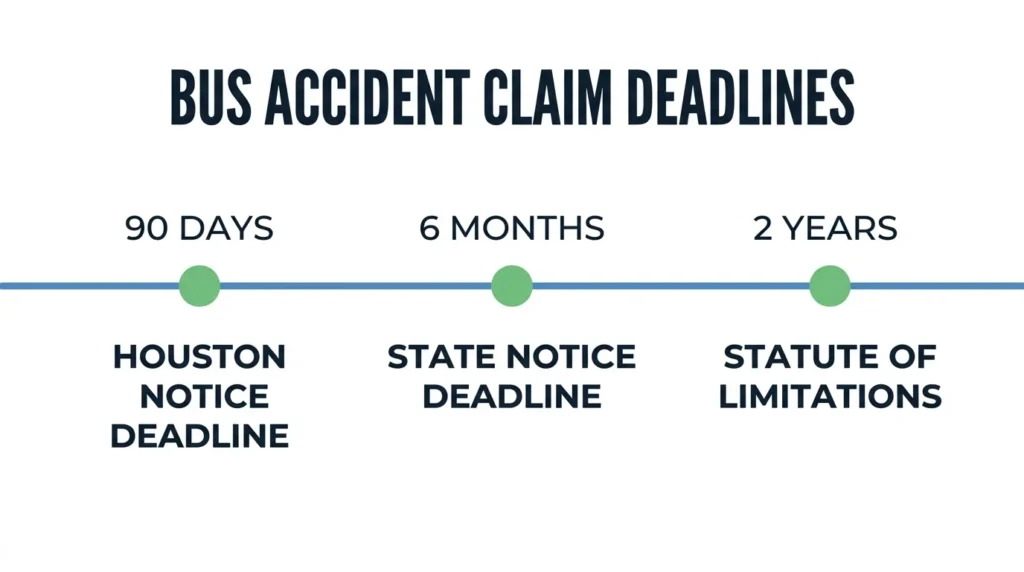
None of this matters, though, until you clear the notice deadline. Under Texas Civil Practice and Remedies Code (CPRC) § 101.101, you must give the government entity written notice within six months of the crash. Miss that window and your claim is over before the cap analysis ever begins.
Damages Not Available in Government Bus Claims
Some damages simply are not on the table when a government owns the bus. Punitive damages top that list.
Punitive damages, also called exemplary damages, are barred by Texas Civil Practice and Remedies Code (CPRC) § 101.024. It does not matter how reckless the government entity was. The law prohibits any award beyond your compensatory damages.
Private operators face a different rule. Against a private bus company, Chapter 41 of the Texas Civil Practice and Remedies Code allows exemplary damages when you prove malice, fraud, or gross negligence by clear and convincing evidence. That gap can mean a large difference in what your claim is worth.
Wrongful death claims get no special treatment from the cap either. When a government bus causes a death, the surviving family’s economic and non-economic claims all count toward the same limit.
Knowing which damages are available and which are not shapes your strategy from day one.
Talk to an Experienced Attorney Today
Government bus claims are hard to value because the cap forces every dollar of your recovery to compete for the same limited space. The damage categories, the aggregate ceiling, and the six-month notice rule all interact in ways that can quietly shrink what you take home.
Angel Reyes & Associates has spent over 30 years handling Texas personal injury claims, with more than $1 billion recovered for clients. We offer free initial consultations, and you pay no fee unless we win. You can also review our case results to see the kinds of matters we handle.
Reach out to us for a free consultation so we can review your specific situation and explain which damages apply to your claim.
Past results do not guarantee future outcomes.
Bus Accident Damage Category FAQs
If multiple passengers are injured in the same government bus crash, how does the per-occurrence cap get divided?
The per-occurrence ceiling is shared across all claimants from a single incident. If total valid claims exceed that ceiling, each person’s share is reduced proportionally, meaning your individual recovery can fall well below the per-person maximum when many riders are injured.
Does my own fault in the crash reduce what I can recover from a government bus operator?
Texas proportionate responsibility rules still apply. If you are found 51 percent or more at fault, you recover nothing; if you are 50 percent or less at fault, your damages are reduced by your share of fault and then subject to the TTCA cap.
Is there a deadline to file a lawsuit against a government bus operator beyond the six-month notice?
Yes. Filing the written notice within six months is a prerequisite, but you still have the standard two-year statute of limitations to file your actual lawsuit. Some city charters, including Houston’s, impose a 90-day notice window that is stricter than the state rule, so local deadlines matter too.
What if a private company was driving the bus under a government contract?
In Texas, a private contractor performing transit functions for a government entity may be treated as a governmental unit for liability purposes. That means TTCA caps and notice requirements can apply to that contractor the same way they apply to the government agency itself.
About the Authors

Angel Reyes
Writer
Angel L. Reyes, III is the Founder and Managing Partner of Angel Reyes & Associates. A nationally recognized trial attorney and business leader, Angel has helped over 70,000 injury victims recover more than $1 billion since founding the firm in 1993. Named to the Texas Super Lawyers list annually since 2008, Angel brings Wall Street experience, Ivy League education, and a deep commitment to client advocacy. He is a frequent legal commentator and published author with extensive contributions to legal scholarship, trial strategy, and consumer protection.

Kyle Nicolas
Editor
Kyle Nicolas is the Web Content & SEO Manager at Angel Reyes & Associates. He has more than 10 years of experience as a marketing co...

Angel Reyes
Reviewer
Angel L. Reyes, III is the Founder and Managing Partner of Angel Reyes & Associates. A nationally recognized trial attorney and business...