Uber and Lyft Accident Laws in Texas


Every article on this site is researched by our internal team, reviewed for legal accuracy against current Texas law, and held to State Bar of Texas advertising standards before publication. We do not publish content that overstates outcomes or makes promises about results.
Learn more about our
editorial standards .
Key Takeaways
- Texas Occupations Code Chapter 2402 makes Uber and Lyft hold a state permit to operate.
- Once a ride is accepted, the rideshare company must carry at least $1 million in coverage.
- You have two years from the crash date to file a Texas rideshare injury lawsuit.
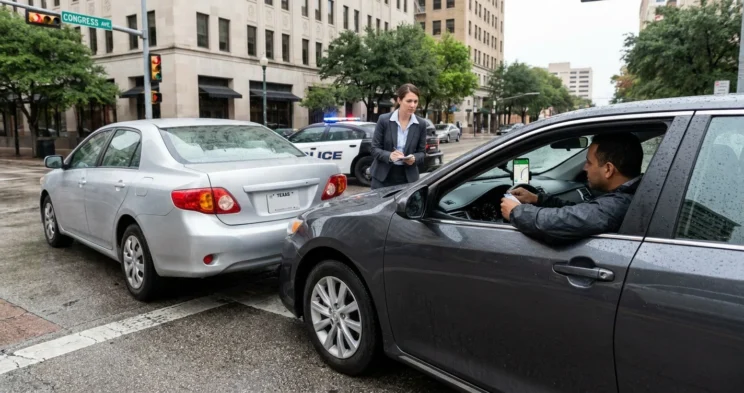
You were riding home from a late dinner near South Congress when your Uber driver ran a yellow light and got T-boned. Now, you’re sitting in an emergency room, and no one can tell you whose insurance will pay for your care. The driver says it’s Uber’s problem, but the Uber app says almost nothing useful.
What Texas Law Says About Rideshare Companies
Texas treats Uber and Lyft as Transportation Network Companies, or TNCs, under Texas Occupations Code Chapter 2402. A TNC is a company that uses a digital platform to connect riders with drivers who use their own personal vehicles for payment.
That classification carries real legal weight, placing most compliance duties on the company itself, not on the individual driver.
The Texas Department of Licensing and Regulation issues and renews TNC permits across the state. A company must hold a valid permit before it can legally operate anywhere in Texas. Cities cannot write their own TNC rules, with narrow exceptions for limited fees at airports and cruise ship terminals.
This structure matters when determining whom to hold responsible. Because compliance sits with the company, you may have a claim against Uber or Lyft that goes beyond the driver alone.
Background Check Requirements For Rideshare Drivers
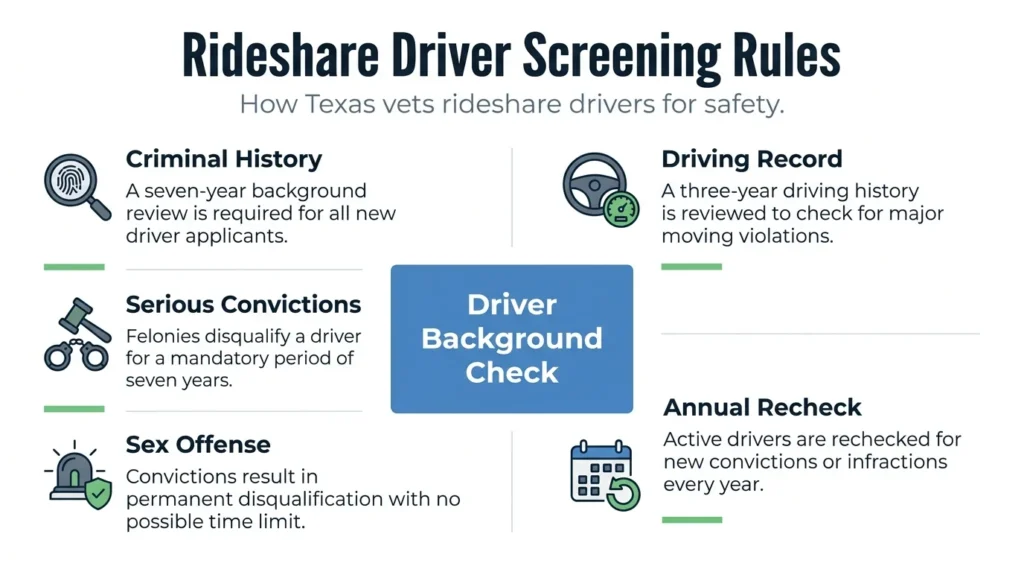
Before a TNC approves any driver, Texas law requires a local, state, and national criminal background check. The criminal history review must look back at least seven years, and the driving record review must cover three years. Active drivers get rechecked every year.
Conviction of a sex offense that places a driver on the national sex offender registry is a permanent disqualification with no time limit. Many other serious convictions (including driving while intoxicated, felonies involving violence or fraud, drug-related offenses, and acts of terrorism) disqualify a driver for seven years under Texas Occupations Code § 2402.107.
When a company approves a driver who carried a disqualifying conviction, you may have a negligent hiring claim. That theory is separate from the standard fault analysis, and it can let you sue the company directly.
Insurance Coverage Requirements By Period
Which policy pays after a rideshare crash depends entirely on what the driver was doing at the moment of impact. Texas Insurance Code Chapter 1954 sets up a tiered structure built around three driver status periods with different rules.
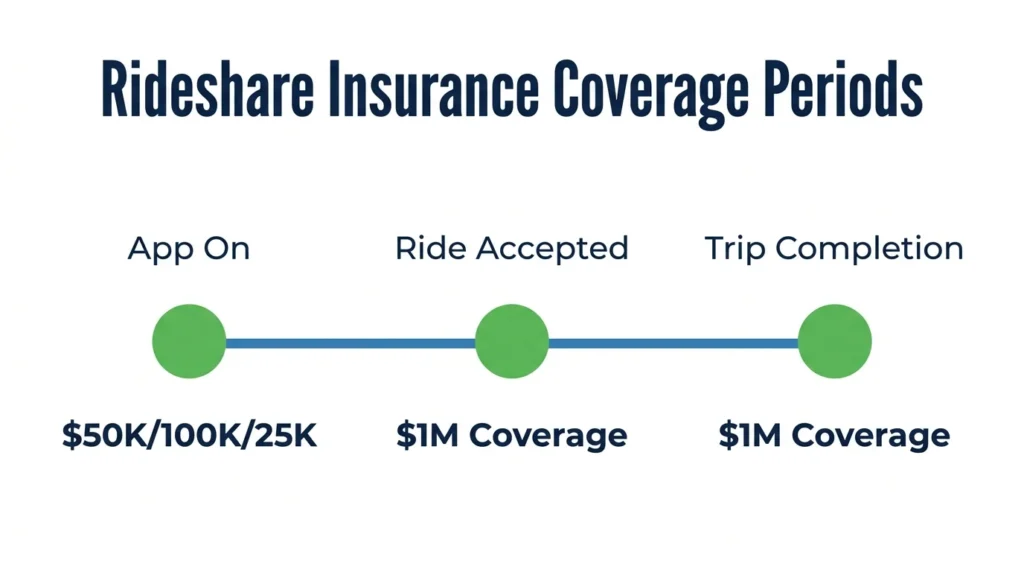
Period 1 (App On, No Ride Accepted)
When the driver is logged in but has not yet accepted a ride, contingent liability coverage applies. The TNC must carry $50,000 per person, $100,000 per accident for bodily injury, plus $25,000 for property damage.
This coverage is available during the app-on period regardless of whether the driver’s personal auto policy responds first. Under Texas Insurance Code § 1954.055, the TNC’s coverage is not contingent on the driver’s personal insurer initially denying a claim.
Periods 2 & 3 (Ride Accepted Through Trip Completion)
Once the driver accepts your ride and until the trip ends, the company’s commercial policy becomes the primary one. The TNC must provide at least $1,000,000 in total liability coverage per incident for death, injury, and property damage.
This coverage pays from the first dollar. The driver’s personal policy does not have to respond first during an active trip.
Texas also requires uninsured and underinsured motorist coverage and personal injury protection during that active ride window. If you were a passenger, those layers can matter when the at-fault driver carries little or no insurance.
Fault & Filing Deadlines in Texas Rideshare Claims
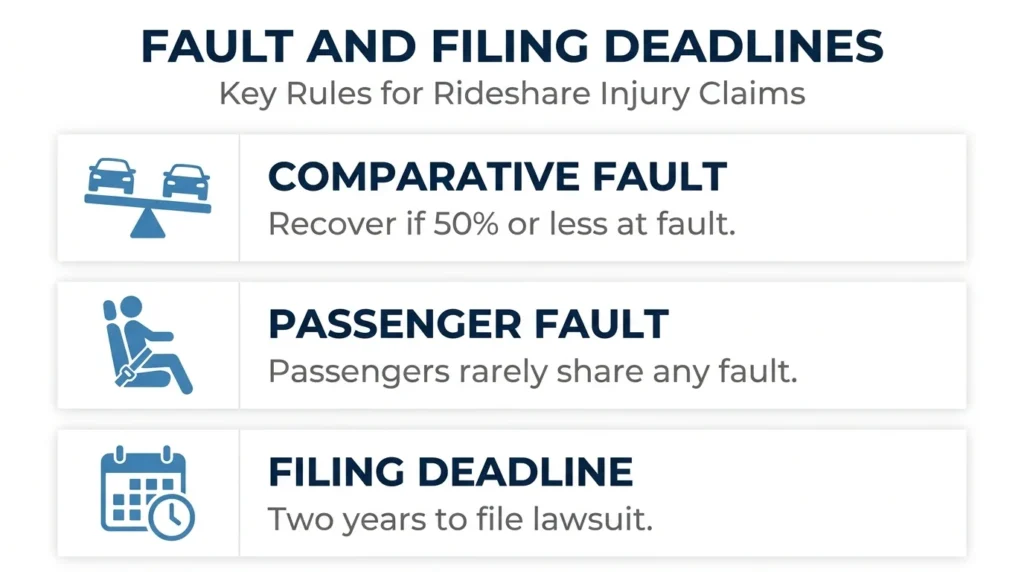
Texas uses a modified comparative fault rule, which means your own share of fault can reduce or erase your recovery. Under Texas Civil Practice and Remedies Code Chapter 33, you can recover only if you are 50% or less at fault, and your damages drop in proportion to your share.
As a passenger, you rarely carry any fault at all. You weren’t driving and had no control over the decisions that caused the crash, which usually puts you in a strong legal position.
You do have a hard deadline to seek compensation, however. The Texas Civil Practice and Remedies Code (CPRC) § 16.003 gives you two years from the date of the accident to file a personal injury lawsuit. Miss it, and your claim is almost always gone for good.
Claims against Uber or Lyft follow that same two-year window under § 16.003. Waiting to figure out which party to sue doesn’t pause the clock, so knowing what to do after a rideshare accident can help you protect your rights.
Work With a Texas Rideshare Accident Attorney
Rideshare claims layer multiple insurance policies on top of strict filing deadlines, and the right coverage often depends on facts you don’t see in the app. Angel Reyes & Associates has experience with these cases, and we work on a contingency basis, so there is no fee unless we win. We’ve recovered more than $1 billion for clients across Texas.
You can read what our clients say about working with us to see how we approach these cases. When you’re ready, schedule a free consultation and we’ll help you understand your options.
Past results do not guarantee future outcomes.
Frequently Asked Questions
Can a pedestrian or cyclist file a claim against Uber or Lyft after being hit by one of their drivers?
Yes. A pedestrian or cyclist hit by a rideshare driver during an active trip falls under the same $1 million commercial policy that protects passengers. The insurance period rules in Texas Insurance Code Chapter 1954 apply regardless of whether the injured person was inside the vehicle.
Does Texas set any age or condition requirements for vehicles used on Uber and Lyft?
Texas Occupations Code Chapter 2402 requires TNCs to make sure each driver’s vehicle passes a safety inspection before the driver is approved and at each annual renewal. The statute does not set a universal model-year cutoff, but the company’s own platform policies may impose stricter vehicle age limits.
Can a rideshare driver be disqualified for traffic violations that are not criminal offenses?
Yes. Chapter 2402 requires TNCs to review a driver’s motor vehicle record going back three years, and the company can reject or deactivate a driver based on moving violations even when no crime was charged. Excessive speeding tickets or a pattern of at-fault collisions can be grounds for disqualification under the company’s internal standards.
What if the Uber or Lyft driver was also logged into a delivery app at the time of the crash?
Texas law ties insurance obligations to the rideshare app status, not to whether the driver was also running another platform at the same time. Each active app creates its own coverage period, but the policies involved may dispute which one is primary, which can complicate a claim.
Does a passenger's own personal auto insurance play any role in a rideshare crash claim?
A passenger’s personal auto policy can come into play if the TNC’s required uninsured or underinsured motorist coverage is insufficient to cover all losses. Personal health insurance may also apply to medical bills before a settlement is reached, depending on the policy terms.
About the Authors

Angel Reyes
Writer
Angel L. Reyes, III is the Founder and Managing Partner of Angel Reyes & Associates. A nationally recognized trial attorney and business leader, Angel has helped over 70,000 injury victims recover more than $1 billion since founding the firm in 1993. Named to the Texas Super Lawyers list annually since 2008, Angel brings Wall Street experience, Ivy League education, and a deep commitment to client advocacy. He is a frequent legal commentator and published author with extensive contributions to legal scholarship, trial strategy, and consumer protection.

Kyle Nicolas
Editor
Kyle Nicolas is the Web Content & SEO Manager at Angel Reyes & Associates. He has more than 10 years of experience as a marketing co...

Spencer Browne
Reviewer
Spencer Browne is a partner at Angel Reyes & Associates and a Board Certified personal injury trial lawyer with nearly 100 jury trials a...