Can You File a Wrongful Death Claim After a Fatal Slip and Fall in Texas?


Every article on this site is researched by our internal team, reviewed for legal accuracy against current Texas law, and held to State Bar of Texas advertising standards before publication. We do not publish content that overstates outcomes or makes promises about results.
Learn more about our
editorial standards .
Key Takeaways
- A fatal fall supports a Texas wrongful death claim only if premises liability applies.
- Duty of care changes with invitee, licensee, or trespasser status at the time of the fall.
- Only a spouse, children, or parents may file, and the deadline is two years from death.
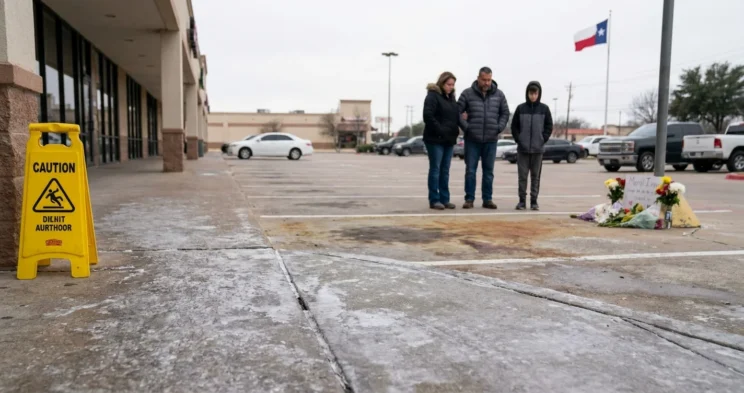
A fall on a flooded grocery aisle, an unlit apartment stairwell, or an iced-over walkway after a Texas cold snap can end a life in seconds. Families are often told that it was simply an accident and nothing could be done.
Texas law says otherwise in the right circumstances. A family can bring a wrongful death claim after a fatal slip and fall, but only when the property owner would have been legally liable for the injury if the person had survived.
That single condition drives everything else: what duty the owner owed, what the family must prove, who is allowed to file, and how long they have to do so.
Does a Fatal Slip and Fall Support a Wrongful Death Claim in Texas?
Yes, provided the fall would have supported a viable premises liability claim if your loved one had lived. A fall by itself, with no provable dangerous condition and no proof the owner knew about it, does not create liability in Texas.
That requirement comes straight from the statute. Texas Civil Practice and Remedies Code §71.003 allows a wrongful death action only when “the individual injured would have been entitled to bring an action for the injury if the individual had lived.”
In practical terms, the death must trace back to a wrongful act, neglect, carelessness, unskillfulness, or default by the property owner. The family steps into the position their loved one would have occupied and proves the same premises liability case that person could have brought.
This is why a fatal fall claim depends on the underlying premises case. Duty, a dangerous condition, the owner’s knowledge, and causation all must hold together. The sections below walk through each of those pieces in the order a Texas court will examine them.
The Property Owner’s Duty of Care Depends on the Visitor’s Status
Texas doesn’t apply one uniform duty to every property owner. What the owner owed depends on your loved one’s legal status on the property at the moment of the fall, and that classification can decide the case before anyone reaches the question of a spill or broken step.

Invitees are people on the property for the mutual benefit of both sides, including customers in a store, tenants’ guests in shared areas, and business visitors. For an invitee, the owner owes ordinary care to inspect the premises and either fix or adequately warn of dangerous conditions the owner knew about or reasonably should have known about, as the Texas Supreme Court set out in Corbin v. Safeway Stores, Inc., 648 S.W.2d 292 (Tex. 1983).
Licensees are on the property with permission but for their own purposes, such as a social guest at a private home. Here the owner has no duty to inspect at all. The duty is narrower: warn about a dangerous condition the owner actually knew about and the licensee did not, or make sure it’s safe, under State v. Tennison, 509 S.W.2d 560 (Tex. 1974).
Trespassers are present without permission or legal right. The owner’s only obligation is to avoid injuring them willfully, wantonly, or through gross negligence, with no duty to inspect, warn, or make the property safe. That standard came from a Texas wrongful death case. In Texas Utilities Elec. Co. v. Timmons, 947 S.W.2d 191 (Tex. 1997), the court applied the ordinary trespasser rule and barred recovery for a fatal electrocution. Status alone can end a claim.
Sorting out which category applies is rarely as obvious as it sounds, particularly in mixed-use buildings, apartment complexes, and after-hours commercial properties. A closer look at how Texas premises liability claims are built shows why that classification deserves early attention.
What the Family Must Prove: A Dangerous Condition and the Owner’s Knowledge
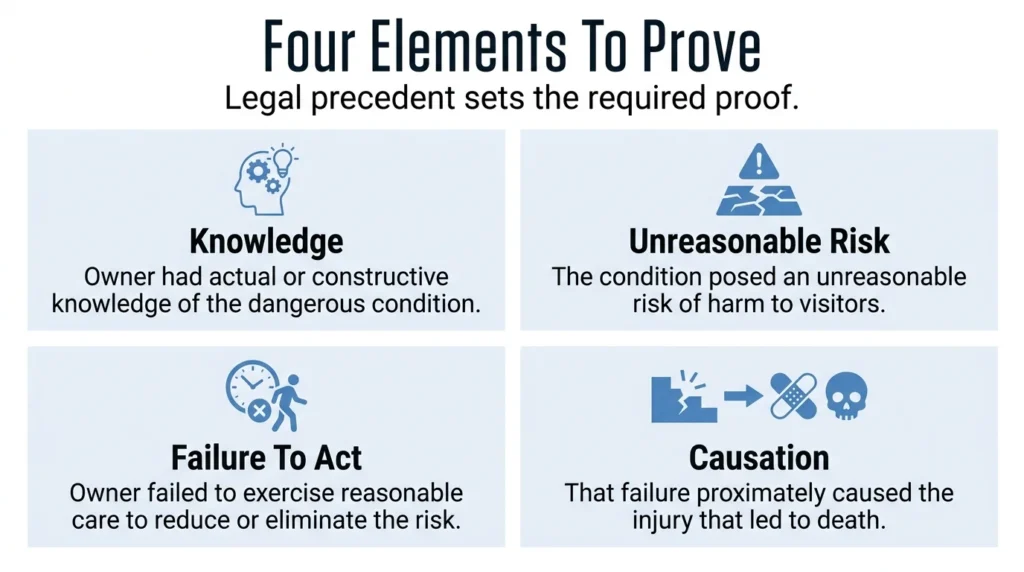
For the most common fact pattern, an invitee who died after a fall on commercial property, the family must prove four elements standing in their loved one’s shoes. Corbin v. Safeway lays them out:
- The owner or occupier had actual or constructive knowledge of a condition on the premises
- The condition posed an unreasonable risk of harm
- The owner failed to exercise reasonable care to reduce or eliminate that risk
- That failure proximately caused the injury that led to the death
The first element is where most fatal fall cases are won or lost. Actual knowledge means someone on the property knew the hazard was there. Constructive knowledge means the hazard had been there long enough that a reasonable inspection would have caught it.
Texas puts real limits on that second route. In CMH Homes, Inc. v. Daenen, 15 S.W.3d 97 (Tex. 2000), the Texas Supreme Court held that knowing a component could wear out over time isn’t the same as knowing an actual dangerous condition exists. Materials naturally deteriorating doesn’t, by itself, put an owner on notice.
So the proof turns on timing. How long had the spill sat on the floor, how long had the mat been torn, how long had the handrail been loose before the fall? Surveillance video, inspection logs, maintenance records, and employee statements are what answer these questions, but this evidence disappears quickly.
Who Can Recover, and How Long Does the Family Have to File?
Texas limits both the list of people who can bring a wrongful death claim and the window for filing one. The rules are strict, and courts enforce them:
- Eligible claimants. Texas Civil Practice and Remedies Code §71.004 states the action is “for the exclusive benefit of the surviving spouse, children, and parents of the deceased.”
- Filing together or separately. Beneficiaries may sue as a group or individually, and any one of them who files is presumed to be suing for the benefit of all.
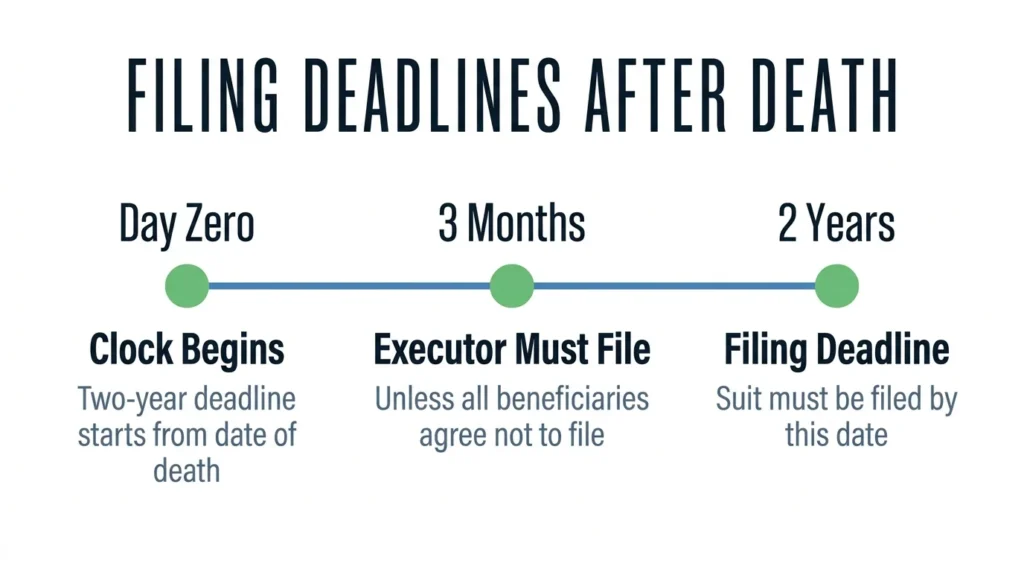
- The three-month rule. If no eligible beneficiary files within three calendar months of the death, the executor or administrator of the estate must bring the action on their behalf, unless all beneficiaries ask that it not be filed.
- The two-year deadline. Texas Civil Practice and Remedies Code §16.003(b) requires a suit “not later than two years after the day the cause of action accrues” for an injury resulting in death.
The accrual date matters more than families expect. The two-year clock runs from the date of death, not the date of the fall, which becomes significant when someone survives a head injury or hip fracture for weeks or months before passing.
The beneficiary list is also narrower than most families assume. Siblings, stepchildren who were never legally adopted, and unmarried partners are not eligible beneficiaries under the statute, no matter how close the relationship was.
These limits shape strategy from the first week. Understanding how Texas wrongful death claims work helps a family decide who files, when they file, and what evidence needs to be preserved before it’s gone.
Talk to a Texas Wrongful Death Attorney About Your Family’s Options
Whether your family has a claim depends on facts that are specific to your loved one’s fall: their status on the property, what the owner knew and when, and how long the hazard was there. These answers come from records that a property owner controls and get overwritten on a schedule.
The two-year deadline continues while families are still grieving. Getting a case reviewed early protects both the evidence and filing window.
Angel Reyes & Associates has guided Texas families through the legal process for over 30 years. The team handles premises liability and wrongful death cases across the state. Contact Angel Reyes & Associates for a free consultation to talk through what happened and what your options are.
Every case is different, and past results do not guarantee future outcomes.
Frequently Asked Questions
Does it matter whether the fatal fall happened on commercial property versus a private home?
It matters less because of the type of property and more because of the deceased’s legal status on it. A fatal fall in a store or other business is typically an invitee situation, where the owner owes the broadest duty: inspecting for hazards and fixing or warning of dangers the owner knew or reasonably should have known about. A fatal fall at a private home is often a licensee situation instead, where a social guest is owed a narrower duty. The owner only has to address dangers it actually knew about. So a commercial setting and a private home aren’t judged under different rules outright; the setting is just a strong clue to which visitor category, and which duty of care, applies.
Does comparative fault reduce what a family can recover if the deceased was partly at fault for the fall?
Texas law generally allows a defendant to argue that an injured or deceased person shared some responsibility for what happened, and that shared fault can reduce or, in some cases, bar recovery. How that general concept would apply to a specific fatal fall, and to what extent, depends heavily on the facts of the case. Because the details of how shared fault gets weighed can vary by case, this is a question best worked through with an attorney reviewing the specific circumstances of the fall rather than answered in general terms alone.
Is a separate survival action available in addition to a wrongful death claim?
Texas law recognizes a distinct type of claim, generally referred to as a survival action, that is separate from a wrongful death claim. Rather than benefiting the surviving spouse, children, or parents directly, a survival action allows the deceased’s estate to pursue certain claims the deceased could have brought had they lived. Whether a survival action is available alongside a wrongful death claim depends on the specific facts of the case, and it’s worth asking an attorney reviewing the situation.
About the Authors

Spencer Browne
Writer
Spencer Browne is a partner at Angel Reyes & Associates and a Board Certified personal injury trial lawyer with nearly 100 jury trials across Texas. He focuses on car, truck, and wrongful death cases, with notable verdicts including a landmark win in the Choctaw Casino bus crash case. A recognized speaker and legal educator, Spencer is a member of the American Board of Trial Advocates and has been honored as a Texas Super Lawyer and one of D Magazine’s Best Lawyers in Dallas. He brings deep trial experience and relentless advocacy to every client he represents.

Graham Griffin
Editor
Graham Griffin is the Web & Content Manager at Angel Reyes & Associates, where he oversees content strategy, AI-powered workflows, a...

Angel Reyes
Reviewer
Angel L. Reyes, III is the Founder and Managing Partner of Angel Reyes & Associates. A nationally recognized trial attorney and business...