Texas’s DWI Laws SB 745 and HB 2017 Explained


Every article on this site is researched by our internal team, reviewed for legal accuracy against current Texas law, and held to State Bar of Texas advertising standards before publication. We do not publish content that overstates outcomes or makes promises about results.
Learn more about our
editorial standards .
Key Takeaways
- SB 745 makes intoxication manslaughter a first-degree felony for multiple deaths.
- HB 2017's 10-year minimum applies only when the driver was unlawfully present in the United States at the time of the incident.
- A Texas wrongful death claim seeks compensation apart from the criminal case.

A drunk driver ran a red light on Greenville Avenue late at night and claimed the life of someone you love. Weeks later, a prosecutor keeps mentioning two new 2025 Texas laws: SB 745 and HB 2017.
Now, you need to know what these laws actually changed, and whether your family can hold the driver accountable beyond the criminal case.
2025 Changes to Texas Intoxication Manslaughter Law
The crime of intoxication manslaughter itself did not change. Intoxication manslaughter is still defined under Texas Penal Code § 49.08 and applies when someone drives while intoxicated and causes a death.
However, two separate laws took effect on September 1, 2025 that changed the penalties for intoxication manslaughter. Each law increases the consequences in specific situations, and both changes apply only to offenses committed on or after September 1, 2025. Any crashes that happened before that date are subject to the previous penalty rules.
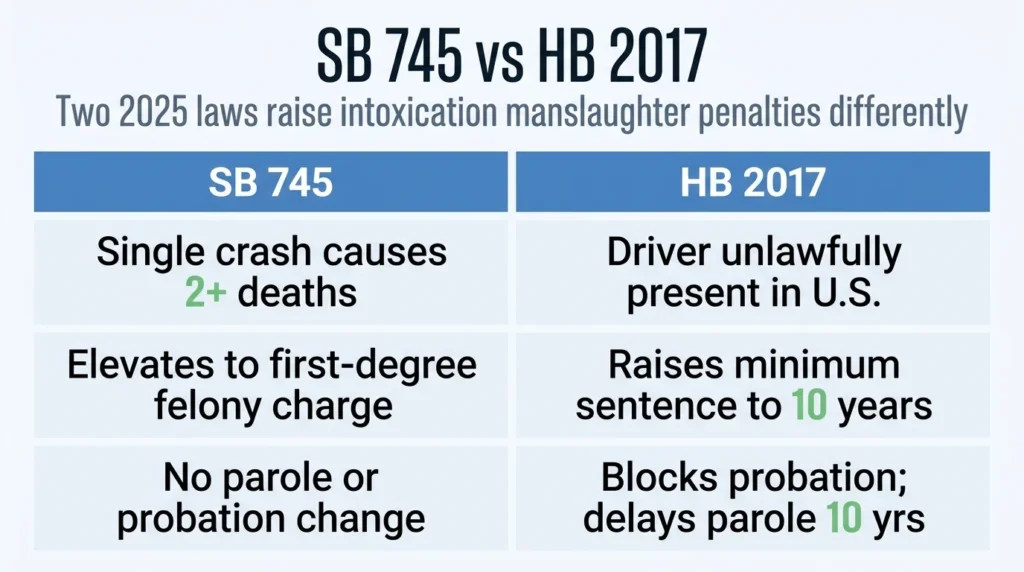
The two laws are as follows:
- SB 745: This law applies broadly and increases penalties based on the facts of the crash.
- HB 2017: This law only applies when the driver was unlawfully present in the United States at the time of the crash.
Each of these laws make different changes to the criminal case and apply under different circumstances. They do not apply to the same drivers or the same types of crashes.
First-Degree Felony Enhancement Under SB 745
SB 745 increases intoxication manslaughter to a first-degree felony when a driver’s conduct in a single criminal event causes more than one death. In plain terms, one crash that kills two or more people can trigger this higher charge.
This change comes from an update to Penal Code § 49.09, which determines when the basic offense can receive a more serious charge or higher penalty.
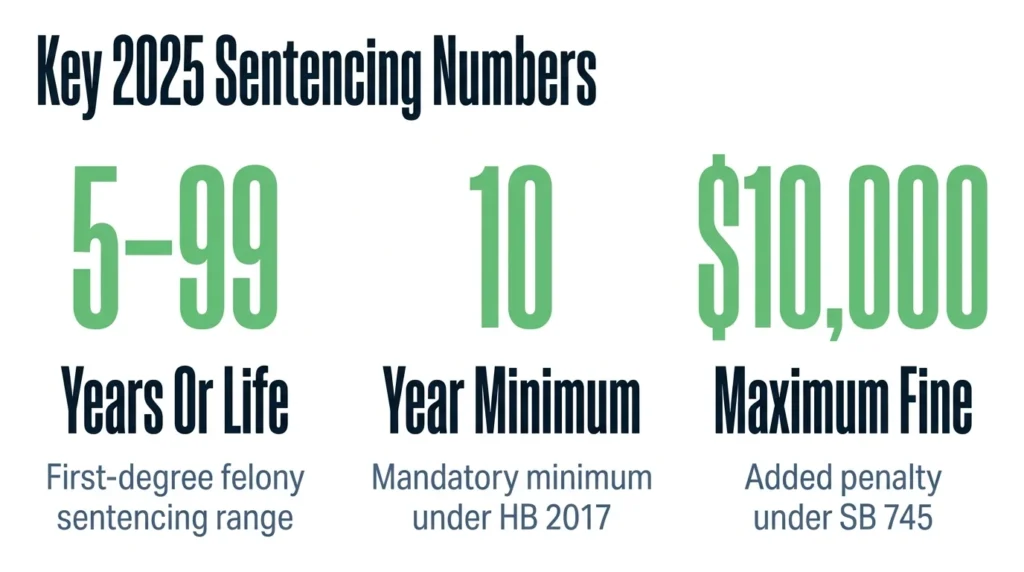
Once the charge becomes a first-degree felony, sentencing is determined by Penal Code § 12.32 and ranges from 5 to 99 years or life in prison, plus a fine of up to $10,000.
This enhancement applies regardless of the driver’s immigration status. It applies to any driver whose single act of drunk driving kills more than one person.
Unlawful Presence Minimum Under HB 2017
HB 2017 (also called Grayson’s Law) raises the mandatory minimum sentence for intoxication manslaughter from 2 to 10 years. This applies only when the driver was unlawfully present in the United States at the time of the offense.
When HB 2017 applies, it also restricts the driver’s right to parole until the driver serves 10 actual calendar years in prison. The law also removes the possibility of community supervision (probation) or deferred adjudication (delayed conviction).
The mandatory minimum sentence, parole restriction, and ban on community supervision (probation) all apply when the driver was unlawfully present in the United States at the time of the offense, as detailed in the House bill analysis for HB 2017. This is confirmed by state guidance in the Texas Department of Criminal Justice legislative summary.
This sentencing increase does not apply to every intoxication manslaughter case. A driver who was lawfully present in the United States at the time of the crash faces the standard penalties, not the 10-year minimum. Again, the only drivers who are subject to these stricter sentencing rules are those who were unlawfully present in the United States at the time of the offense.
Your Right to a Separate Wrongful Death Civil Claim
The purpose of a criminal case is to hold a drunk driver accountable, and its goal is punishment.
However, your family also has a separate legal path to compensation, regardless of how the criminal case is resolved.
Your family can file a wrongful death claim independently from the criminal prosecution under the Texas Civil Practice and Remedies Code Chapter 71, also known as the Wrongful Death Act.
Here’s the difference:
- The criminal case is the state vs. the driver, and the goal is punishment (like prison time).
- Your civil claim is your family vs. the driver, and the goal is money to cover your losses.
These two cases are separate from each other. The rules for a wrongful death claim in Texas are different from the rules in a criminal case, and the driver’s immigration status has no effect on your family’s right to pursue compensation.
What Kind of Damages Can You Recover in a Wrongful Death Claim?
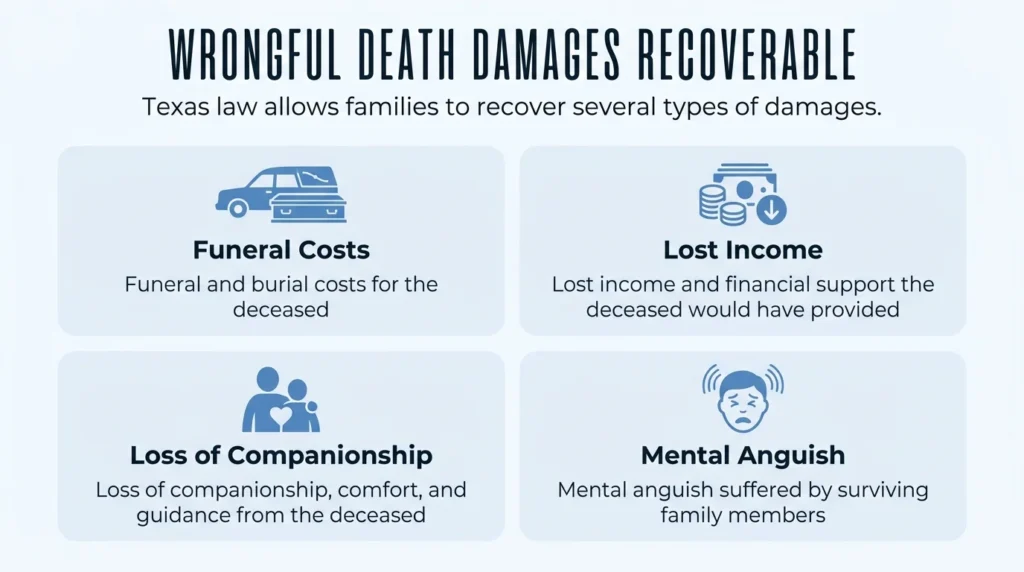
Texas law allows your family to recover several kinds of damages through a wrongful death claim, including:
- Funeral and burial costs
- Lost income and financial support that the deceased would have provided over their lifetime
- Loss of companionship, comfort, and guidance
- Mental anguish suffered by your family
Read more about the rights of drunk driving victims, and how these losses build your claim.
Wrongful Death Claim Filing Deadline
Texas generally gives your family two years from the date of the death to file a claim, with limited exceptions.
Review how the wrongful death filing deadline works to ensure that you do not lose your right to file a claim.
What Is The Texas Dram Shop Act?
If a bar or restaurant served the driver while they were already visibly drunk, that business may share liability under the Texas Dram Shop Act, which can open a second source of compensation for your family.
Talk to an Attorney About Your Wrongful Death Claim in Texas
Losing a loved one to a drunk driver is a weight that no family should carry alone. Angel Reyes & Associates has guided Texans through wrongful death claims for over 30 years, and we have recovered more than $1 billion for clients.
We work on a contingency basis, which means you pay no fee unless we win. Your first consultation is free, and we can handle the majority of your case remotely from our offices across Texas.
Schedule a free consultation today.
Past results do not guarantee future outcomes.
SB 745 and HB 2017 FAQs
Can you get probation for intoxication manslaughter in Texas?
A judge or jury can sometimes grant community supervision (probation) for a standard intoxication manslaughter case, depending on the facts. HB 2017 removes that option when the driver was unlawfully present in the United States at the time of the crash.
What level of felony is intoxication manslaughter before any 2025 enhancement applies?
Intoxication manslaughter is normally a second-degree felony under Texas Penal Code 49.08. That classification is the foundation that both 2025 laws build upon.
Who can file a wrongful death claim after a fatal drunk driving crash in Texas?
Texas law allows the surviving spouse, children, and parents of the deceased to file a claim together, or any one of them can file a claim on behalf of the others. If none of these parties file a claim within three months, the estate’s executor or administrator can file a claim instead.
Can my family win a civil claim even if the criminal case does not end in a conviction?
Yes. Criminal and civil cases use different standards of proof. A civil case only needs to prove that the driver was most likely at fault. This is a lower standard than a criminal conviction, which requires proof beyond a reasonable doubt that the driver is guilty.
Does my family have to wait until the criminal case is resolved before filing a wrongful death claim?
No. Your family can file a civil wrongful death claim while the criminal case is still pending. However, the two-year filing deadline still applies, regardless of the criminal case’s timeline.
About the Authors

Angel Reyes
Writer
Angel L. Reyes, III is the Founder and Managing Partner of Angel Reyes & Associates. A nationally recognized trial attorney and business leader, Angel has helped over 70,000 injury victims recover more than $1 billion since founding the firm in 1993. Named to the Texas Super Lawyers list annually since 2008, Angel brings Wall Street experience, Ivy League education, and a deep commitment to client advocacy. He is a frequent legal commentator and published author with extensive contributions to legal scholarship, trial strategy, and consumer protection.

Kyle Nicolas
Editor
Kyle Nicolas is the Web Content & SEO Manager at Angel Reyes & Associates. He has more than 10 years of experience as a marketing co...

Angel Reyes
Reviewer
Angel L. Reyes, III is the Founder and Managing Partner of Angel Reyes & Associates. A nationally recognized trial attorney and business...