How Are Wrongful Death Settlements Divided Among Family?


Every article on this site is researched by our internal team, reviewed for legal accuracy against current Texas law, and held to State Bar of Texas advertising standards before publication. We do not publish content that overstates outcomes or makes promises about results.
Learn more about our
editorial standards .
Key Takeaways
- Only a surviving spouse, children, and parents share a Texas wrongful death recovery.
- Shares track each beneficiary's own proven loss, not an equal split or a set formula.
- A minor beneficiary's share is not final until a Texas court approves the settlement.
After a death caused by someone else’s negligence, one settlement has to cover an entire family. A surviving spouse, several children, and two grieving parents may all have a claim to the same money.
Texas does not answer that by cutting the total into equal pieces. A Texas wrongful death claim treats each person’s loss as its own question, and that is what decides who receives what.
Who Texas Law Counts as a Beneficiary
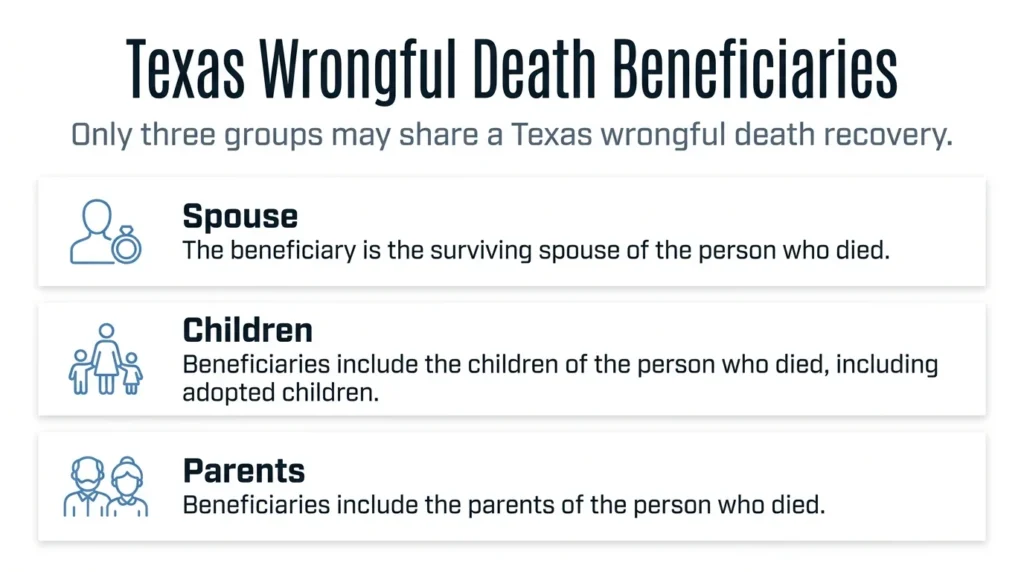
A Texas wrongful death claim exists for the exclusive benefit of three groups. Texas Civil Practice and Remedies Code Section 71.004 names them:
- The surviving spouse
- The children of the person who died
- The parents of the person who died
Siblings, grandparents, cousins, and stepchildren who were never adopted are not beneficiaries under the Texas wrongful death statute, no matter how close the relationship was.
Any one of those beneficiaries may file the case for the benefit of all. This allows one family member to bring a claim that includes the losses of several beneficiaries. A beneficiary must also be alive when the court enters judgment to receive a share.
Texas generally gives families a two-year deadline to bring the claim, running from the date of death.
Each Share Reflects That Person’s Own Loss
Texas does not divide a wrongful death recovery equally. Section 71.010 allows a jury to award damages based on the loss caused by the death and divide that award among the beneficiaries.
There is no percentage table, no tier system, and no inheritance-style formula tied to whether someone is the spouse or a child. Section 71.010 governs how a jury divides an award through its verdict.
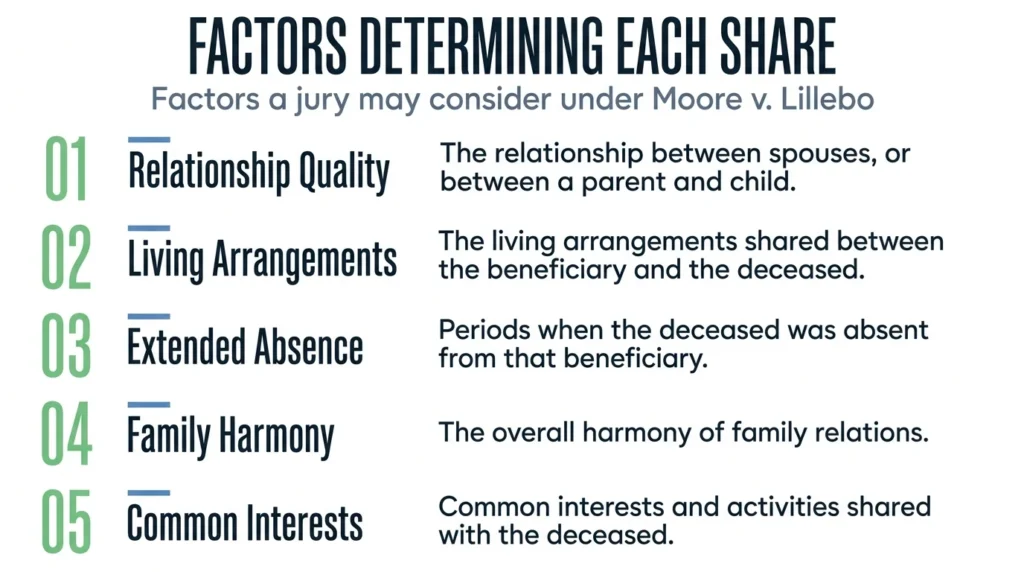
Each beneficiary’s share depends on that person’s proven loss. In Moore v. Lillebo, 722 S.W.2d 683 (Tex. 1986), the Texas Supreme Court identified several factors a jury may consider:
- The relationship between spouses, or between a parent and child
- The living arrangements of the parties
- Any absence of the person who died from that beneficiary for extended periods
- The harmony of family relations
- Common interests and activities
The same opinion treats mental anguish and loss of companionship and society as separate elements. The jury must be instructed not to award compensation twice for the same loss.
A spouse, a young child, and a long-estranged parent are each proving a different loss. Shared households, daily involvement, extended absences, and shared activities help establish each beneficiary’s appropriate share.
Dividing a Settlement Rather Than a Verdict
Most cases settle, and when they do, no jury makes findings. Texas law supplies the standard for wrongful death settlement apportionment but not a procedure. No statute, rule, or controlling Texas opinion tells competent adult beneficiaries how to allocate a negotiated settlement among themselves.
The allocation is negotiated using the same proportionate-loss standard. An adult beneficiary is bound only through that person’s consent and signed release. Other family members cannot accept an allocation on that adult’s behalf.
When a family cannot agree, a court or jury may decide the shares using the same proportionate-loss standard. There is no statutory percentage that applies automatically.
Attorney’s fees and case expenses are generally deducted from the gross settlement before the remaining amount is divided among the beneficiaries.
One recovery is being split among people whose shares are determined separately, so every dollar added to one beneficiary is a dollar unavailable to another.
The Texas Disciplinary Rules of Professional Conduct permit one lawyer to represent multiple beneficiaries only where the lawyer reasonably believes no client’s representation will be materially affected and each client consents after full disclosure. That lawyer cannot later take one beneficiary’s side in a dispute among them.
A lump-sum split among a spouse, children, and parents is an aggregate settlement, so every client must be told the existence and nature of all claims and the extent of each person’s participation before consenting. A beneficiary is entitled to see the full allocation before signing anything.
Conflicts often involve a short or second marriage, adult children from a prior marriage, a long-absent parent, or a disputed common-law marriage. Beneficiaries with competing claims may need separate counsel.
A Minor Beneficiary’s Share
A parent cannot sign away a child’s portion. A judge must approve a minor beneficiary’s settlement, and the money stays under court supervision afterward.
Court Approval Makes the Settlement Binding
A minor with no legal guardian appears through a next friend, usually a surviving parent. Under Texas Rule of Civil Procedure 44, the next friend or attorney may settle the case only with the court’s approval. Once approved, the settlement is binding on the child.
Court approval makes a child’s settlement final. Texas families usually reach that point through a friendly suit, filed so a judge can review the terms.
Hearing requirements vary by court. The 415th District Court in Parker County, for example, requires the settlement agreement and a complete calculation showing how the money will be distributed. That checklist applies only to that court, so families should confirm the requirements in their county.
When a Guardian Ad Litem Is Appointed
An ad litem is not automatic. Rule 173.2(a) requires appointment only if the next friend appears to the court to have an interest adverse to the child, or if the parties agree.
In an apportionment case, that trigger is usually present. The surviving parent serves as next friend while claiming a share of the same limited recovery.
A guardian ad litem advises the court and does not serve as the child’s attorney. During settlement, the ad litem evaluates whether the agreement is in the child’s best interest. The court may not base the ad litem’s fee on a percentage of the settlement.
Where the Child’s Money Goes After Approval
The child’s approved share is managed under Chapter 142 of the Texas Property Code. The court may order:
- Court-ordered investment, or deposit into the registry of the court with the clerk investing under a written order
- A court-created trust holding the child’s property
- A structured settlement funded by a government-guaranteed obligation or a qualifying annuity
The trust route allows a share to be held past age 18. For a beneficiary who is not disabled, that trust ends on death, on an age stated in the trust, or on the 25th birthday, whichever comes first.
Wrongful Death Proceeds Versus Survival Proceeds
Families often receive two kinds of money in the same case.
A wrongful death recovery compensates the surviving spouse, children, and parents for losses of their own. It is not estate property, and Section 71.011 states that wrongful death damages are not subject to the debts of the person who died.
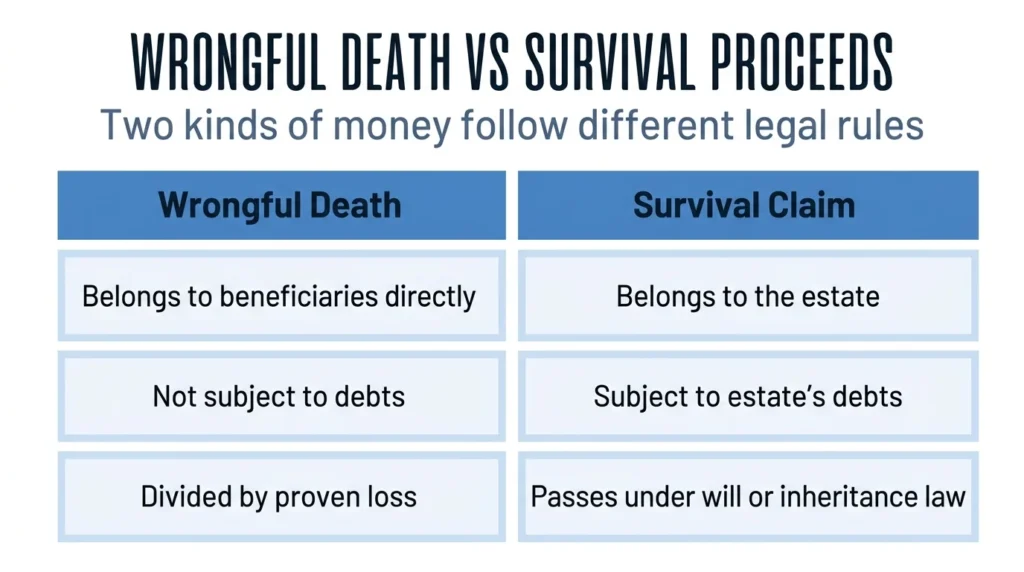
A survival claim is different. Under Section 71.021, the injured person’s own cause of action survives to the heirs, legal representatives, and estate.
A survival recovery belongs to the estate. It passes under the will or, if there is no will, under Texas inheritance law, and it remains subject to the estate’s debts.
Talk With an Attorney
Wrongful death allocations are negotiated, but a judge must approve a minor beneficiary’s share. Adult beneficiaries may also have competing claims to the same recovery.
Angel Reyes & Associates has guided Texas families through these decisions for over 30 years. Contact us for a free consultation to review your options.
Past results do not guarantee future outcomes.
Texas Wrongful Death FAQs
Are Texas wrongful death settlements taxable to family members?
Compensatory damages tied to a physical injury or death are generally excluded from federal taxable income, but punitive damages and certain other amounts may be treated differently. The tax treatment depends on what each part of the settlement was intended to compensate.
Can adopted children receive part of a wrongful death settlement in Texas?
Yes. An adopted child generally has the legal parent-child relationship necessary to qualify as a child beneficiary in a Texas wrongful death claim.
Can a surviving spouse's remarriage affect a Texas wrongful death claim?
Texas Civil Practice and Remedies Code Section 71.005 allows evidence of an actual ceremonial remarriage to be admitted in a wrongful death action. The statute prohibits the defense from referring to a common-law marriage, an extramarital relationship, or the surviving spouse’s prospects of marriage.
Can a family recover exemplary damages in a Texas wrongful death case?
Texas law permits exemplary damages when the death resulted from a defendant’s willful act or omission or gross negligence. Whether they are available depends on the facts and the applicable requirements for proving exemplary damages.
What happens if a wrongful death was caused by a criminal act in Texas?
A related criminal case does not prevent eligible family members from pursuing a Texas wrongful death claim. Texas Civil Practice and Remedies Code Section 71.006 expressly provides that a wrongful death action is not precluded because the death resulted from a felonious act or because a criminal proceeding may also occur.
About the Authors

Angel Reyes
Writer
Angel L. Reyes, III is the Founder and Managing Partner of Angel Reyes & Associates. A nationally recognized trial attorney and business leader, Angel has helped over 70,000 injury victims recover more than $1 billion since founding the firm in 1993. Named to the Texas Super Lawyers list annually since 2008, Angel brings Wall Street experience, Ivy League education, and a deep commitment to client advocacy. He is a frequent legal commentator and published author with extensive contributions to legal scholarship, trial strategy, and consumer protection.

Kyle Nicolas
Editor
Kyle Nicolas is the Web Content & SEO Manager at Angel Reyes & Associates. He has more than 10 years of experience as a marketing co...

Angel Reyes
Reviewer
Angel L. Reyes, III is the Founder and Managing Partner of Angel Reyes & Associates. A nationally recognized trial attorney and business...