Who Can File a Wrongful Death Claim in Texas?


Every article on this site is researched by our internal team, reviewed for legal accuracy against current Texas law, and held to State Bar of Texas advertising standards before publication. We do not publish content that overstates outcomes or makes promises about results.
Learn more about our
editorial standards .
Key Takeaways
- Only a surviving spouse, children, or parents can file a Texas wrongful death claim.
- If no beneficiary sues within three months, the estate's representative must file.
- Adopted children qualify; stepchildren do not unless a legal adoption occurred.
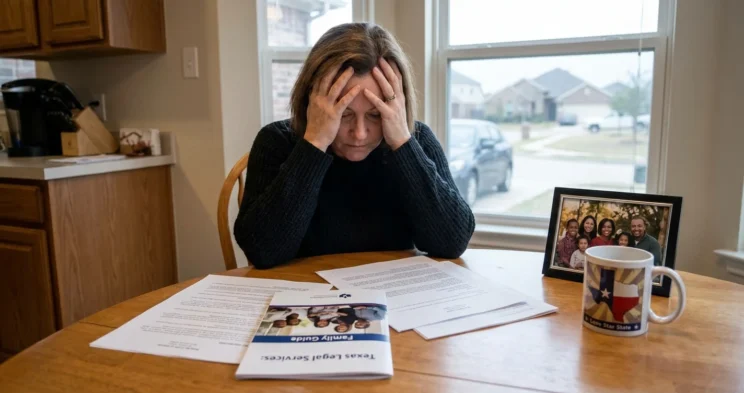
Your family is still in the first raw weeks after a sudden death, and someone has already asked the question nobody wanted to raise: Can the person responsible be held accountable? Then comes the harder question: Who in your family is actually allowed to file?
Texas answers that narrowly. Only the surviving spouse, children, and parents of the person who died may file a wrongful death claim.
That short list surprises most grieving families. No other family members have standing under Texas law to file a claim, no matter how close the relationship was.
Who Can File a Wrongful Death Claim in Texas? The Statutory Beneficiary Hierarchy
Under Texas Civil Practice and Remedies Code (CPRC) § 71.004, the only people who can file a wrongful death claim are:
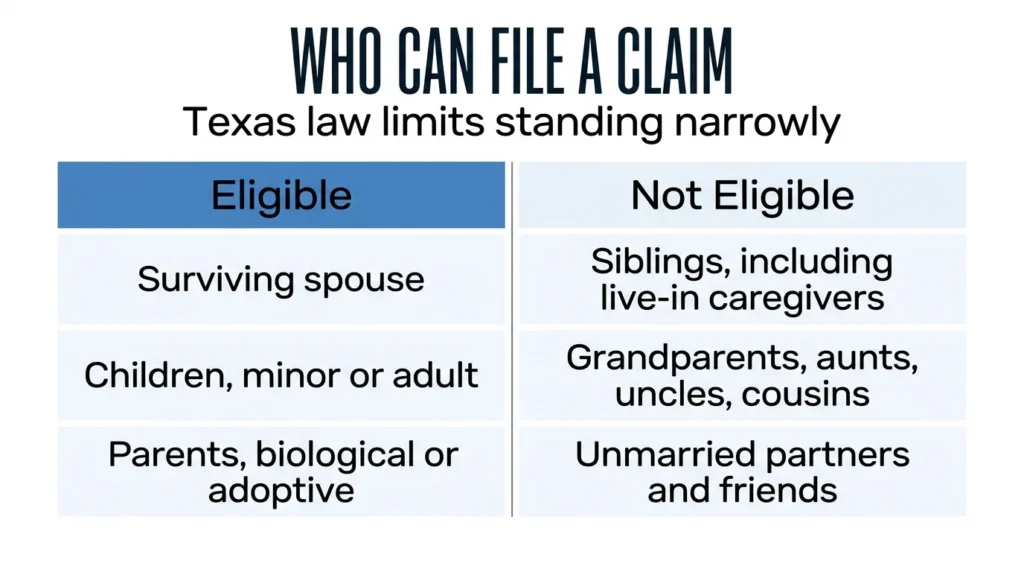
- The surviving spouse of the person who died
- The children of the person who died, whether minor or adult, biological, or legally adopted
- The parents of the person who died, biological or adoptive
Those people may bring the action, or one or more of them may bring it for the benefit of all. One filing can carry the whole eligible group, which is why families do not each need a separate lawsuit.
Other family members do not qualify, regardless of how close the relationship was:
- Siblings, including a brother or sister who lived with or cared for the deceased
- Grandparents, grandchildren, aunts, uncles, and cousins
- Unmarried partners, friends, and other members of the household
Age and financial dependence don’t change the analysis. An adult child living in another state has the same standing to sue for a parent’s death as a teenager who still lived at home, and parents may still file, even when the child they lose is a grown adult.
Closeness affects what a jury may award a particular beneficiary. It does not decide who is allowed into the case. A broader overview of Texas wrongful death claims covers how these cases work once eligibility is settled.
The Three-Month Rule: When the Estate’s Personal Representative Must Step In
The statute does not let a claim sit untouched while a family decides what to do. If none of the eligible beneficiaries has started the action within three calendar months after the death, § 71.004(c) requires the deceased’s executor or administrator to bring and prosecute the action.
That three-month clock runs from the date of death. It does not run from the date of the accident that injured the deceased, the date of their diagnosis, or the date your family learned who was at fault.
There is one way to stop it. The representative does not have to file if all of the eligible beneficiaries ask them not to. Every spouse, child, and parent with standing has to agree.
A single family member who wants the case to move forward is enough to keep the representative’s duty in place. One objector cannot be outvoted here.
Filing a claim does not turn the personal representative into a beneficiary. Whatever the case recovers still belongs to the surviving spouse, children, and parents under § 71.004(a).
Families reach that three-month mark more often than you would expect. Probate takes time, relatives disagree, and nobody wants to think about litigation while planning a funeral. The practical effect of the rule is that a valid claim keeps moving even when the family is not ready to make decisions.
Adopted Children, Stepchildren, and Estranged Family Members
Real families rarely match a three-item statutory list cleanly. Three situations come up again and again.
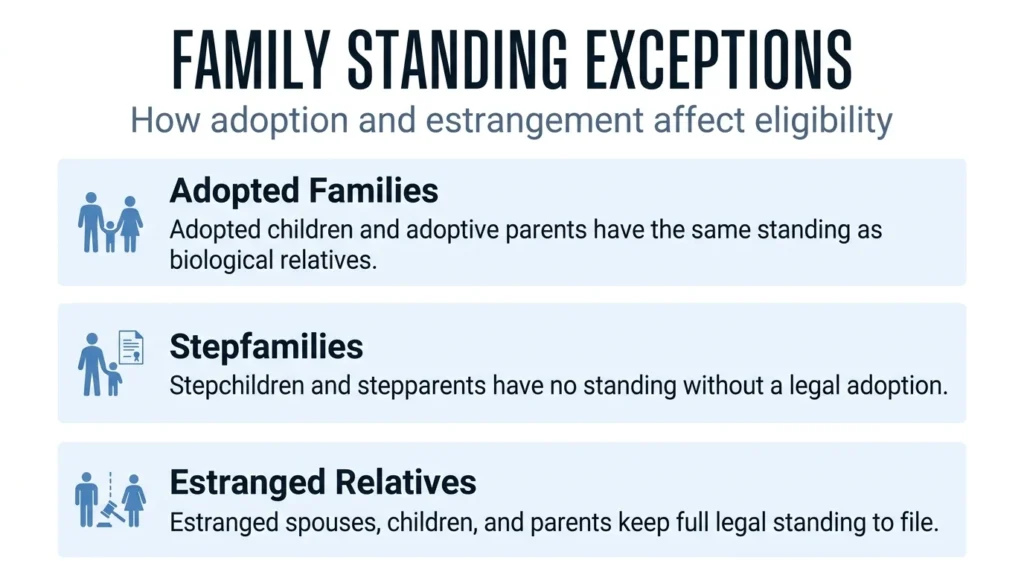
Adopted Children and Parents
Legally adopted children and adoptive parents stand on the same footing as biological relatives. Texas Family Code Chapter 162 provides that an adoption order creates the parent-child relationship for all purposes, and there’s no distinction that would exclude an adopted child from CPRC § 71.004. An adopted child may file for an adoptive parent’s death, and an adoptive parent may file for an adopted child’s death.
The other side of that rule matters just as much. When a biological parent’s rights are terminated through an adoption, the legal relationship ends. That biological parent no longer has standing to file for the child’s death.
Stepchildren and Stepparents
Stepchildren and stepparents are not statutory beneficiaries. A stepchild raised for twenty years by a stepparent who never legally adopted them has no cause of action under § 71.004, and a stepparent has none for a stepchild. Legal adoption is the dividing line, and a close relationship does not substitute for it.
Estranged Family
Estranged spouses, children, and parents keep their standing. Texas ties the right to file to the legal relationship, not to the quality of it. A father who had not spoken to his son in a decade still fits § 71.004(a) as a surviving parent.
Estrangement is not meaningless, though. As a general matter, a jury weighing non-economic damages such as loss of companionship and mental anguish can consider what the relationship actually looked like. The relationship helps shape what that beneficiary’s share is worth.
How Long You Have To File and How Damages Are Divided
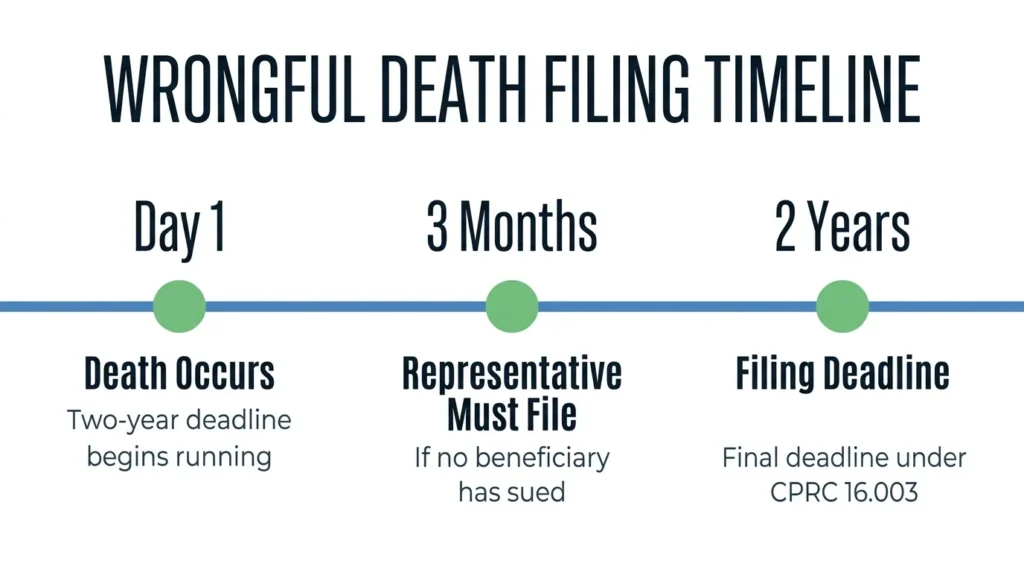
Texas generally allows two years to file a wrongful death action under § 16.003, running from the date of death rather than the date of the underlying incident. The three-month rule is not the filing deadline, and confusing the two costs families their claims. Understanding this statute of limitations to file a wrongful death claim helps you know how long your family has.
The three-month trigger sits inside that two-year window. Passing it does not end the claim. It shifts the filing duty to the estate’s representative while the two-year period keeps running in the background.
If the case succeeds, the same group that could file is the group that shares the recovery. CPRC § 71.010 allows the jury to award damages in proportion to the injury each beneficiary suffered from the death. The award is divided in shares the jury sets, among the beneficiaries who are alive when judgment is entered.
Those shares are not automatically equal. A surviving spouse, two adult children, and a surviving parent may each receive a different amount based on what the evidence shows about their loss.
Talk to a Wrongful Death Lawyer About Your Eligibility
Eligibility is the first question a Texas wrongful death case has to answer, and from the outside it is not always obvious. Adoption records, a marriage that was never formalized, a parent who has been absent for years, and disagreement among siblings all change who belongs in the case.
Angel Reyes & Associates has guided injured and grieving Texans through the legal process for over 30 years, working on contingency so there is no upfront cost to start. Read our client testimonials to see how we’ve helped people with their claims.
If you are unsure whether you or another family member has standing to file, contact Angel Reyes & Associates for a free consultation. Our team of attorneys can review your family’s situation, explain where your case fits within Texas law, and tell you how much time you have left.
Every case is different. Past results do not guarantee future outcomes.
Wrongful Death Claim Frequently Asked Questions
Can a common-law spouse file a wrongful death claim in Texas?
Yes. A surviving partner may qualify as a spouse by proving a valid Texas informal marriage, which generally requires an agreement to be married, living together in Texas as spouses, and representing to others that they were married.
Can a separated spouse file a Texas wrongful death lawsuit?
Yes. Separation does not eliminate a surviving spouse’s eligibility as long as the marriage had not legally ended before the death, although the nature of the relationship may affect the damages awarded.
What happens when the deceased has no surviving spouse, child, or parent?
No other relative can substitute as a Texas wrongful death beneficiary. The estate may still have a separate survival action for claims the deceased could have pursued before death.
Who files a wrongful death claim for a minor child?
Either parent may bring the claim individually or for the benefit of all eligible beneficiaries. When a beneficiary is also a minor, an adult representative may act on the child’s behalf, and court oversight may be required for any settlement.
Can eligible family members disagree about a wrongful death settlement?
Yes. Because one lawsuit may include several beneficiaries with separate losses, disagreements can arise over representation, settlement terms, or allocation of the recovery, and conflicts may require separate counsel or court review.
About the Authors

Angel Reyes
Writer
Angel L. Reyes, III is the Founder and Managing Partner of Angel Reyes & Associates. A nationally recognized trial attorney and business leader, Angel has helped over 70,000 injury victims recover more than $1 billion since founding the firm in 1993. Named to the Texas Super Lawyers list annually since 2008, Angel brings Wall Street experience, Ivy League education, and a deep commitment to client advocacy. He is a frequent legal commentator and published author with extensive contributions to legal scholarship, trial strategy, and consumer protection.

Kyle Nicolas
Editor
Kyle Nicolas is the Web Content & SEO Manager at Angel Reyes & Associates. He has more than 10 years of experience as a marketing co...

Angel Reyes
Reviewer
Angel L. Reyes, III is the Founder and Managing Partner of Angel Reyes & Associates. A nationally recognized trial attorney and business...