Why Do Loaded Trucks Roll Over at Safe Speeds?


Every article on this site is researched by our internal team, reviewed for legal accuracy against current Texas law, and held to State Bar of Texas advertising standards before publication. We do not publish content that overstates outcomes or makes promises about results.
Learn more about our
editorial standards .
Key Takeaways
- Rollover threshold depends on shape and load, not speed limits
- Loaded trailers tip near 0.35-0.40 g versus a car's higher limit
- High or shifted cargo lowers a truck's rollover threshold further
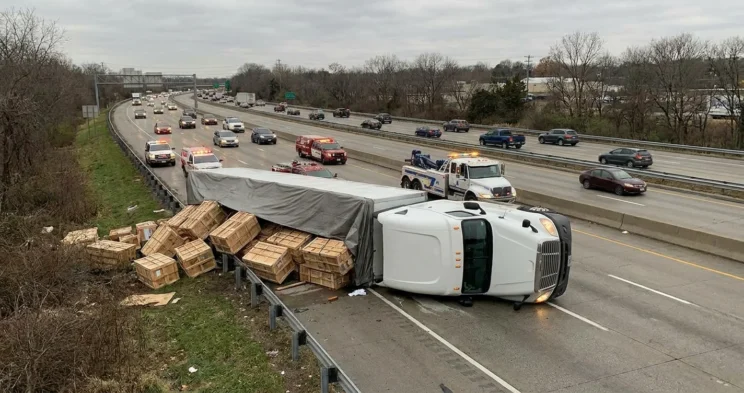
You watch a loaded 18-wheeler take a highway ramp in Texas at a speed that would feel completely normal in your own car. Seconds later, it’s on its side.
No one slammed the brakes or swerved. The truck simply reached its rollover threshold, a physical limit that has almost nothing to do with the posted speed and almost everything to do with the truck’s shape and load.
What Does “Rollover Threshold” Actually Mean?
A vehicle’s rollover threshold is the amount of sideways force, which is measured as lateral acceleration, that it can take in a turn before it tips instead of simply sliding.
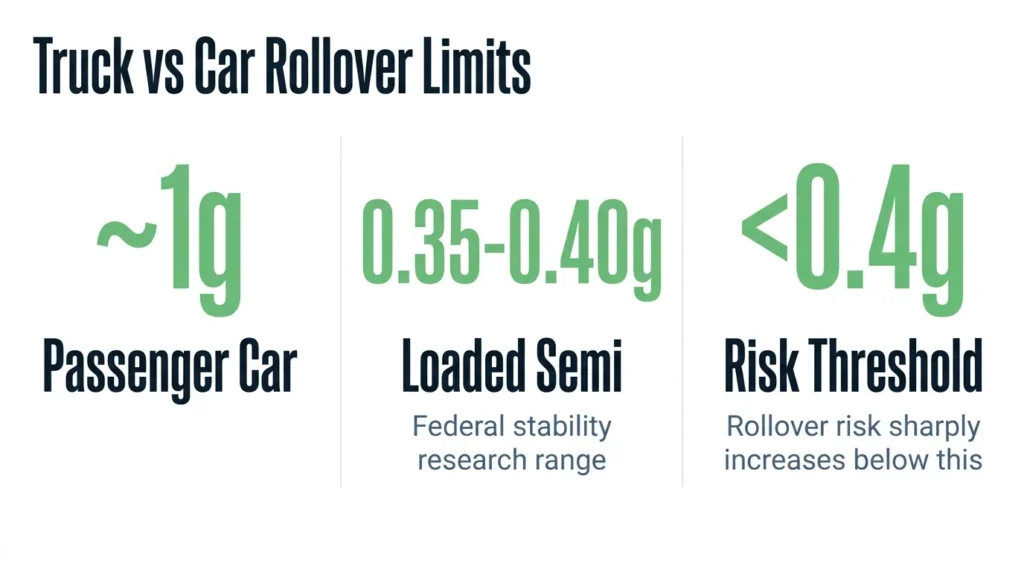
Every vehicle has one. A passenger car’s threshold is commonly close to 1 g or higher. A fully loaded tractor-semitrailer typically sits closer to 0.35 to 0.40 g, according to federal heavy-vehicle stability research.
That gap is key. A curve or ramp that generates enough sideways force to worry a truck driver would barely register to someone driving a sedan through the same turn.
Center of Gravity, Track Width, & Static Stability
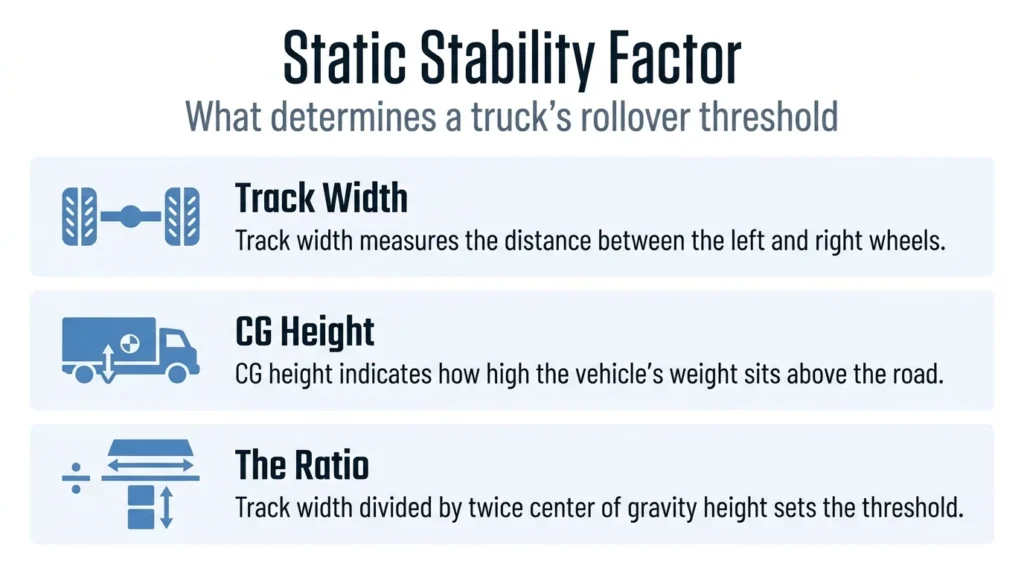
Engineers describe a vehicle’s rollover threshold using a simple ratio called the static stability factor. It compares two measurements:
- Track width: the distance between the left and right wheels
- Center of gravity height: how high the vehicle’s weight sits above the road
The static stability factor equals track width divided by twice the center of gravity height. A wider, lower vehicle has a higher number and a higher rollover threshold. A narrower, taller vehicle has a lower number and tips more easily.
A loaded semitrailer is tall and relatively narrow compared to its height. Federal research puts a fully loaded heavy truck’s rollover threshold target around 0.38 g, with a typical van-style trailer closer to 0.36 g. That same research found rollover risk sharply increases once a truck’s threshold drops below about 0.4 g.
A car built low and wide does not face that problem. Its center of gravity sits close to the pavement, so it can pull much harder through a turn before the physics work against it.
This is why a loaded truck can reach its limit on a Texas highway curve that a car clears without the driver noticing any strain. It is not a difference in caution, rather it is a difference in shape.
How Load Height and Load Shift Lower the Threshold
The truck’s empty frame is only part of the rollover equation. What is loaded onto it, and where, also factors in.
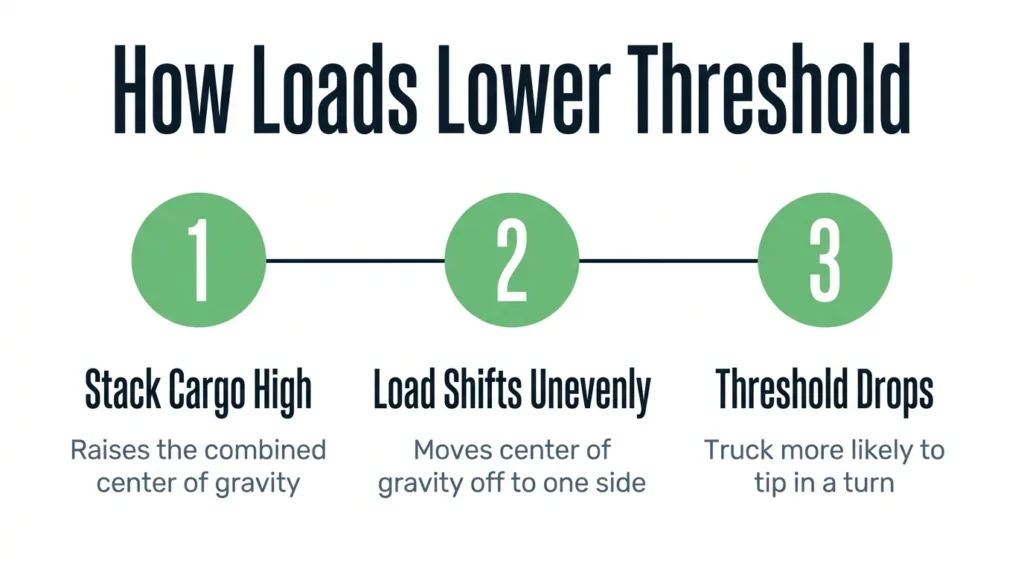
Stack cargo high, and the combined center of gravity of the truck and its freight rises with it. A higher center of gravity means a lower rollover threshold, even if the trailer itself never changes.
Load cargo unevenly, or let it shift once the truck is moving, and the center of gravity moves off to one side. That makes the truck more likely to tip in a turn toward that side compared to a properly balanced load.
Federal crash investigators have documented this connection directly. A joint federal study that examined 239 rollover crashes in detail found that 26 of them involved a load that was too heavy, insecurely fastened, or mounted too high, a load problem that compounded the truck’s rollover risk in most of those cases.
Federal cargo securement rules exist because of rollover risks. Under 49 CFR 393.100, cargo
must be contained, immobilized, or secured to prevent it from shifting “to such an extent that the vehicle’s stability or maneuverability is adversely affected.” The rule is a direct acknowledgment that a shifting load does not just risk falling off the truck. It risks taking the whole vehicle down with it.
Why a Ramp Speed That’s Safe for a Car Can Roll a Loaded Trailer
Lateral acceleration in a turn depends on speed and how sharp the curve is. That force is the same physical quantity whether it is acting on a compact car or a fully loaded semitruck.
The difference is how much of that force each vehicle can absorb before it tips. A car’s threshold sits close to three times higher than a loaded semitrailer’s. A speed that produces comfortable, well-margined lateral force in a car can already equal or exceed a loaded truck’s tipping point on the identical curve.
A loaded truck does not need an unsafe speed to roll over. It needs a speed and a curve that add up to more lateral force than its threshold, a threshold that a high or shifted load has often already lowered before the truck ever reaches the ramp.
Talk to Angel Reyes & Associates About a Truck Rollover Crash
A rollover crash happens fast, but the physics behind it usually took shape long before the truck reached that curve.
If you or someone you love was hurt in a truck rollover, you deserve answers about what put that truck past its limit. Angel Reyes & Associates has spent over 30 years helping injured Texans understand what happened and what comes next.
Contact Angel Reyes & Associates for a free consultation and talk through what happened and learn about your truck accident claim options.
Past results do not guarantee future outcomes.
Truck Rollover Crash FAQs
Is a truck more likely to roll over than to tip from a blowout or crash impact?
A rollover threshold applies to any lateral force strong enough to exceed it, whether that force comes from a turn, a sudden lane change, or another sharp sideways event. A tire blowout or crash impact can generate that same kind of lateral force. The truck’s threshold stays the same either way.
Does a heavier load always mean a higher rollover risk?
Not by itself. Weight alone does not lower a rollover threshold. Where that weight sits does. A heavy load stacked low and centered can be more stable than a lighter load stacked high or off to one side, because the threshold depends on center of gravity height and balance, not total weight.
Can a properly loaded truck still exceed its rollover threshold on a normal Texas highway curve or exit ramp?
Yes. Every loaded truck has a rollover threshold, and ordinary curves and ramps generate real lateral force. A truck that is loaded correctly still has a lower threshold than a car by design, so a curve that feels unremarkable to a car driver can still be enough to challenge a well-loaded truck at a higher speed.
Why don't pickup trucks and vans roll over as easily as loaded tractor-semitrailers?
Pickup trucks and vans sit lower and wider relative to their height than a loaded semitrailer does, which gives them a higher static stability factor. A loaded semitrailer combines a tall cargo box with a comparatively narrow track width, which pushes its rollover threshold much closer to the lateral force an ordinary turn can produce.
What is the difference between a rollover threshold and a truck's rated maximum speed?
A rated maximum speed is a general limit set for the vehicle or the road. A rollover threshold is a specific physical limit tied to lateral acceleration in a turn. A truck can be well under its rated maximum speed and still exceed its rollover threshold if the curve is sharp enough or the load has raised its center of gravity.
About the Authors

Alex Ivanov
Writer
Alex Ivanov is a personal injury attorney at Angel Reyes & Associates, focused on car, truck, and motorcycle accident cases. Licensed in Texas and multiple federal districts, Alex brings international legal experience and a global education to his practice. He earned his LL.M. from Texas A&M University School of Law after graduating from Belarussian State University in 2016. Alex is fluent in Russian, English, Ukrainian, and Belarussian, and is recognized by multiple national trial lawyer associations for his results and leadership under 40.

Graham Griffin
Editor
Graham Griffin is the Web & Content Manager at Angel Reyes & Associates, where he oversees content strategy, AI-powered workflows, a...

Angel Reyes
Reviewer
Angel L. Reyes, III is the Founder and Managing Partner of Angel Reyes & Associates. A nationally recognized trial attorney and business...