Do Different Cargo Types Have Different Securement Rules?


Every article on this site is researched by our internal team, reviewed for legal accuracy against current Texas law, and held to State Bar of Texas advertising standards before publication. We do not publish content that overstates outcomes or makes promises about results.
Learn more about our
editorial standards .
Key Takeaways
- Commodity-specific rules at 49 CFR 393.116-393.136 override the general test
- Logs, coils, pipe, vehicles, and boulders each get exact tiedown formulas
- The bill of lading and load photos show which securement rule applied
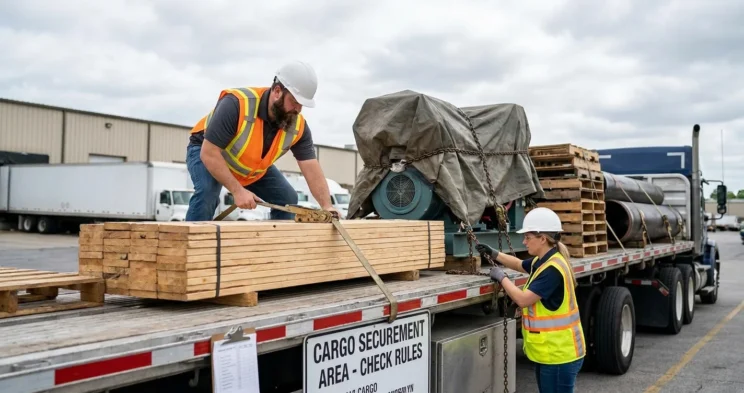
You’re standing on the shoulder of I-35 watching a state trooper photograph steel coils scattered across two lanes. Or maybe logs. Or a pallet of concrete pipe that never should have shifted at all.
Whatever the load was, one question matters right away.
Was that cargo secured the way federal law actually requires for that specific commodity, or just secured in a general sense?
The answer changes everything about how a securement violation gets proven.
One Federal Rule, Two Very Different Legal Tests

Cargo securement is not one uniform rule. A general performance standard applies to most freight, but eleven specific commodities are governed instead by prescriptive rules that leave the carrier no room to argue.
Federal law starts with a baseline duty. Under 49 CFR 393.100 and 393.102, cargo must be contained, immobilized, or secured so it cannot shift or fall during transport.
The general rule at 49 CFR 393.106 turns that duty into a performance test. The aggregate working load limit of the tiedowns used to secure an article, or a group of articles, must equal at least half the weight of that cargo.
This is a calculation, not a checklist. A carrier can reach the required number through almost any combination of straps, chains, or friction devices, even an unconventional one, and still satisfy the rule.
Section 393.106(a) then does the real work for this comparison. It states that commodity-specific rules “take precedence over the general requirements of this section when additional requirements are given for a commodity listed in those sections.”
That single sentence explains why some truck accidents involving spilled cargo turn into a straightforward records review while others turn into a drawn-out engineering debate. Under the general rule, a carrier’s defense team can argue its combination of devices met the 50% threshold.
Under a commodity-specific section, the required tiedown count and placement is written into the regulation. Either the load met it, or it did not.
The Commodity-Specific Rules That Displace the General Standard (49 CFR 393.116–393.136)
Eleven commodities are governed by their own prescriptive sections, running from 49 CFR 393.116 through 393.136 (not the narrower 393.128–393.136 range some summaries reference). Each section spells out an exact tiedown count, placement, angle, or required blocking, with no aggregate-strength math left to the carrier.
The table below covers the commodities most relevant to Texas truck crashes.
| Commodity | Section | What the rule requires |
|---|---|---|
| Logs | § 393.116 | Bunks, bolsters, or stakes must cradle the load. Shortwood loaded crosswise needs at least two tiedowns positioned near one-third and two-thirds of the log length. Longwood needs two tiedowns or two encircling wire-rope wrappers. Log truck securement is one of the sections that varies based on how the logs are loaded. |
| Metal coils (5,000 lbs or more) | § 393.120 | The required tiedown count and placement depend on how the coil sits, eyes vertical, crosswise, or lengthwise. Tiedowns cannot exceed a 45-degree angle, and coils loaded eyes-crosswise cannot be secured with an X-pattern through the eye. |
| Concrete pipe | § 393.124 | Combined tiedown working load limit must equal at least half the total weight of the pipe group. Blocking timbers must be at least 4-by-6 inches, and the rules differ for pipe 45 inches or smaller versus larger diameters. |
| Automobiles, light trucks, and vans (up to 10,000 lbs) | § 393.128 | A minimum of two tiedowns, one front and one rear, must restrain the vehicle against lateral, forward, rearward, and vertical movement, using manufacturer-designed mounting points where they exist. |
| Heavy vehicles, equipment, and machinery (10,000 lbs or more) | § 393.130 | A minimum of four tiedowns must sit as close as practicable to the front and rear or at designed mounting points. Accessory equipment must be lowered and secured, and articulated equipment must be restrained against articulation in transit. |
| Large boulders (over 11,000 lbs or over 2 cubic meters, open vehicles) | § 393.136 | Only chain qualifies as a tiedown. Configuration and required working load depend on the boulder’s shape, and hardwood blocking is required, with a three-point crib for round boulders. |
Five more sections follow the same pattern for dressed lumber, paper rolls, intermodal containers, flattened or crushed vehicles, and roll-on/roll-off containers. The full list of eleven prescriptive sections is set out in Part 393, Subpart I.
Every one of them narrows the carrier’s discretion the same way. The number and placement of tiedowns is written into the section itself.
Livestock & Bulk Material: Named in Practice, but No Dedicated Numbered Rule
Two commodities often come up in cargo-securement conversations without having their own numbered section. Understanding where they actually fall matters just as much as knowing the eleven that do.
- Livestock. No section between 393.100 and 393.136 governs live animals. Livestock trailers fall back on the general performance rule to the extent tiedowns even apply, because live cargo is typically confined by the trailer’s own compartmentalized structure rather than by a tiedown formula.
- Bulk material. Section 393.106(a) excludes commodities in bulk that lack structure or fixed shape, things like liquids, gases, grain, sand, gravel, and aggregates, from the general securement rule when they’re carried in an integral tank, hopper, or box. There is no numbered prescriptive section for generic bulk material.
- Where concrete pipe and boulders actually fit. Concrete pipe and boulders are the closest thing to bulk-like cargo that does get its own numbered rule, but they are covered because they are rigid, discrete objects riding on open vehicles. That is a different reason than the loose, granular bulk material 393.106(a) excludes.
Proving Which Rule Applied: The Evidence Spine
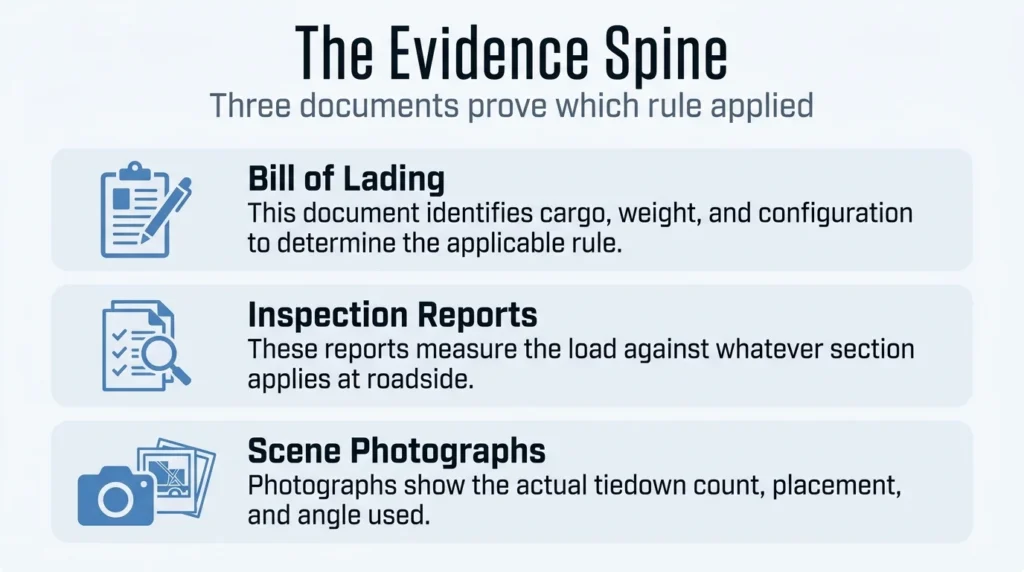
Three documents establish which rule governed a specific load and whether the carrier followed it. Building that record early is often what determines whether a securement violation gets proven or gets argued away.
The bill of lading or shipping manifest is the threshold document. It identifies
- what was actually being carried
- its weight
- its packaging or configuration
All of these are what determine whether the general rule, a specific commodity section, or the bulk exclusion governs that load.
Roadside and post-crash inspection reports measure the load against whatever section applies. Cargo securement is a heavily enforced category at roadside inspections, and a documented violation under Part 393 becomes part of the record from the moment an officer writes it up.
Load and scene photographs connect the two. They show the tiedown count, placement, and angle actually used, which is exactly what gets checked against the numbered section identified from the bill of lading.
Securement violations under the federal motor carrier safety regulations are treated as evidence relevant to a negligence claim, and the bill of lading functions as central documentary evidence in an improperly secured cargo case. That is precisely why these three documents need to be preserved before they disappear.
Talk to Angel Reyes & Associates About Your Truck Accident Claim
A commodity-specific securement violation is often a fact you can check against the regulation rather than a theory you have to argue. That only works if the bill of lading, the inspection report, and the load photographs are preserved before they’re lost.
Angel Reyes & Associates has guided Texans through truck accident claims for over 30 years. Our team of more than 600 dedicated professionals knows how to identify which securement rule applied to a specific load. We hold that record up against what actually happened on the road.
With more than 20 offices across Texas, we are available 24/7 to offer services in English and Spanish with no fees unless we win. If a commercial truck’s cargo shifted, spilled, or came loose in a crash, contact us for a free consultation to review your options with a firm that has recovered more than $1 billion for clients.
Past results do not guarantee future outcomes.
Cargo Securement Rules Differ by Type FAQs
If a commodity doesn't have its own numbered securement section, does that mean it doesn't need to be secured?
No. Cargo without a dedicated commodity-specific section still falls under the general performance rule at 49 CFR 393.100–393.114, which requires cargo to be contained, immobilized, or secured against shifting or falling, with tiedowns whose aggregate working load limit equals at least half the cargo’s weight. The one exception is bulk commodities that lack structure or fixed shape, such as grain, sand, gravel, or liquids, carried in an integral tank, hopper, or box. Under 49 CFR 393.106(a), those loads are excluded from the general rule because the vehicle’s own structure does the containing rather than tiedowns.
Does Texas have its own cargo securement rules separate from these federal standards?
No. Texas has adopted the Federal Motor Carrier Safety Regulations, including Part 393’s general and commodity-specific securement sections, for commercial vehicles operating in the state. There is no separate Texas commodity securement rule that diverges from the federal framework, so the same general-versus-prescriptive structure described above governs a Texas truck crash involving cargo securement.
Can a load meet the general securement rule & still violate a commodity-specific rule?
Yes. If a commodity has its own prescriptive section, one of the eleven running from 49 CFR 393.116 through 393.136, that section displaces the general rule for that commodity. Section 393.106(a) states that the commodity-specific rules “take precedence over the general requirements of this section when additional requirements are given for a commodity listed in those sections.” A carrier’s tiedown combination could add up to the general 50% aggregate strength test and still fail to meet a prescriptive section’s specific tiedown count, placement, or angle requirements.
If the bill of lading doesn't match what was actually loaded, does that affect which securement rule applied?
The bill of lading or shipping manifest is the document that identifies what was actually carried, its weight, and its packaging or configuration, which is what determines whether the general rule, a specific commodity section, or the bulk exclusion governed a given load. When that description doesn’t match the cargo actually on the truck, load & scene photographs and inspection reports become the record used to establish what was really carried and whether it was secured the way the applicable rule required.
About the Authors

Angel Reyes
Writer
Angel L. Reyes, III is the Founder and Managing Partner of Angel Reyes & Associates. A nationally recognized trial attorney and business leader, Angel has helped over 70,000 injury victims recover more than $1 billion since founding the firm in 1993. Named to the Texas Super Lawyers list annually since 2008, Angel brings Wall Street experience, Ivy League education, and a deep commitment to client advocacy. He is a frequent legal commentator and published author with extensive contributions to legal scholarship, trial strategy, and consumer protection.

Kyle Nicolas
Editor
Kyle Nicolas is the Web Content & SEO Manager at Angel Reyes & Associates. He has more than 10 years of experience as a marketing co...

Angel Reyes
Reviewer
Angel L. Reyes, III is the Founder and Managing Partner of Angel Reyes & Associates. A nationally recognized trial attorney and business...