What Happens If the Truck That Hit You Was Overweight?


Every article on this site is researched by our internal team, reviewed for legal accuracy against current Texas law, and held to State Bar of Texas advertising standards before publication. We do not publish content that overstates outcomes or makes promises about results.
Learn more about our
editorial standards .
Key Takeaways
- Overweight trucks violate Texas Transportation Code Chapter 621 and federal law.
- An unexcused violation can establish fault under the negligence per se doctrine.
- Scale tickets, weight receipts, and permit records build your case for you.
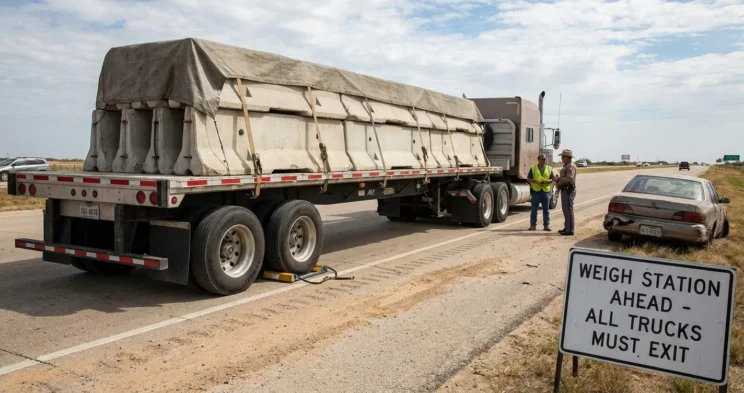
You were driving on I-35 near Waco when a truck hit your vehicle. You already know it was massive. The next question is whether it was carrying more weight than Texas law allows.
After an overweight truck accident in Texas, the violation may affect who can be held responsible and which records can help support your injury claim.
The Law an Overweight Truck Breaks
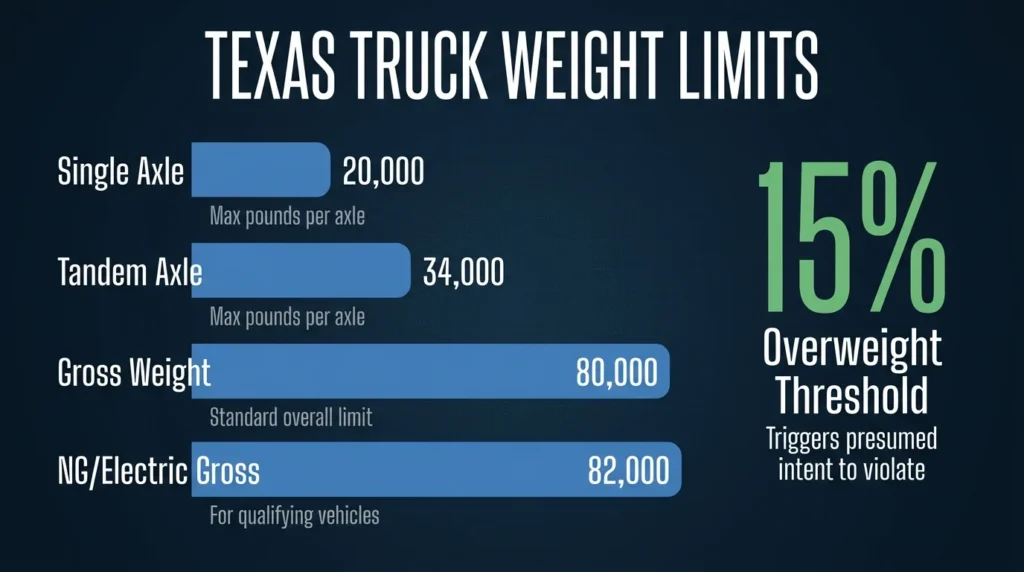
Texas caps how much a commercial truck can weigh on a public highway. Under Texas Transportation Code § 621.101, a single axle cannot carry more than 20,000 pounds, a tandem axle cannot carry more than 34,000 pounds, and the overall gross weight of the vehicle cannot exceed 80,000 pounds (82,000 pounds for certain qualifying natural gas or electric vehicles). Gross weight on a group of consecutive axles is also capped by a federal bridge formula built to protect roads and bridges from excess strain.
Loading a truck beyond these limits is a separate violation under Texas Transportation Code Chapter 621, and the law assumes the loader intended the violation once a truck is loaded 15% or more over its legal limit. That presumption exists to catch cargo shippers and carriers who claim they did not notice.
Federal law reinforces this. 49 CFR § 392.2 requires every commercial motor vehicle to follow the laws of the state where it operates. An overweight truck on a Texas highway is violating Texas weight law and a federal operating rule.
Evidence of a weight violation can help show that the trucking company broke a specific safety rule. A Texas truck accident attorney can use that violation, along with scale tickets, loading records, and permit information, to determine how the excess weight contributed to the crash.
Why This Is Negligence Per Se, Not a Paperwork Problem
An overweight citation may have consequences beyond the fine issued to the trucking company.
In El Chico Corp. v. Poole, 732 S.W.2d 306, 312 (Tex. 1987), the Texas Supreme Court explained that an unexcused violation of certain safety statutes can establish the applicable standard of care and its breach. The injured person must still show that the violation contributed to the crash and prove the resulting damages.
Instead of proving that the weight violation was careless from scratch, the claim can use the violated safety statute to establish the standard the trucking company was required to follow.
Texas weight limits are intended to reduce the stopping and stability risks created by heavily loaded commercial vehicles. These additional regulations help explain how a truck accident case differs from a car accident case.
How Excess Weight Changes Stopping Distance & Rollover Risk
Extra weight changes how the truck behaves on the road in ways that put you at greater risk.
A truck’s brakes must absorb more energy as its weight increases. A fully loaded 80,000-pound tractor-trailer already needs approximately 525 feet to stop from 65 miles per hour under good conditions, compared with approximately 316 feet for a passenger vehicle. A truck carrying weight beyond the legal limit may need even more room to stop.
Cargo weight can also affect rollover risk, especially when improperly loaded or shifting cargo is unevenly distributed or raises the truck’s center of gravity. The Federal Highway Administration’s Western Uniformity Scenario Analysis explains that cargo distribution and center-of-gravity height play a significant role in rollover performance.
These handling problems can help explain why the truck could not stop in time or remain stable before the crash.
How Overweight Truck Permits Work
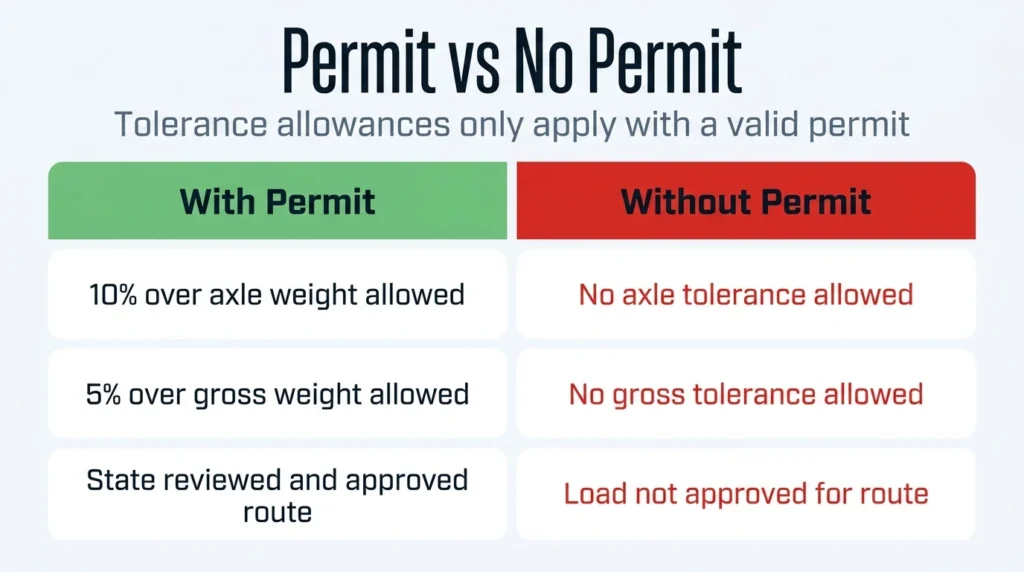
Any load that exceeds the standard 80,000 pound limit needs a special permit before it ever leaves the yard.
The Texas Department of Motor Vehicles issues oversize and overweight permits under Texas Transportation Code Chapter 623. A Single-Trip Permit only authorizes one specific route from origin to destination. TxDMV’s oversize and overweight permit program spells out exactly what a carrier must do before hauling a load over the standard limit.
A properly issued permit even includes built-in tolerance. It allows up to 10% over the standard axle weight and up to 5% over the standard gross weight.
Those allowances apply because the state reviewed the load and its proposed route before issuing the permit. A truck operating without a permit cannot rely on those tolerances.
Without a permit, the load was never approved for that route or weight. Permit records can help show whether the carrier was authorized to haul the load involved in the crash.
Scale Tickets, Weight Receipts, & Permit Records
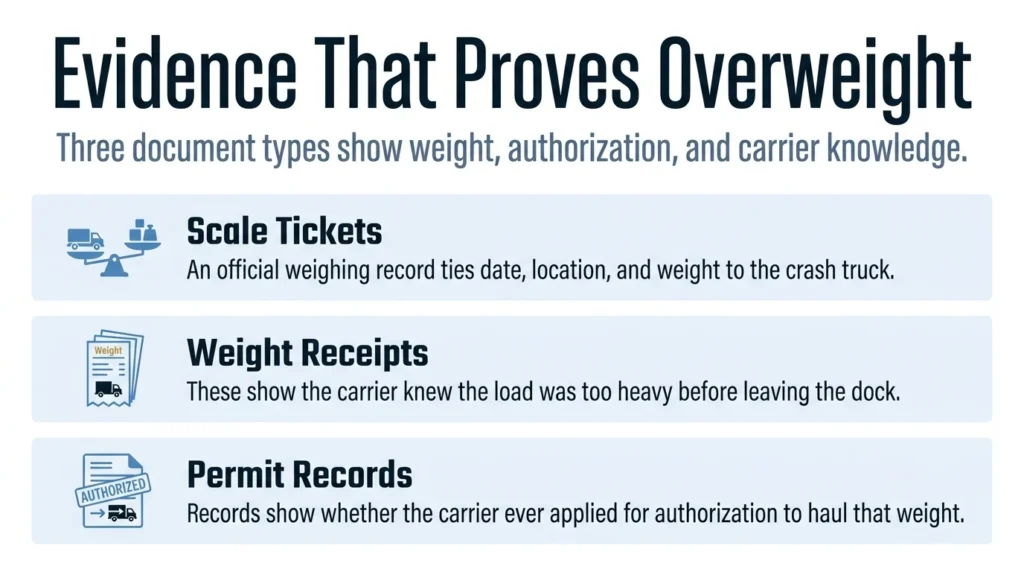
Building this kind of case comes down to documents that show what the truck weighed, whether that weight was authorized, and what the carrier knew before the trip. The Texas DPS Commercial Vehicle Enforcement program and the carrier’s own paperwork typically produce three types of records:
- Scale tickets. When a DPS weight enforcement officer weighs a truck on an approved scale or directs it to the nearest public scale, that weighing creates an official record tying a specific date, location, and weight to the truck involved in your crash.
- Weight receipts. Shippers and consignees generate their own weight records before a truck ever leaves the loading dock, including certified public weigher tickets and terminal weigh-outs. These records can show the carrier knew the load was too heavy before the truck reached the highway.
- Permit records. The state’s permitting system shows whether a carrier ever applied for authorization to carry the weight it was hauling. No permit on file is itself evidence, not just an assumption.
Talk to a Truck Accident Lawyer About Your Case
Scale tickets, weight receipts, and permit records may become harder to obtain over time. Requesting and preserving them early can help establish what the truck weighed and whether the load was authorized.
Angel Reyes & Associates has spent over 30 years guiding injured Texans through situations like this one. If you believe you were hurt in an overweight truck accident, contact Angel Reyes & Associates for a free consultation to talk through what happened and what evidence needs to be preserved.
Past results do not guarantee future outcomes, and every case is different.
Overweight Truck Accident FAQs
Can a trucking company blame the shipper for an overweight load in Texas?
Potentially, but responsibility depends on who loaded the cargo, controlled the shipment, knew or should have known its weight, and contributed to the conditions that caused the crash.
Can an overweight truck legally drive on an interstate highway in Texas with a permit?
It depends on the permit type and applicable federal and state restrictions. Some Texas overweight permits specifically do not authorize travel on the Interstate Highway System, making the truck’s permitted route an important part of an investigation.
Who can be liable when improperly distributed weight causes a truck accident?
Depending on the facts, potentially responsible parties can include the motor carrier, driver, shipper, loader, or another company involved in preparing or transporting the cargo.
Can electronic logging or GPS data help prove an overweight truck violated its permitted route?
Yes. GPS, electronic logging device data, dispatch records, and other trip information may help establish where the truck traveled and whether that route matched the route authorized by an applicable permit.
Does an overweight violation automatically mean the trucking company is responsible for the accident?
No. An injured person still generally must connect the violation to the collision and prove resulting damages. Showing that the truck exceeded an applicable weight limit does not by itself establish that excess weight caused the crash.
About the Authors

Angel Reyes
Writer
Angel L. Reyes, III is the Founder and Managing Partner of Angel Reyes & Associates. A nationally recognized trial attorney and business leader, Angel has helped over 70,000 injury victims recover more than $1 billion since founding the firm in 1993. Named to the Texas Super Lawyers list annually since 2008, Angel brings Wall Street experience, Ivy League education, and a deep commitment to client advocacy. He is a frequent legal commentator and published author with extensive contributions to legal scholarship, trial strategy, and consumer protection.

Kyle Nicolas
Editor
Kyle Nicolas is the Web Content & SEO Manager at Angel Reyes & Associates. He has more than 10 years of experience as a marketing co...

Angel Reyes
Reviewer
Angel L. Reyes, III is the Founder and Managing Partner of Angel Reyes & Associates. A nationally recognized trial attorney and business...