Who’s Liable If the Tractor and Trailer Have Different Owners?


Every article on this site is researched by our internal team, reviewed for legal accuracy against current Texas law, and held to State Bar of Texas advertising standards before publication. We do not publish content that overstates outcomes or makes promises about results.
Learn more about our
editorial standards .
Key Takeaways
- The carrier controls and answers for the whole rig during the lease term.
- A trailer's separate owner can still be liable for trailer-specific defects.
- Titles, the lease, and maintenance records reveal who controlled what and can help establish liability.
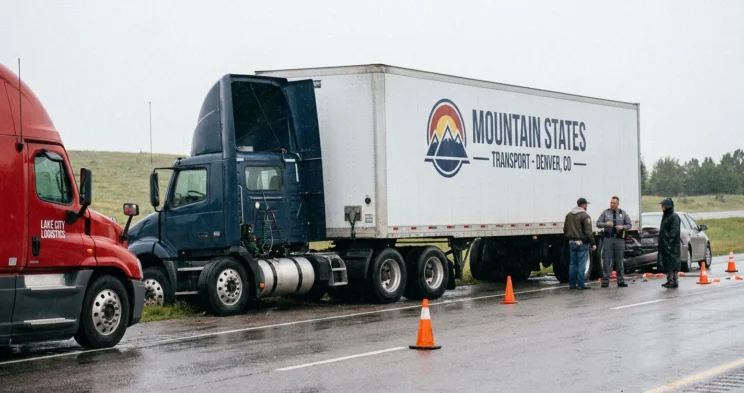
You pull the crash report after a wreck on I-35, and something doesn’t add up. The tractor that hit you is registered to one company. The trailer behind it is titled to a completely different one.
That split ownership is common in trucking. It also raises the central question in a tractor vs trailer owner liability case: which company answers for your injuries, the one driving or the one that owns the box being pulled?
The short answer is usually both. The carrier operating the tractor is generally responsible for the whole rig while it is under lease. The trailer’s separate owner can still carry its own liability for defects or maintenance failures tied specifically to the trailer.
The Carrier’s Responsibility for the Whole Rig During the Lease
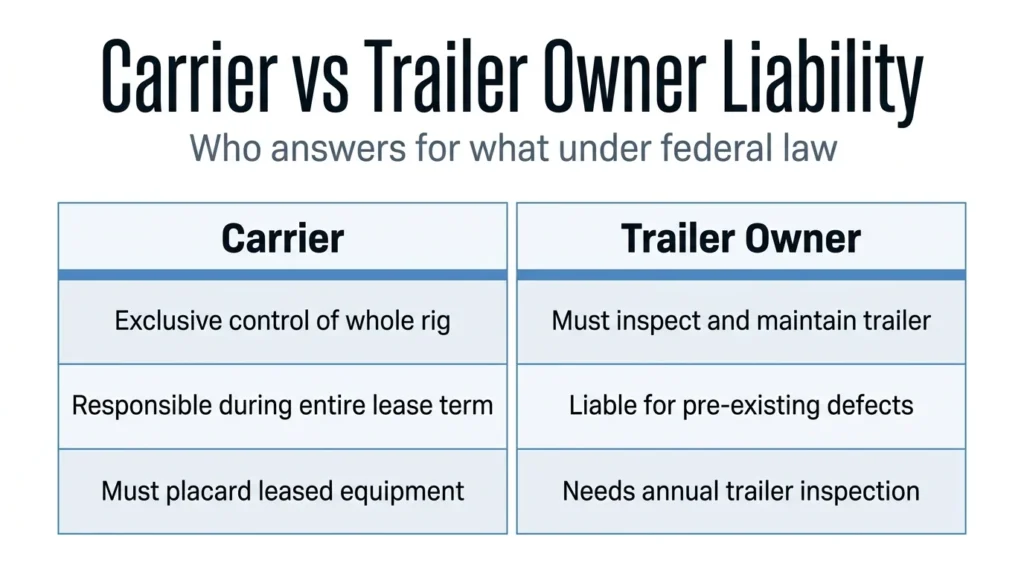
Federal law makes the carrier operating the tractor answerable for the entire combination, including a trailer it does not own, for as long as the lease runs.
Under 49 Code of Federal Regulations (CFR) § 376.12, a written lease between a carrier and an equipment owner must give the carrier “exclusive possession, control, and use” of the leased equipment. The same regulation requires the carrier to “assume complete responsibility for the operation of the equipment” for the full lease term. The lease also has to state exactly when it starts and ends.
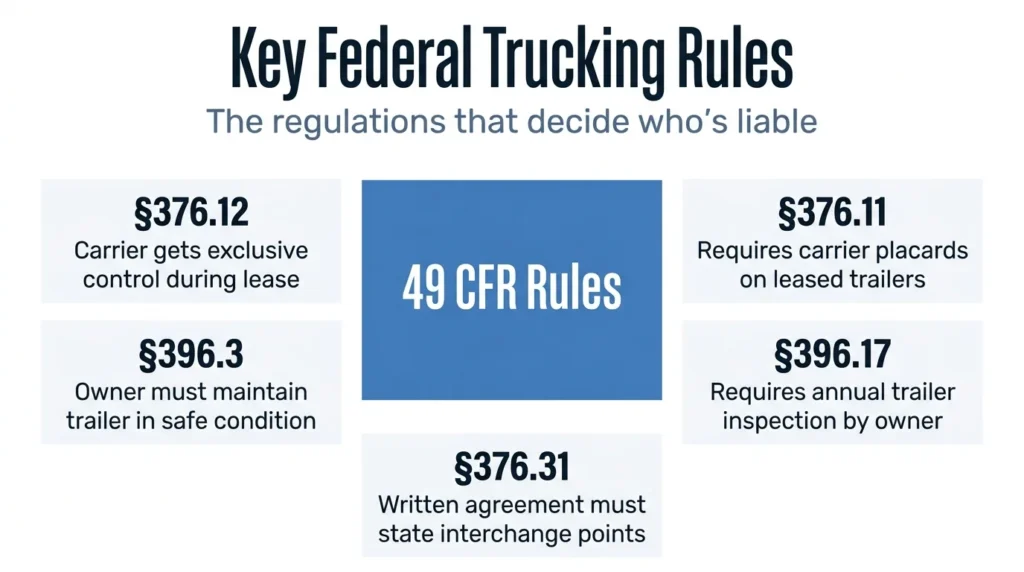
That single rule explains why the carrier is a defendant in a truck accident case involving a separate trailer owner, even when its name never appears on the trailer’s title. Federal law places control, and therefore responsibility, on whichever carrier is running the load.
There is a second piece to this. 49 CFR § 376.11 requires the carrier to identify leased equipment with its own placards for the length of the lease. Courts in the Fifth Circuit, which covers Texas, have treated that identification requirement as reinforcing the carrier’s responsibility for a leased trailer’s operation, a concept called logo liability.
None of this means the carrier is the only company that can be held responsible for a crash. It means the carrier cannot avoid responsibility for the trip simply because someone else owns the trailer. A Texas truck accident involving split ownership almost always calls for looking past the carrier’s name on the vehicle. The next question is what happens when the trailer itself was the problem.
When the Trailer’s Owner Carries Its Own Liability
The trailer’s separate owner can still be independently liable when a defect or a maintenance failure in that specific unit contributed to the crash.
49 CFR § 396.3 requires whoever controls a commercial vehicle or trailer to “systematically inspect, repair, and maintain” it, keeping every part and accessory “in safe and proper operating condition at all times.”
49 CFR § 396.17 adds a separate requirement. Every trailer needs its own annual inspection, and an intermodal equipment provider—one that uses multiple modes of transportation—carries its own duty to inspect equipment before it interchanges that equipment to a carrier.
Worn brake linings, bald tires, or broken trailer lights that existed before the trailer was ever hooked to this particular tractor tell their own story. So does an annual inspection sticker that expired months earlier. Those failures point at the trailer’s title owner, because the defect or the missed inspection traces back to that owner’s own custody rather than to anything the operating carrier did on the day of the crash.
This is why a tractor vs. trailer owner liability analysis rarely ends with the carrier. If the trailer itself failed, the company that owned and was supposed to maintain that trailer may be liable.
Building the Case Around Both Owners, Not the Carrier’s Story
Do not accept a carrier’s informal, after-the-fact statement about who was “responsible” for the trailer. Federal law shows that the operative owner role can shift by written agreement, so the paperwork tells you responsibility, not a verbal claim made after a crash.
49 CFR § 376.31 requires a written interchange agreement that specifically describes the equipment being interchanged (such as a trailer hooked up to a tractor) and states the exact points of interchange. That document, not a phone call from the carrier’s safety department, shows who actually had the trailer and when.
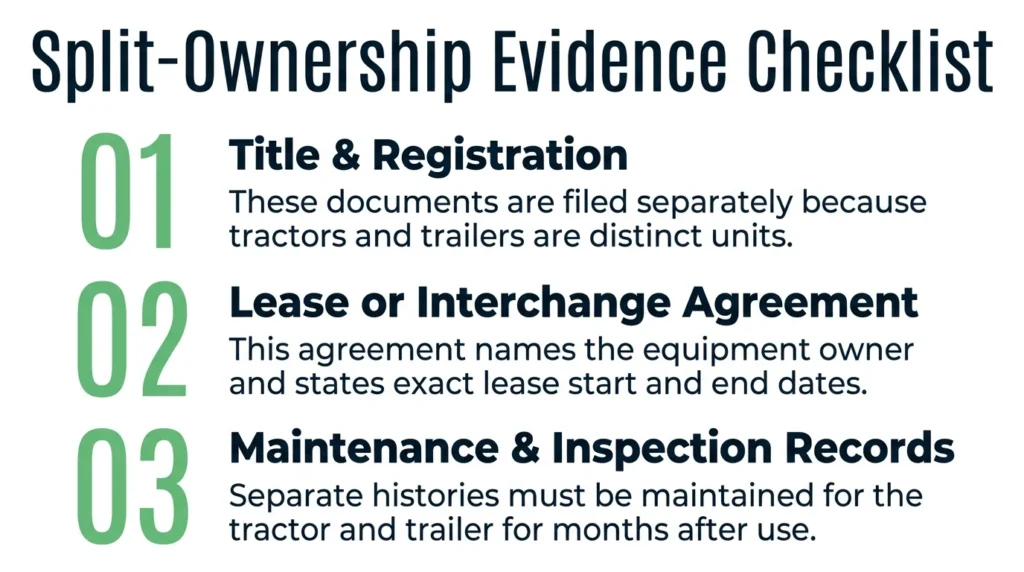
Three categories of evidence anchor a split-ownership case:
- Title and registration records for the tractor and the trailer, filed separately because the two units belong to different owners
- The written lease or interchange agreement, which must name the equipment owner and state the lease’s exact start and end dates
- Separate maintenance and inspection histories for the tractor and the trailer, since each unit follows a separate maintenance schedule
That evidence is usually still available if you request it promptly. Preserving this evidence is one of the most important things to do after a truck accident. Maintenance records must be kept for a year, plus six months after a vehicle leaves a carrier’s control, and annual inspection reports must be kept for 14 months. In a Texas wreck involving a split-ownership rig, pulling both files early is often what separates a case against one company from a case against every company that bears responsibility.
Depending on what the records show, the driver, the operating carrier, the trailer’s separate owner, and sometimes a maintenance contractor can all belong in the same claim.
Get Help Sorting Out Who’s Responsible
Figuring out who owned, controlled, and maintained each piece of the rig takes real digging. Insurance adjusters are not going to volunteer facts that widen their own exposure.
Angel Reyes & Associates has guided Texans through truck accident claims for over 30 years, including cases where the tractor and trailer belonged to two different companies. We work on contingency, so there is no upfront cost to find out who is actually responsible for what happened to you.
Contact Angel Reyes & Associates for a free consultation to review the lease, the interchange agreement, and the maintenance history behind your crash.
Every case is different, and past results do not guarantee future outcomes.
Frequently Asked Questions
Can I pursue the trucking company and the trailer's owner in the same claim?
Yes. When the tractor and trailer belong to two different companies, both can potentially be named depending on what caused the crash. The operating carrier can answer for the whole rig under its lease responsibility, while the trailer’s separate owner can answer for its own equipment defects or maintenance failures. A driver or a maintenance contractor can also belong in the same claim when the facts support it.
Does it matter if the trailer was a short-term rental rather than another carrier's unit?
The same basic control-and-responsibility framework generally applies. Federal lease rules focus on the arrangement between the authorized carrier and whoever owns the equipment, not on the specific label used for that arrangement. What matters is who had exclusive possession, control, and use of the trailer under the lease or rental agreement, and for how long. The written agreement itself, not the label on the paperwork, is what should be examined.
What if the carrier says the trailer wasn't under its control when the crash happened?
That claim should be verified against documents, not taken at face value. The written lease has to state exactly when it begins and ends, and a written interchange agreement has to specify the exact points of interchange for equipment moving between carriers. Those documents show when control actually transferred, which is more reliable than an informal statement made after a crash.
How can someone find out who owns a trailer after a Texas truck accident?
Titles and registration are filed separately for the tractor and the trailer, since they are legally distinct pieces of equipment. The lease or interchange agreement is also required to name the equipment’s owner. Requesting both the title records and the written lease or interchange agreement is typically how the trailer’s actual owner gets identified.
About the Authors

Angel Reyes
Writer
Angel L. Reyes, III is the Founder and Managing Partner of Angel Reyes & Associates. A nationally recognized trial attorney and business leader, Angel has helped over 70,000 injury victims recover more than $1 billion since founding the firm in 1993. Named to the Texas Super Lawyers list annually since 2008, Angel brings Wall Street experience, Ivy League education, and a deep commitment to client advocacy. He is a frequent legal commentator and published author with extensive contributions to legal scholarship, trial strategy, and consumer protection.

Kyle Nicolas
Editor
Kyle Nicolas is the Web Content & SEO Manager at Angel Reyes & Associates. He has more than 10 years of experience as a marketing co...

Angel Reyes
Reviewer
Angel L. Reyes, III is the Founder and Managing Partner of Angel Reyes & Associates. A nationally recognized trial attorney and business...