Do Farm Trucks Have to Follow Federal Trucking Rules?


Every article on this site is researched by our internal team, reviewed for legal accuracy against current Texas law, and held to State Bar of Texas advertising standards before publication. We do not publish content that overstates outcomes or makes promises about results.
Learn more about our
editorial standards .
Key Takeaways
- A farm plate alone doesn't prove a truck qualifies as a covered farm vehicle.
- Missing CDL, logs, and inspection records may mean none were ever required.
- Texas negligence law can still hold farm truck owners accountable for crashes.
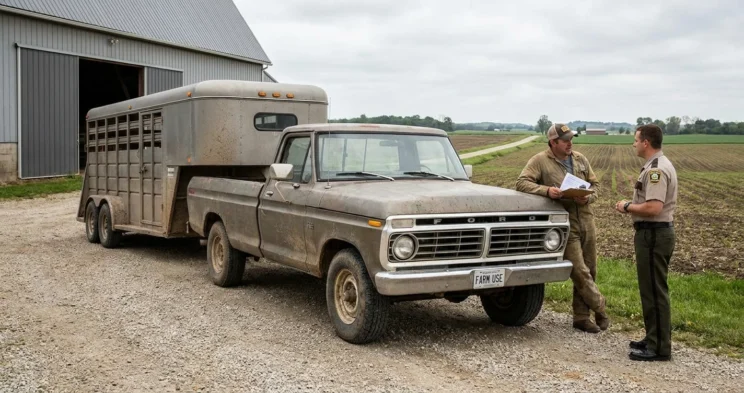
You were hit by a big flatbed hauling hay or livestock on a rural Texas highway, making the case seem like any other trucking claim. Your lawyer moves quickly to pull the driver’s file, medical certificate, logbook, and inspection reports. Then every single one of those requests comes back empty.
That is not a red flag by itself. It may mean the truck that hit you qualifies as a “covered farm vehicle” under federal law; a category that removes many of the rules that apply to ordinary commercial trucks. Understanding what that status means, and what it does not mean, is the first step to building your case the right way.
What Makes a Truck a “Covered Farm Vehicle” Under Federal Law
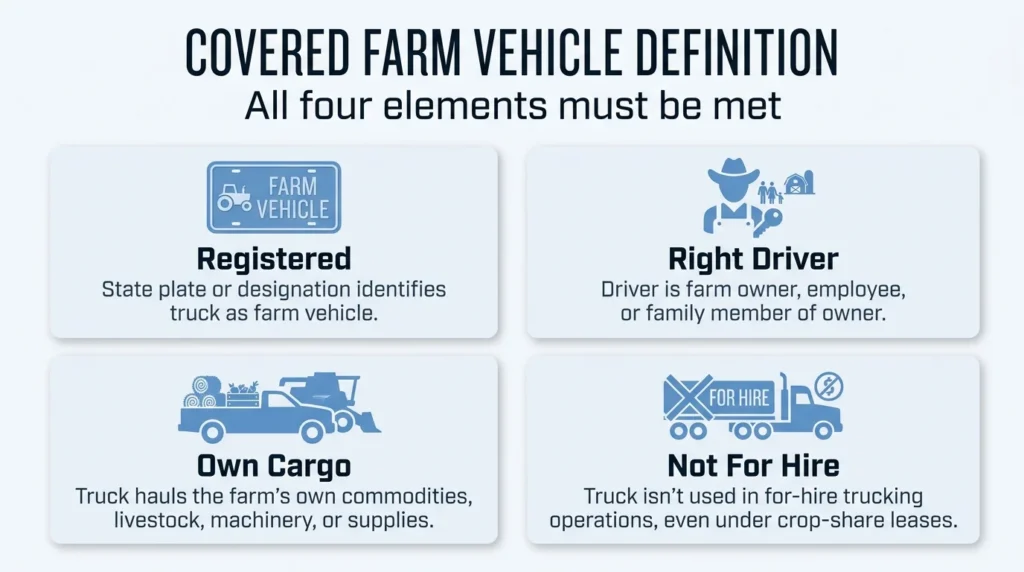
Federal regulation 49 CFR 390.5 defines a “covered farm vehicle” (CFV) using four specific elements. A truck has to meet all four, not just one, to qualify.
- Registered as a farm vehicle. The truck carries a state license plate or designation that lets law enforcement identify it as a farm vehicle.
- Operated by the right person. The driver is the farm or ranch owner, an employee, or a family member of the owner.
- Hauling the farm’s own goods. The truck is transporting agricultural commodities, livestock, machinery, or supplies to or from a farm or ranch.
- Not for hire. The truck is not used in for-hire trucking operations. A tenant farmer hauling the landlord’s share of crops under a crop-share lease does not lose CFV status just because of that arrangement.
Notice what is missing from this list. The federal definition itself says nothing about hazardous materials. That limitation, where it exists, lives in a separate exemption provision, not in the definition of what counts as a CFV.
A CFV can be a single straight truck or a full tractor-trailer combination. Both vehicle types can qualify under this same four-part test.
The Weight & Mileage Thresholds That Decide How Far the Exemption Reaches
Meeting the four-part definition is only half the picture. How far a covered farm vehicle can travel while keeping its exemptions depends on weight.
- 26,001 pounds or less (Gross Vehicle Weight Rating or Gross Combination Weight Rating): The vehicle can use the CFV exemptions anywhere in the United States.
- More than 26,001 pounds: The vehicle can only use the exemptions in its state of registration, or across state lines within 150 air miles of the farm or ranch it serves.
That 150-air-mile figure describes how far a heavier covered farm vehicle can travel and still keep its exemptions. It is a separate rule from the agricultural hours-of-service exception that uses a similar radius, and the two should not be confused.
Texas built its own commercial driver’s license exemption around this same federal framework. Texas Transportation Code § 522.004 exempts a covered farm vehicle, as defined by 49 CFR 390.5, from the state CDL requirement.
Texas did not write its own weight threshold. It simply adopted the federal 26,001-pound line.
What Federal Rules a Qualifying Covered Farm Vehicle Doesn’t Have to Follow
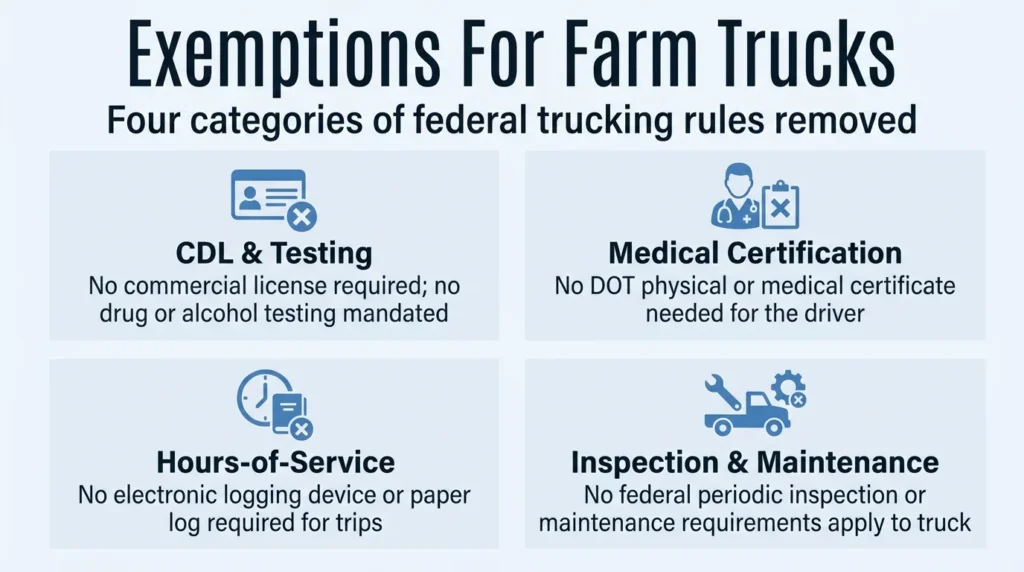
Once a truck qualifies as a CFV, 49 CFR 390.39 removes four categories of federal trucking rules for that vehicle and its driver.
- Commercial driver’s license and testing. No Commercial Driver’s License (CDL) is required, and the driver is not subject to the usual controlled-substance and alcohol testing rules.
- Medical certification. The driver does not need a Department of Transportation (DOT) physical qualification or medical certificate.
- Hours-of-service rules. No electronic logging device or paper log is required for the trip.
- Inspection and maintenance rules. The truck is not subject to the federal periodic inspection, repair, and maintenance requirements that apply to most commercial vehicles.
One rule survives every one of these exemptions. The federal ban on handheld mobile devices while driving still applies, with no exception for farm vehicles.
For a straight farm truck, the exemption goes further still. 49 CFR 391.2 removes most of the broader driver-qualification paperwork too, including the employment application, background checks, and road test. A driver operating an articulated, tractor-trailer style farm vehicle gets only a narrower version of this relief under a separate provision.
Texas Farm-Plate Registration & How It Fits the Federal Definition
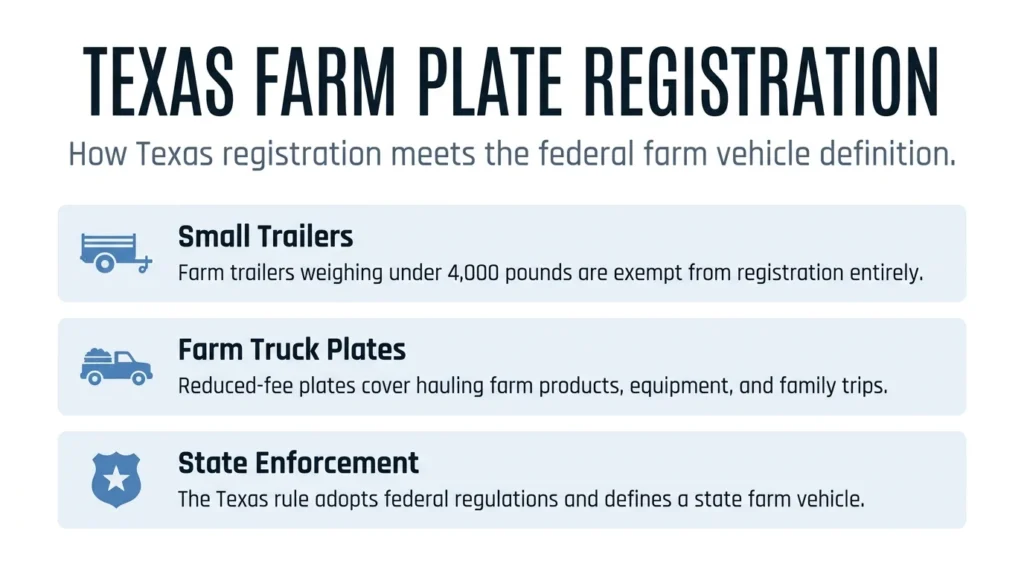
The federal definition requires a plate or designation that identifies the truck as a farm vehicle. Texas supplies that piece through its own registration rules.
- Small farm trailers. Under Texas Transportation Code § 502.146, farm trailers and semitrailers weighing 4,000 pounds or less are exempt from registration entirely. Those between roughly 4,000 and 34,000 pounds can register under a Farm Trailer plate for a small annual fee.
- Farm Truck and Farm Truck Tractor plates. Texas offers a reduced-fee plate for vehicles used to haul the farm’s own products to market, move farm equipment, transport farm laborers, or carry family members to church, school, or medical appointments, according to Texas DPS farm registration guidance. A farm-plated truck cannot be used for gainful employment outside farming or ranching.
- State enforcement standards. 37 Texas Administrative Code § 4.11 adopts the federal trucking regulations for Texas Department of Public Safety enforcement and defines a state “farm vehicle” that tracks the federal language closely.
A farm plate on a truck involved in your crash does not settle the question by itself. It only satisfies the registration element. The driver relationship, the cargo, the for-hire restriction, and the weight and mileage limits still have to hold up independently before a truck qualifies as a covered farm vehicle.
A Texas truck accident lawyer can help confirm which of these elements the vehicle in your crash actually meets.
Why the Usual Trucking Discovery Playbook Can Come Up Empty & What the Case Is Built On Instead
In a typical Texas trucking case, your attorney requests the driver qualification file, the medical certificate, the hours-of-service logs, and the inspection and maintenance records. For a truck that genuinely qualifies as a CFV, every one of those requests can come back empty.
That gap traces directly back to the exemptions above. No CDL or drug-testing file exists because that requirement was removed. No medical certificate exists for the same reason.
No hours-of-service log exists because the trip was never subject to that rule, and no inspection or maintenance report exists because that requirement does not apply either. For a straight farm truck, even the broader hiring and background-check paperwork may never have been created.
An empty file is not proof that something was hidden or destroyed. The records were never legally required to exist in the first place, so their absence does not point to wrongdoing on its own.
That does not mean the case has nowhere to go. It means the case gets built somewhere else.
Your attorney can confirm, and where the facts support it, challenge whether the truck and driver actually meet every element of the covered farm vehicle definition. Business records, fuel and maintenance receipts, witness accounts, and telematics data can still exist even where federal paperwork does not.
From there, the claim rests on Texas common-law negligence: duty, breach, cause, and damages, the same as any other crash. A violation of a specific traffic law under the Texas Transportation Code can support a negligence-per-se theory. Where the facts support it, the farm or ranch that owns the truck can also face claims for negligent hiring or negligent entrustment, separate from anything the federal exemptions removed.
For a deeper look at how these claims come together, our Texas truck accident attorneys can walk through the specifics with you. General background on how these negligence elements work under Texas law is available through FindLaw’s overview of Texas negligence law.
Talk to Angel Reyes & Associates About Your Farm Truck Accident Claim
A crash with a farm truck raises questions most people never expect to face. The missing paperwork alone can make the case feel harder to prove, when it really just means the investigation has to look in different places.
Angel Reyes & Associates can review the details of your crash, help determine whether the truck involved meets the legal definition of a covered farm vehicle, and explain what that means for your claim. For over 30 years, our team of more than 600 dedicated professionals across more than 20 offices has helped injured clients recover over $1 billion, and we are available 24/7 with services in English and Spanish. Get a free consultation to talk through your options.
Past results do not guarantee future outcomes.
Federal Trucking Rules for Farm Trucks FAQs
Can a covered farm vehicle still be held liable for a crash in Texas?
Yes. Federal exemptions from Commercial Driver’s Licence, medical, hours-of-service, and inspection requirements do not eliminate the driver’s or owner’s potential liability for negligent conduct that causes a crash.
What evidence can help prove negligence when a farm truck has no DOT logs or driver qualification file?
Crash-scene evidence, photographs, witness statements, vehicle data, business records, maintenance receipts, and other available records may help establish how the collision occurred and whether the driver or owner acted negligently.
Does a Texas farm truck exemption apply if the vehicle is carrying hazardous materials?
The covered-farm-vehicle exemptions do not provide the same state-law protection when the vehicle is transporting hazardous materials that require placarding, so the cargo and applicable federal and Texas requirements should be examined separately.
Can a farm truck accident lead to a negligent entrustment claim in Texas?
Potentially. A farm or ranch owner may face a negligent-entrustment claim when the evidence supports that the owner entrusted the vehicle to a driver the owner knew or should have known was incompetent, reckless, or otherwise unfit to drive.
Does a farm plate automatically make a truck a covered farm vehicle under federal law?
No. A farm plate addresses only the registration element of the federal definition; the vehicle, driver, cargo, for-hire status, weight, and applicable geographic requirements must also satisfy the covered-farm-vehicle rules.
About the Authors

Angel Reyes
Writer
Angel L. Reyes, III is the Founder and Managing Partner of Angel Reyes & Associates. A nationally recognized trial attorney and business leader, Angel has helped over 70,000 injury victims recover more than $1 billion since founding the firm in 1993. Named to the Texas Super Lawyers list annually since 2008, Angel brings Wall Street experience, Ivy League education, and a deep commitment to client advocacy. He is a frequent legal commentator and published author with extensive contributions to legal scholarship, trial strategy, and consumer protection.

Kyle Nicolas
Editor
Kyle Nicolas is the Web Content & SEO Manager at Angel Reyes & Associates. He has more than 10 years of experience as a marketing co...

Angel Reyes
Reviewer
Angel L. Reyes, III is the Founder and Managing Partner of Angel Reyes & Associates. A nationally recognized trial attorney and business...