Why Do Trucks Swing Wide on Right Turns?


Every article on this site is researched by our internal team, reviewed for legal accuracy against current Texas law, and held to State Bar of Texas advertising standards before publication. We do not publish content that overstates outcomes or makes promises about results.
Learn more about our
editorial standards .
Key Takeaways
- Off-tracking, not driver preference, is why a trailer sweeps across the right lane.
- Texas law still requires the turn be made as closely as practicable to the curb.
- Intersection and dashcam video can disappear quickly, so demand preservation early.
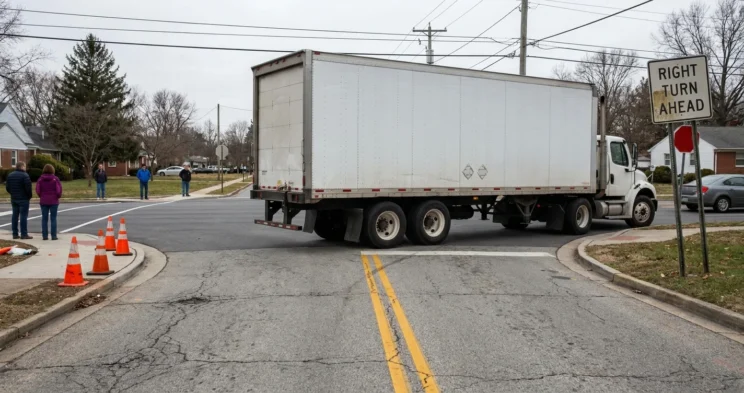
You were stopped in the right lane at a Dallas intersection when the tractor-trailer beside you drifted left, then turned right across the space your car was sitting in.
The reason for this is geometry. A loaded tractor-trailer cannot pivot around a corner the way a sedan does, because the trailer’s rear axles track several feet inside the path the tractor’s front wheels take.
That geometry is measurable and trained for. It does not lower the standard the truck driver owes you under Texas law.
Off-Tracking Forces the Trailer Off the Tractor’s Path
A truck swings wide because of low-speed off-tracking. In a turn, the rear trailer axles do not follow the steer axle, they cut a path several feet inside it.
The Federal Highway Administration defines off-tracking as “the distance between the path of the front inside wheel and the path of the rear inside wheel as a vehicle traverses a curve or turn,” in its Pilot/Escort Vehicle Operators Training Manual.
FHWA’s Western Uniformity Scenario Analysis describes the intersection version. In a 90-degree turn, “the wheels of the rearmost trailer axle follow a path several feet inside the path of the tractor steering axle.”
The same training manual states that once vehicle width plus off-tracking exceeds the travel lane width, the vehicle “will encroach into adjacent lanes, onto the shoulder, or run off the road during the turning maneuver.”
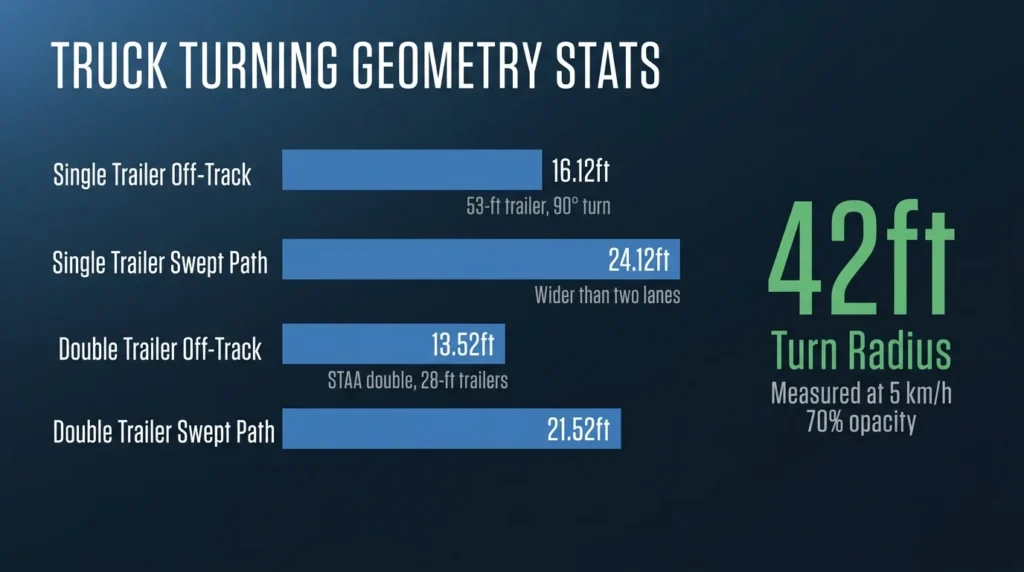
Swept path is the measurement that decides whether the trailer enters the lane beside it. It is the total ground width the combination covers through the turn, meaning off-tracking plus the vehicle’s own width.
FHWA measured both for a 90-degree turn on a 42-foot radius at 5 km/h:
- Single 53-foot trailer (3-S2): 16.12 feet of off-tracking, 24.12-foot swept path.
- STAA double, two 28-foot trailers (2-S1-2): 13.52 feet of off-tracking, 21.52-foot swept path.
A swept path near 24 feet is wider than two standard 12-foot lanes, and the longer single trailer sweeps more ground than the shorter doubles.
Those figures show scale, not a universal constant. A tighter radius produces more off-tracking, a wider radius less.
A truck wide right turn accident starts with that geometry, but it does not end there. Texas truck accident cases turn on how the driver handled a maneuver the whole industry knows is coming.
Tail Swing: The Rear of the Trailer Moves the Opposite Way
Off-tracking is only half the geometry. The trailer’s overhang behind the rear axles pivots outward, opposite the direction of the turn.
On a right turn, that opens two hazard zones at once:
- Off-tracking pulls the trailer’s wheels toward the curb side, into the right lane and sometimes over the curb.
- Tail swing pushes the trailer’s rear corner out toward the lane the tractor just left.
FHWA’s pilot and escort manual confirms that long combinations are “subject to trailer sway, tail swing, and rearward amplification,” and that an extremely long load may block at least two lanes on the roadway it is turning from while blocking at least two lanes on the roadway it is turning onto.
FHWA’s Signalized Intersections: Informational Guide adds that “[l]arge trucks and buses are more likely to off-track than passenger cars,” and that at right turns “the rear wheels of their vehicles may ride up over the curb or swing out into other lanes where traffic may be present.”
The car beside the truck and the car behind it are both exposed during the same maneuver. Because the effect is documented and trained for, the law treats a wide right turn as a maneuver the driver must plan, not an accident that simply happens.
Physics Explains the Swing, but Texas Law Sets the Duty
Size is not a license. A driver who needs extra room to finish a turn is still bound by the Texas rules of the road, plus a federal layer wherever that layer is stricter.
The Federal Rule: 49 CFR 392.2
Under 49 CFR 392.2, every commercial motor vehicle “must be operated in accordance with the laws, ordinances, and regulations of the jurisdiction in which it is being operated.” Where an FMCSA rule “imposes a higher standard of care,” that rule controls instead.
Federal licensing law names the exact hazard. 49 CFR 383.113(c)(5) requires a CDL holder to demonstrate the “[a]bility to position the motor vehicle correctly before and during a turn to prevent other vehicles from passing on the wrong side, as well as to prevent problems caused by off-tracking.”
Section 545.101, the Texas Turning Rule

Texas Transportation Code § 545.101(a) governs every right turn in the state: “To make a right turn at an intersection, an operator shall make both the approach and the turn as closely as practicable to the right-hand curb or edge of the roadway.”
Two phrases carry the weight. “As closely as practicable” accepts that some vehicles cannot hug the curb perfectly, and “both the approach and the turn” attaches the duty before the truck ever begins to pivot.
The statute anticipates off-tracking. It does not license a wide swing that ignores traffic already lawfully beside the truck.
One qualifier exists. Section 545.101(e) lets the Texas Transportation Commission or a local authority post an official traffic-control device requiring “a course different from that specified in this section,” and whether one exists is verifiable at the intersection itself.
Lane discipline reinforces the rule. Texas Transportation Code § 545.060(a) requires driving “as nearly as practical entirely within a single lane,” and bars moving from that lane “unless that movement can be made safely.”
Texas Has Adopted the Federal Motor Carrier Regulations
Carriers sometimes argue that a local Texas run sits outside the federal rules. Texas closed that gap itself.
Texas Transportation Code § 644.051 directs the Department of Public Safety to adopt rules consistent with the federal safety regulations, and 37 Tex. Admin. Code § 4.11(a) incorporates them by reference, including 49 CFR Parts 390 through 393 and 395 through 397.
The turn is federally trained content, not an unforeseeable event. 49 CFR Part 380, Appendix A makes Space Management, Visual Search, and Hazard Perception required Class A theory topics, and public road training covers “executing sharp left and right turns, centering the vehicle, maneuvering in restricted areas.”
When the Trailer Sweeps Into a Lawfully Occupied Right Lane

The squeeze play is the crash pattern that occurs when a trailer enters an occupied right lane, and it runs in a predictable sequence:
- The truck cannot finish the right turn from inside the right lane, so it takes a wide entry or drifts left first.
- A driver, motorcyclist, or cyclist is lawfully in the right lane, or reads the leftward drift as a left turn and stays beside the trailer.
- The tractor comes around and the trailer’s rear axles cut back to the right, across the space the smaller vehicle occupies.
- The smaller vehicle is pinned between the trailer and the curb, a signal pole, or another fixed object.
“Squeeze play” is trucking and CDL vernacular, not a statutory term. It does not need to be one, because 49 CFR 383.113(c)(5) already requires the driver to position the vehicle to prevent other traffic “from passing on the wrong side” and to prevent “problems caused by off-tracking.”
Driver education outside Texas puts the same point in plain terms. The New York State Driver’s Manual, which is general driver guidance rather than Texas law, tells motorists that “[b]ecause trucks make wide right turns, they move to the left before they turn right,” and warns them not to delay near a large vehicle where the driver may not be able to see them.
Put the two Texas statutes side by side. The motorist holding the right lane is doing what § 545.060(a)(1) requires, while the truck driver is making a movement that § 545.060(a)(2) permits only if it “can be made safely” and that § 545.101(a) requires be made as closely as practicable to the curb.
Expect the carrier to argue the smaller vehicle should never have been alongside. Under Texas Civil Practice & Remedies Code § 33.001, “a claimant may not recover damages if his percentage of responsibility is greater than 50 percent,” which makes the fault split, rather than the fact of contact, the real battleground.
That fight is where “I never saw the car” gets tested. 49 CFR 393.80 requires two outside rear-vision mirrors, one on each side, giving the driver a view of the highway to the rear along both sides of the vehicle.
A trailer sweeping across an occupied lane leaves the smaller vehicle nowhere to go. Injuries to the occupants of the passenger vehicle in the right lane can be serious, and some of these collisions become wrongful death claims.
Texas Civil Practice and Remedies Code § 16.003 generally allows two years for personal injury and two years for wrongful death, accruing on the date of death. Two years sounds generous, but the evidence that decides these cases is gone long before then.
Proving the Claim With Swept-Path Reconstruction, Intersection Geometry, and Video
These cases are won on measurable facts, and some of those measurements are on a clock. Three kinds of proof carry a Texas truck accident case built on a wide right turn: the swept path, the intersection, and the video.
Swept-Path Reconstruction
Swept-path analysis calculates the space a vehicle needs to complete a turning maneuver. Transoft Solutions, the vendor behind the widely used AutoTurn package, publishes a plain-language definition of swept path analysis, which is an industry explainer rather than legal authority.
Texas highway engineers rely on the method already. The TxDOT Roadway Design Manual states that “[v]ehicle swept path analysis software (e.g., AutoTurn or similar software) can also be used to analyze turning movements through intersections.”
After a crash, the same software runs in reverse. Feed in the tractor and trailer dimensions plus the actual intersection geometry, and it shows the path the combination genuinely needed and whether sweeping into an occupied lane was avoidable.
The Intersection Itself
Intersection geometry is fixed and documentable, and TxDOT’s guidance shows how much room a large design vehicle takes. Accommodating the longest vehicles “results in a wide pavement area,” and “a radius of 100-ft without channelizing island would be necessary to accommodate the wide, off-tracking path of a WB-62 without undesirable encroachment.”
The site facts worth measuring are concrete: curb radius, lane widths, receiving-lane width, channelizing islands, signal and pole locations, and any traffic-control device prescribing a different turning course under § 545.101(e).
Video, and the Clock on It
Peer-reviewed forensic engineering supports using intersection and dashcam footage quantitatively. Writing in the Journal of the National Academy of Forensic Engineers, Ziernicki, Pierce, and
Leiloglou note that surveillance video is “usually evidenced by low frame rate, low resolution, and significant lens distortion,” then show the fix: warp the image with a reverse distortion to correct it, then use photogrammetry to measure and build a time-space analysis of the vehicles.
Retention floors are short. 49 CFR 395.8(k) requires a carrier to keep records of duty status and supporting documents “for a period of not less than 6 months from the date of receipt,” and 49 CFR Part 379, Appendix A sets similarly short schedules for other carrier records. Private and municipal cameras typically overwrite far sooner.
Waiting for a judge to fix a hole in the record is not a plan. In Brookshire Bros., Ltd. v. Aldridge, 438 S.W.3d 9 (Tex. 2014), the Texas Supreme Court held that spoliation is a two-step judicial process requiring a duty to reasonably preserve evidence and an intentional or negligent breach of that duty.
The Court also held that a spoliation instruction is “warranted only when the trial court finds that the spoliating party acted with the specific intent of concealing discoverable evidence, and that a less severe remedy would be insufficient to reduce the prejudice.” In practice, a jury will usually never be told the video vanished.
So the footage has to be demanded before it is overwritten. The evidence worth preserving includes:
- Electronic logging device and hours-of-service records with their supporting documents
- Onboard and forward-facing camera video from the truck
- Intersection, traffic, and nearby business camera footage
- The truck’s dimensions and trailer configuration, which drive the swept-path model
- Mirror configuration and adjustment
- A scene survey of curb radius, lane widths, and traffic-control devices
- The Texas peace officer’s crash report
- Curb scrub, tire marks, and the height and geometry of damage on the smaller vehicle
Talk to a Lawyer Before the Evidence Is Gone
The geometry of a corner can be reconstructed months later. The video usually cannot.
Hours-of-service records sit behind a six-month federal retention floor, and camera systems overwrite well before that. The value of an early call is preservation, not pressure.
If you were lawfully in the right lane when a trailer swept across it, you are not the party who broke the rule. The fault split will still be contested, so your account should be documented while it can be corroborated.
Angel Reyes & Associates has guided injured Texans through the legal process for over 30 years, and the team includes investigators and accident reconstruction specialists.
Request a free consultation to review your options and get preservation letters moving.
Past results do not guarantee future outcomes.
Truck Wide Right Turn Swing FAQs
If a truck signals a right turn but moves left first, who has the right of way in the right lane?
Texas law puts the duty on the vehicle that is changing position, not on the one already holding its lane. Texas Transportation Code § 545.060(a) tells a driver to stay “as nearly as practical entirely within a single lane,” and it bars an operator from moving “from the lane unless that movement can be made safely.” The truck is the vehicle moving. Federal licensing law expects the truck driver to manage that exact situation.
Does it matter whether the truck was on an interstate run or a local Texas-only delivery?
For the turning duty, no. 49 CFR 392.2 says every commercial motor vehicle “must be operated in accordance with the laws, ordinances, and regulations of the jurisdiction in which it is being operated,” with the federal rule controlling only where it sets a higher standard of care. A truck making a right turn in Texas is bound by the Texas turning statutes either way.
How long do I have to file a truck accident claim in Texas, and why does that not mean I can wait?
The deadline for filing suit, not the deadline for the proof, because the evidence runs out first. 49 CFR 395.8(k) obligates a carrier to keep records of duty status and supporting documents only “for a period of not less than 6 months from the date of receipt,” and camera systems routinely overwrite much sooner.
About the Authors

Angel Reyes
Writer
Angel L. Reyes, III is the Founder and Managing Partner of Angel Reyes & Associates. A nationally recognized trial attorney and business leader, Angel founded the firm in 1993, which has gone on to help over 70,000 injury victims recover more than $1 billion. Named to the Texas Super Lawyers list annually since 2008, Angel brings Wall Street experience, Ivy League education, and a deep commitment to client advocacy. He is a frequent legal commentator and published author with extensive contributions to legal scholarship, trial strategy, and consumer protection.

Kyle Nicolas
Editor
Kyle Nicolas is the Web Content & SEO Manager at Angel Reyes & Associates. He has more than 10 years of experience as a marketing co...

Angel Reyes
Reviewer
Angel L. Reyes, III is the Founder and Managing Partner of Angel Reyes & Associates. A nationally recognized trial attorney and business...