Can a Truck Blind You With Road Spray?


Every article on this site is researched by our internal team, reviewed for legal accuracy against current Texas law, and held to State Bar of Texas advertising standards before publication. We do not publish content that overstates outcomes or makes promises about results.
Learn more about our
editorial standards .
Key Takeaways
- Texas law, not federal law, sets the splash guard rule for trucks on Texas roads.
- A guard must hang within eight inches of the road and match the tire's width.
- Truck defect reports are kept only three months, so act before proof is gone.
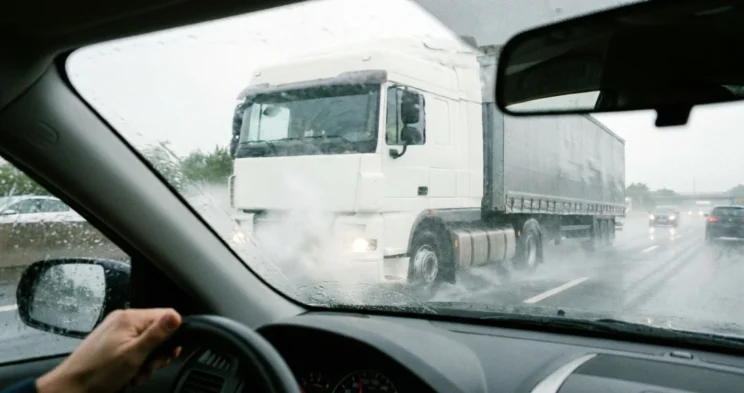
You are behind a loaded 18-wheeler on I-35 in a hard rain, and the road vanishes. The trailer tires throw a sheet of water across your windshield, the wipers cannot move it, and for a few seconds you are traveling at highway speed with no forward vision at all.
Texas treats that as an equipment and driving problem rather than as unavoidable weather, and the state rule on truck splash guards says so in its own words.
A Truck Can Take Your Vision Away With Road Spray
The Texas Department of Public Safety standard for safety guards, 37 Tex. Admin. Code Sec. 21.4, requires them to be built so that slush, mud, gravel, and other roadway material is not transmitted from a truck’s rear wheels to the windshield of the following vehicle.
The mechanism is plain. The rearmost tires of a loaded rig lift standing water off the pavement and fling it upward and rearward at speed, and a compliant guard sits in that trajectory to intercept it.
When the guard is missing, too narrow, hung too high, shredded, or tied back, the water goes exactly where the guard was supposed to be. Trailer side skirts and fairings affect the sideways plume that washes over a passing car, though no spray control requirement for skirts or fairings appears in the Texas equipment rules or the federal motor carrier regulations.
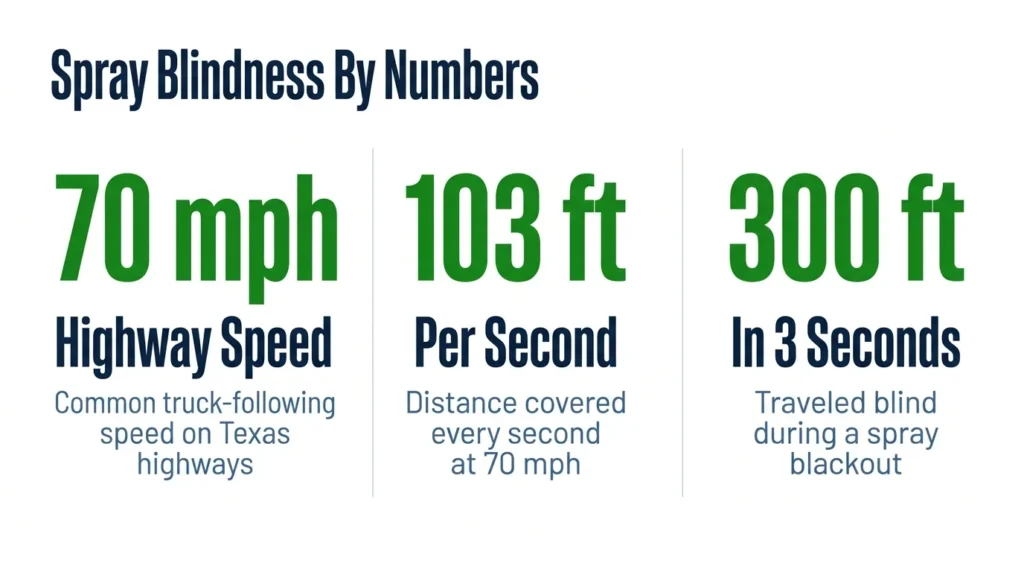
A few seconds of that is not a small thing. At 70 mph a vehicle covers roughly 103 feet every second, so three seconds behind a blanked windshield is about 300 feet traveled with nothing usable ahead of you.
The Federal Highway Administration’s low visibility guidance makes the broader point. Heavy precipitation cuts visibility distance, and low visibility widens the speed differences between drivers, which raises crash risk.
If a truck’s spray took your vision away, truck accident attorneys look at that through the equipment on the rig and the way it was being driven.
Texas Truck Splash Guard Requirements, and What a Compliant Setup Has to Do
The enforceable splash guard specification for a truck on a Texas road comes from state law, not federal law. Texas Transportation Code Sec. 547.606 requires safety guards or flaps on a road tractor, truck, trailer, truck-tractor in combination with a semitrailer, or semitrailer in combination with a towing vehicle when the rearmost axle carries at least four tires or at least two super single tires.
The guards must be of a type prescribed by the department and suspended behind the rearmost wheels within 8 inches of the highway surface. The statute does not apply to a truck-tractor operated alone or to a pole trailer. Subsection (c) defines a super single tire as a wide-base single tire that may be used in place of two standard tires on the same axle.
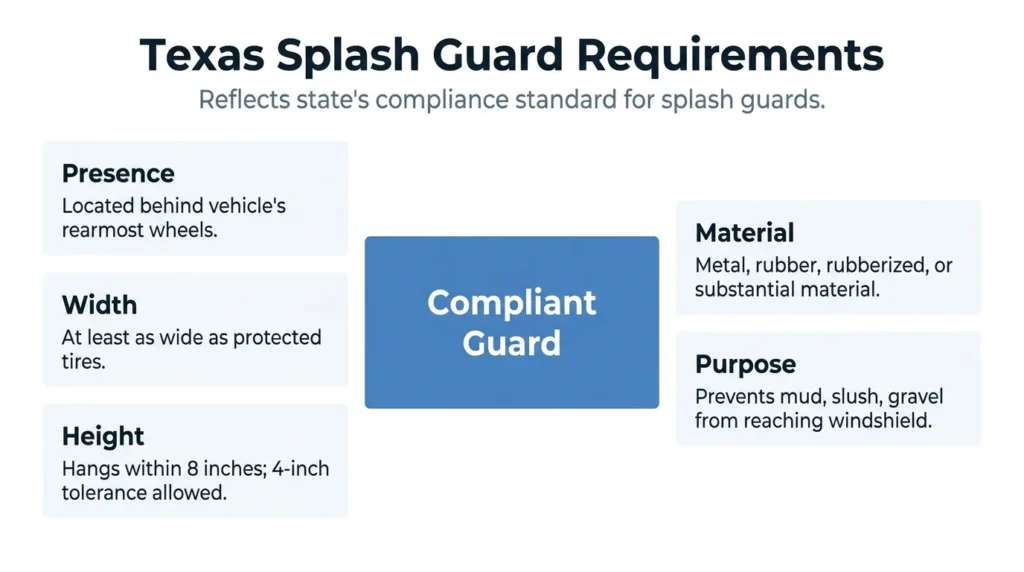
37 Texas Administration Code Sec. 21.4 supplies the department standard the statute points to. A compliant guard must:
- Be present behind the rearmost wheels of the vehicle or combination
- Be at least as wide as the tires it protects
- Hang within 8 inches of the roadway surface, with a 4-inch tolerance allowed
- Sit no more than 12 inches from the roadway at its bottom edge while the vehicle is standing still
- Be made of metal, rubber, rubberized material, or other substantial material
- Stay in place behind the rear wheels by its own weight or structure while the vehicle is operated
- Be free to swing upward and backward in motion, so long as it still blocks the trajectory of the debris
- Be constructed to prevent slush, mud, gravel, and other roadway material from reaching the following vehicle’s windshield
That last item is the purpose of the rule, stated in the same breath as the specification. It exists to keep what the tires pick up off the glass in front of the driver behind.
The practical value is that the standard can be applied to a photograph. A guard either exists behind the rearmost wheels or it does not, either matches the tire’s width or it does not, and either clears the 8-inch and 12-inch figures or it does not.
Condition and mounting matter just as much. Substantial material that is split or shredded blocks nothing, and a flap that is bolted up, zip tied, folded, or chained back has been pulled out of the debris path by the people responsible for maintaining it.
Texas backs the requirement with real exposure. Texas Transportation Code Sec. 547.004 makes it a misdemeanor to operate a vehicle that is unsafe, not properly equipped, or equipped in a prohibited manner, and it reaches an owner who knowingly permits someone else to operate one.
Subsection (c) lets a court dismiss that charge if the defect is fixed before the first court appearance and a small reimbursement fee is paid, but subsection (d) removes that path for commercial motor vehicle offenses. A trucking company cannot repair its way out of a splash guard citation the way a passenger car owner can.
If the crash happened on I-35E, LBJ Freeway, or another road around Dallas, working with a Dallas truck accident is strongly recommended.
The Federal Rules That Actually Apply, and the One That Does Not
Federal law sets no mud flap specification. 49 CFR Part 393 contains no splash guard, mud flap, or spray suppression section, and the provision most often miscited for one, 49 CFR 393.86, is the rear impact and underride guard rule that never mentions mud flaps. Pages quoting a federal ground clearance, deflection angle, or material spec for flaps are incorrect.
What the federal rules do supply are maintenance duties and driving duties.
49 CFR 396.3 requires every motor carrier to systematically inspect, repair, and maintain its vehicles and to keep parts and accessories in safe and proper operating condition at all times. Subsection (a)(1) reaches parts affecting safety of operation beyond those specified in Part 393, which is how an unlisted splash guard still becomes a federal maintenance duty.
49 CFR 396.11 requires a driver to report any defect that would affect safe operation, and it requires the carrier or its agent to certify the repair before the vehicle returns to service.
The strongest federal sentence for a rain case is 49 CFR 392.14. Extreme caution must be exercised when conditions such as rain, mist, or fog adversely affect visibility or traction, speed must be reduced when those conditions exist, and operation must be discontinued if conditions become sufficiently dangerous.
Texas imposes a parallel duty on every operator. Texas Transportation Code Sec. 545.351 prohibits a speed greater than is reasonable and prudent under the circumstances then existing, and subsection (c)(5) requires reduced speed when a special hazard exists with respect to weather or highway conditions.
These federal duties reach past interstate carriers. Through 37 Texas Administration Code Sec. 4.11, Texas DPS incorporates 49 CFR Parts 390 through 393 and 395 through 397 by reference and applies them to specified intrastate operations, including intrastate vehicles over 26,000 pounds actual or rated gross weight. The reach is broad without being universal, so which duties bind the truck that hit you belongs in an early case review.
How a Spray Blindness Case Is Built, and Where It Is Honestly Limited
A spray blindness case usually rests on two theories that stand independently of each other.
The equipment theory is that the carrier or owner put a rig on a wet Texas highway without guards meeting Sec. 547.606 and 37 TAC Sec. 21.4, and without satisfying the 49 CFR 396.3 duty to keep safety related parts in proper operating condition. A splash guard violation is a violation of Texas traffic law and evidence of negligence.
The operation theory is that the driver failed to reduce speed for rain as Sec. 545.351 and 49 CFR 392.14 require. A rig with legal flaps can still throw an unreasonable plume if it holds 70 mph through a downpour.
Being straight about the limit keeps a case defensible. The equipment rule establishes that a non-compliant guard allowed to spray a compliant one was designed to intercept. Whether a compliant guard would have prevented this particular blinding, in this rain, at this speed, is a factual question that accident reconstruction and human factors analysis resolve.
The research supports that caution. In an October 2003 study for the AAA Foundation for Traffic Safety, Manser, Koppa, and Mousley tested add-on spray suppression devices on tractor-trailers that already carried baseline equipment, finding a slight reduction on an older truck at lower speeds, no benefit at higher speeds, and no significant reduction on a newer aerodynamic tractor at any speed tested.
That finding concerns bolt-on devices layered over existing equipment. It says nothing about a rig running with no guard, a shredded guard, or a guard hung a foot and a half off the pavement.
Such add-ons are permitted under 49 CFR 393.3 so long as they do not decrease safety, but nothing requires them, and nothing in the testing suggests correct equipment makes heavy truck spray harmless in a hard rain.
Expect a counterargument. The defense will say you were following too closely, moving too fast for conditions, or should never have started the pass. Sec. 545.351 applies to every operator, so the standard cuts in both directions, and the answer to it is proof: the rule, the hardware, and the weather record.
The Evidence That Disappears First
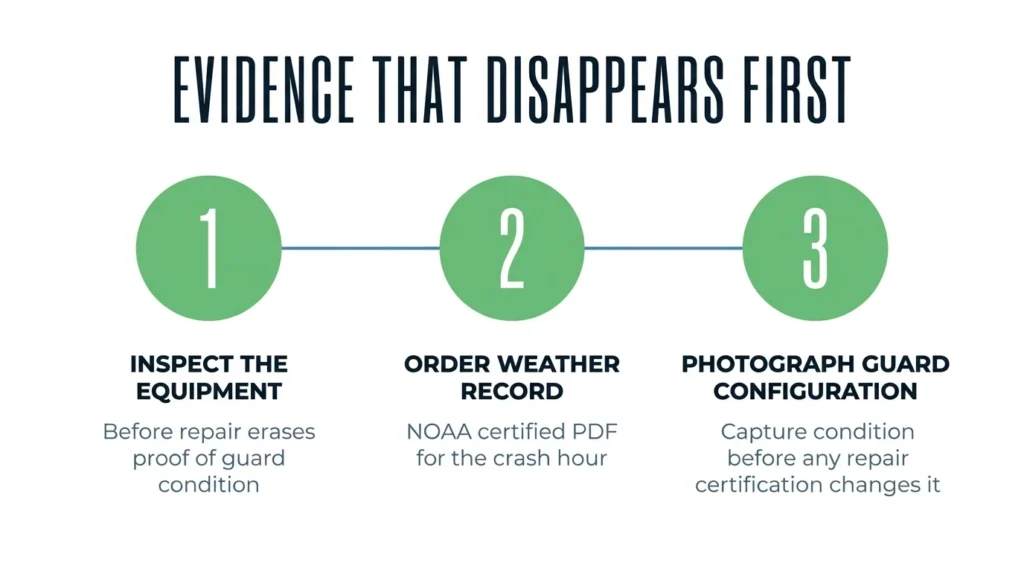
Three categories of proof decide these cases, and the first starts vanishing within days:
1. Inspect the equipment before it is repaired. The urgency is written into the regulations. 49 CFR 396.11 requires the carrier or its agent to certify that a reported defect was repaired before the vehicle operates again, so the carrier’s own lawful maintenance process erases the physical proof. A torn flap gets replaced, a missing flap gets installed, and a bent bracket gets straightened.
The inspection needs the presence, width, material, mounting height at rest, and free hang of each guard behind the rearmost wheels, plus the condition of any anti-sail brackets or straps. Photographs taken against a measuring reference show the 8-inch and twelve inch figures in 37 TAC Sec. 21.4 be evaluated rather than estimated.
The paperwork sits on a short clock. Driver vehicle inspection reports and matching repair certifications under 49 CFR 396.11 are retained three months, while systematic maintenance records under 49 CFR 396.3(b) are kept one year where the vehicle is housed or maintained, plus six months after it leaves the carrier’s control.
2. Order the weather record for the crash hour. NOAA’s National Centers for Environmental Information publishes Local Climatological Data, including hourly observations and hourly and short duration precipitation by station and date range. NCEI can certify only PDF summaries, so the certified PDF is the version to order for an authenticated exhibit.
That record establishes that measurable rain was falling when the crash happened, how hard, and for how long. It supports both the spray mechanism and the argument that the driver was on notice of a rain hazard under 49 CFR 392.14 and Sec. 545.351(c)(5).
3. Photograph the guard configuration at the scene. These photographs are the only practical way to show the equipment’s condition at the time of the crash, because they capture it before any repair certification changes it.
Tie each image to the rule. Show whether a guard exists behind the rearmost wheels, whether it is as wide as the tire, how far the bottom edge sits above the pavement at rest, what the material is and whether it is intact, and whether the guard hangs free or is secured up out of the debris path.
Supporting images carry the same story. Standing water and drainage at the scene, spray patterns and water lines on the trailer and the involved vehicles, and the condition of your own windshield and wipers all corroborate what happened.
Preservation is practical work. Send the preservation letter early, inspect before repair, and request the maintenance file while it still exists. Texas sets a deadline for filing a lawsuit, and the proof in a spray case disappears long before that deadline runs.
Talk to Angel Reyes & Associates About Your Truck Spray Crash
If a truck’s road spray blinded you before a crash, the proof starts disappearing right away. The guard gets repaired and certified back into service, the driver vehicle inspection reports are retained for only three months, and the certified weather record has to be ordered from NCEI.
Angel Reyes & Associates has guided injured Texans through situations like this for over 30 years, with offices across the state and attorneys who work truck cases from the equipment up.
Consultations are free, the team is available 24/7, and we serve clients in Spanish.
Contact Angel Reyes & Associates for a free consultation, and bring whatever you already have: the crash report, the date and hour, and any photograph of the truck. Every case is different, and the sooner someone looks at yours, the more of the proof is still there to find.
Past results do not guarantee future outcomes.
Truck Road Spray FAQs
Do the Texas splash guard rules apply to a truck-tractor driving without a trailer?
No. Texas Transportation Code Sec. 547.606(b) states that the safety guard and flap requirement does not apply to a truck-tractor operated alone, and it also excludes a pole trailer. A bobtail tractor running in rain is outside that particular equipment rule.
What are super single tires, and do they change the splash guard requirement?
Super singles do not remove the requirement. Under Texas Transportation Code Sec. 547.606(a), safety guards or flaps are required when the rearmost axle carries at least four tires or at least two super single tires, and 37 Texas Administration Code Sec. 21.4 applies the same standard on either configuration. Subsection (c) defines a super single tire as a wide-base single tire that may be used in place of two standard tires on the same axle.
Are trailer side skirts or aerodynamic fairings required in Texas for spray control?
No spray control requirement for side skirts or fairings appears in either the Texas equipment rules or the federal motor carrier regulations. Texas Transportation Code Sec. 547.606 and 37 Texas Administration Code Sec. 21.4 addresses safety guards or flaps behind the rearmost wheels, not skirts along the trailer’s length. Skirts and fairings do affect the sideways plume that washes over a vehicle alongside the trailer, so their presence or absence can matter to how a crash happened.
Does it matter whether I was following the truck or passing alongside it?
Both positions can leave a driver blinded, but they do not line up with the equipment rule in the same way. The purpose language in 37 Texas Administration Code Sec. 21.4 speaks specifically about keeping slush, mud, gravel, and other roadway material from being transmitted from the rear wheels to the windshield of the following vehicle, so a following driver’s account maps most directly onto that standard.
Who is responsible for a splash guard violation, the driver or the trucking company?
Both can be. Texas Transportation Code Sec. 547.004 makes it a misdemeanor to operate a vehicle that is unsafe, not properly equipped, or equipped in a prohibited manner, and it also reaches an owner who knowingly permits another person to operate one. Subsection (d) removes the repair-and-dismiss path available in subsection (c) when the offense involves a commercial motor vehicle.
About the Authors

Angel Reyes
Writer
Angel L. Reyes, III is the Founder and Managing Partner of Angel Reyes & Associates. A nationally recognized trial attorney and business leader, Angel has helped over 70,000 injury victims recover more than $1 billion since founding the firm in 1993. Named to the Texas Super Lawyers list annually since 2008, Angel brings Wall Street experience, Ivy League education, and a deep commitment to client advocacy. He is a frequent legal commentator and published author with extensive contributions to legal scholarship, trial strategy, and consumer protection.

Kyle Nicolas
Editor
Kyle Nicolas is the Web Content & SEO Manager at Angel Reyes & Associates. He has more than 10 years of experience as a marketing co...

Angel Reyes
Reviewer
Angel L. Reyes, III is the Founder and Managing Partner of Angel Reyes & Associates. A nationally recognized trial attorney and business...