How Do You Look Up a Trucking Company’s Safety Record?


Every article on this site is researched by our internal team, reviewed for legal accuracy against current Texas law, and held to State Bar of Texas advertising standards before publication. We do not publish content that overstates outcomes or makes promises about results.
Learn more about our
editorial standards .
Key Takeaways
- Start with the carrier's USDOT number in SAFER, then open SMS for violation detail.
- A blank safety rating means FMCSA never reviewed the carrier, not that it passed.
- Texas-only carriers can look empty in FMCSA data, so check TxDMV Texas Truck Stop.
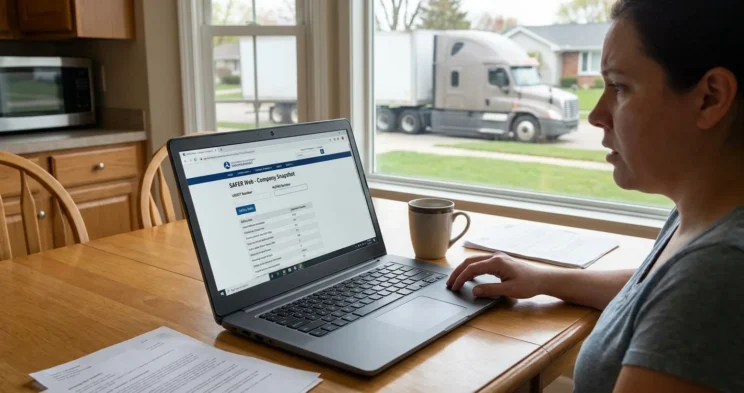
You can look up a trucking company’s safety record yourself for free using the carrier’s USDOT number. The Federal Motor Carrier Safety Administration publishes inspection, violation, crash, and insurance data in four public systems, and none of the free ones requires a login or a records request.
If an 18-wheeler ran you off I-35, the crash report may give you a company name and a USDOT number you have never seen before. That number gives you a place to begin your search.
Start With the Carrier’s USDOT Number in the SAFER Company Snapshot
Every FMCSA carrier lookup starts in the same place. The SAFER Company Snapshot search accepts the DOT Number, MC/MX Number, or Company Name.
Use the USDOT number when you have it. A company-name search returns near matches, and the gap between a carrier’s legal name and its DBA trips up more searches than any other input error.
FMCSA operates SAFER as a free platform that provides commercial motor carrier safety data to the public and industry. Its Company Snapshot shows a carrier’s identification, size, commodity information, safety rating (if any), roadside inspection summary, and crash information.
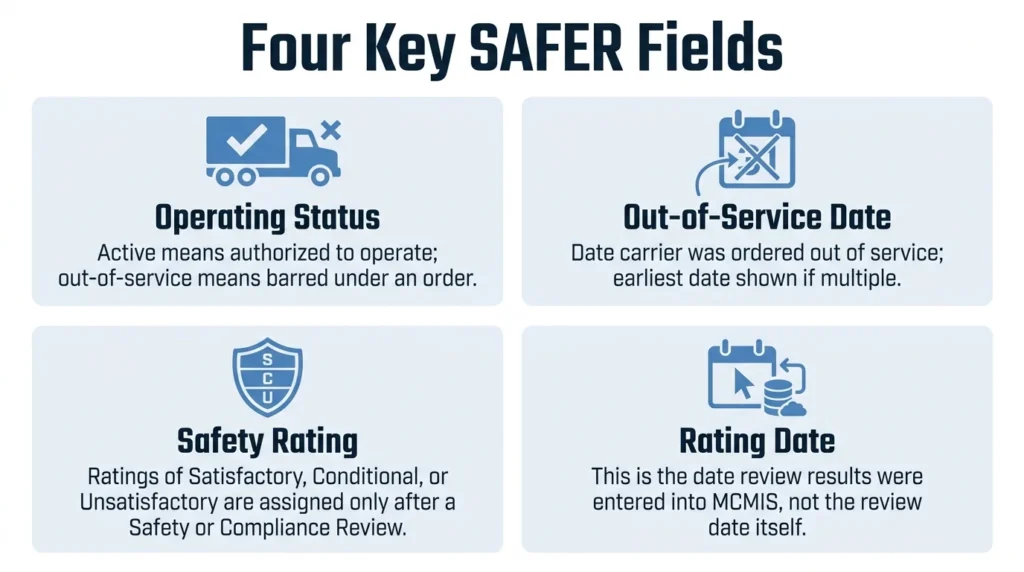
Four fields on that page carry most of the weight, and SAFER’s own help text defines each one:
- Operating Status. ACTIVE means the entity’s USDOT number is active. OUT-OF-SERVICE means the carrier is under an out-of-service order and is not authorized to operate.
- Out of Service Date. The date the company was ordered out of service. Where there are multiple orders, the field shows the earliest date.
- Carrier Safety Rating. Assigned only through a Safety Review or Compliance Review. The three possible ratings are Satisfactory, Conditional, and Unsatisfactory.
- Rating Date. The date the Safety or Compliance Review was input into MCMIS. This is the staleness cue on the page, because a rating describes the carrier as it was on that date.
A carrier’s safety record is only one part of evaluating a Texas truck accident claim, along with evidence about the driver, vehicle, trucking company, and crash itself.
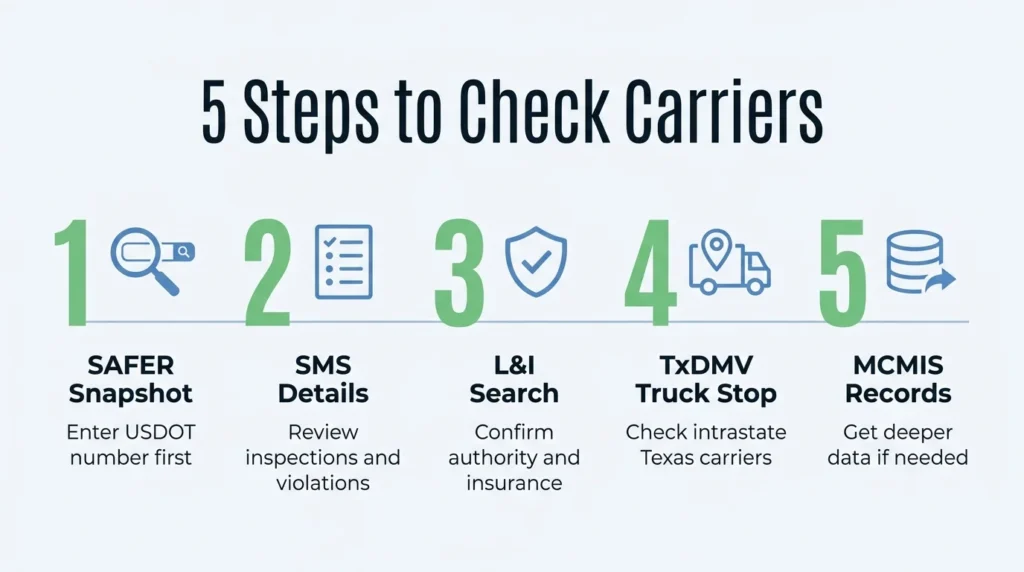
Open the Safety Measurement System for the Inspection & Violation Detail
The Safety Measurement System provides access to inspections and violations, searchable by carrier name or U.S. DOT number.
SMS evaluates 24 months of performance data drawn from roadside inspections, violations, and state-reported crashes, and it updates monthly. Violations are sorted into seven BASICs, short for Behavior Analysis and Safety Improvement Categories:
- Unsafe Driving
- Hours-of-Service Compliance
- Driver Fitness
- Controlled Substances/Alcohol
- Vehicle Maintenance
- Hazardous Materials Compliance (not publicly displayed for property carriers)
- Crash Indicator (not publicly displayed for property carriers)
Each public BASIC score carries a percentile rank from 0 to 100, with lower scores indicating better performance. The SMS Help Center explains that FMCSA compares a carrier with others in the same safety event group, which includes carriers with similar operations and event frequency.
The percentile measures the carrier’s performance relative to its peers. An 80th-percentile Vehicle Maintenance result means the carrier performed worse than most comparable carriers in that category. It does not mean the carrier is “80 percent unsafe.”
Recency also affects the result. FMCSA’s SMS fact sheet confirms that recent violations are weighted more heavily than older ones.
A prioritization symbol beside a BASIC means FMCSA may prioritize the carrier for further monitoring, triggered by exceeding an Intervention Threshold or by acute or critical violations found during a recent investigation. It is not a safety rating.
FMCSA cautions users against drawing conclusions about a carrier’s overall safety condition from SMS data alone unless the carrier has an Unsatisfactory safety rating. Official safety ratings appear in SAFER.
Confirm Authority & Insurance in Licensing & Insurance, Then Check Texas Separately
The Licensing and Insurance public carrier search is where you confirm that a carrier holds operating authority and has financial responsibility filings on file. FMCSA describes L&I as covering interstate for-hire carriers that have been granted authority or have applications pending.
Search by USDOT Number or Docket Number alone, or by Legal Name or DBA Name plus State. The search always looks for a legal or DBA name beginning with the text you enter, and new applications do not appear in results for 24 hours after filing.
The screen shows the carrier’s authority status and filings submitted to FMCSA. Those filings can help identify the commercial policy limits available after a Texas truck accident, although the screen may not disclose every policy or coverage layer.
Carriers must maintain continuous financial responsibility to keep their operating authority. Gaps in the authority history, revocations, or a pending status may indicate that the carrier lacked active authority during a particular period.
What the Federal Screens Miss for a Texas-Only Carrier
SAFER states that operational data such as inspections and crashes is generally presented only for interstate carriers, and that SAFER consists of interstate carrier data plus several states’ intrastate data.
A hauler that never crosses state lines may have little or no information in an FMCSA carrier lookup for reasons unrelated to its safety practices. A sparse record should therefore be treated as incomplete rather than evidence of a clean safety history.
Checking a Texas Intrastate Carrier Through TxDMV Texas Truck Stop
Carriers operating intrastate commercial motor vehicles in Texas must register with the TxDMV Motor Carrier Division and hold a TxDMV Number, formerly called a TxDOT number.
The state lookup is the TxDMV Motor Carrier Lookup, known as Texas Truck Stop. It answers the question of whether a motor carrier business is properly licensed in Texas.
Run the USDOT number in SAFER first, and if the carrier is intrastate-only or the SAFER record comes back sparse, go to Texas Truck Stop for the TxDMV certificate and insurance filing status.
Go to MCMIS When the Free Screens Are Not Enough
MCMIS is the system of record underneath SAFER, SMS, and L&I. FMCSA describes it as containing information on the safety fitness of commercial motor carriers, truck and bus carriers, and hazardous materials shippers subject to the Federal Motor Carrier Safety Regulations and the Hazardous Materials Regulations.
Two options provide more information than the free screens:
- Company Safety Profile. A $20.00 fee, returned to the requester’s email address within 72 hours, and available to any individual or company. It contains safety-related information on an individual company’s operations, including selected items from inspection and crash reports, as well as the results of any reviews or enforcement actions.
- Analysis and Information Online. Free. It holds SMS, crash statistics with a crash query tool and a visualization tool, safety investigations, roadside inspections, traffic enforcement, data-quality reviews, registration statistics, and the Driver SMS. Datasets update monthly.
Treat all of it as a dated snapshot to which records are added and corrected over time. These figures reflect the data available at the time they were checked and may change with subsequent updates.
Reading What Comes Back
Each system provides a different piece of information. However, not one of them is a verdict.
What an Inspection History Tells You
SAFER shows inspection counts by type, how many resulted in an out-of-service status, the carrier’s out-of-service percentage, and a National Average row beneath it.
Raw counts can be misleading. A large fleet with hundreds of inspections and a low out-of-service percentage can look worse at a glance than a three-truck operation that has been inspected twice.
Read the percentage row against the national-average row on your own screen. This provides more useful context than the inspection count alone.
What a Violation Pattern Tells You
SMS sorts violations into seven behavior categories and ranks a carrier against similar peers over 24 months, making repetition the key metric to look for.
A cluster of brake and lighting violations in Vehicle Maintenance may reveal a recurring maintenance problem. Repeated logbook violations in Hours-of-Service Compliance may show a similar pattern. Recent entries deserve closer attention because FMCSA gives them more weight than older violations.
What a Crash Entry Does & Does Not Tell You
SAFER records each crash once and at its highest level of severity, and the crash data feeding SMS is state-reported. Neither one assigns fault.
FMCSA’s Crash Preventability Determination Program exists because reported crashes include ones the carrier did not cause. Crashes FMCSA determines to be Not Preventable stop affecting the carrier’s Crash Indicator measure and percentile, and appear instead in a separate table titled “Reviewed – Not Preventable Crashes.”
The program covers a defined list of eligible crash types, including struck in the rear, struck on the side at the rear, and struck on the side by a same-direction motorist.
What an Insurance Filing Tells You
An insurance filing shows the coverage reported to FMCSA. A carrier with a clean inspection history may still carry coverage near the minimum required by 49 CFR 387.9. That amount may be exhausted quickly when a crash causes a spinal injury or death.
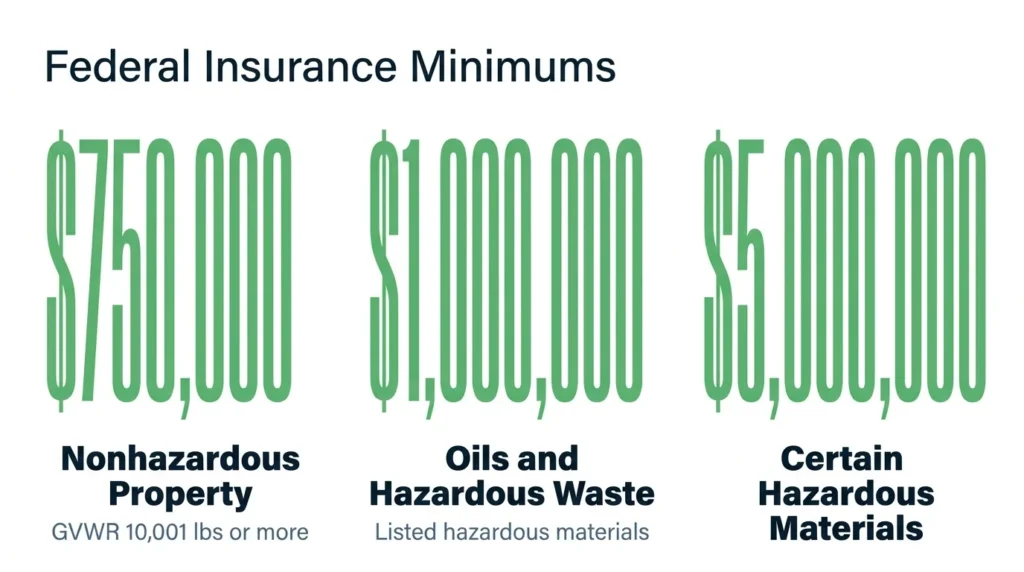
Available coverage can affect the compensation realistically available through a Texas truck accident claim.
Two cautions apply to every screen you pulled. A blank safety rating means FMCSA has not reviewed the carrier, not that the carrier passed, because ratings are issued only from a Safety Review or a Compliance Review.
DataQs lets motor carriers, drivers and their representatives, FMCSA and state partners, and the general public request and track a review of federal and state data believed to be incomplete or incorrect.
Talk to a Truck Accident Lawyer About What You Found
SAFER, SMS, L&I, and MCMIS hold public safety and compliance data. They do not hold the carrier’s own driver qualification file, maintenance records, dispatch logs, or electronic logging device data, and those internal records are usually what decides a serious case.
Angel Reyes & Associates has guided injured Texans through the legal process for over 30 years, serves clients across the state, and is available 24/7. Se habla español.
If the record you pulled raised questions you cannot answer from a public screen, bring it to a free consultation and have someone read it with you.
Every case is different, and past results do not guarantee future outcomes.
Trucking Company Safety Record FAQs
Can a trucking company change its name or USDOT information after a crash?
Yes. Motor carriers can update identifying information, so checking DBA names, prior names, addresses, and related identifiers may help determine whether records belong to the same operation.
How long does FMCSA keep trucking company safety data available?
Different FMCSA systems use different reporting periods, and some public safety measures focus on relatively recent activity rather than a carrier’s entire operating history. Older records may require additional research beyond the current public-facing safety screens.
Can a trucking company's safety violations be used as evidence in a Texas truck accident case?
Potentially, but prior violations do not by themselves prove negligence or fault in a particular crash. Their relevance depends on issues such as the type of violation, its timing, and whether it relates to the conduct alleged in the case.
What records can show whether a trucking company knew a driver was unsafe?
Driver qualification files, employment records, prior driving-history inquiries, drug and alcohol testing records, and certain internal safety documents may provide information that is not available through a public carrier lookup. Access to particular records depends on the circumstances and applicable law.
What should I do if I cannot find a trucking company using its name?
Try searching by the USDOT or MC number because legal names and DBA names can differ, and company-name searches can produce near matches. If the carrier operated only within Texas, its state registration information may also help identify the correct business.
About the Authors

Angel Reyes
Writer
Angel L. Reyes, III is the Founder and Managing Partner of Angel Reyes & Associates. A nationally recognized trial attorney and business leader, Angel has helped over 70,000 injury victims recover more than $1 billion since founding the firm in 1993. Named to the Texas Super Lawyers list annually since 2008, Angel brings Wall Street experience, Ivy League education, and a deep commitment to client advocacy. He is a frequent legal commentator and published author with extensive contributions to legal scholarship, trial strategy, and consumer protection.

Kyle Nicolas
Editor
Kyle Nicolas is the Web Content & SEO Manager at Angel Reyes & Associates. He has more than 10 years of experience as a marketing co...

Angel Reyes
Reviewer
Angel L. Reyes, III is the Founder and Managing Partner of Angel Reyes & Associates. A nationally recognized trial attorney and business...