Who Is Liable for a Box Truck Accident?


Every article on this site is researched by our internal team, reviewed for legal accuracy against current Texas law, and held to State Bar of Texas advertising standards before publication. We do not publish content that overstates outcomes or makes promises about results.
Learn more about our
editorial standards .
Key Takeaways
- A box truck under 26,001 pounds needs no CDL, but the company can still be liable.
- Photograph the GVWR plate before the truck is repaired, resold, or returned.
- Texas generally gives two years from the crash date to file an injury claim.
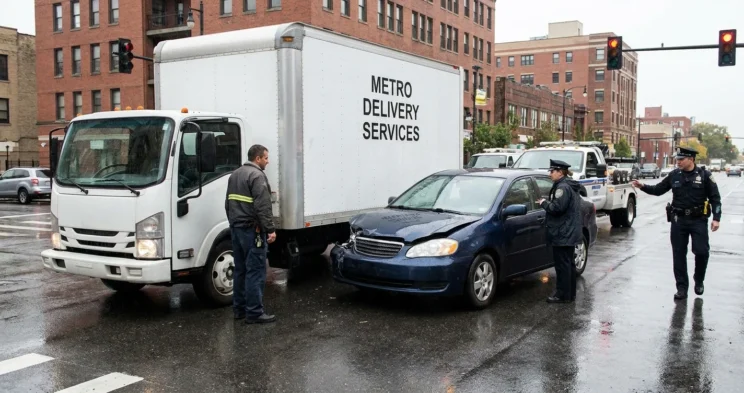
The truck that hit you had a company name on the door and a cargo box behind the cab. It wasn’t an 18-wheeler, and the driver may have told you he didn’t need a special license to drive it.
A truck accident claim looks at how each party contributed to the crash rather than relying on the truck’s classification alone.
What Counts as a Box Truck, & Which Rulebook Applies
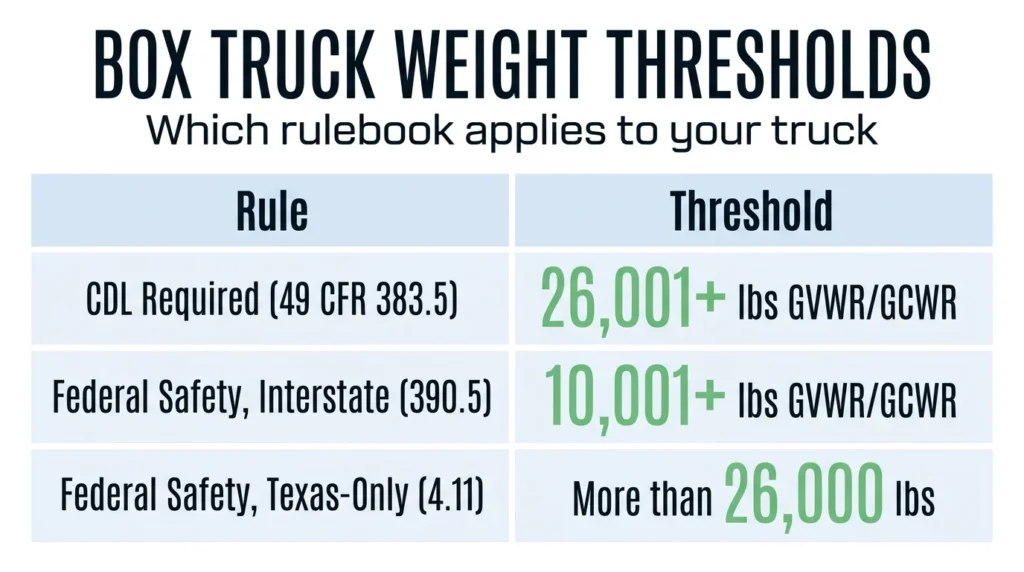
“Box truck” describes a body style. Texas and federal law classify these vehicles by weight rating and use.
This group includes straight trucks with the cab and cargo box on a single chassis, proper box trucks, cube vans on a van chassis, and refrigerated or flatbed straight trucks. Most delivery versions carry a hydraulic liftgate on the rear.
Separate weight thresholds may determine which rules apply to the truck involved in your crash.
- Commercial driver’s license required: a gross vehicle weight rating or gross combination weight rating of 26,001 pounds or more, under 49 CFR 383.5.
- Federal safety regulations, interstate trips: a gross vehicle weight rating or gross combination weight rating of 10,001 pounds or more, under 49 CFR 390.5.
- Federal safety regulations, Texas-only trips: more than 26,000 pounds actual or rated gross weight, under 37 Tex. Admin. Code Sec. 4.11.
A mid-size box truck hauling freight that starts or ends outside Texas can fall under the federal safety rulebook even though its driver needs no CDL. Whether one last-mile delivery leg counts as interstate commerce depends on where the goods were moving, so no bright-line rule applies.
Who Can Be Held Liable After a Box Truck Accident in Texas
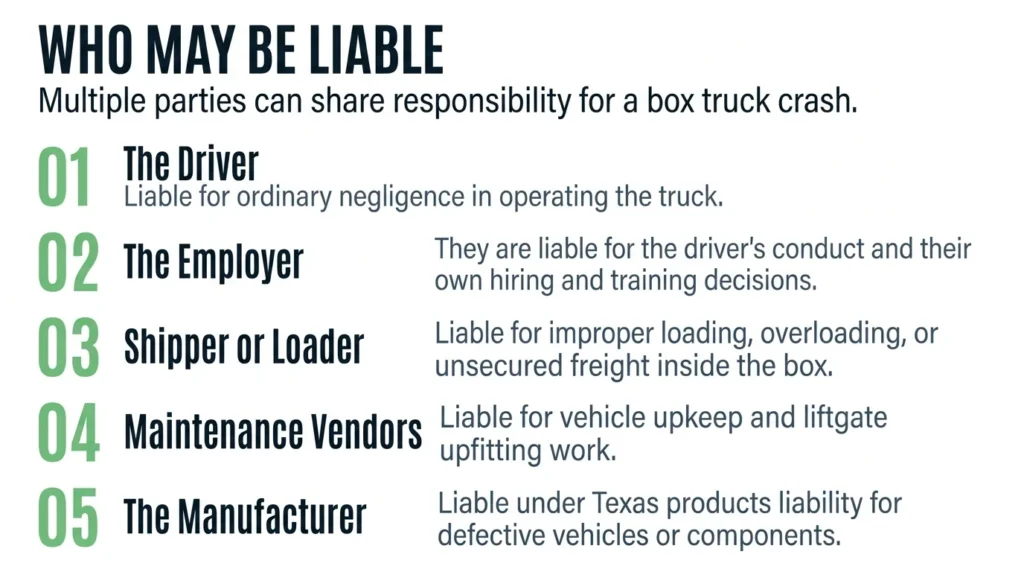
More than one party may be responsible for a box truck accident. Potentially liable parties include:
- The driver, for ordinary negligence.
- The employer, both for the driver’s conduct and for its own decisions.
- The shipper, warehouse, or loading crew, for improper loading, overloading past the truck’s rating, or unsecured freight inside the box.
- Maintenance vendors and the body or liftgate upfitter who worked on the vehicle.
- The vehicle or component manufacturer, under Texas products liability.
An employer is liable for a driver acting within the course and scope of employment, and that rule does not depend on the size of the truck. Chapter 72 of the Texas Civil Practice and Remedies Code defines a commercial motor vehicle without a weight threshold, covering any vehicle used commercially to transport property or passengers, or to provide a service, and excluding only personal, family, and household use. A delivery van rated well under 26,000 pounds falls squarely within that range.
The company can also be liable for its own actions. Negligent hiring, training, supervision, retention, entrustment, and maintenance are ordinary Texas common-law claims, and none of them require the defendant to be a federally regulated motor carrier.
When federal rules apply, they provide standards for evaluating the company’s conduct. 49 CFR 391.11 sets driver qualification requirements for minimum age, English language ability, medical certification, and a road test. 49 CFR 392.9 requires cargo inspection and securement. The cargo must be reinspected within the first 50 miles and after each change in duty status or every 3 hours or 150 miles, whichever comes first. Inspection records can help establish responsibility when shifting or unsecured cargo causes a truck accident.
The Graves Amendment & Rented Box Trucks
Box trucks are frequently rented, so the company name on the door may not identify the party responsible for the crash.
49 U.S.C. Sec. 30106, the Graves Amendment, bars vicarious liability against an owner in the business of renting or leasing motor vehicles when the owner committed no negligence or criminal wrongdoing. Suing a rental company purely because it owned the truck usually fails.
The rental company may still face claims based on its own conduct, including negligent maintenance or renting the truck to a driver who was obviously unfit. Subsection (b) also preserves state financial responsibility and insurance requirements.
The Delivery Truck Case, Where the Driver Never Needed a CDL
Many box truck crashes involve delivery vehicles that fall below the weight threshold for a commercial driver’s license.
A 26-foot box truck can be specified with a gross vehicle weight rating of 26,000 pounds or less and then driven by an employee holding the same Class C license most Texas adults already carry. Penske markets a whole rental category of 22 to 26 foot trucks at up to 26,000 pounds gross vehicle weight, explicitly as non-CDL equipment, with up to 10,000 pounds of payload.
Once a vehicle reaches the CDL threshold, 49 CFR 383.23(a) prohibits driving it without the required commercial license.
Below the line, none of that applies. A Class C license in a box truck driver’s wallet is not a violation when the truck is rated at 26,000 pounds or less. The absence of a CDL requirement does not absolve the company of responsibility for its own conduct.
The Evidence Used in a Box Truck Claim
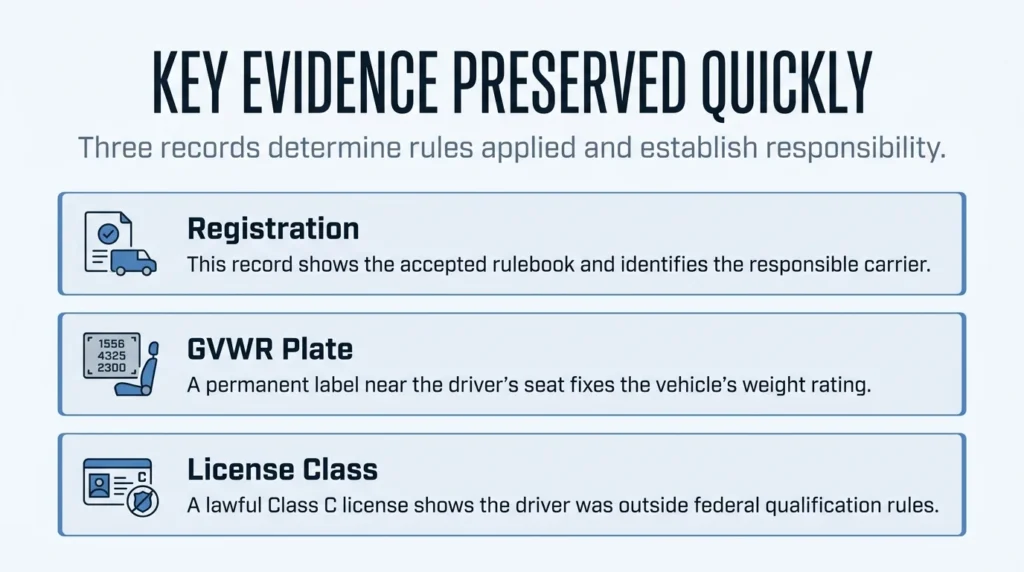
Three records can help determine which rules applied and who may be responsible for the crash. Preserve them quickly because a rented or leased truck may be repaired, resold, or returned to the fleet within days.
1. The registration. Whether the operator holds a USDOT number, federal operating authority, or a TxDMV motor carrier registration under Chapter 643 of the Transportation Code shows which rulebook the company itself accepted. It also identifies the responsible carrier when the box, the chassis, and the trade name on the door belong to three different entities.
2. The GVWR plate. 49 CFR 567.4 requires a permanent certification label, affixed so it cannot be removed without destroying or defacing it, on the hinge pillar, door-latch post, or door edge next to the driver’s seat. It states the gross vehicle weight rating, the gross axle weight ratings, the month and year of manufacture, the VIN, and the vehicle type. This one label determines the CDL question and, for a Texas-only run, also the federal safety question. Photograph it before the truck moves.
3. The license class held. A lawful Class C license is not a violation on the driver’s part.
You’ll also need several supporting records, and each has a short life:
- The weight ticket or bill of lading showing whether the truck was loaded past its rating.
- Loading dock and warehouse video.
- Liftgate maintenance and inspection records.
- Telematics or dashcam data held by a fleet vendor rather than the carrier.
- The driver’s timecard or dispatch record, which may be the only hours record that exists.
- The maintenance file and the rental or lease agreement.
A damaged truck can leave a yard off I-35 or LBJ Freeway within days. A Dallas truck accident lawyer can send a preservation letter before that happens.
How Much Insurance Sits Behind a Box Truck
For interstate operations at 10,001 pounds and up, 49 CFR 387.9 requires $750,000 for for-hire carriage of non-hazardous property, $1,000,000 for oil and certain hazardous materials, and $5,000,000 for bulk hazardous substances and specified division materials.
Texas intrastate carriers registered under Chapter 643 must maintain liability insurance in an amount set by TxDMV rule, per Sec. 643.101, implemented at 43 Tex. Admin. Code Sec. 218.16. Those state minimums are generally lower than the federal floor.
A box truck below both the CDL and registration thresholds may carry only a standard commercial auto policy. Identifying every potentially responsible party quickly can help uncover all available coverage sources.
Talk to a Box Truck Accident Lawyer
The registration, GVWR plate, and driver’s license class can help determine which rules apply and who may be responsible. A Texas truck accident claim may depend on preserving this evidence before the truck is repaired or returned to service.
Angel Reyes & Associates has guided injured Texans through crashes like this one for over 30 years, with offices across the state, board-certified personal injury attorneys on the team, and investigators who know what to request before a truck is repaired or returned. The initial consultation is free, and someone is available 24/7. Se habla español.
Request a free consultation and get a clear read on who may be responsible for your box truck crash.
Every case is different, and past results do not guarantee future outcomes.
Box Truck Liability FAQs
Does it matter if a private individual rented the box truck for a personal move instead of a company?
Yes. The Graves Amendment, 49 U.S.C. Sec. 30106, bars vicarious liability against an owner in the business of renting or leasing motor vehicles when that owner committed no negligence or criminal wrongdoing, so the rental brand on the side of the truck is rarely a defendant on ownership alone.
Can the company still be liable if the box truck driver was an independent contractor?
Often, yes. Sec. 72.051 defines “employee” to include a person who works for another for compensation and an agent whose conduct the principal is liable for under respondeat superior, so what matters is how the working relationship operated and whether the driver was acting within the course and scope of that relationship.
Who is responsible if a liftgate or falling cargo injures someone while the truck is parked at a loading dock?
It depends on who controlled the equipment and the load. These claims depend on the driver’s or crew’s ordinary negligence, the warehouse’s or property owner’s loading and premises duties, and product-defect theories against the liftgate or body manufacturer if the equipment itself failed. Maintenance and inspection records for the gate are usually central.
About the Authors

Angel Reyes
Writer
Angel L. Reyes, III is the Founder and Managing Partner of Angel Reyes & Associates. A nationally recognized trial attorney and business leader, Angel has helped over 70,000 injury victims recover more than $1 billion since founding the firm in 1993. Named to the Texas Super Lawyers list annually since 2008, Angel brings Wall Street experience, Ivy League education, and a deep commitment to client advocacy. He is a frequent legal commentator and published author with extensive contributions to legal scholarship, trial strategy, and consumer protection.

Kyle Nicolas
Editor
Kyle Nicolas is the Web Content & SEO Manager at Angel Reyes & Associates. He has more than 10 years of experience as a marketing co...

Angel Reyes
Reviewer
Angel L. Reyes, III is the Founder and Managing Partner of Angel Reyes & Associates. A nationally recognized trial attorney and business...