Should You Go to the ER or Urgent Care After a Crash?


Every article on this site is researched by our internal team, reviewed for legal accuracy against current Texas law, and held to State Bar of Texas advertising standards before publication. We do not publish content that overstates outcomes or makes promises about results.
Learn more about our
editorial standards .
Key Takeaways
- The ER is the right default after a crash whenever any red flag or doubt exists.
- Most urgent care clinics have no on-site CT or MRI and refer serious imaging out.
- Insurers read your first treatment record as proof of how serious the injury was.
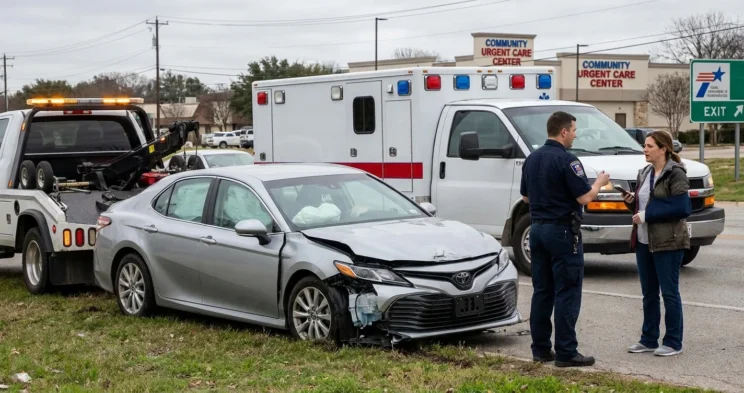
The wreck on I-35 is behind you, the tow truck is gone, and your neck is starting to tighten. The urgent care down the road has a shorter line than the hospital across town, but should you go to the emergency room?
After a car crash, the ER is the right choice any time the collision carries real force or your symptoms carry any red flag. Only a hospital emergency department can run a CT, an MRI, or a lab panel on site and tell you the same day whether something serious is happening inside you.
There is a second reason, and most people never hear it until their claim is already in trouble. Where you go first becomes part of your medical record, and an insurance adjuster reads that record as a measurement of how badly you were hurt.
What the ER & Urgent Care Can Actually Diagnose After a Crash
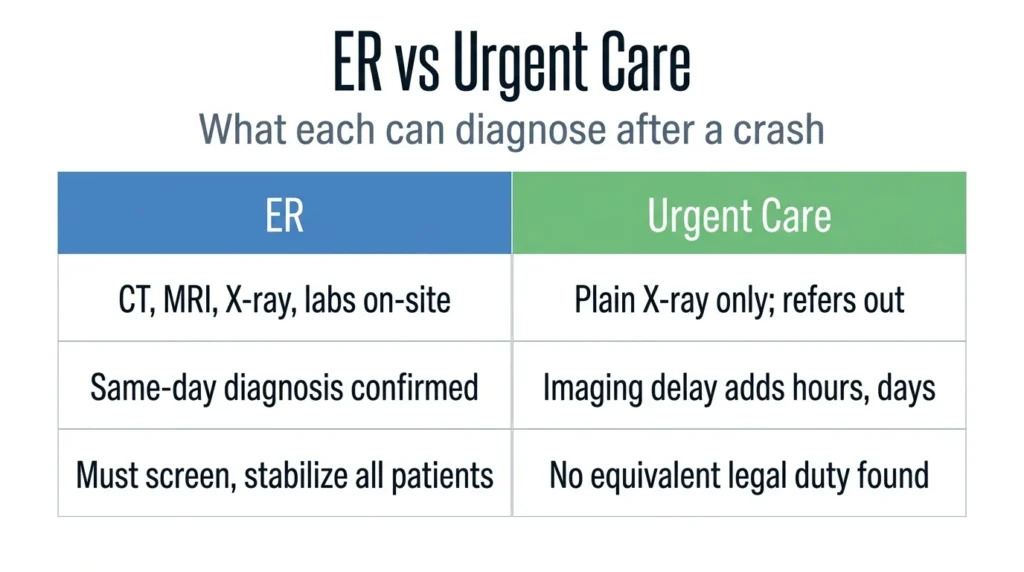
A hospital emergency department can rule a crash injury in or out the same day. Most urgent care clinics cannot.
Emergency departments keep CT, MRI, ultrasound, X-ray, EKG, and blood testing on site, backed by specialists and lab support around the clock. That equipment is the whole point of the visit after a collision.
Most urgent care clinics carry plain X-ray at best. When a patient needs anything more, the clinic refers out to a hospital or an imaging center, which can add hours or days before a definitive image exists.
So the real question is not which door has the shorter wait or the smaller bill. The question is whether internal bleeding, a fracture, or a brain bleed can be ruled out before you drive home and go to sleep.
When a Crash Injury Requires the ER, Not Urgent Care
Certain symptoms belong at a hospital, without debate. The American College of Emergency Physicians directs patients to the emergency room rather than urgent care for the following, and states that urgent care “cannot substitute for emergency services”:
- Chest pain
- Uncontrolled bleeding
- Seizures
- Severe abdominal pain
- Head injuries
- Sudden severe headache or dizziness
- Sudden confusion
Two crash-specific triggers get added to that list, head injury or trauma, and high-speed accidents or falls.
What catches people off guard is feeling fine in the first hour does not mean you are fine.
The CDC’s HEADS UP guidance on concussion signs and symptoms warns that concussion symptoms “may not show up right away” and may take hours or days to appear or be noticed. It lists danger signs that call for immediate emergency care: repeated vomiting, seizures, a headache that keeps getting worse, slurred speech, weakness or numbness, unequal pupil size, and increasing confusion.
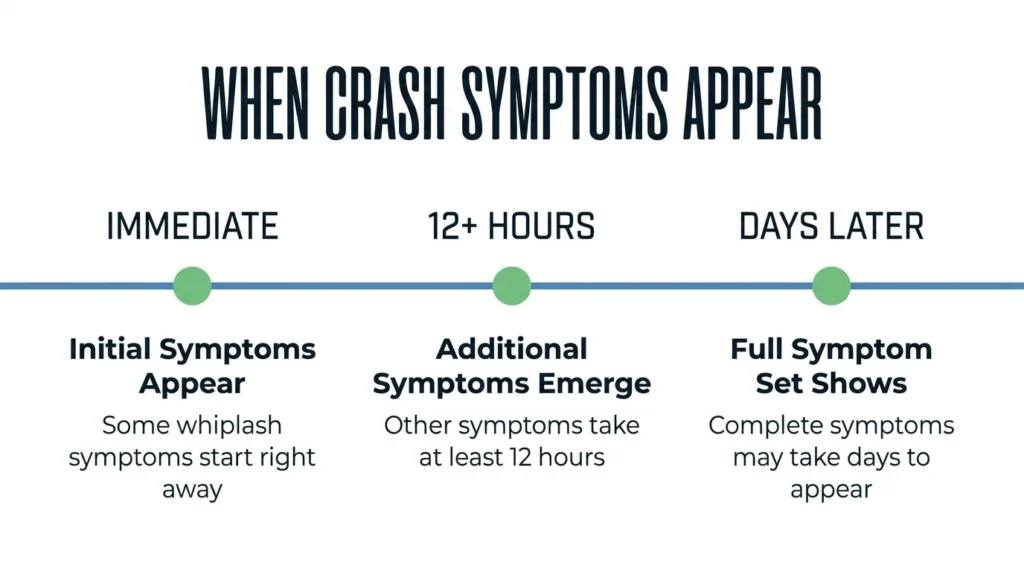
Whiplash follows a similar pattern, because some symptoms begin right after a crash while others take at least 12 hours to appear, and that the full set of symptoms may take a day or several days to show up.
Internal bleeding is the same story with higher stakes. Abdominal pain that keeps worsening, deep bruising across the belly or chest, dizziness, or fainting are reasons to get to an emergency room even if you walked away from the car feeling steady.
The ER also carries a floor of care that urgent care clinics are not shown to share. Under the federal Emergency Medical Treatment and Labor Act, Medicare-participating hospital emergency departments must provide a medical screening examination to anyone who requests one for a possible emergency medical condition, and must provide stabilizing treatment or an appropriate transfer, regardless of the patient’s ability to pay.
That mandate applies to hospital emergency departments. No equivalent screening and stabilization requirement was found for freestanding urgent care clinics. If cost is the reason you are eyeing the smaller clinic, the hospital is the setting with the legal duty to see you.
How the Choice Reads in Your Insurance Claim File
Adjusters treat your first treatment record as a stand-in for how badly you were hurt. An urgent care visit, or any delay in getting seen, hands them a ready argument that the injury was not serious enough for a hospital, or that something other than the crash caused the symptoms that surfaced later.
The adjuster’s job is to close your claim for as little as possible. That is how the business works, and a thin opening record gives them the cheapest version of your story.
Claims-practice commentary describes the pattern consistently. Sources including versustexas.com, the Butler Firm, and ChartRequest report that insurers flag gaps in treatment, with a gap of roughly 30 days treated as a common trigger for the argument that the injury healed on its own or was never real.
Treatment volume also feeds directly into how non-economic damages, the pain and suffering portion of a claim, get calculated. A record that starts late or stays thin can pull settlement value down whether or not the injury was genuine.
None of that is a codified rule. It is how claims get handled in practice, which is exactly why it blindsides injured people, and why it shows up so often in Texas car accident claims.
The Texas Legal Doctrine Behind the Gap-in-Treatment Argument
The adjuster’s argument rests on a Texas Supreme Court decision from 1967. In Moulton v. Alamo Ambulance Service, Inc., 414 S.W.2d 444 (Tex. 1967), the court held that a defendant may put a plaintiff’s failure to consult a doctor, failure to consult one as promptly as a reasonably prudent person would, failure to follow a doctor’s advice, or failure to otherwise properly care for an injury in front of the jury, without pleading it as an affirmative defense.
That doctrine addresses seeking and following medical care in general. It does not speak to which tier of facility a patient walked into first, and no Texas court has been found to rule on facility choice as such.
What practitioners report is that insurers can and do treat a lower level of initial care much the way they treat a treatment delay. Moulton is the reason that line of argument is available to them at all.
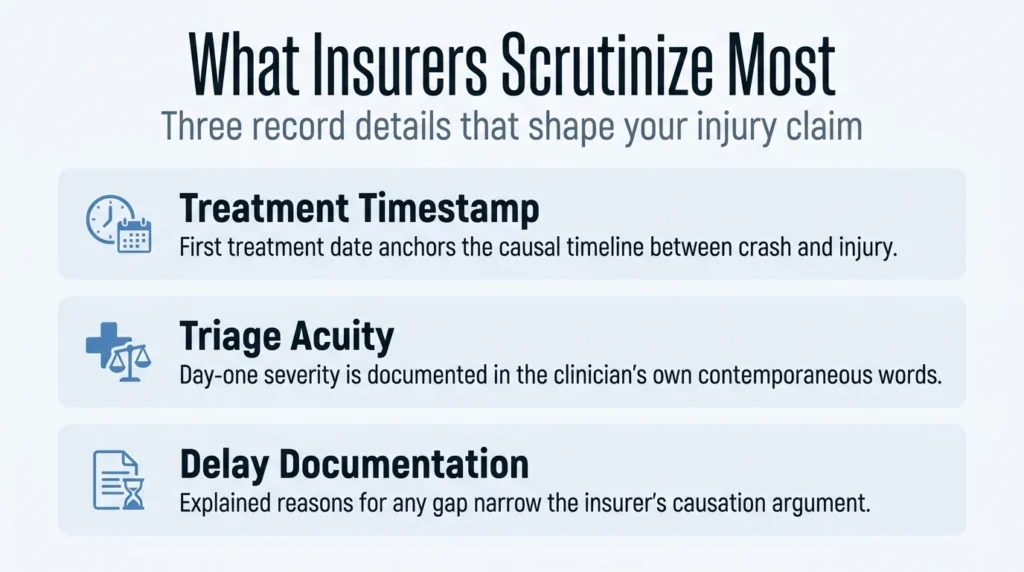
Three pieces of the medical record carry most of the weight in answering it:
The first treatment record and its timestamp anchor the causal timeline. The longer the gap between the crash and that first entry, the more room the doctrine above gives an insurer to argue that something else caused your injury.
The triage acuity assignment documents day-one severity in the treating clinician’s own contemporaneous words. Emergency departments in the United States triage on the Emergency Severity Index, a five-level scale in which Levels 1 and 2 are assigned by acuity and risk of deterioration, and Levels 3 through 5 by the resources a patient is expected to need.
Documentation of any reason for delay narrows the argument before it gains traction. Transportation problems, adrenaline masking symptoms, a referral that took days, insurance or money barriers, and symptoms that genuinely appeared later are all legitimate explanations. An explained gap is a far smaller target than an unexplained one, so tell the treating provider and tell your lawyer as early as you can.
Talk to a Lawyer Before the Insurance Company Reads Your Chart for You
If you already went to urgent care, waited a few days, or skipped care entirely because you felt fine, your claim is not finished. It means the record needs context that no adjuster is going to supply for you.
Angel Reyes & Associates has guided injured Texans through the legal process for over 30 years. A lawyer can review what your chart already says, help document the reasons behind a gap or a lower level of initial care, and take the insurance company’s questions before you answer them alone.
Contact Angel Reyes & Associates for a free consultation.
Past results do not guarantee future outcomes.
Post-Crash ER & Urgent Care FAQs
Does urgent care have to treat me if I cannot pay right away, the way an ER does?
No equivalent legal duty was found for freestanding urgent care clinics. Under the federal Emergency Medical Treatment and Labor Act (EMTALA), Medicare-participating hospital emergency departments must give anyone who requests it a medical screening exam and provide stabilizing treatment or an appropriate transfer, regardless of ability to pay.
How long after a car accident can I start treatment without hurting my injury claim?
There is no fixed safe number, but claims-practice commentary treats a gap of roughly 30 days as a common threshold insurers use to argue an injury was minor or unrelated to the crash. Get evaluated as soon as possible, and document any reason for delay, such as transportation problems or later-onset symptoms.
Does choosing urgent care instead of the ER make my injury claim look weaker to the insurance company?
It can. Adjusters read your first treatment record as a stand-in for how badly you were hurt, and a lower level of initial care such as an urgent care visit gives them a ready argument that the injury was not serious enough for a hospital. That practice traces to a Texas Supreme Court doctrine allowing a defendant to argue a plaintiff’s treatment delay to the jury on causation, though no Texas court has ruled on facility-tier choice specifically.
About the Authors

Angel Reyes
Writer
Angel L. Reyes, III is the Founder and Managing Partner of Angel Reyes & Associates. A nationally recognized trial attorney and business leader, Angel founded the firm in 1993, which has gone on to help over 70,000 injury victims recover more than $1 billion. Named to the Texas Super Lawyers list annually since 2008, Angel brings Wall Street experience, Ivy League education, and a deep commitment to client advocacy. He is a frequent legal commentator and published author with extensive contributions to legal scholarship, trial strategy, and consumer protection.

Kyle Nicolas
Editor
Kyle Nicolas is the Web Content & SEO Manager at Angel Reyes & Associates. He has more than 10 years of experience as a marketing co...

Angel Reyes
Reviewer
Angel L. Reyes, III is the Founder and Managing Partner of Angel Reyes & Associates. A nationally recognized trial attorney and business...