Can a Headrest Cause or Prevent Whiplash?


Every article on this site is researched by our internal team, reviewed for legal accuracy against current Texas law, and held to State Bar of Texas advertising standards before publication. We do not publish content that overstates outcomes or makes promises about results.
Learn more about our
editorial standards .
Key Takeaways
- Head restraint geometry, not mere presence, decides whiplash outcomes.
- FMVSS 202a caps front backset at 55 mm and sets minimum restraint height.
- Texas gives you two years to file a rear-end collision injury claim.
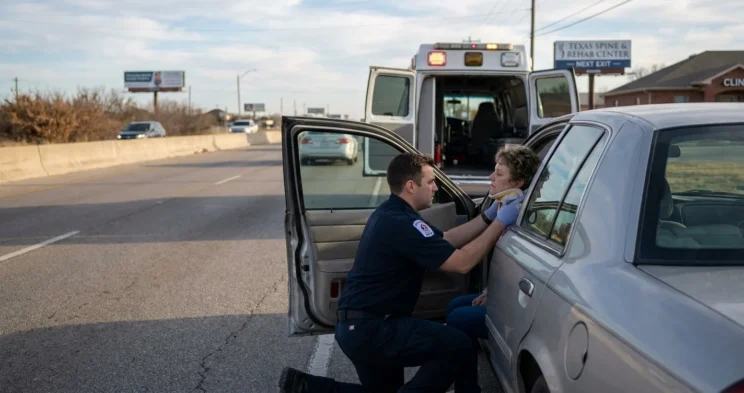
You walked away from a rear-end collision thinking you were fine. Then the neck stiffness and headaches showed up a few days later, and someone mentioned your headrest position might be part of the story.
A head restraint can do either. It can prevent whiplash, or it can contribute to it. The deciding factor is not whether your car has one. It is whether that restraint sits close enough and high enough to catch your head early in a rear impact.
Engineers call the horizontal gap between the back of your head and the front of the restraint the backset. The vertical measurement is simply height. Together, these two numbers decide whether the restraint intercepts your head quickly or lets it travel backward first.
In a rear-end collision, your seat pushes your torso forward before your head catches up. Your head lags behind, then swings backward relative to your torso. Clinicians describe the resulting neck injury as a sigmoid, S-shaped deformation of the cervical spine that strains the joints, ligaments, discs, and muscles beyond their normal range of motion, according to NIH/NCBI clinical literature.
A well-positioned restraint interrupts that backward motion early. A restraint that sits too low or too far back lets your neck absorb more of that motion before your head ever makes contact. That distinction matters for anyone recovering from a Texas car accident, because a crash that looks minor from the outside can still leave lasting neck damage.
What Federal Law Requires for Head Restraint Height & Backset
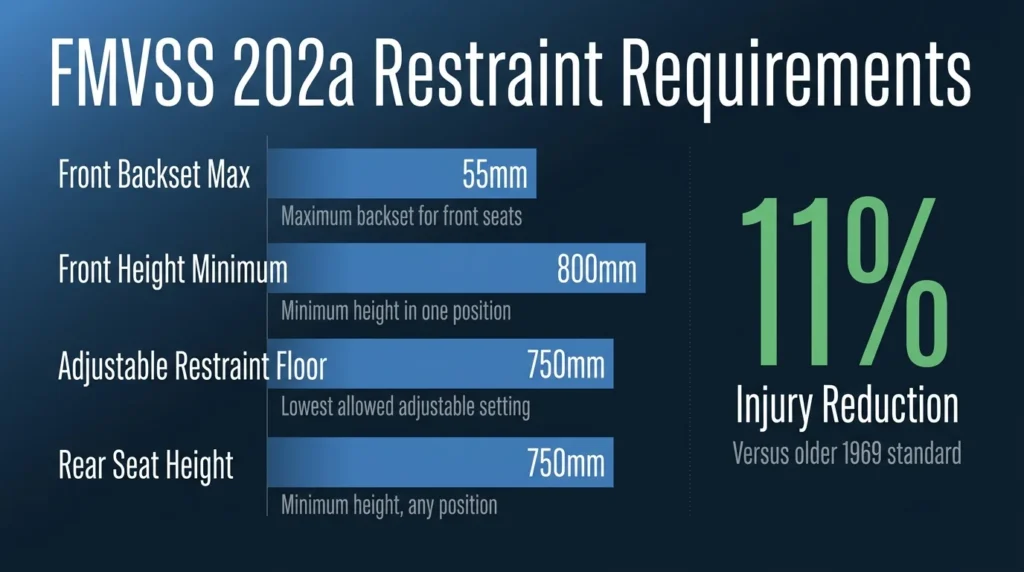
Federal law sets exact numbers for backset and height, so “properly positioned” is not a matter of guesswork:
- The current standard, 49 CFR § 571.202a, has applied to new vehicles since September 1, 2009.
- For front outboard seats, the back seat cannot exceed 55 mm, and the restraint must reach a height of at least 800 mm in at least one adjustment position. Adjustable restraints cannot drop below 750 mm at their lowest setting.
- For rear outboard seats, the restraint must reach at least 750 mm in any adjustment position.
- The earlier 1969 version of the standard allowed shorter, more flexible restraints. The 202a update closed that gap. Industry analysis citing NHTSA estimates the tighter geometry reduces cervical spine injuries by roughly an additional 11% compared to the older rule.
What Independent Crash Testing Shows
Federal minimums set a floor. Independent crash testing shows how much geometry matters in practice.
The Insurance Institute for Highway Safety rates head restraints in two stages. First, it measures static geometry, height and backset, against a good, acceptable, marginal, or poor scale. Restraints scoring marginal or poor stop there and receive an overall poor rating.
Restraints with good or acceptable geometry move on to a dynamic sled test that simulates a rear impact with a crash-test dummy, measuring how quickly the restraint catches the head and how much force reaches the neck.
The real-world numbers back this up. In an IIHS analysis of roughly 3,000 insurance claims from rear-struck vehicles, drivers in seats rated good had 35% fewer neck-injury claims lasting three months or more than drivers in seats rated poor.
Because most new vehicles eventually earned good ratings under that original protocol, IIHS retired it in 2022. In December 2025, the organization launched a tougher Whiplash Prevention Evaluation that tests two rear-impact severities with a more detailed dummy, again rating vehicles good through poor.
When Active Head Restraints and Seatback Design Don’t Work
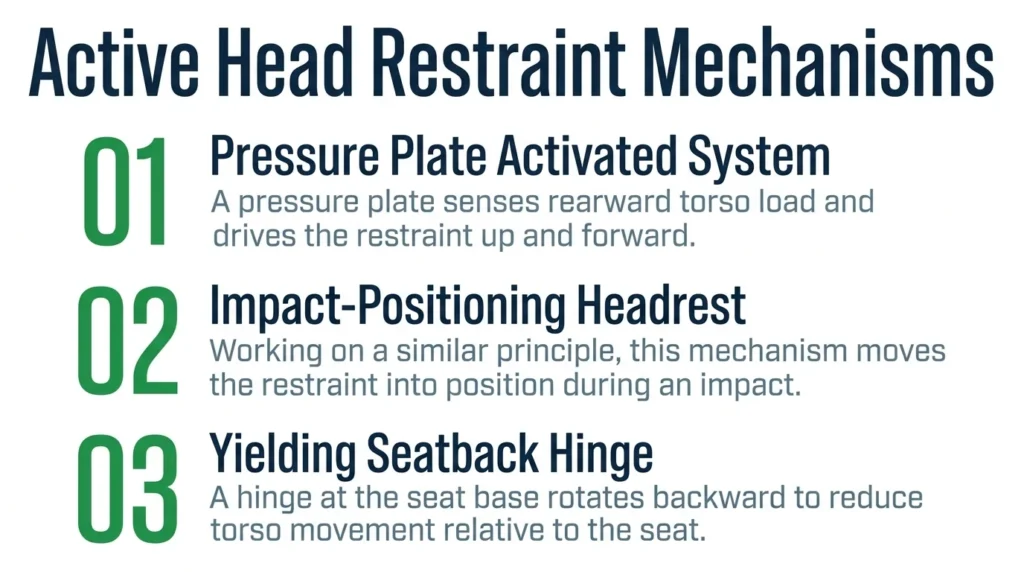
Some automakers try to fix poor static geometry with moving parts. Others accept a different trade-off in how the seatback itself behaves. Both approaches can fail.
Active head restraint systems sense a rear impact and move the restraint into position as the crash happens. Saab’s Active Head Restraint uses a pressure plate in the seatback that detects the torso’s rearward load and drives the restraint up and forward.
Toyota’s active headrest works on a similar principle. Volvo’s Whiplash Injury Prevention System instead uses a yielding hinge at the base of the seatback that rotates backward under impact, reducing how far the torso moves relative to the seat.
These systems only help when they trigger correctly. An occupant’s size or seating position can fail to load the trigger the way the design assumes. A crash pulse outside the system’s designed range can do the same.
A worn, damaged, or previously repaired recliner or trigger linkage can prevent the mechanism from firing at all. When an active system does not trigger, the restraint behaves like an ordinary fixed restraint sitting wherever it was left. This is why static position still matters even in vehicles equipped with active systems.
Seatback design carries its own trade-off. Front seatback strength is governed by an older standard, FMVSS 207, which plaintiffs’ attorneys and consumer-safety commentators argue has not kept pace with modern seat design. Some manufacturers have designed front seatbacks to yield, or recline backward, under rear-impact load, on the theory that a yielding seat reduces whiplash risk for the front occupant.
That trade-off can come at the cost of the seatback’s strength in a more severe impact, particularly when a child sits directly behind.
A Dallas County, Texas case shows how this plays out in litigation. According to court records and news coverage, including NBC 5 Dallas-Fort Worth, a family’s 2002 Lexus ES 300 was struck from behind on Central Expressway in September 2016.
The family’s theory, per that reporting, was that the front seats were defectively designed to collapse backward in a rear impact, throwing the parents into their two young children who were seated behind them in child safety seats and suffered severe head injuries.
Toyota’s own defense, as reported, was that it “consciously chose to protect front-seat occupants from crash injuries such as whiplash at the expense of rear-seat passengers.” In August 2018, a Dallas County jury found the seats unreasonably dangerous and awarded the family more than $242 million, an amount later reduced on post-verdict motions and reported as upheld on appeal.
This is a public court record and a matter of news reporting. It is not a case result from this firm, and it did not involve this firm’s clients. It illustrates how a seatback design trade-off can turn a routine rear-end collision into a catastrophic injury.
How a Rear-Impact Whiplash Claim Is Investigated in Texas
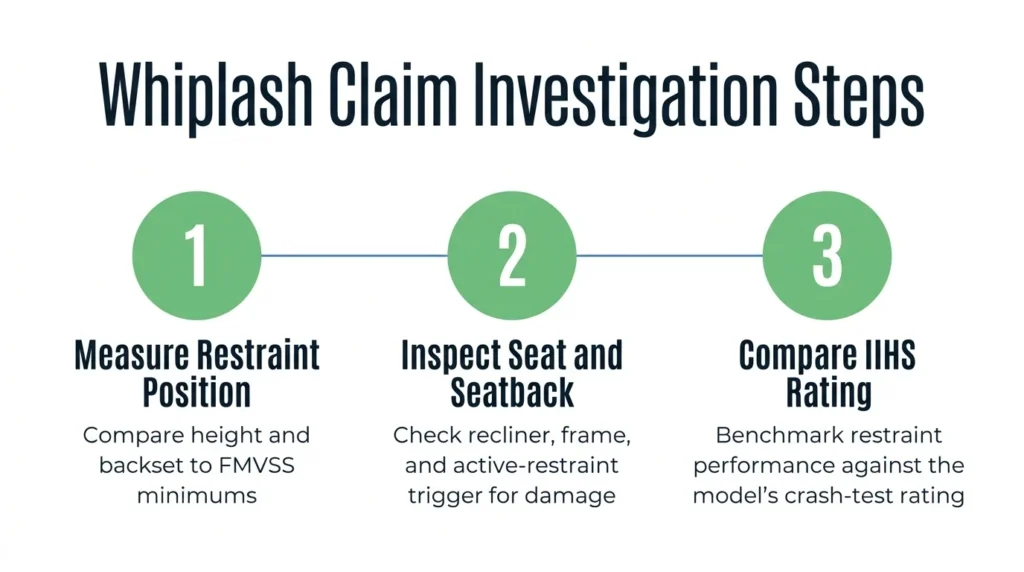
When a restraint or seatback design issue may be involved, investigators build the case around three types of evidence:
- Restraint position measurement, as found. The head restraint’s actual height and backset in the involved seat, as left by the occupant or as found after the crash, can be measured and compared against the FMVSS 202a minimums and the manufacturer’s own design specification.
- Seat and seatback inspection. This examines the recliner mechanism, seatback frame, and, where equipped, the active restraint’s trigger linkage for damage, wear, prior repair, or a failure to fire, along with whether the seatback shows permanent deformation beyond its designed range.
- Comparison against the model’s dynamic test rating. The specific make, model, and year’s IIHS seat rating provides an objective benchmark for whether the restraint system was designed to perform in the exact type of crash at issue.
Texas also gives injury victims a limited window to act. Under Texas Civil Practice & Remedies Code § 16.003, most negligence-based personal injury claims, including rear-end collision claims, carry a two-year statute of limitations running from the date of the collision, with limited exceptions such as claims involving minors.
A design-defect or product-liability claim against a vehicle or seat manufacturer, such as the seatback theory described above, can run alongside an ordinary negligence claim against the at-fault driver.
Talk to Angel Reyes & Associates About Your Rear-Impact Injury
Whiplash severity after a rear-end collision often comes down to restraint and seat design, the same details a claim investigation examines closely. If you’re dealing with ongoing neck pain after being rear-ended in Texas, you don’t have to sort out backset measurements and seatback specifications on your own.
Angel Reyes & Associates has guided Texans through situations like this for over 30 years. Contact Angel Reyes & Associates for a free consultation to talk through what happened and what your options are.
Past results do not guarantee future outcomes.
Headrest & Whiplash FAQs
What is the difference between a "headrest" and a "head restraint"?
There is no design difference. “Head restraint” is the technical, regulatory term for the same part commonly called a headrest. Federal standard 49 CFR § 571.202a uses that term because the rule governs the part’s position, not merely its presence.
Does Texas have its own law setting a minimum head restraint height, or is it federal?
Head restraint height and backset are governed by federal law, not Texas law. FMVSS 202a (49 CFR § 571.202a) sets a nationwide minimum height and maximum backset for front and rear outboard seats. Texas law governs the claim itself, including the filing deadline.
Can a properly positioned head restraint completely prevent whiplash?
Not completely, but good positioning substantially lowers the risk. A restraint that catches the head early, within FMVSS 202a’s height and backset limits, reduces how far the neck extends in a rear impact. Drivers in seats rated “good” by the Insurance Institute for Highway Safety had 35% fewer neck-injury claims lasting three months or more than those rated “poor,” though crash severity still matters.
About the Authors

Angel Reyes
Writer
Angel L. Reyes, III is the Founder and Managing Partner of Angel Reyes & Associates. A nationally recognized trial attorney and business leader, Angel founded the firm in 1993, which has gone on to help over 70,000 injury victims recover more than $1 billion. Named to the Texas Super Lawyers list annually since 2008, Angel brings Wall Street experience, Ivy League education, and a deep commitment to client advocacy. He is a frequent legal commentator and published author with extensive contributions to legal scholarship, trial strategy, and consumer protection.

Kyle Nicolas
Editor
Kyle Nicolas is the Web Content & SEO Manager at Angel Reyes & Associates. He has more than 10 years of experience as a marketing co...

Angel Reyes
Reviewer
Angel L. Reyes, III is the Founder and Managing Partner of Angel Reyes & Associates. A nationally recognized trial attorney and business...