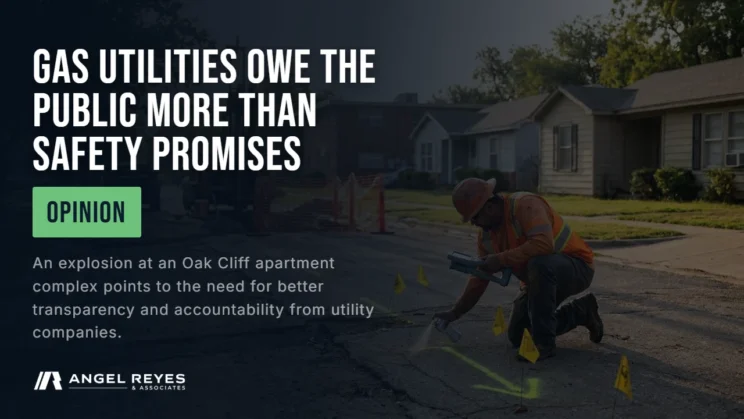
Gas Utilities Owe the Public More Than Safety Promises


Every article on this site is researched by our internal team, reviewed for legal accuracy against current Texas law, and held to State Bar of Texas advertising standards before publication. We do not publish content that overstates outcomes or makes promises about results.
Learn more about our
editorial standards .
Key Takeaways
- The NTSB found Atmos detected the Jackson leaks at least eight weeks before the 2024 explosions.
- Federal rules say using the 811 system doesn't relieve a gas operator of damage-prevention duties.
- Federal pipeline-safety law preserves tort liability, so regulation doesn't replace a lawsuit.
This is an opinion piece, and is intended to provide analysis and commentary on current events and issues facing personal injury law. While resources are provided to support claims, opinion statements should not be misconstrued as fact, evidence, or argument in favor of or against any particular legislation. This is not legal advice.
If you run pressurized gas lines under people’s homes, you owe them reassurance that you’re managing the risk. That reassurance comes in the form of proof through transparency and accountability.
Nobody in Oak Cliff can dig up the main on East Ninth Street and inspect it. That requires permits, licensing, and permissions from an untold number of authorities. So we’ve invented a system where residents instead rely on the company’s records, regulators, and what the company tells them. That arrangement only works if someone outside the company can check the work.
On May 28, The Clyde apartments in Oak Cliff exploded. The National Transportation Safety Board’s (NTSB) preliminary account lists three people killed and at least six injured. The Dallas Morning News reported that a Dallas County judge this month ordered Atmos Energy to turn over records of earlier line strikes to the families of the victims who are suing the company.
Atmos denies wrongdoing, and no court has decided who is responsible. This is an ongoing matter. However, the records fight raises a question bigger than one lawsuit: when a company operates infrastructure that can level a building, how does the public know it is controlling the risk?
Knowing About a Leak Isn’t Fixing It
A completed federal investigation offers one answer. In January 2024, two homes exploded just days apart in Jackson, Mississippi. One woman died. The NTSB found that Atmos had detected the leaks at least eight weeks earlier, classified them as nonhazardous, and left them unrepaired.
Aging pipe connections were part of it. Investigators also found that Atmos lacked adequate procedures for rechecking known leaks in shifting clay soil, so those leaks worsened over time.
The final report goes even further. The NTSB’s investigation concluded that Atmos used more protective leak-monitoring procedures in Kansas than it did in Mississippi. The report indicated those requirements could have prevented the Mississippi explosions.
Lessons learned in one state weren’t reaching the others. The better practice already existed inside the same company, yet it stayed there while other markets lived under the weaker standard.
Atmos told investigators it has since repaired 2,206 Jackson leaks identified between January 2024 and April 2025. Good. A safety system is supposed to turn experience into action. The question is whether it does that across the whole company, or only in the state where the lesson was learned.
None of this tells us what caused The Clyde explosion. It does show why the public should be able to check whether lessons from Jackson ever reached our backyard here in Dallas.
What Real Transparency Looks Like
Utilities like to talk about safety culture. It’s good for PR and gives customers peace of mind. However, the NTSB has already drafted something more useful. After the Jackson incidents, it recommended that Atmos publish schedules and milestones for replacing vulnerable pipe connections and filling gaps in its service-line records.
Those are recommendations, not court orders. Applied to any gas utility, they still set the right standard, and it has four parts:
- Name the material risks and who is exposed to them.
- Say what corrective work is planned and when it will be done.
- Report what has been finished and independently checked.
- Explain every missed deadline and every open finding.
Since mismarked lines sit at the center of the Oak Cliff case, I’d add a fifth part for North Texas: locating accuracy. How often are lines marked in the wrong place, and what changes when they are?
After Jackson, the Pipeline and Hazardous Materials Safety Administration (PHMSA) also began a multistate assessment of Atmos. In May 2024, a deputy administrator told Congress the agency anticipated sharing the results with the public. The Dallas Morning News has since reported that no report has come out. PHMSA now says the review began on an unverified preliminary data analysis that it is rechecking.
Atmos disputes the statistics PHMSA used to justify the review and says no state regulator found a violation. Fine. Then publish the scope, the corrected data, and the findings. If the numbers were wrong, why not show the right ones? Right now, the public hasn’t seen a page of the review. Nobody outside the agency and the company can judge whether its concerns were real or resolved.
And “the public” means more than the people paying the gas bill. In Avondale, Louisiana, a 2024 explosion killed one person in a house that had no natural gas service. Gas from a fractured Atmos main traveled underground and got inside.
Renters, neighbors, and workers live near the hazard whether or not they hold an account. The warnings should reach them too.
Records Are Safety Equipment
Accountability also needs consequences a court can enforce. San Bruno shows what that looks like. In 2010, a Pacific Gas and Electric Company (PG&E) transmission pipeline ruptured in a California neighborhood, killing eight people. Federal investigators faulted the company’s integrity management program.
Years later, a federal jury convicted PG&E of five willful pipeline-safety violations and of obstructing the NTSB investigation. The sentence carried a $3 million fine, five years of probation, an independent monitor, and an order to publicize the crimes.
The monitor and public notice mattered more than the fine because they put the company’s conduct under a court’s supervision.
PG&E’s convictions say nothing about Atmos. Objecting to a discovery request is not obstruction; companies object to discovery every day, and judges sort it out. San Bruno belongs here because it shows that accurate records are a safety obligation the law can enforce.
Hiring a Locator Doesn’t Move the Duty
That brings us back to Oak Cliff. Discovery is a legal process that structures how each side in a lawsuit gets relevant evidence from the other, under a judge’s supervision. For families like these, it is often the only window into records the company alone holds.
The families in this case wanted to know if poor marking was a pattern. The Dallas Morning News reported that they asked for records of every improperly marked Atmos line struck between January 2024 and July 1, 2026 (a quoted count of 2,965 in Atmos’ Mid-Tex division). Atmos pushed back, calling the request overbroad, burdensome, and irrelevant to the one line at The Clyde, citing NTSB letters that limit what can be released.
The judge wasn’t persuaded. As she saw it, that much improper marking made the records more important to produce.
Atmos’ public position is that a third-party driller struck the line and that the company had hired a professional locating firm to mark it. Maybe that’s how it happened, but federal rules require every gas operator to run its own written damage-prevention program, including temporary marking of buried lines before digging begins. Those same rules say taking part in the 811 system doesn’t relieve the operator of responsibility for compliance.
The way I read that, a gas company can pay someone else to hold the paint can, but the duty stays with the company.
Whether Atmos, its locator, or someone else failed at The Clyde is for the evidence to decide. That’s why the evidence has to come out. A family looking for answers deserves a fair look at the file, even when the company holding it disputes responsibility.
Federal law leaves room for that. The pipeline-safety statute preserves tort liability rather than swapping it for regulation. Regulators investigate what went wrong, and courts decide who pays for the harm.
Litigants don’t get unlimited access, and that’s fair. Courts can seal sensitive material and limit who sees it. They just shouldn’t leave that call to the discretion of the company under examination.
Where the Companies Have a Point
Utilities will say they report plenty of data, spend heavily on modernization, and find more leaks because detection keeps improving. All of that can be true. PHMSA publishes operator data every year, and Atmos describes its safety programs in detail. A rising leak count, standing alone, proves nothing.
They’ll also say some information has to stay confidential during an investigation. That’s right too. Federal rules limit what parties may release while an NTSB investigation is open.
But the public needs the numbers that give a leak count meaning: severity, repair speed, repeat failures, and proof that corrective work held up. When details must be withheld, say what, on whose authority, and until when.
I’d hold any gas utility to three commitments:
- Explain the risks that reach the public.
- Show that the repairs are finished and that they work.
- When a failure and the harm it caused are proven, accept the legal responsibility that comes with it.
Running a hazard under people’s homes creates those obligations, and families shouldn’t have to wait on a regulator to see them honored.
If a gas leak or explosion has upended your life, my firm, Angel Reyes & Associates, can help you get answers and press for accountability. Give us a call, and we’ll talk it through.
About the Authors

Angel Reyes
Writer
Angel L. Reyes, III is the Founder and Managing Partner of Angel Reyes & Associates. A nationally recognized trial attorney and business leader, Angel founded the firm in 1993, which has gone on to help over 70,000 injury victims recover more than $1 billion. Named to the Texas Super Lawyers list annually since 2008, Angel brings Wall Street experience, Ivy League education, and a deep commitment to client advocacy. He is a frequent legal commentator and published author with extensive contributions to legal scholarship, trial strategy, and consumer protection.

Kyle Nicolas
Editor
Kyle Nicolas is the Web Content & SEO Manager at Angel Reyes & Associates. He has more than 10 years of experience as a marketing co...

Angel Reyes
Reviewer
Angel L. Reyes, III is the Founder and Managing Partner of Angel Reyes & Associates. A nationally recognized trial attorney and business...