What Is Property Damage Liability Coverage?


Every article on this site is researched by our internal team, reviewed for legal accuracy against current Texas law, and held to State Bar of Texas advertising standards before publication. We do not publish content that overstates outcomes or makes promises about results.
Learn more about our
editorial standards .
Key Takeaways
- Texas sets a $25,000 minimum property damage limit per collision, not per claimant.
- Repairs, total-loss value, loss of use, and diminished value all draw on one shared limit.
- Your collision or UM/UIM coverage may help if the at-fault driver's limit runs out.
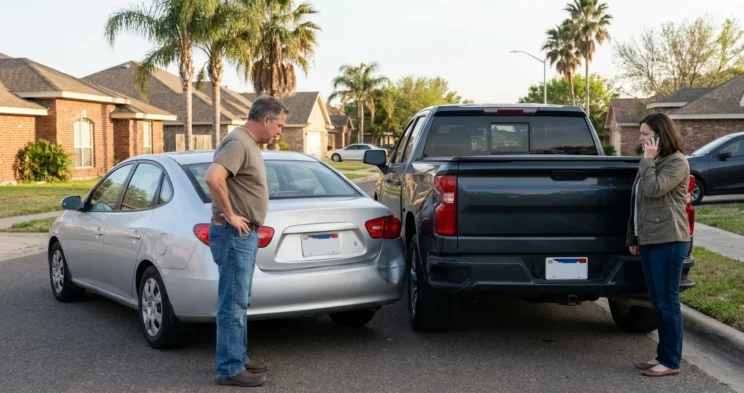
When another driver damages your car, property damage liability is the part of that driver’s auto liability insurance that can pay for your vehicle and other property damaged in the crash. Payment depends on responsibility for the crash, policy coverage, documented losses, and the available limit.
If you’re facing repair bills and need transportation, knowing what this coverage includes can help you understand where payment may come from. Texas’s minimum property-damage limit is $25,000 per collision, and several people’s losses may compete for that amount.
Whose Property Does Property Damage Liability Coverage Pay For?
Property damage liability coverage pays for other people’s property that the at-fault driver damages. That includes your car and can include a fence, a mailbox, or a building. It does not pay for the at-fault driver’s own vehicle and is separate from bodily injury liability, which addresses injuries to people.
Under Texas Transportation Code §601.072(a-1)(3), the current minimum is $25,000 for property damaged or destroyed in one collision. That is the “25” in Texas’s 30/60/25 liability limits, separate from the bodily injury amounts.
The $25,000 is a minimum for the whole collision, not a promised payment to you. Drivers can purchase higher limits. Chapter 601 also permits methods of meeting financial-responsibility requirements other than a standard insurance policy.
The at-fault driver’s declarations page shows the purchased limit and policy period. The TDI auto insurance glossary describes this page as a coverage summary. The full policy terms and endorsements still count.
What Vehicle Damage Can the At-Fault Driver’s Coverage Pay?
The at-fault driver’s property damage liability insurance can pay reasonable, crash-related repair costs or a totaled vehicle’s pre-crash value. Payment depends on proof and the available property-damage limit.
For repairs, the estimate identifies crash damage and the work needed. A supplement can document damage found during repairs.
For a total loss, the insurer values what your car was worth immediately before the crash. That does not promise a new car or payment of your loan balance. Comparable local vehicles, dealer quotes, and records of your car’s features help you assess the valuation; keeping the salvage can reduce payment.
Reasonable crash-related towing and storage may also be covered. Invoices showing amounts and dates support those expenses. Every accumulating storage fee is not automatically reimbursable.
Can It Pay for a Rental Car, Loss of Use, or Diminished Value?
Yes, these losses may be recoverable when supported by evidence. Texas recognizes loss of use for a reasonable repair or replacement period, including after a total loss, and a repaired car’s remaining market-value loss may also qualify.
Rental Costs & Loss of Use
A rental bill is one way to document the cost of losing use of your car. The TDI auto insurance guide describes rental payment during a reasonable repair period and notes that payment may stop shortly after a total-loss decision.
That insurer practice does not establish a fixed legal cutoff. In J&D Towing, LLC v. American Alternative Insurance Corp., the Texas Supreme Court held that loss-of-use damages are available even when property is a total loss. Those damages must be foreseeable, supported by evidence, and limited to a reasonable replacement period.
The case arose under underinsured coverage but resolved the underlying Texas damages question. It does not promise unlimited rental reimbursement. The daily cap in your own rental-reimbursement coverage does not control the other driver’s liability coverage.
Diminished Value After Repair
A repaired vehicle may still be worth less because of its crash history. TDI Bulletin B-0027-00, issued in 2000, recognizes that a liability insurer may owe a third party for remaining market-value loss after complete repair. Its discussion of no diminished-value obligation after complete repair concerns the first-party collision and comprehensive contract described in the bulletin.
Diminished value requires proof; no automatic percentage or additional payment is guaranteed. A before-and-after valuation can help establish that loss.
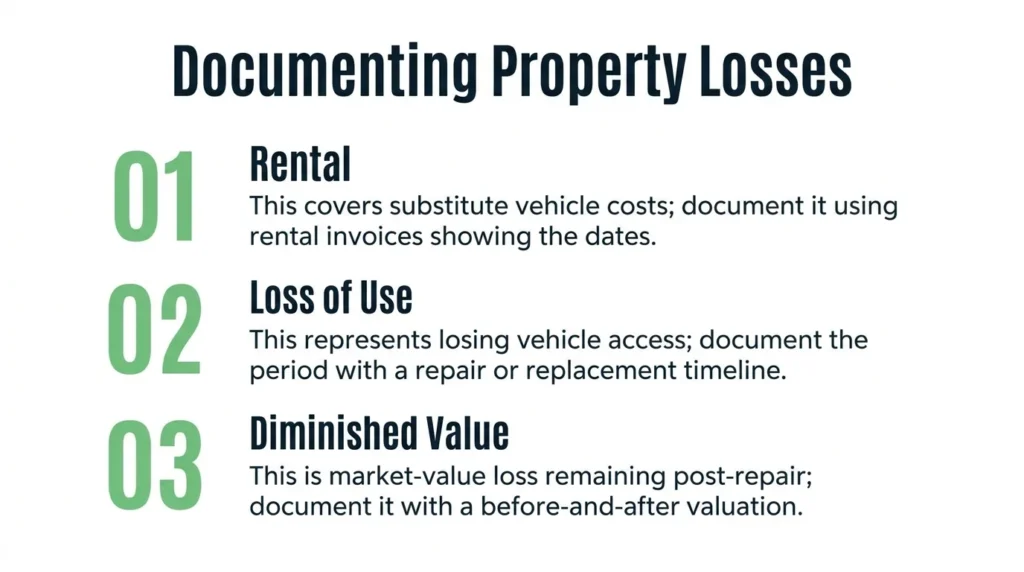
These covered losses draw on the same property-damage limit as your repairs. A rental bill documents loss of use; it does not create a separate guaranteed fund.
What Happens When Several People Share One Property-Damage Limit?
Covered property losses from one collision share the applicable per-collision property-damage limit. Texas’s $25,000 minimum does not reset for each car, building, or type of expense.
For illustration, assume a crash damages two vehicles and a building. The policy has $25,000 available, but covered property losses total $40,000. That leaves $15,000 beyond the limit.
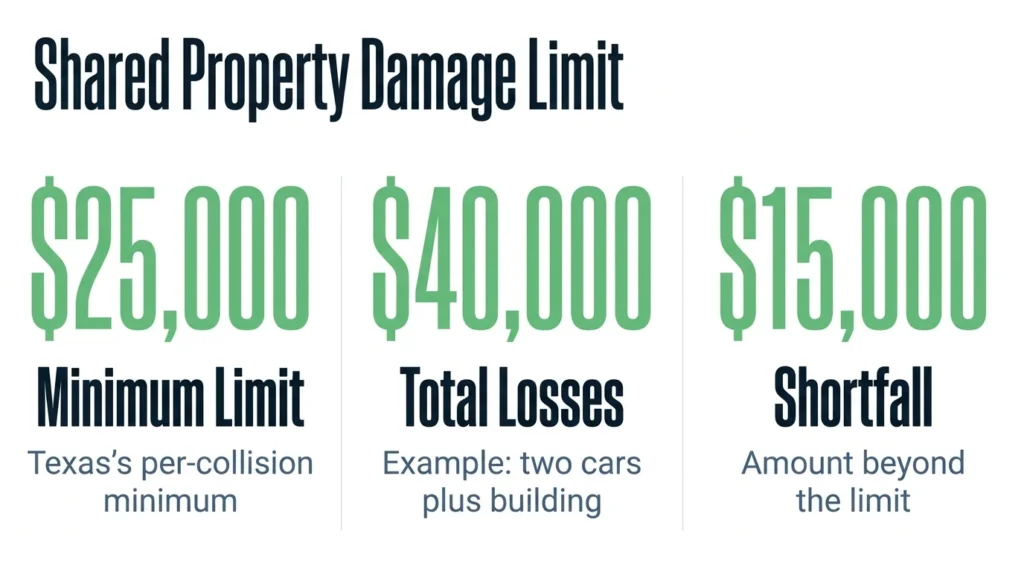
Repairs, rental or loss of use, diminished value, towing, and storage do not each receive a separate limit. How the available amount is divided depends on the policy and settlement circumstances. The example does not establish any claimant’s share or priority.
Under Texas Transportation Code §601.073(e), good-faith settlements can reduce the statutory amount still available. A list of all property-damage claimants helps show the competing losses.
What Coverage May Help When the At-Fault Driver’s Limit Runs Out?
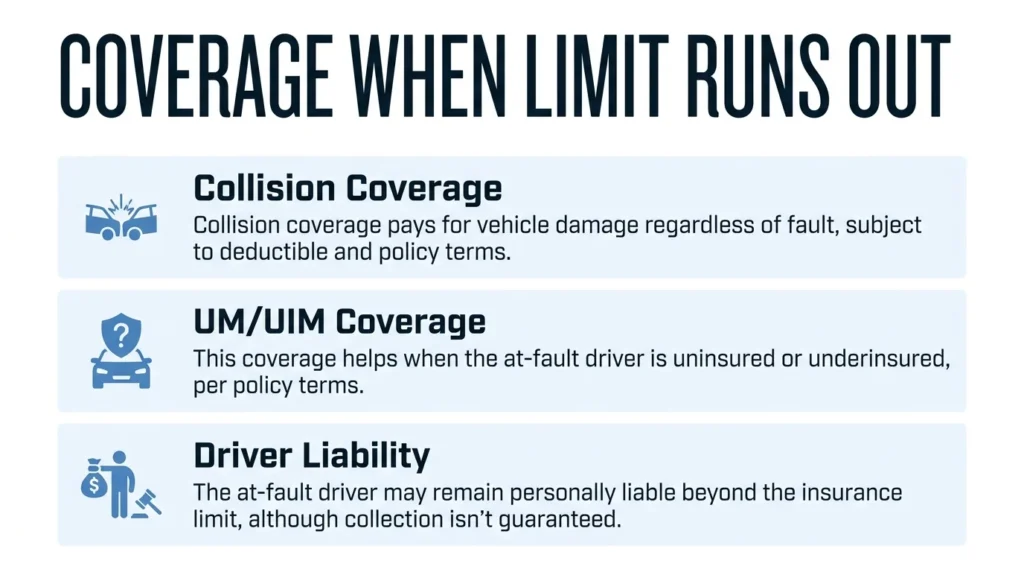
Your own collision coverage or uninsured/underinsured motorist (UM/UIM) property-damage coverage may help with uncovered vehicle losses if you purchased it and the policy applies.
Collision covers damage to your vehicle regardless of who caused the crash, subject to your policy and deductible. UM/UIM property-damage coverage addresses uninsured or inadequately insured drivers. Your policy terms and any deductible affect payment, and neither coverage necessarily pays every category of loss the at-fault driver owes.
The responsible driver may remain personally liable beyond the insurance limit. Collecting that amount is not guaranteed.
The coverage and loss records help explain a possible shortfall. The at-fault driver’s declarations page shows the purchased limit, while the repair estimate or valuation shows your vehicle loss.
Rental, towing, and storage invoices document expenses and dates; the list of other property claimants shows competing losses against the same limit.
Talk With Angel Reyes & Associates About Your Texas Crash
Angel Reyes & Associates has guided injured Texans for over 30 years. You can contact Angel Reyes & Associates for a free consultation about your crash, available insurance, and documented property losses.
Past results do not guarantee future outcomes.
Property Damage Liability Coverage FAQs
Does property damage liability cover personal belongings damaged in a Texas car accident?
Yes, property damage liability may cover personal belongings damaged in a crash caused by another driver, such as a laptop or other items inside your vehicle, if the losses are supported by evidence and covered by the policy. Keep receipts, photographs, and repair or replacement estimates to document the damage.
How long do I have to file a property damage claim after a car accident in Texas?
Texas generally provides a two-year statute of limitations for lawsuits seeking compensation for property damage, under Texas Civil Practice and Remedies Code § 16.003(a). Insurance notification requirements may apply much sooner, so review your policy and report the claim promptly.
Can I choose my own repair shop when filing a property damage liability claim?
Generally, yes; you can choose where to have your vehicle repaired, but the insurer may dispute the estimate, labor rates, or proposed repairs. Obtain a written estimate and ask the insurer to explain any differences before authorizing work that could leave you responsible for additional costs.
About the Authors

Angel Reyes
Writer
Angel L. Reyes, III is the Founder and Managing Partner of Angel Reyes & Associates. A nationally recognized trial attorney and business leader, Angel founded the firm in 1993, which has gone on to help over 70,000 injury victims recover more than $1 billion. Named to the Texas Super Lawyers list annually since 2008, Angel brings Wall Street experience, Ivy League education, and a deep commitment to client advocacy. He is a frequent legal commentator and published author with extensive contributions to legal scholarship, trial strategy, and consumer protection.

Kyle Nicolas
Editor
Kyle Nicolas is the Web Content & SEO Manager at Angel Reyes & Associates. He has more than 10 years of experience as a marketing co...

Angel Reyes
Reviewer
Angel L. Reyes, III is the Founder and Managing Partner of Angel Reyes & Associates. A nationally recognized trial attorney and business...