What Is a Medical Billing Affidavit in Texas?


Every article on this site is researched by our internal team, reviewed for legal accuracy against current Texas law, and held to State Bar of Texas advertising standards before publication. We do not publish content that overstates outcomes or makes promises about results.
Learn more about our
editorial standards .
Key Takeaways
- An unchallenged 18.001 affidavit supports medical charges but does not prove causation.
- Deadlines run from the defendant's answer and expert dates, not from the accident date.
- A counteraffidavit removes the shortcut for disputed charges but is not an automatic loss.

A Texas medical billing affidavit is a sworn statement used under §18.001 to support proof that medical charges were reasonable and services were necessary. When bills arrive from several providers after an injury, this document can help your lawyer present those expenses in court without calling a live expert to establish those points.
Under Texas Civil Practice and Remedies Code §18.001, a compliant, uncontroverted affidavit can supply sufficient evidence. It does not conclusively establish the charges, prove the accident caused your treatment, or decide how much you can recover.
What Does a Texas Medical Billing Affidavit Prove?
An 18.001 affidavit supports the reasonableness of specific charges and the necessity of specific services in a Texas injury lawsuit. You still need separate evidence connecting your injury and treatment to the event that hurt you.
What the Affidavit Contains & Who Can Sign It
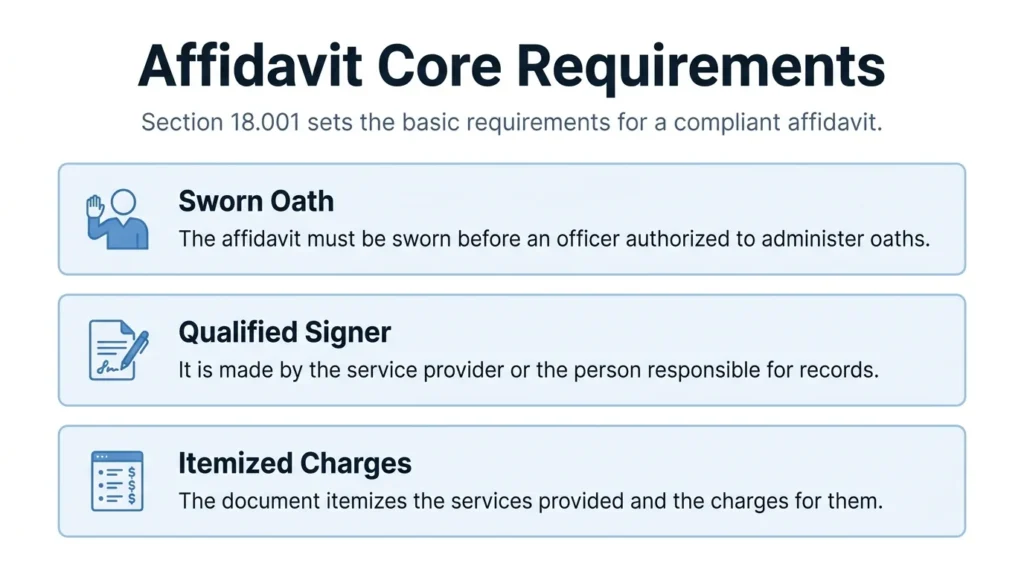
Section 18.001 sets out the basic requirements. The affidavit must:
- Be sworn before an officer authorized to administer oaths.
- Be made by the service provider or the person responsible for the relevant records.
- Itemize the services provided and the charges for them.
A treating doctor is not the only eligible signer. In Gunn v. McCoy, the Texas Supreme Court upheld affidavits from insurers’ subrogation agents who had the relevant billing records.
Section 18.002 provides sample forms, including a records-custodian form that separates payments from the unpaid balance still collectible after adjustments. Substantial compliance with those forms is sufficient, and they are not the only permitted forms.
The itemized bills record what was charged. The affidavit supplies a sworn statement about those charges and services. Neither makes the medical-expense amount an automatic award.
Why Does the Affidavit Matter to an Injury Claim?
The affidavit gives your lawyer a streamlined way to present the medical-expense part of your claim. It supports that part of the claim’s value, but it does not increase a settlement by itself or establish a claim-value formula.
After a wreck on I-35, you may receive bills from several providers. Organized proof helps counsel present those expenses in car accident claims and address disputes over individual charges.
Billed Charges Are Not the Same as Recoverable Amounts
Section 41.0105 separately limits recovery of medical expenses to amounts actually paid or incurred by or on behalf of the claimant. An affidavit does not override that limit.
The full billed charge may differ from the amount paid by you or your health insurer. An adjustment or write-off removes an amount the provider cannot collect; a remaining enforceable balance is an amount still owed.
In Haygood v. De Escabedo, 356 S.W.3d 390 (Tex. 2011), the Texas Supreme Court held that amounts a provider has no legal right to collect cannot be recovered simply because they appear on a bill.
Your lawyer needs payment records, credits, adjustments, and remaining balances to reconcile the affidavit with the amount actually paid or incurred. An insurance payment on your behalf is different from a written-off sum that no one owes.
When Must the Affidavit Be Served After a Lawsuit Is Filed?
For Texas lawsuits filed on or after September 1, 2019, ordinary service deadlines depend on the defendant’s answer and applicable expert-designation dates. The accident date does not start these clocks. HB 1693 established this framework in §18.001.
An expert-designation date is a deadline for identifying expert witnesses. The statute considers both the offering party’s court-ordered designation date and its designation date under the civil rules.

The supplement rule covers continuing services provided after a relevant statutory deadline. All parties may agree to different timing, or the court may grant leave.
The offering party serves copies on the other parties and files a notice of service with the court. The initial affidavit itself generally does not need to be filed before trial, subject to the evidence rules.
Treatment dates show when you received care. Document-service dates show when the affidavit or counteraffidavit went to the other parties. Your lawyer tracks both and checks the actual scheduling order.
What Happens When the Defense Serves a Counteraffidavit?
A timely, compliant counteraffidavit removes the initial affidavit’s statutory evidentiary shortcut for the charges or services it disputes. It does not prove the defense’s proposed amount is correct or automatically defeat your claim.
Qualifications & Notice
In In re Allstate Indemnity Co., 622 S.W.3d 870 (Tex. 2021), the Texas Supreme Court held that a nurse with coding and billing expertise could challenge the charges at issue. The author needs expertise relevant to the disputed matter; a physician credential is not always required.
The counteraffidavit must give reasonable notice of the basis for the challenge. Allstate treated that notice question separately from later trial questions about whether expert testimony is admissible and reliable.
Under §18.001(f), this procedure cannot be used to controvert causation. The counteraffidavit addresses charges or necessity, rather than whether the accident caused the treatment.
How the Challenge Changes the Proof
Without a compliant counteraffidavit, the initial affidavit can supply sufficient evidence of reasonable charges and necessary services. With a compliant counteraffidavit, your lawyer must establish the disputed matters through ordinary evidence.
Your lawyer compares the challenged line items, stated grounds, author’s expertise, original affidavit, and supporting records. The challenge creates a dispute to address, not an automatic loss.
Even without a compliant counteraffidavit, the defense is not automatically barred from contesting charges through evidence or argument at trial. The Texas Supreme Court applied that principle in In re Guevara.
The opposing party serves the counteraffidavit. In an ordinary negligence lawsuit, that party may be the person you sued, with an insurer supporting the defense; the insurer is not necessarily a named defendant. Allstate itself involved a claim against the injured person’s own underinsured motorist carrier.
What Records Help Counsel Check the Medical-Expense Proof?
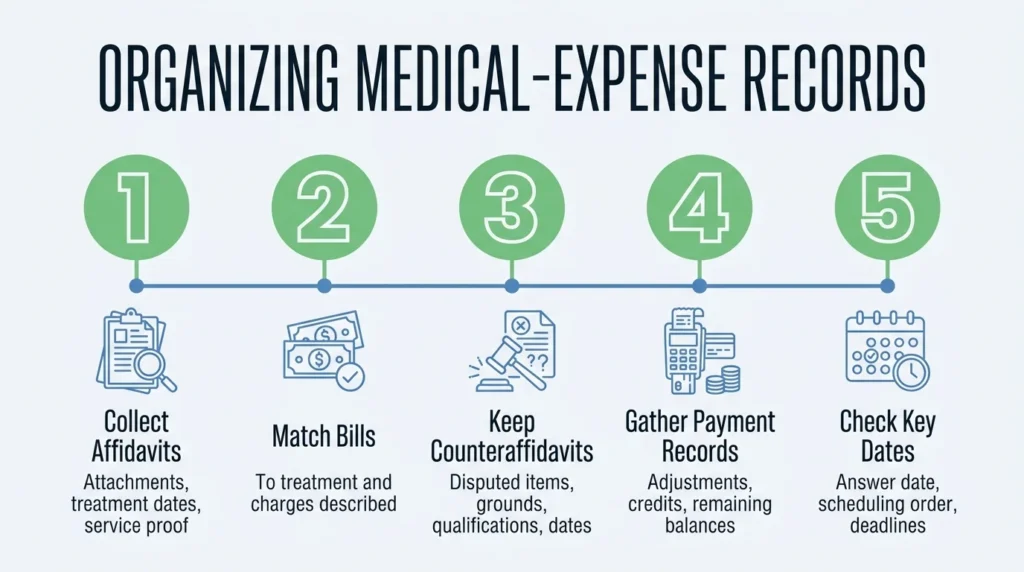
A provider-by-provider record helps your lawyer match each affidavit to treatment, bills, challenges, and payments. Work with your lawyer to organize the records; you do not need to prepare or serve these legal documents on your own:
- Collect each provider’s affidavit and attachments, treatment dates, and proof of when the affidavit was served.
- Match itemized bills to the treatment and charges described in each affidavit.
- Keep any counteraffidavit with its disputed items, stated grounds, author’s qualifications, and service date.
- Gather payment records, adjustments, credits, and remaining balances.
- Have counsel check the defendant’s answer date, scheduling order, expert-designation deadlines, and trial setting.
Talk With Angel Reyes & Associates About Your Medical-Expense Evidence
Angel Reyes & Associates can review your medical bills, affidavits, counteraffidavits, and payment records in a free consultation. Bring the records you have so our team can walk you through your options.
Past results do not guarantee future outcomes.
Texas Medical Billing Affidavit FAQs
Can a medical billing affidavit be challenged if the provider made a billing error?
Yes. Incorrect charges, inaccurate itemization, or discrepancies between the affidavit and billing records may provide grounds to challenge the evidence, depending on the circumstances and applicable procedural requirements.
Does a Texas medical billing affidavit prove that a preexisting condition was caused by an accident?
No. Under Texas Civil Practice and Remedies Code §18.001(f), the affidavit procedure cannot be used to establish causation, so separate evidence is needed to connect the treatment to the accident rather than a preexisting condition.
Can medical billing affidavits from multiple providers be used in the same Texas injury lawsuit?
Yes. Each provider may supply a separate affidavit covering its services and charges, allowing the parties to evaluate medical expenses from hospitals, physicians, imaging centers, and other treatment providers individually.
What happens if a medical provider changes its charges after serving a Texas medical billing affidavit?
A change in charges may require updated billing records and, depending on the circumstances, a supplemental affidavit that complies with the applicable procedural deadlines. The parties should reconcile any revised charges, payments, adjustments, and outstanding balances before presenting the medical expenses as evidence.
About the Authors

Angel Reyes
Writer
Angel L. Reyes, III is the Founder and Managing Partner of Angel Reyes & Associates. A nationally recognized trial attorney and business leader, Angel founded the firm in 1993, which has gone on to help over 70,000 injury victims recover more than $1 billion. Named to the Texas Super Lawyers list annually since 2008, Angel brings Wall Street experience, Ivy League education, and a deep commitment to client advocacy. He is a frequent legal commentator and published author with extensive contributions to legal scholarship, trial strategy, and consumer protection.

Kyle Nicolas
Editor
Kyle Nicolas is the Web Content & SEO Manager at Angel Reyes & Associates. He has more than 10 years of experience as a marketing co...

Angel Reyes
Reviewer
Angel L. Reyes, III is the Founder and Managing Partner of Angel Reyes & Associates. A nationally recognized trial attorney and business...