Is a Party Host Liable for a DWI?


Every article on this site is researched by our internal team, reviewed for legal accuracy against current Texas law, and held to State Bar of Texas advertising standards before publication. We do not publish content that overstates outcomes or makes promises about results.
Learn more about our
editorial standards .
Key Takeaways
- Texas generally does not hold private hosts liable for serving adult guests who drive drunk.
- Hosts 21 or older can face claims for knowingly furnishing alcohol to guests under 18.
- Save texts, posts, receipts, and ages to show who supplied alcohol and to whom.
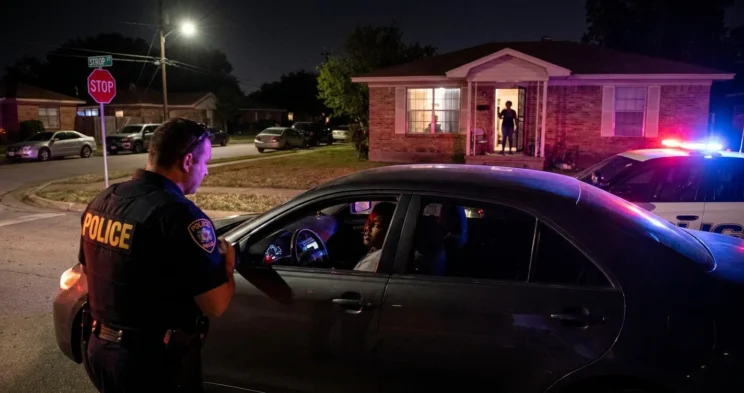
You were driving in your neighborhood or a friend’s neighborhood, and got hit by another driver. Then you find out the driver had been drinking at a local private party.
A private party host in Texas generally is not liable merely for serving an adult guest who later drives drunk. If that driver injured you, however, the guest’s age, the alcohol supplier, and the host’s conduct can change which claims are available.
Social host liability in Texas includes a specific claim involving guests under 18. Separate rules may apply to alcohol sellers and employers who take control of incapacitated employees. A DWI arrest alone does not establish a civil claim, rather the claim concerns injuries or property damage caused by intoxication.
Can You Sue a Party Host Who Let an Adult Guest Drive Drunk?
Generally, no, if the host’s only conduct was supplying alcohol to an adult social guest or failing to stop that guest from driving. In Graff v. Beard, a guest allegedly left a party intoxicated and collided with a motorcycle. The Texas Supreme Court rejected a duty on the social hosts even though the claimant alleged they knew the guest was intoxicated and would drive.
At a house party, start with who supplied the alcohol and the guest’s age. The same social-host limitation reaches guests who are 18, 19, or 20. In Smith v. Merritt, the Texas Supreme Court rejected negligence claims based on providing alcohol socially to a 19-year-old.
Being below the drinking age does not bring someone within the under-18 provision. Texas Alcoholic Beverage Code § 2.03 makes Chapter 2 the exclusive cause of action for providing alcohol to someone 18 or older.
Section 2.02(a) preserves claims against the person whose drinking caused injury or property damage. You can still investigate car accident injury claims against the driver. Graff addresses social alcohol service and letting an adult drive; it does not give homeowners immunity from every possible claim.
When Can a Host Be Liable for an Intoxicated Guest Under 18?
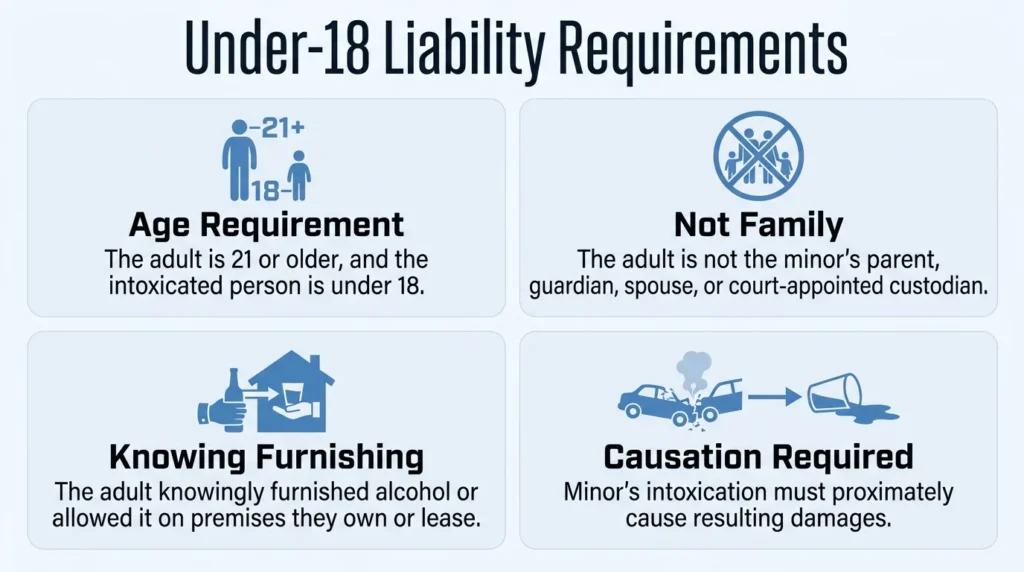
Section 2.02(c) allows a civil claim against certain adults who knowingly furnish alcohol to a person under 18 or knowingly allow that furnishing. The statute requires all of these conditions:
- The defendant adult is 21 or older, and the intoxicated person is younger than 18.
- The adult is not that minor’s parent, guardian, spouse, or an adult to whom a court has committed the minor’s custody.
- The adult either knowingly furnished alcohol that contributed to the minor’s intoxication or knowingly allowed such furnishing on premises the adult owns or leases.
- The minor’s intoxication proximately caused the damages.
The Two Routes Have Different Property Requirements
An adult who personally furnishes the alcohol need not own or lease the property to fall within the first route. The ownership or lease requirement applies to the second route, which concerns knowingly allowing the furnishing. Running an event does not by itself satisfy that property requirement.
The family exclusions concern the particular intoxicated minor. A parent hosting other people’s teenagers can still face a claim involving those guests, and permission from another child’s parent is not a listed exclusion. These exclusions concern this specific claim, not permission for all underage drinking or immunity from unrelated claims.
A Recent Decision Applies the Under-18 Statute
Older decisions rejecting common-law social-host liability do not erase Section 2.02(c), enacted in 2005. In March 2026, the San Antonio Court of Appeals recognized the statutory claim in Cisneros v. Leal.
The court reversed summary judgment and sent the case back; it did not find the hosts liable. It explained that allowing service can include passive acquiescence, and the hosts’ denial of express permission did not settle that question on that record. Knowledge remains required: ownership of the house alone does not establish liability.
How Do Office Parties & BYOB Events Change the Analysis?
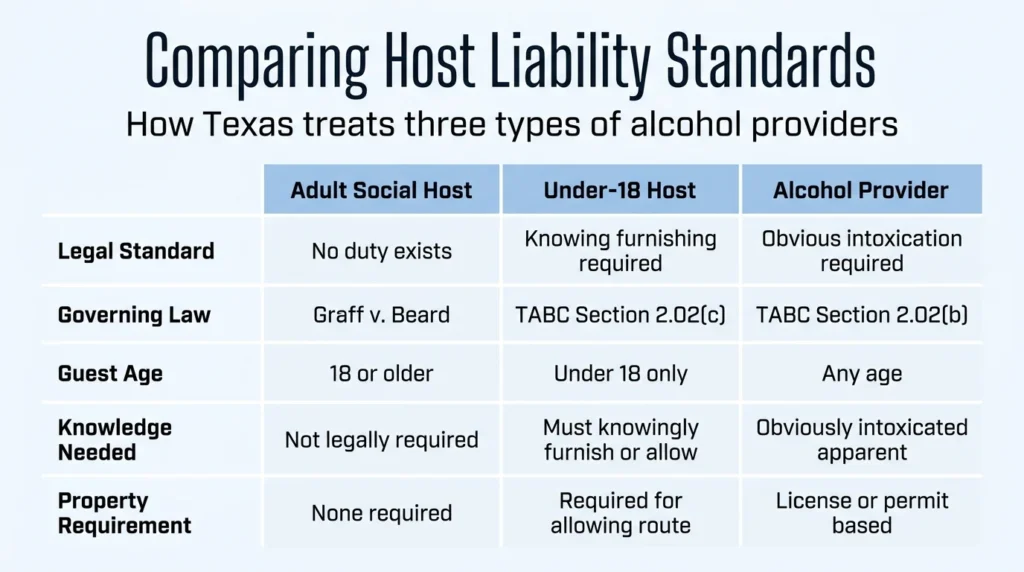
The event’s name does not decide liability. Identify the guest’s age, who supplied or sold alcohol, who knowingly allowed under-18 service, and who owned or leased the premises.
BYOB Venues & Guest-Supplied Alcohol
Another guest bringing the drinks does not end the under-18 inquiry. The Texas Alcoholic Beverage Commission’s FAQs discuss potential under-18 civil liability at BYOB locations. Section 2.02(c)’s conditions still matter, including knowledge and the ownership or lease requirement for allowing someone else to furnish alcohol.
TABC notes that Texas has no general statewide BYOB law, although local rules and permit restrictions may apply. Those licensing questions do not resolve civil liability.
A building owner is not automatically an alcohol provider, and the absence of a license does not establish that an event was purely social. For an adult guest at a private social BYOB event, Graff remains relevant.
Office Parties & Employer Control
An office party at a Dallas restaurant may involve an employer, organizer, supervisors, restaurant or caterer, and individual servers. Investigate their roles separately. A licensed provider or alcohol seller faces a different analysis from an employer hosting a purely social gathering.
In Otis Engineering Corp. v. Clark, the Texas Supreme Court addressed an employer that exercised control over an employee because of his incapacity. The employer had to act as a reasonably prudent employer to avoid an unreasonable risk of harm to others. The case involved sending an intoxicated employee home during his shift.
Otis does not impose a general duty on every office-party sponsor to stop guests from driving. The employment relationship or awareness of drinking alone does not establish that duty; actual supervisory directions and intervention matter.
How Is a Claim Against a Bar Different?
Alcohol providers face a separate statutory standard. Section 2.01 includes those selling or serving alcohol under a license or permit and those otherwise selling alcohol.
Under § 2.02(b), it must have been apparent when alcohol was provided that the recipient was obviously intoxicated to the point of presenting a clear danger to themselves and others. That intoxication must also have proximately caused the damages.
This differs from Graff’s adult social-host rule and Section 2.02(c)’s under-18 conditions. A licensed caterer at a party may face the provider test, while a private host who merely offered a gathering place requires a separate analysis.
A later DWI arrest does not establish the recipient’s apparent condition at service. Nor is a criminal charge a prerequisite to the civil claim. The claim requires proof of the applicable civil elements and resulting harm.
What Evidence Helps Identify a Potential Claim?
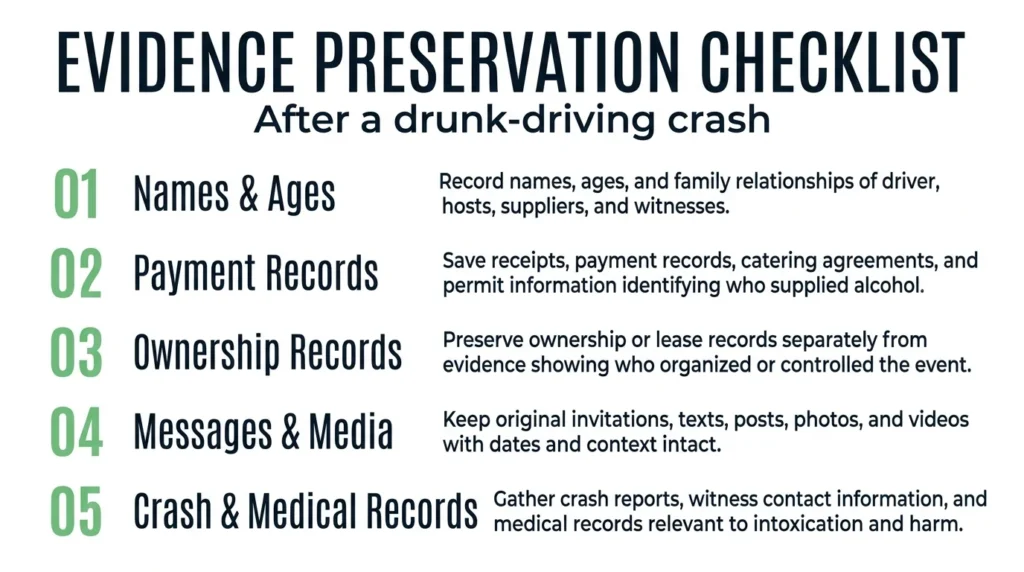
Preserve evidence showing who supplied alcohol to whom, the ages and relationships involved, and who owned or leased the location. Evidence of practical control, knowledge, timing, and the resulting harm also helps distinguish the possible claims:
- Record the names and ages of the driver, hosts, suppliers, and witnesses. Note any family or custody relationship between a host and a guest under 18.
- Save receipts, payment records, catering agreements, and permit information identifying who supplied or sold drinks.
- Preserve ownership or lease records separately from evidence showing who organized or controlled the event.
- Keep original invitations, texts, posts, photos, and videos with dates and context. Service, visible behavior, and departure timing may matter, as may supervisor directions and ride arrangements at office events.
- Gather crash reports, witness contact information, and medical records relevant to intoxication, causation, and harm.
No single photo or DWI arrest proves every element. Keep original messages and images, as edited screenshots or cropped photos can lose useful context.
Discuss a Texas Drunk-Driving Injury Claim With Angel Reyes & Associates
If you are recovering from a crash, sorting out the people and businesses involved can feel overwhelming. Bring the event information and crash records you have to a consultation so you can discuss the available evidence and your options with our team.
Request a free consultation with Angel Reyes & Associates.
Past results do not guarantee future outcomes.
DWI Claims & Party Host Liability FAQs
What should I do after a drunk driver hits me after leaving a private party?
Seek medical attention, report the crash to law enforcement, document the scene, and collect contact information from witnesses. Preserve any available evidence about the driver’s intoxication and the events leading up to the collision. If you suspect a party host, alcohol provider, or employer may have contributed to the circumstances, keep relevant messages, photographs, receipts, and event information. A Texas personal injury attorney can help evaluate potential claims against the driver and any other parties who may be legally responsible.
Does a party host have to pay for damages if a drunk guest causes a fatal accident?
A private party host in Texas is not automatically responsible for a fatal accident caused by an intoxicated adult guest. However, liability may depend on whether the circumstances support a recognized legal claim, such as a statutory claim involving the knowing provision of alcohol to a person under 18. The intoxicated driver may be held responsible for wrongful death damages if the driver’s conduct caused the death.
Can a party host be sued if an intoxicated guest injures a pedestrian?
An injured pedestrian may pursue a claim against the intoxicated driver if the driver’s negligence caused the injuries. However, a private host in Texas generally is not liable solely for serving alcohol to an adult guest who later causes a crash. A separate claim against the host would require facts supporting a recognized basis for liability, such as a qualifying claim under the statute governing alcohol furnished to minors under 18.
About the Authors

Angel Reyes
Writer
Angel L. Reyes, III is the Founder and Managing Partner of Angel Reyes & Associates. A nationally recognized trial attorney and business leader, Angel founded the firm in 1993, which has gone on to help over 70,000 injury victims recover more than $1 billion. Named to the Texas Super Lawyers list annually since 2008, Angel brings Wall Street experience, Ivy League education, and a deep commitment to client advocacy. He is a frequent legal commentator and published author with extensive contributions to legal scholarship, trial strategy, and consumer protection.

Graham Griffin
Editor
Graham Griffin is the Web & Content Manager at Angel Reyes & Associates, where he oversees content strategy, AI-powered workflows, a...

Angel Reyes
Reviewer
Angel L. Reyes, III is the Founder and Managing Partner of Angel Reyes & Associates. A nationally recognized trial attorney and business...