Who Is Liable for a Sidewalk Fall?


Every article on this site is researched by our internal team, reviewed for legal accuracy against current Texas law, and held to State Bar of Texas advertising standards before publication. We do not publish content that overstates outcomes or makes promises about results.
Learn more about our
editorial standards .
Key Takeaways
- Liability starts with who controlled the exact sidewalk segment, not the nearest address.
- Claims against Texas cities usually need proof the city actually knew about the hazard.
- A 311 report is not claim notice, and some cities have shorter deadlines than six months.
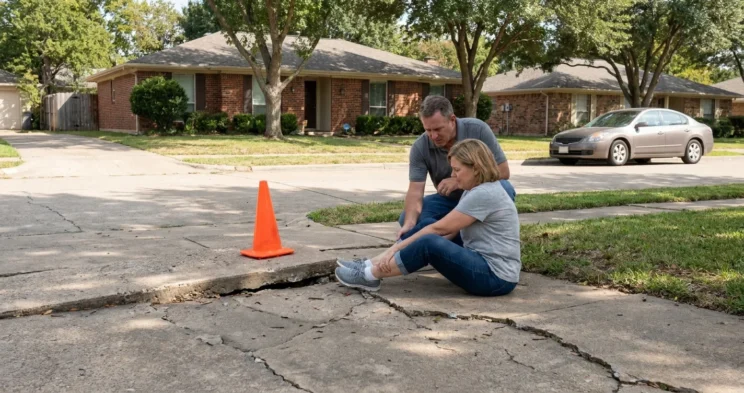
In Texas, liability for a sidewalk fall depends on who controlled the exact spot where you fell and what that party knew about the hazard.
If the sidewalk was city property, government immunity can limit your ability to sue. A claim involving an ordinary sidewalk defect generally requires proof that the city knew about the danger, and strict deadlines apply for notifying the city of your injury claim.
Who Controls the Sidewalk Where You Fell?
Start with the precise point of your fall and the party that owned, occupied, controlled, altered, or worked on that segment. The location could be a public sidewalk, private walkway, driveway crossing, utility installation, or construction area.
In City of El Paso v. Chacon, a Texas appeals court explained that owning adjoining property ordinarily does not, by itself, create a duty to keep a public sidewalk safe. A city rule requiring repairs does not, on its own, make the adjoining owner liable for injuries.
An ordinance expressly imposing injury liability, special use of the sidewalk, or wrongful conduct causing the defect may change that analysis.
Identifying who controlled the sidewalk helps determine who may owe you a duty under Texas premises liability law.
Do Texas Cities Make Adjacent Owners Repair Sidewalks?
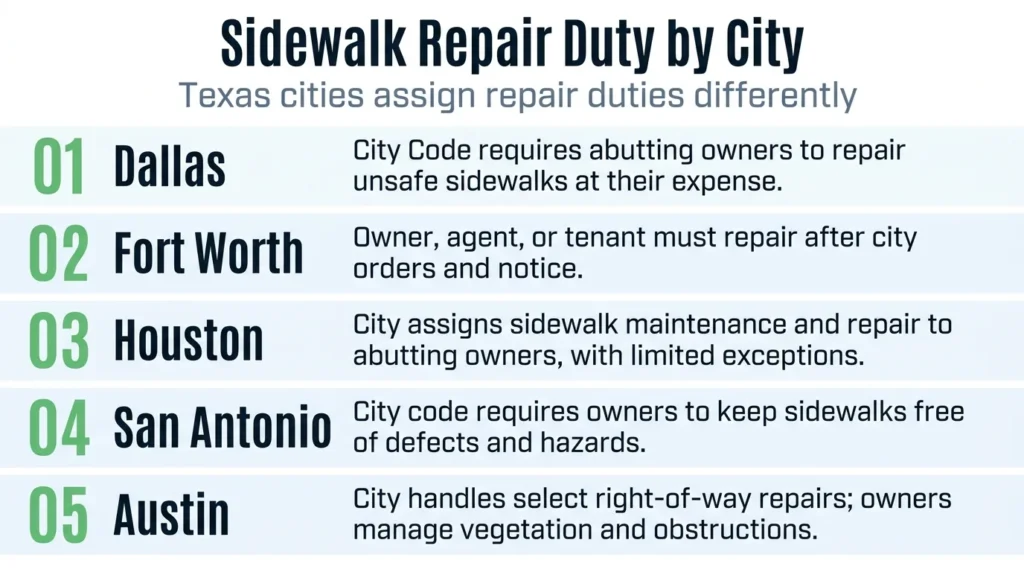
Some do, but the rules differ by city and type of work. Being required to repair a sidewalk does not automatically make a property owner responsible for an injury or rule out a claim against the city.
|
City |
What current rules or guidance say |
|
Dallas |
City Code §43-63(a) requires abutting owners to repair or reconstruct defective, unsafe, or hazardous sidewalks at their expense. |
|
Fort Worth |
City Code §30-1(b) requires an owner, agent, or tenant to repair an unsafe or defective sidewalk after the public works director issues an order and provides notice. |
|
Houston |
City Council guidance assigns neighborhood sidewalk maintenance and repair to abutting owners, with limited city replacement circumstances. |
|
San Antonio |
City disability-access guidance cites sections 29-11 and 6-1 for owners’ duties to keep sidewalks free of defects, hazards, and obstructions. |
|
Austin |
Transportation and Public Works guidance describes city repairs and maintenance in select rights-of-way, including sidewalks, and adjoining owners’ duties regarding vegetation and obstructions. |
Chacon also explains that the city may still share responsibility even when an adjoining owner has primary responsibility.
When Can You Sue a City for a Sidewalk Fall?
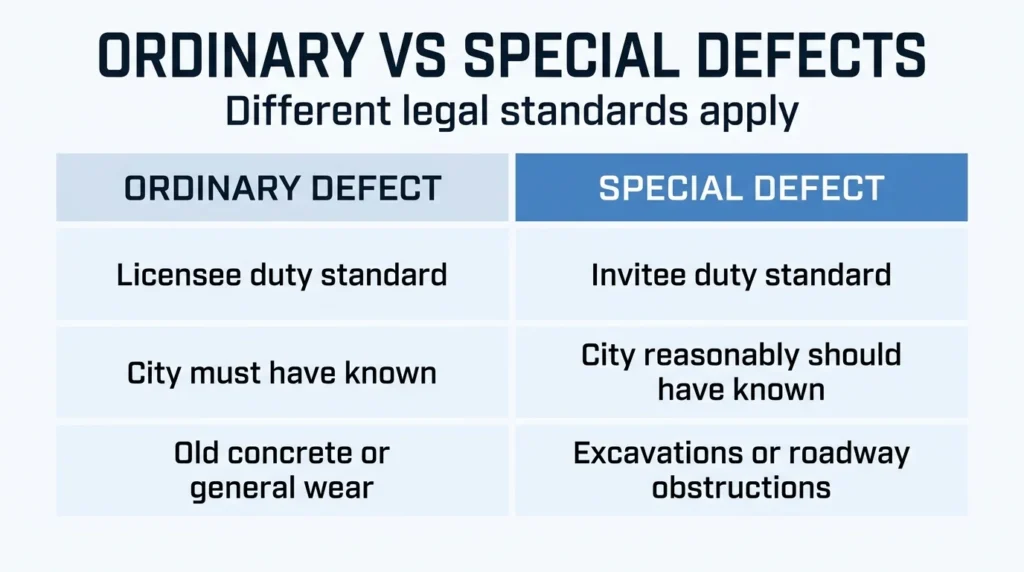
For an ordinary sidewalk defect, a claim against a city generally requires proof that the city knew about the danger. Under Texas Civil Practice and Remedies Code § 101.022(a), a city generally owes the same limited duty a private property owner owes a licensee.
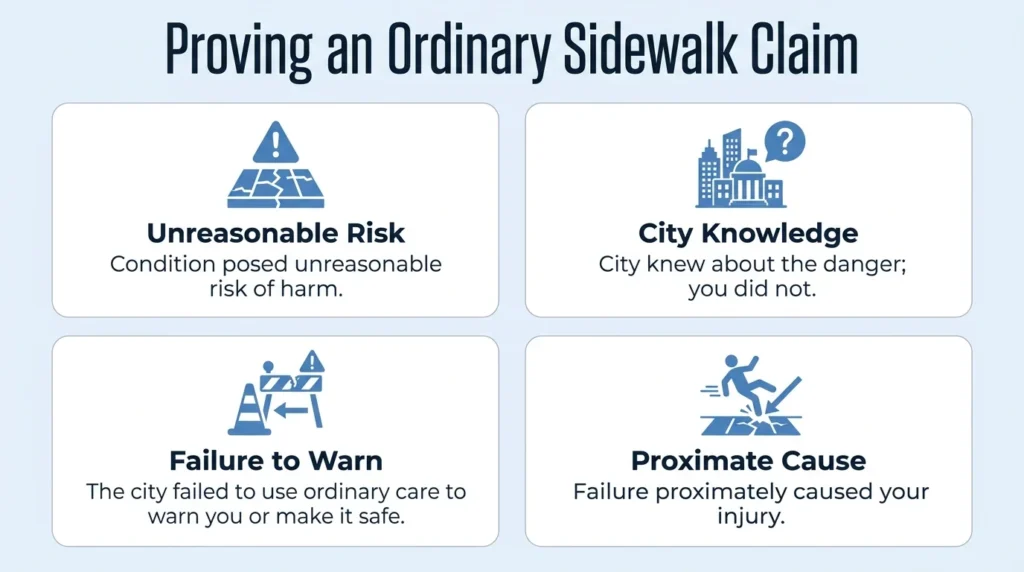
For an ordinary claim that the city failed to warn or make the condition safe, you generally must establish:
- A condition posed an unreasonable risk of harm.
- The city actually knew about it, and you did not.
- The city failed to use ordinary care to warn you or make it reasonably safe.
- That failure proximately caused your injury.
The statute includes qualifications for paid use of the premises and the circumstances covered by § 101.022(c). Paying property taxes does not count as paying to use a particular sidewalk. The licensee standard also addresses willful, wanton, or grossly negligent conduct.
How Can You Show the City Knew About the Hazard?
In City of Corsicana v. Stewart, the Texas Supreme Court required knowledge of the dangerous condition existing at the time of the accident. Circumstantial evidence must support that awareness. Knowing that a problem might develop later was insufficient.
Old concrete, general wear, or an argument that the city should have inspected does not establish the same thing. A 311 complaint made before your fall may help if its date, location, description, photographs, and handling records show that the city received a report about the same continuing hazard.
When Does a Sidewalk Hazard Qualify as a Special Defect?
Under § 101.022(b), qualifying special defects, including excavations or obstructions on highways, roads, or streets, carry a different duty. In Denton County v. Beynon, the court explained that the condition must belong to that class and threaten ordinary roadway users.
For a qualifying special defect, the invitee standard applies, including what the government reasonably should have known. Courts consider the condition itself and how it relates to roadway use. A severe injury, raised slab, or particular measurement does not automatically make a defect special.
What Evidence Helps Identify the Responsible Party & Prove Notice?
1. Photograph the defect with a reliable scale. Include close and wide views showing buildings, the curb, walking path, lighting, and warnings. Keep original files and date information. Do not put yourself at risk to take a measurement.
2. Record the exact location. Note the address, side of street, nearest intersection, and point of the fall. Get witness contacts and ask nearby businesses to preserve video promptly.
3. Request the full pre-incident 311 history. Get attachments, timestamps, routing, employee notes, inspections, work orders, closure reasons, and repair completion records. A closed request does not necessarily mean the repair was completed.
4. Compare complaints with your defect and timeline. A different slab or a hazard that appeared after a repair may not establish knowledge of the relevant condition.
5. Request ownership and maintenance records. Obtain parcel, right-of-way, easement, permit, and maintenance records from the responsible entity. A report to one agency does not establish that the city received it.
6. Keep injury and claim records. Save medical records, bills, missed-work information, incident reports, correspondence, and proof you delivered your notice of claim. These records can help support a personal injury claim.
Does a 311 Report Count as Notice of an Injury Claim?
A 311 repair complaint made before your fall does not itself notify the city of your later injury claim. Under § 101.101, the city generally must receive claim notice within six months describing the injury or damage, when and where it happened, and the incident.
A lawful city charter or ordinance may require earlier notice. Houston requires a verified written claim within 90 days. Its Legal Department filing instructions explain the required content and submission process. Check the particular city’s requirements.
The statute recognizes an actual-notice exception. In City of San Antonio v. Tenorio, the court required the city to know about the injury, its own fault contributing to it, and the parties’ identities. Awareness of an accident, a routine investigation, or what officials should have discovered is not sufficient on its own.
An ambulance call, police report, or earlier 311 complaint does not automatically preserve your claim. Send proper written notice promptly, and keep proof of delivery. Giving notice and filing an injury lawsuit have separate deadlines.
Talk With Angel Reyes & Associates About Your Sidewalk Fall
Bring photographs, the exact location, 311 numbers, medical records, and city correspondence to a free consultation with Angel Reyes & Associates. We can review your situation and walk through your options.
Past results do not guarantee future outcomes.
Sidewalk Injury Claim FAQs
How Long Do You Have to File a Sidewalk Injury Lawsuit in Texas?
Under Texas Civil Practice and Remedies Code § 16.003, you must file most personal injury lawsuits within two years of the injury. Claims against government entities also have separate notice requirements that may expire much sooner.
Can You Recover Compensation if You Were Partially at Fault for a Sidewalk Fall?
Under Texas law, you may still recover compensation if you were 50% or less responsible for the accident, although your percentage of fault reduces your recovery. If you are more than 50% responsible, Texas Civil Practice and Remedies Code § 33.001 generally bars recovery.
What if You Trip on a Sidewalk Outside an Apartment Complex or Shopping Center?
A landlord, property manager, or commercial property owner may be responsible if the accident occurred on a walkway under their control and the circumstances establish a legal duty. Liability depends on the property’s use, the dangerous condition, and whether the responsible party failed to meet its duty of care.
Can You Sue a Utility Company for a Sidewalk Trip-and-Fall Accident?
A utility company may face liability if its installation, excavation, or repair work created a dangerous sidewalk condition that caused your injury. Whether a claim is viable depends on the company’s responsibility for the work and the accident circumstances.
What Types of Compensation Are Available for a Sidewalk Fall Injury in Texas?
Depending on the circumstances, compensation may include medical expenses, lost income, pain and suffering, and other legally recoverable damages. Claims against Texas government entities are subject to statutory damage limits under Texas Civil Practice and Remedies Code § 101.023.
About the Authors

Angel Reyes
Writer
Angel L. Reyes, III is the Founder and Managing Partner of Angel Reyes & Associates. A nationally recognized trial attorney and business leader, Angel founded the firm in 1993, which has gone on to help over 70,000 injury victims recover more than $1 billion. Named to the Texas Super Lawyers list annually since 2008, Angel brings Wall Street experience, Ivy League education, and a deep commitment to client advocacy. He is a frequent legal commentator and published author with extensive contributions to legal scholarship, trial strategy, and consumer protection.

Graham Griffin
Editor
Graham Griffin is the Web & Content Manager at Angel Reyes & Associates, where he oversees content strategy, AI-powered workflows, a...

Angel Reyes
Reviewer
Angel L. Reyes, III is the Founder and Managing Partner of Angel Reyes & Associates. A nationally recognized trial attorney and business...