What is a Hospital Lien?


Every article on this site is researched by our internal team, reviewed for legal accuracy against current Texas law, and held to State Bar of Texas advertising standards before publication. We do not publish content that overstates outcomes or makes promises about results.
Learn more about our
editorial standards .
Key Takeaways
- A Texas hospital lien only applies if you were admitted within 72 hours of the crash.
- The lien is capped at the lesser of 100 days of charges or 50% of your recovery.
- Charges above a reasonable and regular rate can be challenged and negotiated down.

The settlement finally comes together, and then a letter from the hospital’s billing department shows up claiming a share of it. In Texas, that claim can be real.
A hospital that treats you after a crash can attach a lien to your injury claim under Texas Property Code Chapter 55, and a valid lien gets paid out of your financial recovery before the money reaches you.
What most injured Texans never hear is how many conditions the hospital has to meet first, and how much of the billed amount it can actually collect.
Both of those answers sit in the statute, and both of them can work in your favor.
How a Texas Hospital Gets a Lien on Your Claim (The 72-hour Rule)
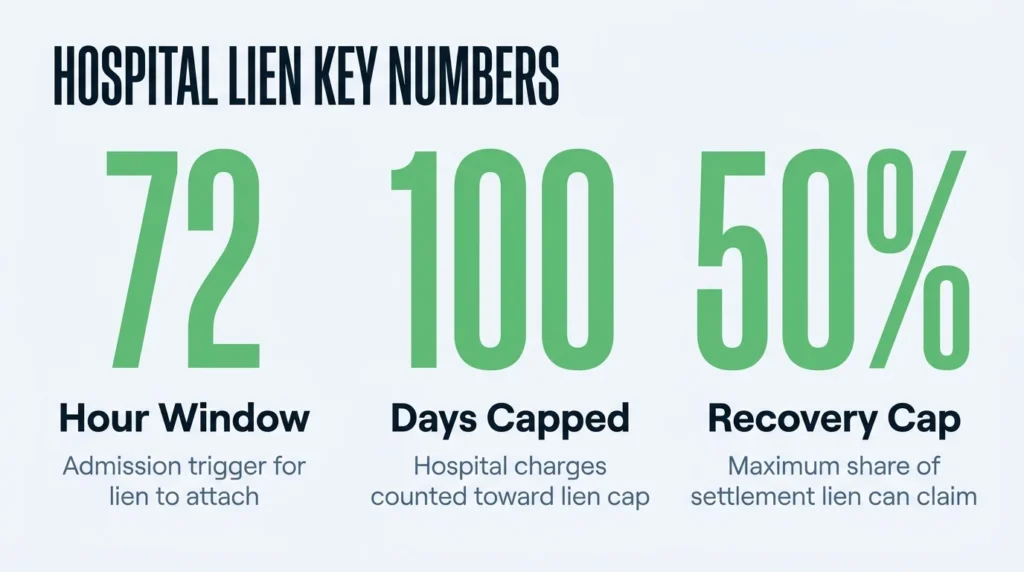
A hospital earns its lien automatically, without your signature and without going to court. Under Texas Property Code § 55.002, a hospital holds a lien on your cause of action, judgment, or settlement when it treats you for injuries caused by someone else’s negligence and you are admitted within 72 hours of the accident.
That 72-hour clock runs from the accident itself, not from the moment treatment begins.
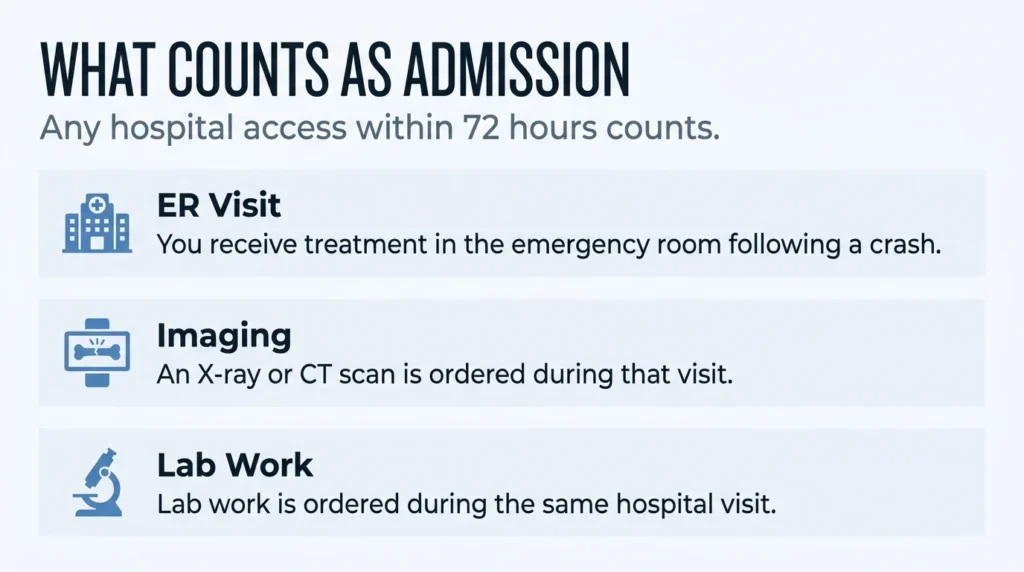
“Admitted” reaches much further than an overnight stay. Section 55.0015 treats you as admitted if you were allowed access to any department of the hospital for any treatment, care, or service. Inside the 72-hour window, that can include:
- An emergency room visit after a car accident on I-35
- Imaging such as an X-ray or CT scan
- Lab work ordered during that same visit
The lien also travels with you. If the first hospital transfers you to another facility for the same injury, § 55.002(b) extends the lien to that hospital as well.
Emergency medical services providers have a parallel lien right, but only in counties with a population of 800,000 or less. In the state’s largest counties, that EMS lien is off the table, though the hospital lien itself carries no population limit.
What Makes a Hospital Lien Enforceable?
Holding a lien and being able to collect on it are two different things. The Texas hospital lien statute requires the provider to perfect the lien, and a hospital that skips a step can lose its grip on your settlement money.
Section 55.005 sets out two steps:
- Mail written notice of the lien to the injured person.
- File written notice of the lien with the county clerk in the county where the services were provided, before any settlement or judgment funds are paid out.
The filed notice has to identify you by name and address, the date of the accident, the hospital’s name and location, and the name of the party alleged to be liable, if that name is known.
Timing controls the outcome here. A lien filed after the funds have already been disbursed does not reach that money.
There is no separate calendar deadline tied to your discharge date. Some sources describe a fixed post-discharge filing window, but perfection under the statute turns on filing before payment, not on a set number of days.
Once perfected, the lien stays on record until it is formally released. Under § 55.006, discharge happens only when the provider files a certificate with the county clerk stating the debt has been paid or released.
A perfected lien also survives your signature on a release. Under § 55.007, a release of the underlying claim is not valid against the lien unless the lien charges were paid in full, paid to the extent of what you actually received, or the hospital was itself a party to that release. That is why lien verification belongs before a case closes rather than after.
How Much a Hospital Lien Can Actually Take
Even a properly perfected lien has a ceiling. Under § 55.004, the lien is limited to the lesser of:
- Hospital charges for services during the first 100 days of hospitalization, or
- 50% of everything you recover by settlement or judgment
The lien may also cover reasonable and necessary charges for emergency care by physicians during the first seven days of hospitalization.
The statute strips out charges above a reasonable and regular rate for the services. It also excludes physician charges where insurance or a medical indemnity plan’s benefits were accepted, along with a few narrower categories the statute lists by name.
Reasonable and regular does not mean whatever the hospital’s list price says. In In re North
Cypress Medical Center Operating Co., 559 S.W.3d 128 (Tex. 2018), the Texas Supreme Court held that a hospital’s negotiated reimbursement rates from insurers, Medicare, and Medicaid are relevant and discoverable when a patient challenges a lien as unreasonable. Those rates reflect what the hospital accepts as payment in full from the vast majority of its patients.
Chargemaster prices alone do not answer the question, and neither do reimbursement rates by themselves. Both feed the same reasonableness analysis.
This is where the itemized bill earns its place in the file. Comparing line-item charges against what that same hospital accepts from insurers is the practical test of whether the liened amount holds up, and it sits at the center of who pays medical bills after a car accident in Texas.
What a Hospital Lien Can’t Reach
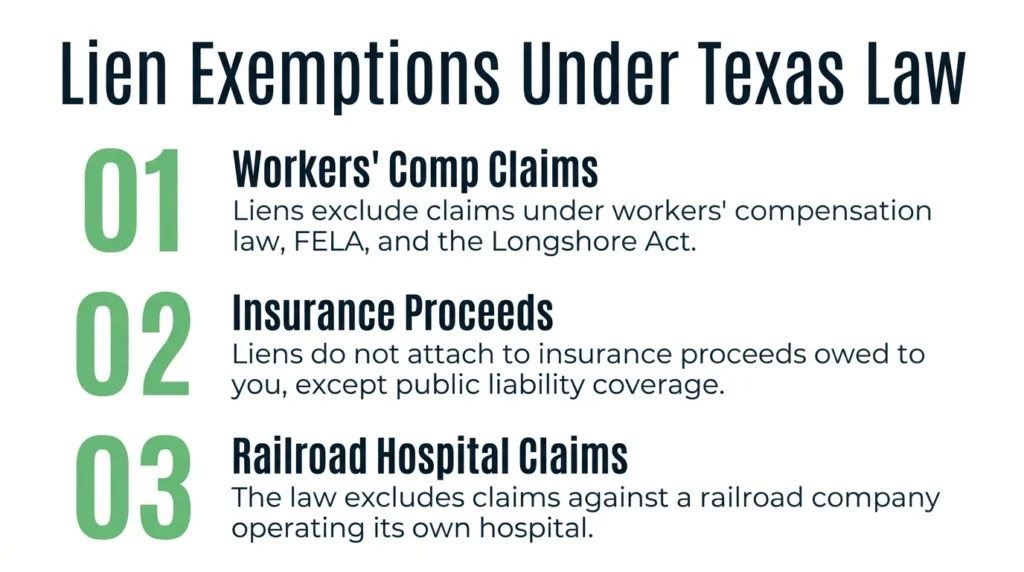
The lien attaches to your injury cause of action, to a judgment or agency award for that injury, and to settlement proceeds from the claim. Under § 55.003, it does not attach to:
- Claims under Texas workers’ compensation law, the Federal Employees’ Liability Act, or the Federal Longshore and Harbor Workers’ Compensation Act
- Proceeds of an insurance policy in favor of the injured person or that person’s beneficiary or representative, other than public liability insurance carried by the insured
- Claims against a railroad company that operates its own hospital where the injured person was treated
The at-fault party’s own liability coverage is the pot the lien is built to reach. Insurance benefits payable to you generally sit outside it.
Where the statute goes quiet is your own PIP, MedPay, and UM/UIM benefits. The text does not name those coverages, and how a particular policy is characterized can shape the answer. Treat that as a question to work through with your attorney rather than a settled rule.
Negotiating a Hospital Lien Before Your Settlement Closes
Chapter 55 creates no negotiation procedure, and yet hospital liens get reduced regularly. The leverage comes from the statute’s own limits and from a sober look at what the hospital can prove.
The reasonableness ceiling is contestable. North Cypress opens a path to the hospital’s actual accepted rates for the same services, and a wide gap between those rates and the billed amount supports an argument for a lower payoff.
The caps do independent work. When the financial recovery is modest, the 50% limit can cut the lien substantially before anyone sits down to negotiate.
Hospitals weigh their own position too. When liability coverage is thin or fault is contested, a prompt partial payment often beats a long collection effort.
Three pieces of evidence carry that conversation. The filed lien notice and its date show whether perfection happened before payment. Your admission timing shows whether the 72-hour trigger applied at all. The itemized charges show whether the amount survives the reasonable and regular standard.
Hospital liens are also easy to confuse with auto insurance subrogation, a separate reduction mechanism with its own rules. Both can land on the same settlement, and both need to be resolved before funds are released.
Talk to Angel Reyes & Associates About Your Hospital Lien
A lien notice in your mailbox is not the last word on what the hospital collects. Whether the 72-hour trigger applied, whether the filing beat disbursement, and whether the charges are reasonable and regular are all questions with real answers.
Angel Reyes & Associates has guided injured Texans through situations like this for over 30 years.
Our team can review the filed lien, test the charges against what the hospital accepts from insurers, and work to reduce what comes out of your recovery before the money moves.
Contact Angel Reyes & Associates for a free consultation.
Past results do not guarantee future outcomes.
Hospital Lien FAQs
Does a hospital lien cover ambulance bills in Texas?
Not necessarily. Texas law gives emergency medical services providers a separate lien right subject to specific statutory requirements, including a county-population limitation, so an ambulance bill should not automatically be treated the same as a hospital lien.
What happens if a hospital never files its lien with the county clerk?
Under Texas Property Code § 55.005, a hospital must file written notice of the lien with the county clerk before settlement or judgment proceeds are paid; otherwise, the lien does not attach to those proceeds.
Can a hospital lien attach to a wrongful death settlement in Texas?
Texas hospital lien law can apply to certain claims arising from an injury, but whether a particular wrongful-death recovery is subject to a hospital lien depends on the nature of the claim and the statutory requirements.
About the Authors

Angel Reyes
Writer
Angel L. Reyes, III is the Founder and Managing Partner of Angel Reyes & Associates. A nationally recognized trial attorney and business leader, Angel founded the firm in 1993, which has gone on to help over 70,000 injury victims recover more than $1 billion. Named to the Texas Super Lawyers list annually since 2008, Angel brings Wall Street experience, Ivy League education, and a deep commitment to client advocacy. He is a frequent legal commentator and published author with extensive contributions to legal scholarship, trial strategy, and consumer protection.

Kyle Nicolas
Editor
Kyle Nicolas is the Web Content & SEO Manager at Angel Reyes & Associates. He has more than 10 years of experience as a marketing co...

Angel Reyes
Reviewer
Angel L. Reyes, III is the Founder and Managing Partner of Angel Reyes & Associates. A nationally recognized trial attorney and business...