Who Is Liable in a Left Turn Crash?


Every article on this site is researched by our internal team, reviewed for legal accuracy against current Texas law, and held to State Bar of Texas advertising standards before publication. We do not publish content that overstates outcomes or makes promises about results.
Learn more about our
editorial standards .
Key Takeaways
- Texas Section 545.152 requires left-turning drivers to yield to oncoming immediate hazards.
- Proven speeding or a signal violation can make the oncoming driver share fault for a crash.
- Under Chapter 33, an injured person more than 50% responsible cannot recover damages.
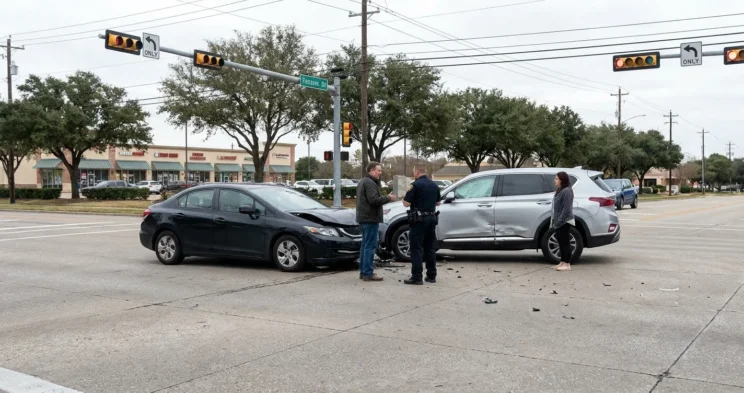
In Texas, a driver turning left must yield to oncoming traffic that presents an immediate hazard, but that driver is not automatically responsible for the entire crash. Who is at fault in a left turn accident depends on each driver’s conduct and how it contributed to the collision. Proven unsafe speed or a signal violation by the oncoming driver can support shared responsibility.
Being injured and blamed for a crash is stressful. Before accepting an insurer’s fault assessment, look at the evidence about speed, signals, and visibility. An adjuster’s initial position is not a court finding.
When Does the Left-Turning Driver Have to Yield in Texas?
A driver turning left must yield to opposing traffic already in the intersection or close enough to be an immediate hazard. Texas Transportation Code § 545.152 applies at intersections and when turning into an alley, private road, or driveway. Section 545.103 also requires a safe turning movement.
The yield duty starts the fault analysis. Determining whether the oncoming vehicle presented an immediate hazard requires evidence of its position and movement as the turn began.
How Green Lights & Arrows Affect a Turn
A circular green light permits a left turn subject to the driver’s yielding duties. A green light alone does not give a turning driver priority over oncoming traffic.
TxDOT’s arrow signal guidance distinguishes three arrow indications: a flashing yellow arrow allows a left turn after yielding to oncoming traffic, a steady yellow arrow means prepare to stop, and a steady green arrow provides a protected turn.

Even with a green arrow, the driver must proceed cautiously. Section 544.007(c) preserves duties to yield to traffic lawfully using the intersection and to stop and yield to pedestrians or other sidewalk users lawfully in an adjacent crosswalk.
When Could the Oncoming Driver Share Fault?
An oncoming driver may share fault if unsafe speed or a signal violation contributed to the crash. Neither allegation automatically cancels the turning driver’s yield duty. The investigation must connect the other driver’s conduct to what happened.
Oncoming Speed
Sections 545.351 and 545.352 govern speed. Drivers must travel at a reasonable and prudent speed for conditions, with appropriate reductions when approaching or crossing intersections.
Exceeding the applicable limit is prima facie evidence of unlawful speed, meaning initial evidence that can be challenged.
A statement that the other car was “flying” needs support. Vehicle data or video may help establish speed and whether it contributed to the collision. That connection matters when evaluating both the approaching driver’s conduct and the hazard facing the turning driver.
Entering on a Yellow Light
An oncoming driver who “ran a yellow” did not necessarily violate the signal. Under § 544.007(e), steady yellow warns that the green movement is ending or red is approaching. Entering on yellow is not automatically a violation; steady red requires stopping under subsection (d).
Evidence must distinguish yellow-light entry from red-light entry. Unsafe speed can still matter, but the color alone does not settle responsibility.
An Intersection Signal That Changed Mid-Turn
A turn indication may change after a driver enters the intersection. That later change alone does not prove either driver’s entry signal or fault.
Reconstruct the indication each driver faced upon entry, the vehicles’ positions, and the sequence through impact. A witness who noticed the light only after the collision may not resolve what it showed when either driver entered.
What If Another Turning Vehicle Blocked the View?
A vehicle waiting in the opposite left-turn lane can hide approaching through traffic. The Federal Highway Administration’s left-turn lane research explains how lane alignment and vehicle position affect visibility.
A blocked view may explain why the turning driver did not see an approaching car. It does not by itself excuse the yield duty or establish that the waiting driver was negligent. Ordinary lawful waiting in a turn lane does not automatically transfer responsibility.
Examine where the waiting vehicle sat, how the opposing turn lanes aligned, and when the oncoming vehicle first became visible. Sight-line photographs from the turning driver’s position can help show the obstruction. Later photographs should identify differences from crash conditions, especially if the blocking vehicle is gone.
What Evidence Helps Resolve a Disputed Left-Turn Crash?
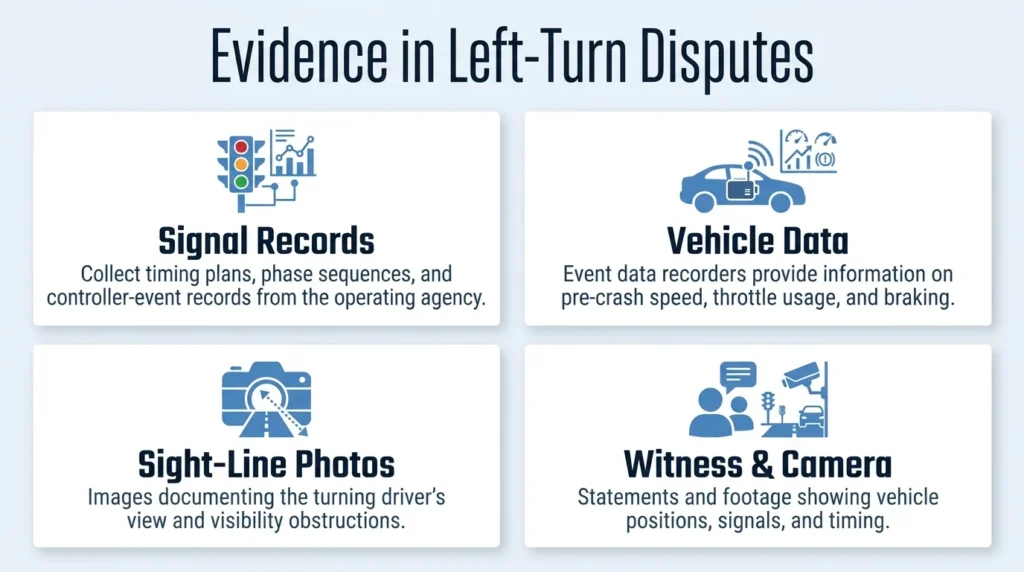
Signal records, vehicle data, sight-line photographs, and witness or camera evidence can help resolve disputes about entry signals, speed, and visibility. Start by identifying which evidence could answer the specific disagreement in your crash.
Signal Timing Records
Identify the agency operating the signal and request the timing plan applicable on the crash date, phase sequence, and any retained controller-event, maintenance, or malfunction records. TxDOT accepts written public-information requests with contact information and a clear description of the records sought. A city-operated signal may require a request to a different custodian.
A programmed timing plan describes the intended operation. It does not, by itself, timestamp the actual collision sequence. Compare it with available logs, video, and witness observations before concluding which indication a driver faced.
The Oncoming Vehicle’s Event Data Recorder
An event data recorder may provide information about vehicle motion and driver inputs, including pre-crash speed, throttle, and braking. NHTSA’s event data recorder research also describes limitations that require comparison with other evidence.
Ask a qualified professional whether the particular vehicle recorded relevant information and whether it can be retrieved. Do not assume every vehicle supplies the same data or that access is automatic.
Sight-Line Photographs & Witness Evidence
Document the turning driver’s viewing position, opposing lane, lane alignment, and obstructions safely. Do not stand in moving traffic. Note whether later photographs recreate what the driver could see at the time.
Seek witness contact information and original dashcam or nearby camera files promptly. Compare viewing angles, visible signal heads, sequence, and available timestamps. Ask witnesses what they personally saw, including when they first noticed each vehicle and signal.
A camera mounted near the intersection does not guarantee recorded footage. Houston TranStar, for example, says it does not record or save its camera images. That limitation applies to its system, not every Texas traffic camera.
How Does Shared Fault Affect a Texas Claim?
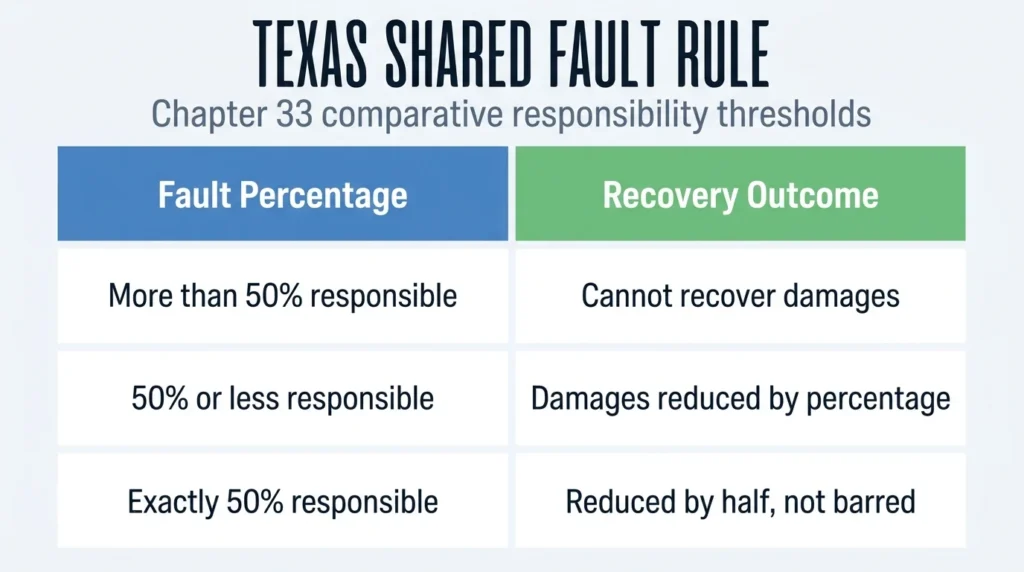
For ordinary tort claims within its scope, Texas Civil Practice and Remedies Code Chapter 33 allows the factfinder to allocate responsibility based on conduct that caused or contributed to the harm, when supported by sufficient evidence.
A claimant more than 50% responsible cannot recover damages. At 50% or less, damages are reduced by the claimant’s percentage. Exactly 50% does not exceed that threshold, so recovery is reduced by half rather than barred.
No reliable percentage follows from the words “left-turn crash” alone. Yielding, speed, entry signals, and visibility must be considered together. Texas car accident lawyers can review those facts and the evidence supporting an insurer’s position.
Talk to Angel Reyes & Associates About a Left-Turn Crash
You do not have to sort through conflicting accounts alone. Contact Angel Reyes & Associates for a free consultation about your left-turn crash and the available evidence. Bring any photographs, witness details, or footage you already have. Our team is here to help.
Past results do not guarantee future outcomes.
Left Turn Crash Liability FAQs
What happens if both drivers claim they had the right of way in a left-turn accident?
When drivers disagree about who had the right of way, investigators may examine traffic signals, witness statements, vehicle data, photographs, and available video footage. These sources can help establish each vehicle’s position and movement before the collision. If the dispute continues, a court may determine responsibility based on the evidence.
How long do I have to file a lawsuit after a left-turn accident in Texas?
In many Texas personal injury cases, the statute of limitations is two years from the date the cause of action accrues. However, exceptions may apply, including certain claims involving minors or government entities. Because deadlines can vary, consider consulting a Texas attorney promptly to determine which deadline applies to your circumstances.
Can I file a claim if the driver who hit me during a left turn was uninsured?
You may still have options for pursuing compensation. Depending on your insurance policy and the circumstances, uninsured motorist coverage may help cover eligible damages. Personal injury protection or medical payments coverage may also provide benefits for certain expenses, regardless of who caused the crash. The available coverage depends on your policy terms and applicable law.
About the Authors

Spencer Browne
Writer
Spencer Browne is a partner at Angel Reyes & Associates and a Board Certified personal injury trial lawyer with nearly 100 jury trials across Texas. He focuses on car, truck, and wrongful death cases, with notable verdicts including a landmark win in the Choctaw Casino bus crash case. A recognized speaker and legal educator, Spencer is a member of the American Board of Trial Advocates and has been honored as a Texas Super Lawyer and one of D Magazine’s Best Lawyers in Dallas. He brings deep trial experience and relentless advocacy to every client he represents.

Graham Griffin
Editor
Graham Griffin is the Web & Content Manager at Angel Reyes & Associates, where he oversees content strategy, AI-powered workflows, a...

Angel Reyes
Reviewer
Angel L. Reyes, III is the Founder and Managing Partner of Angel Reyes & Associates. A nationally recognized trial attorney and business...