Who Has the Right of Way When Merging?


Every article on this site is researched by our internal team, reviewed for legal accuracy against current Texas law, and held to State Bar of Texas advertising standards before publication. We do not publish content that overstates outcomes or makes promises about results.
Learn more about our
editorial standards .
Key Takeaways
- In Texas, an ending lane or turn signal alone does not give a merging driver automatic priority.
- A signed zipper merge means taking turns at the taper, never forcing into an occupied space.
- A through driver who speeds up or crowds an entering car may share fault, based on the evidence.

In Texas, reaching the end of an on-ramp or ending lane does not give a merging driver automatic priority, and neither does a turn signal. The driver entering an occupied through lane must make a safe entry. The driver already in that lane still has duties of their own.
After a merging collision, each driver may blame the other. Answering who has the right of way when merging starts with the lane layout, traffic controls, and what both drivers did before contact.
Who Has the Right of Way When a Lane Merges in Texas?
The driver entering from an on-ramp or a lane that ends usually has to fit into traffic safely. Reaching the merge point does not let that driver claim the space. On a roadway with two or more clearly marked lanes, Texas Transportation Code § 545.060 and § 545.104 require a driver to stay in a lane until leaving it is safe and to signal a lane change.
Safe Entry From On-Ramps & Ending Lanes
The key question is whether a safe gap existed when the merging driver began to move. This applies to on-ramp merges into occupied through lanes. It also applies to lane drops, where your lane ends and you must move into the lane beside you.
The physical layout matters. § 545.060 applies where the roadway has clearly marked lanes, which often includes a marked acceleration lane or an ending lane. Ramps are not all built the same way, so the actual markings and controls at that spot shape how the rule applies.
For example, say a driver on an LBJ Freeway on-ramp moves left into a gap that a through vehicle already occupies. Fault does not turn on whose bumper ended up farther ahead after contact. It turns on whether the gap was open and safe when the ramp driver started moving over.
There is no single safe response for every ramp. Traffic, signs, available space, and the road layout determine whether adjusting speed or waiting for an opening is appropriate. Do not assume that every ramp requires a full stop or that a particular speed makes entry safe.
Why a Turn Signal Does Not Award Priority
A signal is required, but it only tells other drivers what you plan to do. A turn signal does not force other drivers to let you in, and it does not make an unsafe move legal. A driver who signals and then moves into an occupied space can still be at fault.
How Does a Work-Zone Zipper Merge Affect Priority?
At a signed late-merge work zone, drivers can use both lanes up to the point where one closes and then take turns entering the open lane. That is the zipper merge. It calls for coordinated, alternating entry. A zipper merge does not give either driver permission to force into an occupied space.
Texas traffic-control guidance recognizes this setup. TxDOT’s list of changes to the Texas Manual on Uniform Traffic Control Devices, effective January 18, 2026, adds a Late Merge section with signs and a figure.
How a Signed Zipper Merge Works
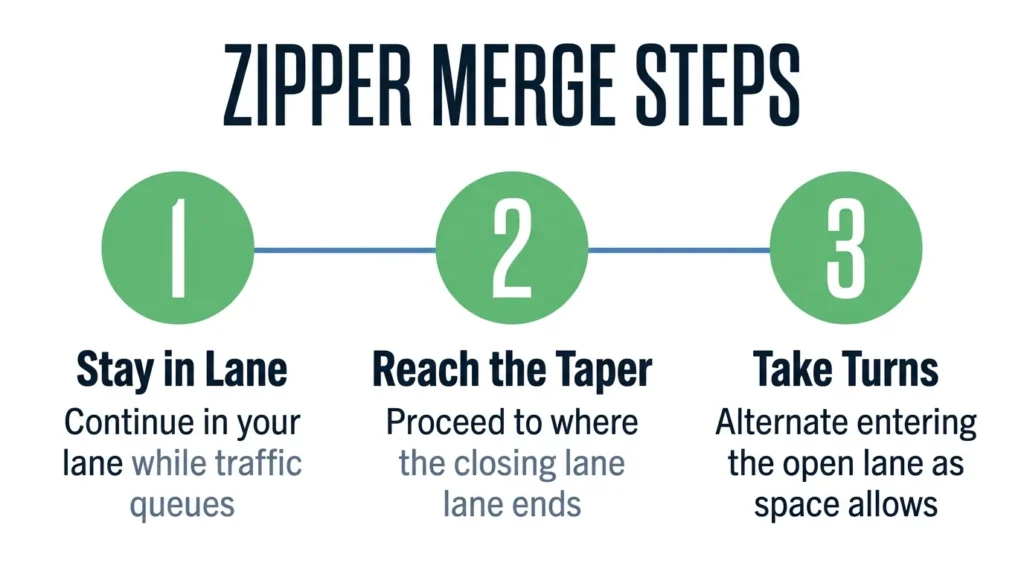
Research from the Texas A&M Transportation Institute, sponsored by TxDOT and the Federal Highway Administration, describes the basic process. Where signs direct a late merge, the sequence runs this way:
- Stay in your current lane while traffic is queued, including the lane that closes ahead.
- Continue to the taper, where the closing lane narrows and ends.
- Take turns entering the open lane as space allows.
As an illustration, consider an I-35 construction zone with late-merge signs. A driver in the open lane lets one car from the closing lane move in, then moves forward. The next car in the closing lane waits for the following gap. Neither driver tries to take the same space at the same time.
Why the Signs at the Scene Control
Not every Texas lane closure uses a late-merge layout. The report explains the practice; it is research, not a regulation. A signed zipper merge does not establish a statewide rule giving drivers automatic turns at every closure.
What drivers must follow are the controls actually in place. Under Texas Transportation Code §544.004, drivers must obey applicable official traffic-control devices, subject to the statute’s exceptions, including directions from a police officer or escort flagger. The signs at that closure on that day, and where they stood, can shape who should have yielded.
Can the Through Driver Share Fault for a Merging Accident?
Yes, the through driver can share fault, depending on the facts. The merging driver’s duty to enter safely does not settle every collision. The through driver must still drive at a reasonable speed, keep control, and follow at a safe distance.
Those duties come from Texas Transportation Code § 545.351 and § 545.062. They focus attention on what the driver already in the lane was doing in the seconds before the crash.
Through-Driver Conduct Worth Investigating

Some fact patterns call for a closer look. A through driver might speed up to close a gap the merging driver was already using. They might crowd a vehicle that had started entering, drive too fast for traffic, follow too closely, or ignore merge signs in a work zone. Each of these needs evidence before it shows fault.
Other conduct usually is not enough on its own. Simply declining to make room does not, by itself, prove the through driver was negligent. Texas law does not require through traffic to change lanes for every ramp driver. The same distinction matters at on-ramps, lane drops, and work-zone merges.
How Texas Divides Responsibility
Texas uses proportionate responsibility under Civil Practice and Remedies Code Chapter 33. Responsibility for a crash can be divided among the people whose conduct caused it. An injured person found more than 50 percent responsible cannot recover damages under that chapter. Otherwise, their recovery drops by their own percentage of responsibility.
No fixed fault split applies to merging crashes. Each case depends on what both drivers did. An insurer’s initial position on fault should be checked against the evidence.
What Evidence Helps Establish Merging Accident Fault?

Useful evidence shows what both drivers did before contact and the lane layout at the exact merge point. No single item automatically proves fault. Once you are safe, work through these evidence-preservation steps:
- Save the original dashcam file. Keep the full clip, including the approach before impact. It can show who changed lanes, when a gap existed, and whether either driver braked or sped up.
- Ask who actually recorded the traffic camera video. TxDOT states that its live traffic cameras are for real-time monitoring and do not record footage. Other cameras, such as those at nearby businesses, have to be checked one by one.
- Photograph the lane markings and signs safely. Capture which lane ended, where the taper began, and what merge signs were visible. Construction setups can change by location and date, so images from the scene matter.
- Document positions and speeds. Footage, witness accounts, impact locations on each vehicle, and available vehicle data can help show where both cars were and how fast they moved. Damage alone does not reveal exact speed or a fault percentage.
§ 544.004 also ties sign enforcement to whether a device was properly placed and legible. Photos of the work-zone signs can matter for that reason too.
Talk to Angel Reyes & Associates About a Merging Collision
A merging crash often comes down to seconds of driving and a few feet of pavement. You do not have to sort out the footage, the signs, and the other driver’s story alone.
Contact Angel Reyes & Associates for a free consultation to talk through what happened and the evidence available in your case. Our team is here to help.
Past results do not guarantee future outcomes.
Right-of-Way When Merging FAQs
Can a driver be at fault for speeding up to block someone from merging?
Potentially. A driver who accelerates to close a gap or otherwise drives negligently may share responsibility for a merging crash. Fault depends on the available evidence and whether the driver’s actions contributed to the collision.
Is it illegal to refuse to let someone merge in Texas?
Not necessarily. Texas law does not generally require a driver to create a gap for every vehicle attempting to merge. However, deliberately driving aggressively, speeding up dangerously, or making an unsafe maneuver to prevent another driver from entering may contribute to a finding of negligence.
Can a driver merge across a solid white line in Texas?
Drivers should follow the lane markings and traffic controls governing the roadway. A solid white line generally discourages crossing, and certain markings or posted restrictions may prohibit a lane change. Whether crossing a particular line was unlawful depends on the specific road markings and applicable rules.
Can a passenger help prove fault in a Texas merging accident?
Yes. A passenger who witnessed the collision may provide an account of the vehicles’ positions, signals, speeds, and movements. Their statement can help investigators evaluate competing versions of events, particularly when dashcam footage or independent witnesses are unavailable.
How long do I have to file a lawsuit after a merging accident in Texas?
Texas generally allows two years from the date of an accident to file a personal injury lawsuit, subject to exceptions that may change the deadline. Different rules can apply to certain claims or circumstances, so it is important to confirm the applicable deadline rather than wait until it approaches.
About the Authors

Spencer Browne
Writer
Spencer Browne is a partner at Angel Reyes & Associates and a Board Certified personal injury trial lawyer with nearly 100 jury trials across Texas. He focuses on car, truck, and wrongful death cases, with notable verdicts including a landmark win in the Choctaw Casino bus crash case. A recognized speaker and legal educator, Spencer is a member of the American Board of Trial Advocates and has been honored as a Texas Super Lawyer and one of D Magazine’s Best Lawyers in Dallas. He brings deep trial experience and relentless advocacy to every client he represents.

Kyle Nicolas
Editor
Kyle Nicolas is the Web Content & SEO Manager at Angel Reyes & Associates. He has more than 10 years of experience as a marketing co...

Angel Reyes
Reviewer
Angel L. Reyes, III is the Founder and Managing Partner of Angel Reyes & Associates. A nationally recognized trial attorney and business...