Who Is Liable for a Jet Ski Accident?


Every article on this site is researched by our internal team, reviewed for legal accuracy against current Texas law, and held to State Bar of Texas advertising standards before publication. We do not publish content that overstates outcomes or makes promises about results.
Learn more about our
editorial standards .
Key Takeaways
- Operators, lending owners, and rental businesses may share liability based on their conduct.
- Texas rental businesses must instruct every operator before release and keep signed records.
- Preserve the rental agreement, waiver, ages, maintenance records, and accident report early.
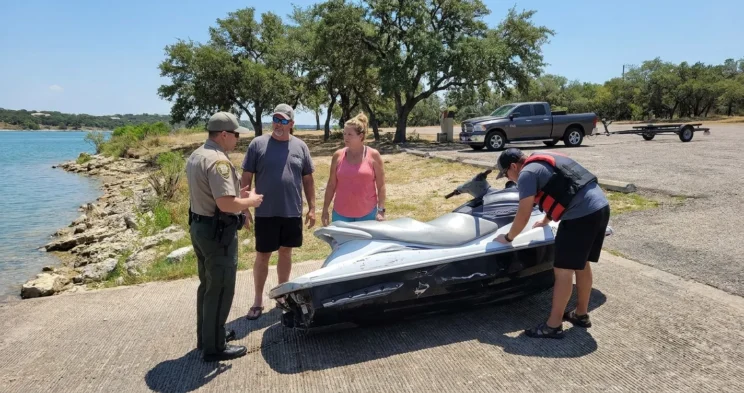
After a jet ski accident, the operator, a lending owner, or a rental business may be responsible if their conduct caused the injury. More than one party may share responsibility. If you are facing medical bills while the owner and rental company blame someone else, the evidence can help clarify each party’s role.
Who Can Be Responsible for a Jet Ski Accident?
Responsibility depends on what each party did and how it caused harm. Texas negligence analysis ordinarily asks whether someone owed a duty, breached it, and caused injuries through that breach.
A collision investigation compares both operators’ speed, route, lookout, and separation. The jet ski rider is not automatically at fault because a jet ski was involved.
When a rider is thrown off, examine maneuvers, wake, instructions, cutoff equipment, and mechanical condition. A fall alone does not prove careless riding or a defect.
For a swimmer injury, investigate visibility, proximity, and designated swimming boundaries. Each scenario requires connecting someone’s conduct to the injury, rather than assuming the accident proves liability.
Which Texas Personal Watercraft Rules Matter?
Texas Parks and Wildlife Code Chapter 31 sets standards for evaluating unsafe operations. Chapter 31 applies to public water in Texas and vessels on that water; it excludes privately owned water. That boundary does not decide whether a separate negligence claim exists.
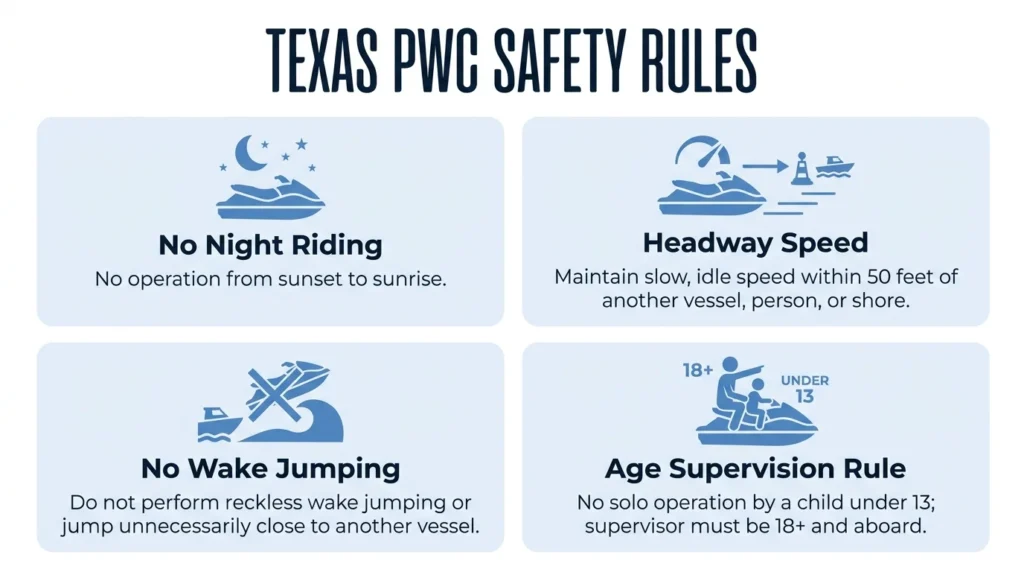
The Texas Parks and Wildlife Department’s personal watercraft rules cover jet skis. Key requirements include:
- No operation from sunset to sunrise.
- Headway speed within 50 feet of another vessel, person, object, or shore. This means slow or idle speed sufficient for steering.
- No reckless wake jumping or jumping unnecessarily close to another vessel.
- No solo operation by a child under 13. A supervising person must be at least 18, legally able to operate, and aboard while underway.
Watching a child from shore or another boat does not meet the supervision rule. Completing boater education does not let a child under 13 operate alone.
Under TPWD equipment guidance, every rider and towed person needs an approved wearable life jacket; inflatable jackets are unsuitable for personal watercraft. An equipped cutoff lanyard must attach to the operator’s body or clothing.
Section 31.106 contains exceptions for professional exhibitions and officially sanctioned races, tournaments, or exhibitions. Its 50-foot provision does not prohibit operation on water less than 100 feet wide. These exceptions do not excuse unsafe riding.
TPWD generally requires boater education for personal watercraft operators born on or after September 1, 1993, subject to exemptions. Section 31.110 includes qualifying onboard adult supervision among the exemptions. A missing education card therefore does not automatically establish unlawful operation.
When Could a Jet Ski Rental Business Be Liable?
A rental business may face a claim when skipped instruction, a careless handoff, or unsafe equipment contributes to an injury. An inexperienced renter is not automatically an unlawful renter, and the company does not guarantee every trip’s safety.
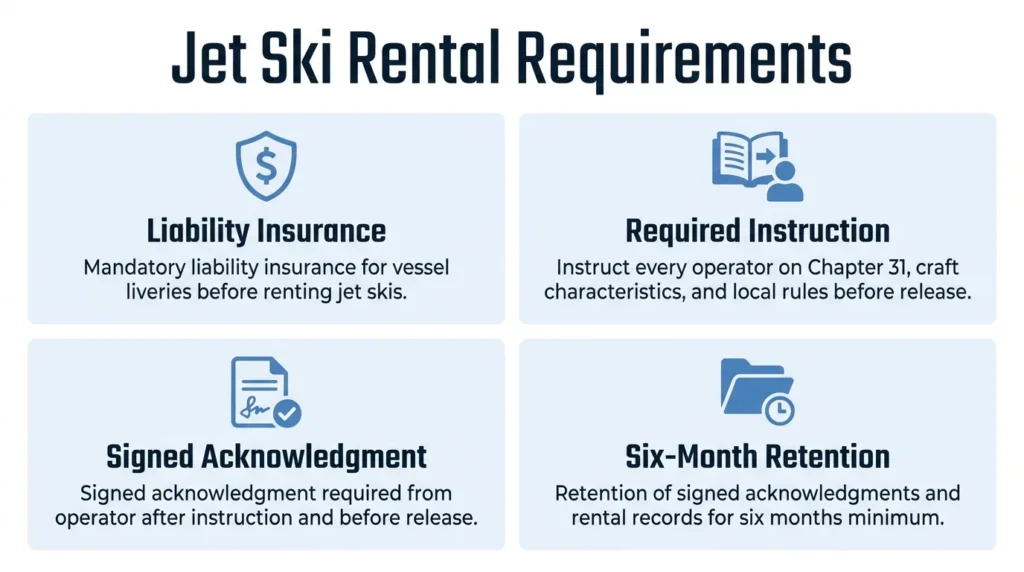
Under §31.111, a vessel livery must:
- Carry liability insurance.
- Instruct every operator before release about Chapter 31, the craft’s operating characteristics, and local boating rules.
- Obtain each operator’s signed acknowledgement after instruction and before release.
- Retain that acknowledgement for at least six months.
Section 31.040 separately requires rental records kept for six months. TPWD enforcement guidance identifies renting without required instruction as a violation.
After a jet ski rental accident, establish who gave the briefing, what it covered, and whether staff knew an operator could not ride safely. A signed acknowledgment matters, but video, checklists, employee names, and briefing materials can help establish whether instruction actually happened.
Distinguish the person signing the contract from every actual operator. Check each operator’s age, education, and onboard supervision. A rental business that permits an under-13 child to operate alone may face scrutiny if that unsafe handoff contributes to injury.
Not every rental to someone under 18 violates Texas law; company policies may impose stricter age limits. Equipment condition also matters when a defect or maintenance failure contributed to the accident.
Could the Owner Who Lent the Jet Ski Be Responsible?
An owner may face a negligent-entrustment claim for supplying a jet ski to someone the owner knew or should have known could not operate safely, if that person’s negligent operation causes injury. Ownership alone does not establish liability.
The general Texas negligent-entrustment framework concerns a road vehicle, not a jet ski, so applying that framework requires examining the boating incident’s facts and governing law.
Look at permission, control, and what the owner knew about the operator’s competence or recklessness. Inspection and repair records can also reveal an existing defect, notice of it, and responsibility for repairs. Neither the accident nor missing education paperwork alone proves the owner’s liability.
What Evidence Helps Determine Liability After a Jet Ski Accident?
Preserve evidence that connects each party’s conduct to the accident and your injuries. Medical care and immediate safety come first.
Operators must stop, provide identifying information, and assist when doing so would not endanger their vessel, crew, or passengers. TPWD requires reports within 30 days for accidents involving a death or missing person, injury requiring more than first aid, or property damage exceeding $2,000. That reporting window does not permit delaying emergency help.
Once safe, take these steps:
- Keep medical records and documentation of expenses and lost work.
- Request the complete rental agreement and every waiver page.
- Request the instruction acknowledgment, briefing materials, video, and staff names.
- Record operators’ and riders’ identities and ages, plus education and supervision details.
- Request preservation of the watercraft and its maintenance and repair records.
- Save photographs, witness contacts, and the accident report.
Request preservation promptly. The six-month rental-record retention minimum is not a lawsuit deadline or a reason to wait.
How a Rental Waiver Affects the Claim
An instruction acknowledgment differs from a contractual release of liability. Neither document should be judged by its title alone; preserve the complete wording.
In Quintana v. CrossFit Dallas, a Texas appeals court applied fair-notice principles and enforced an adult release. A preinjury release of a company’s own negligence generally must meet express-negligence and conspicuousness requirements: it must expressly address that negligence and be presented conspicuously.
That fitness center case does not resolve minors’ releases, nonsigners’ claims, gross negligence, or maritime rules. Review the actual jet ski agreement before concluding that signing it ends every claim.
Location and circumstances may affect governing law. In Foremost Insurance Co. v. Richardson, the Supreme Court held that a pleasure-boat collision on navigable waters can fall within federal admiralty jurisdiction. Texas fault rules and filing deadlines should not be assumed to govern every jet ski injury.
Talk With Angel Reyes & Associates About a Jet Ski Accident
Bring the rental agreement, waiver, photographs, and medical records you have. Contact Angel Reyes & Associates for a free consultation to discuss potentially responsible parties and the evidence that counts. Our team is here to assist you.
Past results do not guarantee future outcomes.
Jet Ski Accident Liability FAQs
Can a jet ski accident victim recover compensation if they were partially at fault?
Potentially. Texas generally follows a modified comparative responsibility rule under Chapter 33 of the Texas Civil Practice and Remedies Code, which may reduce compensation based on the injured person’s share of responsibility and bar recovery if that share exceeds 50%.
Who is responsible if a child is injured in a jet ski accident in Texas?
Depending on the circumstances, responsibility may fall on the operator, an owner who negligently entrusted the watercraft, or a rental business that failed to meet applicable safety obligations. Investigators should examine the child’s age, supervision, operator conduct, and whether any safety violations contributed to the injury.
Can someone file a jet ski accident claim if they were not wearing a life jacket?
Possibly. The absence of a life jacket does not automatically eliminate an injury claim, but compliance with applicable safety requirements and whether the omission contributed to the injuries may affect the case.
Can a passenger sue a jet ski operator for injuries caused by reckless driving?
Potentially. An injured passenger may pursue a negligence claim if the operator’s unsafe actions, such as excessive speed or dangerous maneuvers, caused the injuries, subject to applicable defenses and governing law.
About the Authors

Angel Reyes
Writer
Angel L. Reyes, III is the Founder and Managing Partner of Angel Reyes & Associates. A nationally recognized trial attorney and business leader, Angel founded the firm in 1993, which has gone on to help over 70,000 injury victims recover more than $1 billion. Named to the Texas Super Lawyers list annually since 2008, Angel brings Wall Street experience, Ivy League education, and a deep commitment to client advocacy. He is a frequent legal commentator and published author with extensive contributions to legal scholarship, trial strategy, and consumer protection.

Kyle Nicolas
Editor
Kyle Nicolas is the Web Content & SEO Manager at Angel Reyes & Associates. He has more than 10 years of experience as a marketing co...

Angel Reyes
Reviewer
Angel L. Reyes, III is the Founder and Managing Partner of Angel Reyes & Associates. A nationally recognized trial attorney and business...