Who’s Liable After an ADAS Crash in Texas?


Every article on this site is researched by our internal team, reviewed for legal accuracy against current Texas law, and held to State Bar of Texas advertising standards before publication. We do not publish content that overstates outcomes or makes promises about results.
Learn more about our
editorial standards .
Key Takeaways
- Texas self-driving and ADAS crashes can involve multiple liable parties including drivers, manufacturers, fleet operators, and repair shops, with fault allocated under proportionate responsibility rules.
- Software failures fall into three categories (perception, planning, and control), each requiring different evidence and supporting different legal theories under Texas product liability or negligence law.
- Digital evidence like ADS logs, software versions, and EDR data can be overwritten or lost within days, making immediate preservation efforts critical to building a strong claim.
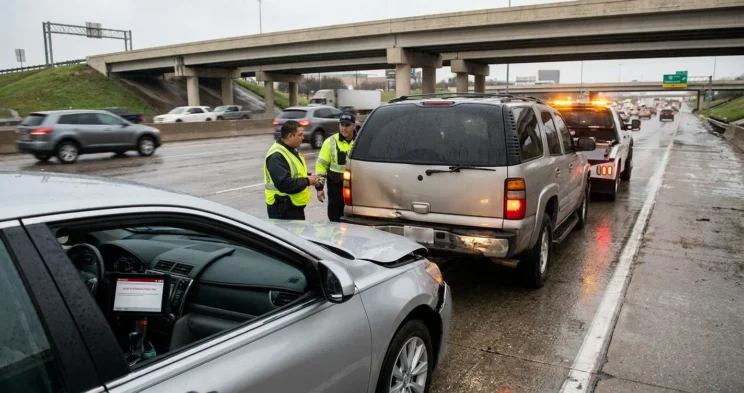
You were driving home on I-35E through Dallas yesterday when the car ahead slammed its brakes. Your vehicle’s automatic emergency braking should have kicked in. It didn’t. Now you’re dealing with injuries, a totaled car, and questions no one seems able to answer. Was it the system’s fault? The other driver’s? Something else entirely?
Advanced driver assistance system (ADAS) crashes create liability puzzles that standard car accidents don’t. Multiple parties may share responsibility. Digital evidence can vanish within days. Plus, the technology itself is often a black box that requires specialized investigation to understand.
Liability Depends on What Failed
Most Texas self-driving and ADAS crashes involve shared responsibility across humans, companies, and software. The fastest path to clarity is preserving evidence and mapping the failure to a legal theory.
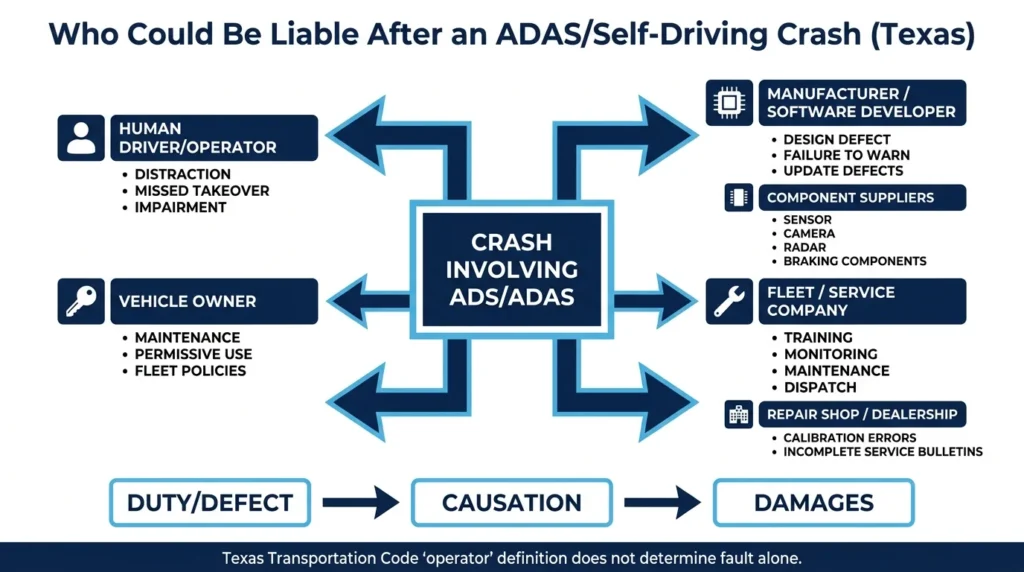
Common potentially liable parties include:
- The human driver or operator
- The vehicle owner
- The vehicle or software manufacturer
- Component suppliers
- Fleet or service companies
- Repair shops that performed calibration work
Texas Transportation Code provisions define who counts as an “operator” when an automated driving system is engaged. That statutory label doesn’t automatically decide civil liability, though. You still need proof of duty, breach or defect, causation, and damages.
Evidence preservation is urgent. Vehicle software logs can be overwritten within hours or days. Once the vehicle is repaired, sold, or scrapped, critical data may be gone forever. Early preservation letters and inspection requests can make or break these cases.
Self-Driving vs. ADAS: What System Was Actually in Control?4
Before fault can be analyzed, you need to identify whether the vehicle was truly driving itself or if it was driver-assist technology with the human still responsible for supervision.
Automated Driving Systems (ADS) handle all driving tasks within their operational limits. The human may not need to monitor the road constantly.
Advanced Driver Assistance Systems (ADAS) provide features like lane centering, adaptive cruise control, or automatic emergency braking. The human remains responsible for supervising and intervening.
This distinction changes everything for the liability analysis. Mode confusion happens frequently. A driver thinks the system is engaged when it isn’t. The system disengages without adequate warning. Alerts get missed in traffic.
Common indicators that automation was involved include dashboard icons showing system engagement, audible alerts before or during the crash, unusual steering or braking behavior, and app notifications about the trip. Documenting these details immediately after a crash helps preserve your recollection.
How Texas Fault Rules Affect Your Recovery
Texas uses a proportionate responsibility system that assigns percentages of fault across all parties. Your percentage directly affects whether you can recover and how much.
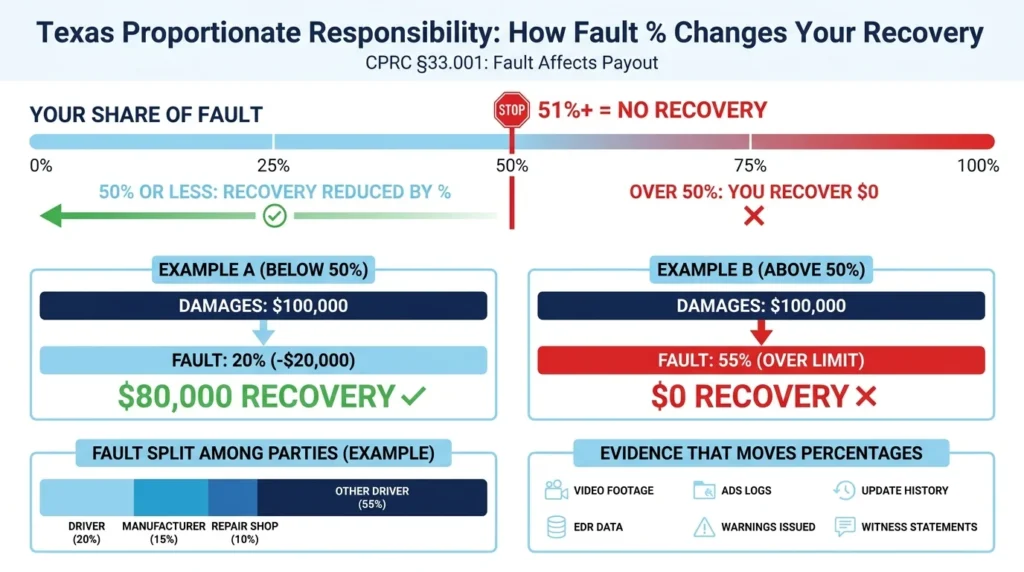
Under Texas Civil Practice and Remedies Code § 33.001, you cannot recover damages if you’re found more than 50% responsible for the crash. If you’re 50% or less at fault, your recovery is reduced by your percentage of responsibility.
In automation crashes, fault percentages might be allocated across the human supervisor who wasn’t paying attention, the manufacturer whose software failed, the repair shop that miscalibrated sensors, and the other driver whose actions triggered the incident.
Evidence that typically moves fault percentages includes video footage, Event Data Recorder (EDR) information, ADS logs, warning adequacy documentation, software update history, and witness statements.
3 Core Software Failure Modes
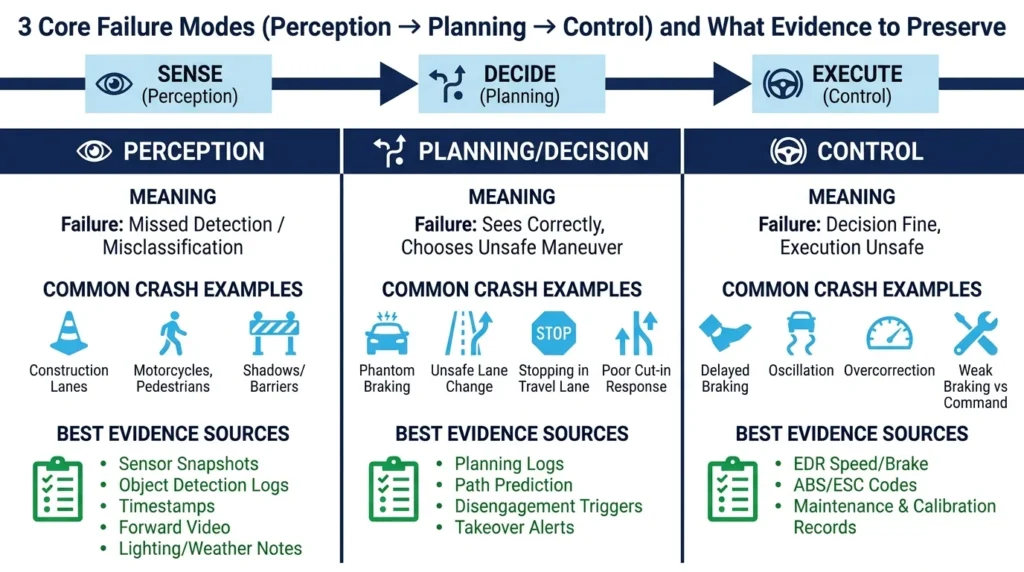
Automation crashes often trace back to what the system “saw,” what it “decided,” or how it “executed.” Understanding this framework helps connect technical problems to legal claims.
1. Perception Failures
Perception issues involve what the vehicle thought was on the road. The system may have missed detection entirely, generated false positives, or misclassified objects.
Examples include misreading lane lines in construction zones, failing to detect motorcycles, or pedestrians, and confusing shadows or barriers for actual obstacles. Dallas-area roads like Preston Road and Harry Hines Boulevard present complex visual environments that can challenge these systems.
Evidence to look for includes camera, radar, or lidar snapshots (if available), object detection logs, timestamps, forward video, and witness descriptions of lighting and weather conditions.
2. Planning & Decision Failures
These failures happen when the system recognizes the environment but selects an unsafe maneuver. The vehicle sees the situation correctly but responds poorly.
Examples include phantom braking on the Dallas North Tollway, unsafe lane changes, hesitation or stopping in travel lanes, and improper responses to vehicles cutting in. These scenarios appear among the leading causes of accidents when automation is involved.
Evidence to look for includes maneuver planning logs, path prediction outputs, disengagement triggers, and alerts sent to the driver before the crash.
3. Control Failures
Control failures occur when the intended maneuver is reasonable but the vehicle doesn’t execute it safely. The system decided correctly but the hardware or software didn’t follow through.
Examples include overcorrection, delayed braking, steering oscillation, and braking force that doesn’t match commanded deceleration.
Evidence to look for includes EDR speed and brake data, ABS and stability control codes, maintenance records, and calibration records after windshield or sensor service.
How Defects Arise: Updates, Calibration & Security Gaps
Many automation failures aren’t isolated incidents. They’re lifecycle problems involving updates, calibration drift, or security weaknesses that change system behavior over time.
Sensor & Calibration Issues
After collisions, windshield replacements, or alignment work, ADAS sensors require precise recalibration. Improper calibration can cause the system to misread lane positions, distances, or obstacles. Documentation of all repair and calibration work becomes critical evidence.
Over-the-Air (OTA) Update Defects
Modern vehicles receive software updates wirelessly. Version changes can introduce regression bugs, alter feature behavior, or roll out incompletely. If the crash happened shortly after an update, software versioning becomes key evidence.
Items to preserve immediately:
- Current software and firmware versions
- Update timestamps and release notes
- In-app notifications about updates
- Dealership service logs
Take photos of your vehicle’s software version screen. Save any emails from the manufacturer about updates. Do not factory reset the vehicle or connected apps.
Cybersecurity Considerations
While less common, security vulnerabilities can affect vehicle behavior through insecure update processes, unauthorized access, or compromised connected devices. Preserve the vehicle, charging cables, connected phones, OBD devices, and dashcam storage cards so experts can investigate properly.
Texas Legal Pathways: Product Liability vs. Negligence
Texas cases typically blend product liability theories with negligence claims. Understanding both helps identify defendants and required proof.
Product Liability Claims
Under Texas Civil Practice and Remedies Code Chapter 82, you may pursue claims against manufacturers and sellers for defective products.
Design defect claims argue the system’s design was unreasonably dangerous. Texas typically requires showing a safer alternative design existed that the manufacturer could have adopted.
Manufacturing defect claims argue a specific vehicle or component deviated from intended specifications. This might involve faulty sensors, wiring problems, or calibration errors unique to your vehicle.
Failure to warn claims argue the manufacturer didn’t adequately warn about system limitations, required driver monitoring, or update-related risks.
Negligence Claims
Negligence theories can broaden accountability beyond manufacturers.
Human driver negligence applies when the driver was distracted, overreliant on the system, impaired, or ignored takeover alerts.
Fleet or company negligence applies when operational decisions about training, monitoring, maintenance, or dispatch contributed to the crash. This often comes into play in commercial vehicle cases.
Repair shop negligence applies when improper sensor calibration after repairs or incomplete software service bulletins made the system unreliable.
Proving the Vehicle Was in Autonomous or ADAS Mode
Mode status is often disputed. The goal is to triangulate from independent sources.
Event Data Recorders (EDRs) capture pre-crash data including speed, braking, and steering inputs. The National Highway Traffic Safety Administration provides guidance on what EDRs record and why this data is so important.
ADS and ADAS logs contain detailed telemetry about system engagement, sensor readings, and decision-making. Access is often difficult without fast legal action. The National Transportation Safety Board has highlighted the need for standardized data access from advanced vehicle systems.
Other corroborating sources include dashcam recordings, phone metadata, app trip history, insurance telematics, fleet dispatch records, 911 records, and nearby business surveillance cameras.
Practical Steps for Texas Crash Victims
At the scene or hospital, photograph:
- Dashboard alerts and warning messages
- Infotainment screens showing system status
- Steering wheel and sensor areas for damage
- VIN and odometer reading
Request and retain:
- Tow yard location and contact information
- Insurance claim numbers
- Police report information
- Witness contact details
- Locations of nearby surveillance cameras
Do not:
- Authorize destructive downloads or repairs without legal counsel
- Delete app data or trip history
- Allow the vehicle to be scrapped or sold
- Accept a quick settlement before evidence is preserved
What to Do Now to Protect Your Claim
In automation cases, standard post-crash steps aren’t enough. Digital evidence disappears quickly. Vehicles get repaired. Insurers may push for fast resolution before the full picture emerges.
First 24 to 72 hours: Get medical care and document all symptoms. Secure the vehicle at a known location. Identify potential camera sources near the crash site. Notify your insurer but be careful about recorded statements. Do not reset or update the vehicle.
Preservation letter targets: Manufacturer, dealership or repair facility, tow yard, fleet operator, and insurers. Request EDR and ADS logs, software versions, update history, and calibration records.
An attorney experienced in these cases coordinates inspections with qualified experts, reviews technical data against legal theories, and develops a proportionate responsibility strategy that accounts for all potentially liable parties.
Talk to a Texas Firm That Handles Complex Crash Cases
Self-driving and ADAS crashes require investigation that goes beyond standard accident claims. At Angel Reyes & Associates, we have over 30 years of experience helping Texas families navigate difficult injury cases. We’ve recovered more than $1 billion for our clients, and we don’t charge fees unless we win.
If you were hurt in a crash involving automated vehicle technology anywhere in the Dallas area or across Texas, time is so the essence. Evidence can disappear quickly. Contact us today for a free consultation to discuss your situation and learn what steps to take next.
ADAS Crash FAQs
Does a windshield replacement or body repair affect ADAS performance?
Yes. Many ADAS features need recalibration after windshield work, front-end repairs, wheel alignment, or sensor replacement, and poor calibration can affect braking, lane keeping, or object detection.
Can a used or recently purchased car still have unresolved ADAS software or safety issues?
It can. Used vehicles may still need software updates, recall work, or calibration corrections, so service records and recall history can matter after a crash.
What if the self-driving or driver-assist feature was modified or an aftermarket device was installed?
Aftermarket hardware or software changes can complicate a claim because they may affect how the system performed or who may share responsibility. Preserving records of any modifications is important.
Are self-driving crash claims handled the same way as a normal insurance claim?
Not usually. These cases often involve technical vehicle data, multiple potentially responsible parties, and disputes over software status or system limitations that do not come up in a typical crash.
Can a vehicle recall help prove fault after a Texas ADAS crash?
A recall may be relevant if it involves the same feature or component, but it does not automatically prove legal liability. The key question is still whether the recalled issue contributed to your specific crash.
About the Authors

Angel Reyes
Writer
Angel L. Reyes, III is the Founder and Managing Partner of Angel Reyes & Associates. A nationally recognized trial attorney and business leader, Angel has helped over 70,000 injury victims recover more than $1 billion since founding the firm in 1993. Named to the Texas Super Lawyers list annually since 2008, Angel brings Wall Street experience, Ivy League education, and a deep commitment to client advocacy. He is a frequent legal commentator and published author with extensive contributions to legal scholarship, trial strategy, and consumer protection.

Kyle Nicolas
Editor
Kyle Nicolas is the Web Content & SEO Manager at Angel Reyes & Associates. He has more than 10 years of experience as a marketing co...

Angel Reyes
Reviewer
Angel L. Reyes, III is the Founder and Managing Partner of Angel Reyes & Associates. A nationally recognized trial attorney and business...