Are Double and Triple Trailers More Dangerous?


Every article on this site is researched by our internal team, reviewed for legal accuracy against current Texas law, and held to State Bar of Texas advertising standards before publication. We do not publish content that overstates outcomes or makes promises about results.
Learn more about our
editorial standards .
Key Takeaways
- Rearward amplification makes a double's rear trailer swing wider and later than expected.
- Federal law requires a special CDL endorsement to legally pull double or triple trailers.
- Texas roads mostly carry standard pup doubles, not heavier Rocky Mountain or turnpike rigs.
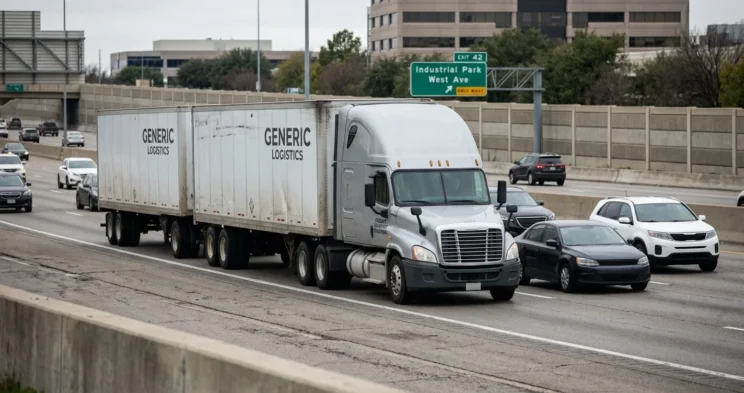
You’re merging onto I-35 in Dallas when a rig pulling two trailers rolls into the lane beside you. The back trailer swings out further than you expect, well after the truck itself has already straightened out.
That gap between what you see and what you expect is not your imagination. Double and triple trailer combinations are not uniformly more dangerous than a standard tractor-trailer, but they carry one proven handling weakness.
The rear trailer swings wider and later than the driver’s steering input suggests. Federal regulators consider that weakness serious enough to require a separate license endorsement before a driver can pull one.
What Counts as a “Double” or “Triple” Trailer: What’s Actually on Texas Roads
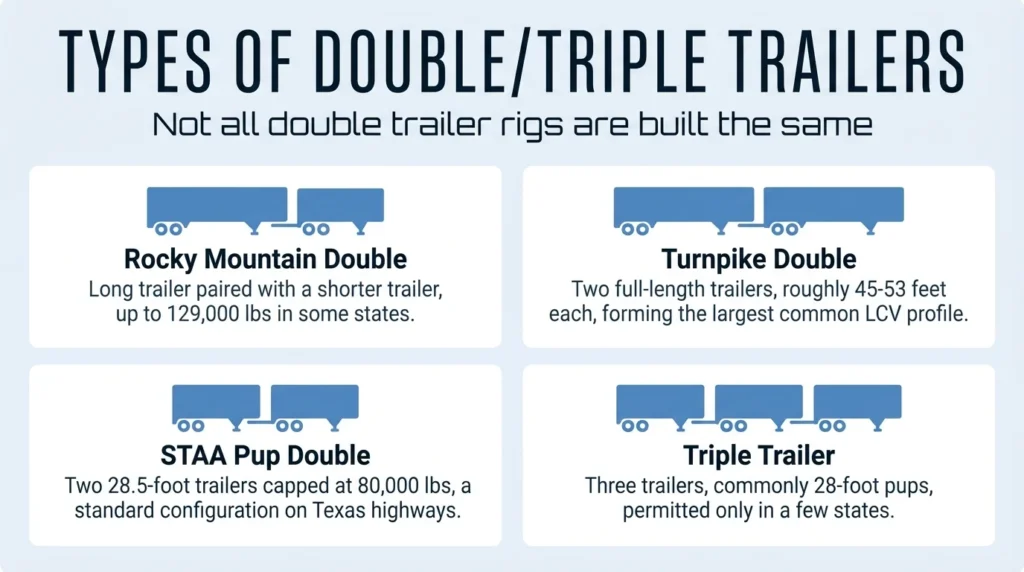
Not every double trailer rig is built the same way. The one you’re most likely to see on a Texas highway is the standard STAA “pup” double, two trailers of about 28.5 feet each, capped at 80,000 pounds combined, not the heavier rigs built for the longer combination vehicle networks running in other states;
- Rocky Mountain double: one long trailer (roughly 40 to 48 feet) paired with one shorter trailer (roughly 20 to 28.5 feet), historically a western and mountain-state configuration, permitted up to about 129,000 pounds under some states’ longer combination vehicle permits.
- Turnpike double: two full-length trailers of roughly equal size, commonly 45 to 53 feet each. This is the largest common longer combination vehicle profile.
- Pup trailer / STAA double: two roughly 28.5-foot, 8.5-foot-wide trailers joined by a converter dolly, capped at 80,000 pounds combined gross weight. This is the standard, nationally protected double you’re actually likely to pass on I-10, I-20, or I-35.
- Triple-trailer combination: three trailers, commonly three 28-foot pups, permitted only in a small number of states.
Texas is not one of the states grandfathered to run the heaviest longer combination vehicles under the 1991 federal freeze on that class of truck. Texas Transportation Code § 621.205 caps a standard combination at 65 feet overall, with a single trailer limited to 28.5 feet. That matches the standard pup double, not the longer Rocky Mountain or turnpike configurations.
A 129,000-pound Rocky Mountain double is not a routine sight on Texas roads, even though federal freight policy still defines and permits that configuration in a handful of other states.
If you were hurt by any size of double or triple rig, a truck accident attorney can help you sort out which configuration was involved and what that means for your claim.
Rearward Amplification: Why the Rear Trailer Swings Wider & Later Than the Driver Expects
Rearward amplification is the physics behind that gap between what a driver does and what the rear trailer actually does.
During a sudden steering move, like a swerve to avoid a stalled car, the lateral force on the rearmost trailer is amplified and delayed compared to the tractor’s own movement. That delay is exactly why the trailer at the back of a double or triple swings wider and later than the driver expects.
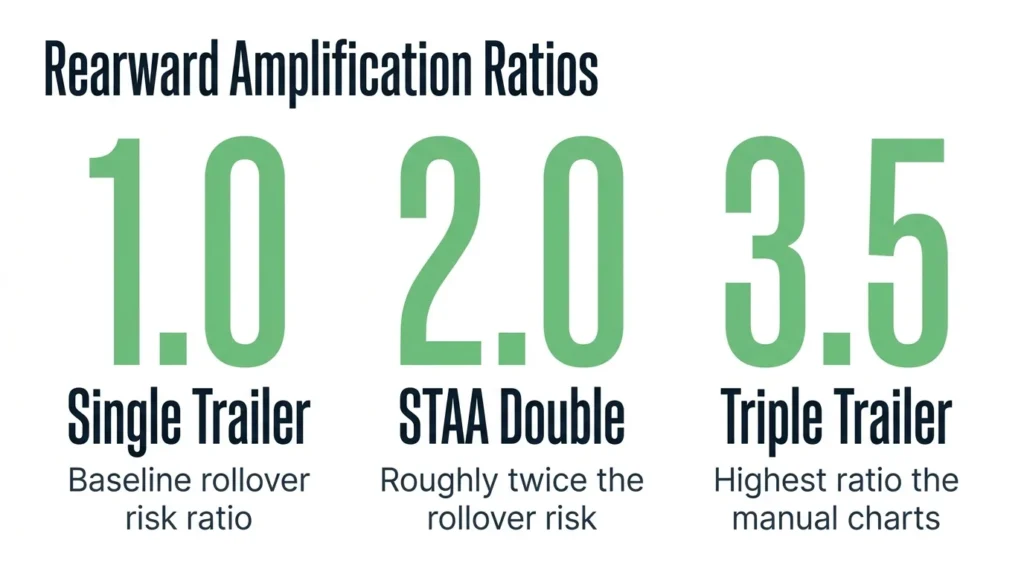
The New York State Commercial Driver’s Manual, drawing on a 1983 University of Michigan Transportation Research Institute study, charts how much worse this gets as trailers are added:
- A standard 5-axle tractor-semitrailer has a rearward amplification ratio near 1.0, the baseline.
- A standard STAA double with 27-foot trailers rises to about 2.0. The rear trailer is roughly twice as likely to roll over in a sudden maneuver as a single-trailer rig.
- A triple with 27-foot trailers climbs to about 3.5, the highest ratio of any configuration the manual charts.
Federal highway research confirms the same mechanism using independent test methods. A ratio above roughly 2.0 is treated as a meaningful warning sign for rollover and steering-related crashes.
Loading counts too. Placing the heaviest trailer closest to the tractor, with the lightest trailer at the rear, reduces the whip effect.
A related problem called offtracking compounds the same way. Each trailer’s wheels follow a slightly wider path than the one ahead of it in a turn, so the last trailer in a triple drifts furthest from the tractor’s actual path.
Why Federal Law Requires a Special License Endorsement to Pull Doubles and Triples
Federal regulators didn’t create the doubles and triples endorsement as paperwork for its own sake. They built a separate knowledge test because pulling a second or third trailer changes how a truck handles enough to demand documented proof the driver understands it.
The hardware that makes a double or triple possible is governed by 49 CFR § 393.70, which sets the coupling standards for combination vehicles in normal operation:
- The towed unit’s path may not deviate more than 3 inches to either side of the towing vehicle’s own path on a level, paved surface.
- Every converter dolly and full trailer must carry safety chains or cables, separate from the tow-bar connection, in case the coupling fails.
- Fifth-wheel assemblies, drawbars, and pintle hooks must be properly mounted and locked against accidental separation.
On top of the hardware, 49 CFR § 383.93 lists Double/Triple Trailers as a distinct CDL endorsement, earned through a knowledge test.
49 CFR § 383.115 spells out exactly what a driver has to know before earning it: how to assemble and hook up the units, how to place the heaviest trailer to control the whip effect, and the handling and stability risks unique to combination vehicles, including off-tracking, oscillatory sway, and rollover in a steady turn.
A driver who never learned or never proved that knowledge is a driver Texas roads shouldn’t have to share.
Are Doubles and Triples Actually More Dangerous? What the Data Shows
The honest answer is not a simple yes or no. Double and triple trailer combinations have a documented handling disadvantage serious enough that federal regulators require a separate endorsement, but the government’s own watchdog has called the broader crash-rate comparison unresolved.
The U.S. Government Accountability Office studied this question directly and titled its 1992 report
“The Safety of Longer Combination Vehicles Is Unknown.” GAO found the data available at the time couldn’t settle whether these configurations crash more often overall.
GAO did confirm they are less stable, sway more, need a wider turning path, and are more prone to drifting out of their lane than a single-trailer truck. A follow-up review two years later reached the same conclusion.
The Federal Motor Carrier Safety Administration’s Large Truck Crash Causation Study found doubles made up roughly 3 percent, and triples less than half a percent, of the fatal and injury crashes it examined. That reflects how few of these rigs are on the road, not a measure of per-mile risk.
What the data does confirm is the mechanism, not just the outcome. Rearward amplification and offtracking are physical realities, not theories, and a rollover triggered by either one can be catastrophic. When a crash like that ends in a fatality, families need to understand their wrongful death options as much as the mechanics of what went wrong.
Building the Case After a Double or Triple Trailer Crash in Texas
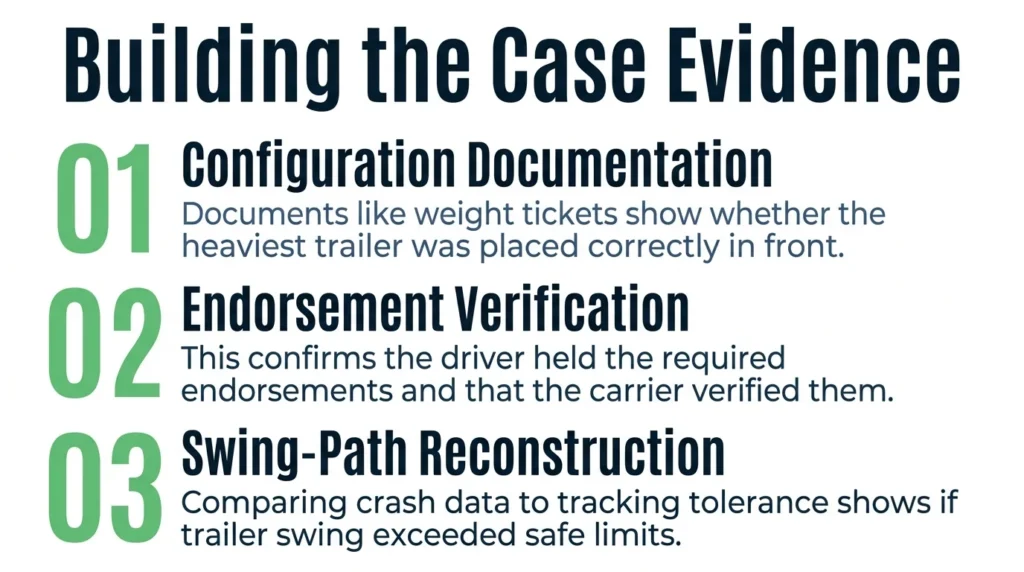
When investigating a double or triple trailer crash, three categories of evidence usually decide the case. These include how the trailers were loaded and coupled, whether the driver actually held a valid endorsement, and whether the trailer’s swing path exceeded what safe operation should have produced:
- Configuration documentation. Weight tickets, bills of lading, and coupling records show which trailer was loaded heaviest and whether it was placed correctly, with the heaviest trailer closest to the tractor, to control rearward amplification.
- Endorsement verification. Confirms the driver actually held a valid doubles/triples endorsement on their CDL at the time of the crash, and whether the carrier’s own hiring file documented that check.
- Swing-path reconstruction. Using crash data and the 3-inch tracking tolerance set out in 49 CFR § 393.70, we can show whether the rear trailer’s actual path went beyond what a properly maintained, properly loaded combination should have produced.
None of this evidence disappears on its own. It has to be pulled before records are lost and before the carrier’s own investigation writes the story first.
Talk to an Attorney About Your Double or Triple Trailer Crash
If you were injured in a crash involving a double or triple trailer combination, you don’t have to sort out coupling records, endorsement history, and swing-path physics on your own.
Angel Reyes & Associates has guided Texans through crashes like this for over 30 years. These cases turn on specialized evidence that only holds up when it’s gathered quickly, before weight tickets are discarded and before a driver’s qualification file quietly disappears.
Contact us for a free consultation to talk through what happened and what your options are.
Past results do not guarantee future outcomes.
Double & Triple Trailer Danger FAQs
Does Texas allow Rocky Mountain doubles or turnpike doubles on its highways?
No. Texas is not one of the states grandfathered under the 1991 federal freeze on longer combination vehicles (LCVs) over 80,000 pounds. Texas Transportation Code § 621.205 caps standard vehicle combinations at 65 feet overall length, with each trailer limited to 28.5 feet, matching the standard STAA “pup” double, not the longer Rocky Mountain double (up to about 129,000 pounds) or turnpike double configurations that operate in other states.
What CDL endorsement does a driver need to legally pull double or triple trailers?
Federal law requires a Double/Triple Trailers (“T”) endorsement, listed under 49 CFR § 383.93. Unlike some other CDL endorsements, it requires only a knowledge test, not a separate skills or driving test. 49 CFR § 383.115 sets out what that test covers: assembly and hookup procedures, proper placement of the heaviest trailer, and handling and stability characteristics unique to combination vehicles, including off-tracking, oscillatory sway, and rollover in steady turns.
How can I find out if a truck driver actually had a valid doubles/triples endorsement at the time of a crash?
This is one of the first things investigated after a double or triple trailer crash. Verification comes from the driver’s CDL record and the trucking company’s own driver qualification file, which is supposed to document that the endorsement was checked before the driver was allowed to pull double or triple trailers. If that check never happened, or the endorsement had lapsed, it becomes central evidence in the case.
Does loading the heaviest trailer in the wrong position make a double or triple trailer crash more likely?
Yes. Placing the heaviest trailer closest to the tractor, with the lightest trailer at the rear, is a documented practice for reducing rearward amplification, the “crack-the-whip” effect that makes a trailing trailer swing wider and later during a sudden steering maneuver. Federal regulators consider proper placement of the heaviest trailer important enough to include as a required knowledge topic for the doubles and triples endorsement itself.
Are triple-trailer trucks legal to operate in Texas?
Not under Texas’s own highway limits. Texas Transportation Code § 621.205 permits combinations of no more than three vehicles at up to 65 feet overall, but true triple-trailer combinations over 80,000 pounds fall under the federal longer combination vehicle rules, and Texas is not among the states grandfathered to run them under the 1991 federal freeze. Triples are permitted only in a small set of other grandfathered states and routes.
About the Authors

Angel Reyes
Writer
Angel L. Reyes, III is the Founder and Managing Partner of Angel Reyes & Associates. A nationally recognized trial attorney and business leader, Angel has helped over 70,000 injury victims recover more than $1 billion since founding the firm in 1993. Named to the Texas Super Lawyers list annually since 2008, Angel brings Wall Street experience, Ivy League education, and a deep commitment to client advocacy. He is a frequent legal commentator and published author with extensive contributions to legal scholarship, trial strategy, and consumer protection.

Kyle Nicolas
Editor
Kyle Nicolas is the Web Content & SEO Manager at Angel Reyes & Associates. He has more than 10 years of experience as a marketing co...

Angel Reyes
Reviewer
Angel L. Reyes, III is the Founder and Managing Partner of Angel Reyes & Associates. A nationally recognized trial attorney and business...