Bird Scooter Accidents in Texas


Every article on this site is researched by our internal team, reviewed for legal accuracy against current Texas law, and held to State Bar of Texas advertising standards before publication. We do not publish content that overstates outcomes or makes promises about results.
Learn more about our
editorial standards .
Key Takeaways
- Bird operates exclusively in Austin and San Antonio in Texas, including on the UT Austin and UTSA campuses.
- Bird does not automatically cover rider injuries through company insurance. Standard Texas auto policies also typically exclude e-scooters.
- Surveillance footage overwrites within 24 to 72 hours — preserving evidence quickly is critical to your claim.
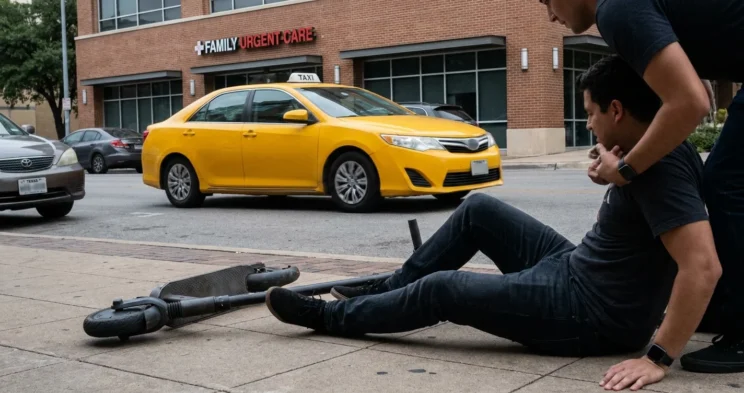
Where Bird Scooters Operate in Texas
Bird operates in Austin and San Antonio. These are Bird’s only Texas markets.
As of April 2024, Austin’s scooter program permits only Bird and Lime to operate. Bird runs approximately 3,000 scooters in Austin under the city’s 6,700-scooter fleet cap. Bird scooters are also available on the University of Texas at Austin campus, where they operate under geofenced speed zones.
In San Antonio, Bird operates in the city’s service area, which includes the UTSA campus.
Knowing which city your accident occurred in matters. Austin and San Antonio operate under different ordinances, and the rules governing where you can ride and how fast differ between them. If your crash happened on a university campus, it may also involve additional institutional reporting requirements.
Austin and San Antonio Rules for Bird Scooter Riders
The rules that govern Bird scooter use vary by city. You can raise violations of these rules as comparative fault arguments in your claim.
Austin
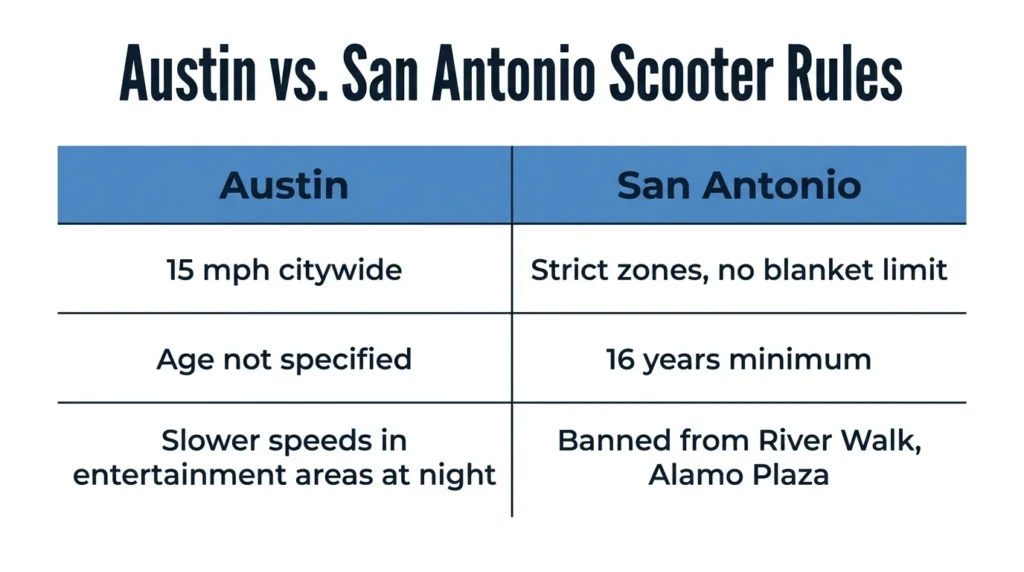
Austin’s updated ordinance, effective April 2024, sets a speed limit of 15 mph for Bird scooters throughout the city. In entertainment areas, the speed limit drops to 10 mph between 10 p.m. and 5 a.m.
You may ride on sidewalks, but you must do so in a reasonable and prudent manner, and you have to yield to pedestrians. You cannot park the scooter in a way that blocks pedestrian access or Americans with Disabilities Act pathways.
At UT Austin, Bird scooters are permitted on campus. The standard speed limit is 15 mph. Geofenced safety zones reduce the limit to 5 mph. You must park the scooter in a designated area. Students, employees, and visitors are required to display an appropriate UT Parking and Transportation Services permit.
San Antonio
San Antonio has some of the strictest e-scooter ordinances in Texas. You may use sidewalks when no bike lane is available, but you must maintain at least two feet of clearance from pedestrians.
Several areas in San Antonio prohibit Bird scooters entirely: the River Walk, Alamo Plaza, Mission Reach, and other designated leisure areas.
You must be at least 16 years old to use a Bird scooter in San Antonio. Also, a curfew prohibits use from 11 p.m. to 6 a.m.
At UTSA, Bird operates within the San Antonio service area. UTSA Parking and Transportation Services govern campus-specific rules. If your accident occurred on the UTSA campus, confirm whether campus rules applied to the specific location before filing a claim.
Bird’s Liability and Insurance Coverage
Bird’s user agreement includes liability waivers that riders accept before each ride. Under Texas law, most appeals courts have held that pre-injury waivers cannot shield a company from gross negligence claims. If Bird deployed a defective scooter or failed to maintain its fleet, the waiver may not hold.
Bird does not automatically cover rider personal injury through company insurance. City permit requirements for scooter operators primarily require insurance covering damage to public property.
Standard Texas auto insurance policies typically exclude e-scooters. Homeowners and renters policies generally do not cover damage caused by motorized vehicles. But scooters aren’t classified as motor vehicles under Texas law. Because they have fewer than four wheels, scooters are outside coverage. The Texas Department of Insurance has confirmed that standard auto policies typically will not cover e-scooter rider injuries.
If another vehicle driver caused your crash, that driver’s liability insurance is generally the primary source of recovery based on e-scooter laws and liability in Texas.
What to Do After a Bird Scooter Accident in Austin or San Antonio
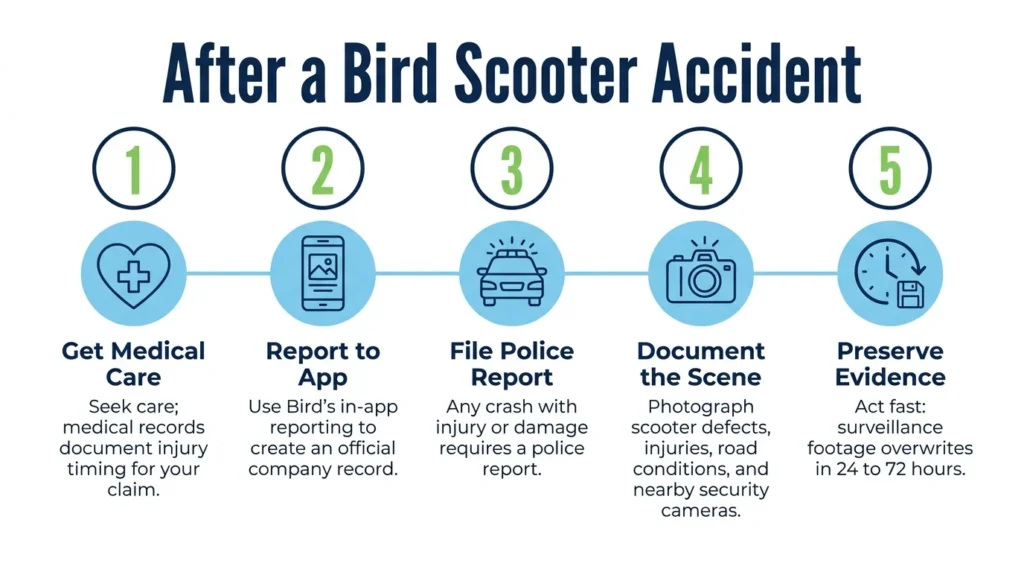
Step 1: Get medical attention. Seek care even if your injuries seem minor at the scene. Medical records create documentation of what happened and when. Gaps in treatment can be used against you later.
Step 2: Report through the Bird app. Bird provides in-app incident reporting. Use it to create an official record with the company immediately after the accident.
Step 3: File a police report. Any crash involving injury or property damage should have a police report on file. In Austin and San Antonio, this is important for establishing an official account while the facts are still fresh.
Step 4: Document the scene. Photograph the scooter, any visible defects, your injuries, road conditions, and the surrounding area. Note the location of any security cameras on nearby buildings or businesses.
Step 5: Preserve evidence. Send written requests to businesses and city agencies with cameras in the area before footage is overwritten. Surveillance video typically overwrites within 24 to 72 hours. A bird scooter accident lawyer can send preservation letters the same day you call.
Legal Options After a Bird Scooter Accident
The details of how your accident happened affect who is liable in a scooter accident.

Bird may be liable if the scooter was defective or if the company failed to maintain its fleet in Austin or San Antonio. A product liability theory may also apply if a mechanical failure caused the crash.
If a motor vehicle driver caused the accident, that driver is the primary defendant. Their liability insurance is the starting point for recovery.
The City of Austin or the City of San Antonio may bear responsibility if a road defect caused the crash. Claims against Texas government entities are governed by the Texas Tort Claims Act. CPRC Chapter 101 requires notice within 90 to 180 days, depending on the entity. Municipal liability is capped at $250,000 per person and $500,000 per occurrence.
If you were hit by a Bird scooter rider as a pedestrian, you have a personal injury claim against the rider. Depending on the facts, Bird may also bear some responsibility if the scooter was defective or negligently maintained.
Texas’s proportionate responsibility rule applies to all of these claims under CPRC Chapter 33. Your recovery is reduced by your assigned fault percentage. If you are more than 50% responsible, recovery is barred entirely.
The filing deadline is two years from the date of the accident under CPRC § 16.003. Claims against government entities require notice within a shorter window before you can file suit.
Work with a Texas Personal Injury Attorney
Bird scooter accident claims involve coverage gaps, liability waivers, comparative fault rules, and, in some cases, government entity procedures. An attorney can evaluate which parties are responsible and what recovery is available.
Angel Reyes & Associates has represented injury victims across Texas for more than 30 years. We have recovered more than $1 billion for our clients. We offer free initial consultations and work on a no-fee-unless-you-win basis. You can review our past case results to understand how we approach these claims. To discuss your situation, contact us for a free consultation.
Past results do not guarantee future outcomes.
Bird Scooter Accident FAQs
Do you have to wear a helmet on a Bird scooter in Texas?
Texas does not have a statewide helmet requirement for adult e-scooter riders, but local rules, campus policies, and Bird’s safety guidance may still matter after a crash. Not wearing a helmet can also become part of a comparative fault argument if the injury involved head trauma.
Can a tourist file a claim after a Bird scooter accident in Austin or San Antonio?
Yes. If you’re a visitor injured in Texas, you can generally bring a Texas personal injury claim if the crash happened here, but the case will still depend on the accident location, the parties involved, and the available insurance or liability sources.
What evidence from the Bird app can help after a scooter accident?
Ride data may help show the scooter’s route, start and stop time, speed zones, and where the ride ended. Screenshots, receipts, incident reports, and account records should be saved before app information becomes harder to access.
Can poor lighting or missing signs affect a Bird scooter injury claim?
Yes. Poor lighting, missing warnings, blocked bike lanes, construction hazards, or unclear no-ride zones may help explain why a crash happened and can point to another responsible party.
What happens if a Bird scooter accident causes a serious injury, but there is little insurance coverage?
Coverage gaps are common in e-scooter cases, so the claim may require looking beyond one insurance policy. Depending on the facts, possible sources may include an at-fault driver’s policy, a defective-product claim, a premises-related claim, or a government-entity claim with special notice rules.
About the Authors

Angel Reyes
Writer
Angel L. Reyes, III is the Founder and Managing Partner of Angel Reyes & Associates. A nationally recognized trial attorney and business leader, Angel has helped over 70,000 injury victims recover more than $1 billion since founding the firm in 1993. Named to the Texas Super Lawyers list annually since 2008, Angel brings Wall Street experience, Ivy League education, and a deep commitment to client advocacy. He is a frequent legal commentator and published author with extensive contributions to legal scholarship, trial strategy, and consumer protection.

Kyle Nicolas
Editor
Kyle Nicolas is the Web Content & SEO Manager at Angel Reyes & Associates. He has more than 10 years of experience as a marketing co...

Spencer Browne
Reviewer
Spencer Browne is a partner at Angel Reyes & Associates and a Board Certified personal injury trial lawyer with nearly 100 jury trials a...