Bus Accident Reconstruction and Expert Witnesses


Every article on this site is researched by our internal team, reviewed for legal accuracy against current Texas law, and held to State Bar of Texas advertising standards before publication. We do not publish content that overstates outcomes or makes promises about results.
Learn more about our
editorial standards .
Key Takeaways
- Reconstruction experts use crash data and physics to prove how a bus crash happened.
- Texas gives bus crash victims two years from the crash date to file a lawsuit.
- Event recorder and driver log data can be erased within days of the crash without a legal hold.
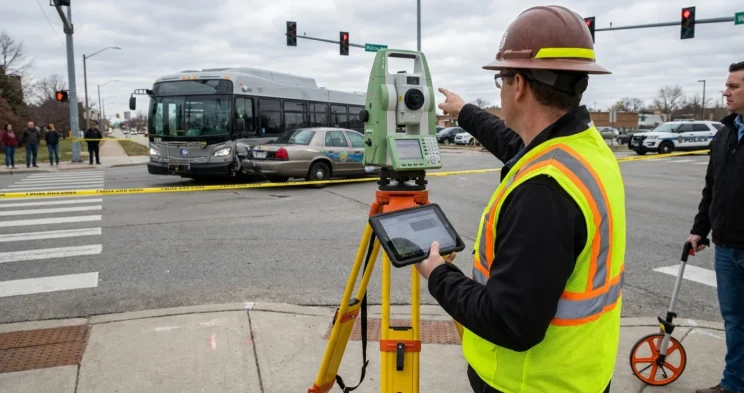
You were riding a charter bus home from a game in San Antonio when it swerved hard on I-35 and slammed into the barrier. Now, you are injured, the bus company says the crash was unavoidable, and the insurance offer barely covers your first hospital bill.
How do you prove what really happened when the other side controls most of the evidence?
What Is Bus Accident Reconstruction?
Accident reconstruction is the scientific study of physical, electronic, and documentary evidence from a crash that is used to determine how it happened, why it happened, and who caused it. A trained expert rebuilds the sequence of events second by second, from the moment the problem began to the point at which the crash ended.
This is different from a police report. The police report records what drivers and witnesses said at the scene. A reconstruction expert uses engineering methods to calculate speed, braking, the point of impact, and how each vehicle moved.
Bus crashes are harder to analyze than ordinary car wrecks. The size of the vehicle, the number of passengers onboard, the commercial license rules, and the federal safety regulations all add unique layers of complexity.
Reconstruction findings are important in two places: the insurance negotiation and the courtroom. A solid report can challenge a low offer or dispute who was at fault in your Texas bus accident claim.
What Evidence Do Reconstruction Experts Analyze in Bus Crashes?
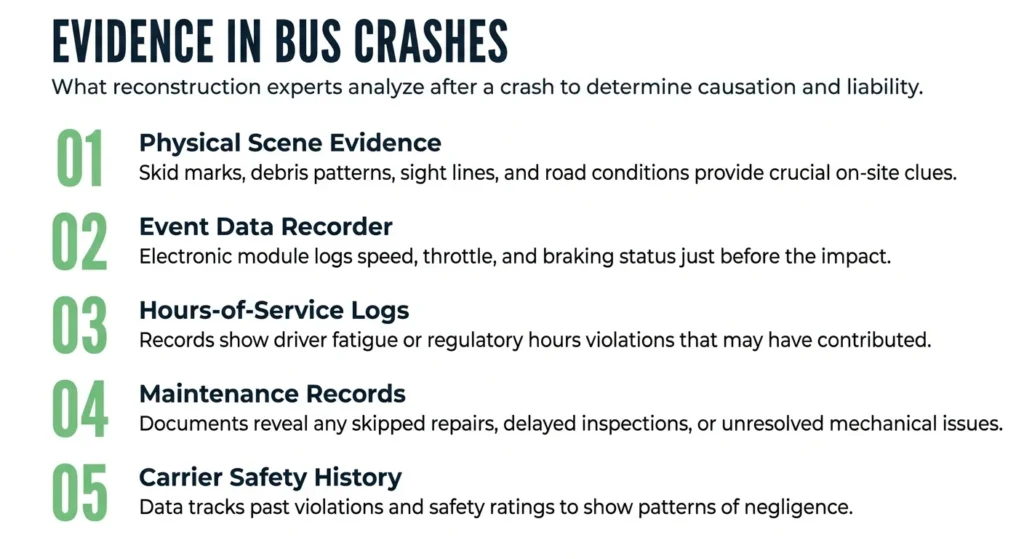
First, the reconstruction expert analyzes the physical evidence at the scene of the crash. This includes skid marks, gouge marks in the pavement, the debris field, road surface conditions, signage, and the driver’s sight lines.
Second, the reconstruction expert analyzes the data. Many commercial buses carry an event data recorder, which is an onboard device that logs the speed, throttle, and brake use in the seconds before the crash. You can read more about what this technology captures from NHTSA event data recorder research. However, not all carriers are federally required to install one.
Commercial drivers also leave a digital record of their hours. Electronic logging devices track hours of service and show whether the driver was fatigued or over the federal driving limit set by federal hours-of-service rules for commercial drivers.
Maintenance records are also important. Federal rules require bus operators to keep repair and inspection logs. If maintenance was skipped or repairs were delayed, it can be used as direct evidence that the carrier cut corners on safety.
Finally, the reconstruction expert looks into the carrier’s safety history. A company’s safety rating, past violations, and audit results are tracked in FMCSA passenger carrier safety records. A pattern of repeated failures can show that the crash wasn’t really an accident, but the result of a system that ignored safety.
Types of Experts in Bus Accident Cases
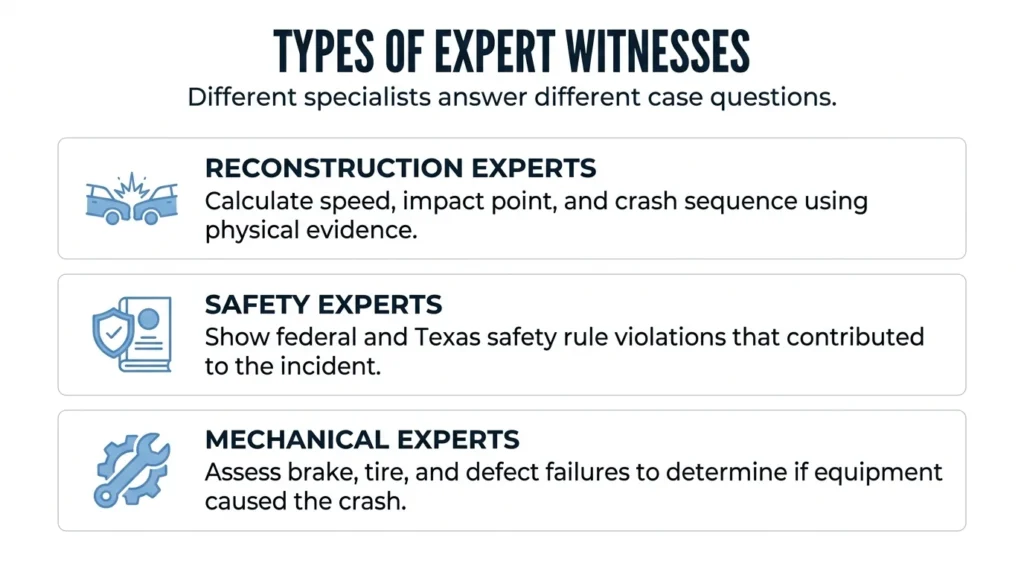
A serious bus case rarely relies on one expert. Different questions call for different specialists, and people often use the term “expert witness” to describe three distinct roles: accident reconstruction experts, transportation safety experts, and mechanical experts.
Accident Reconstruction Experts
Accident reconstruction experts are usually engineers or former law enforcement officers with focused training in crash physics. They calculate vehicle speeds, determine the point of impact, and build scale diagrams and computer simulations of how the crash happened.
Their credentials are tested in court. Many are accredited through ACTAR traffic reconstruction standards, and a judge weighs these credentials before allowing their testimony.
The reconstruction report often becomes the foundation that other experts and your attorney build your case on.
Transportation Safety Experts
Transportation safety experts focus on the rules. They examine whether the carrier followed federal FMCSA standards and Texas commercial vehicle requirements before the crash happened.
A safety expert can show that breaking the commercial vehicle safety rules in Texas Transportation Code Chapter 644 was a direct cause of your injuries. This connection turns a paperwork violation into proof of fault.
Mechanical Experts
Mechanical engineers handle the vehicle itself. They assess whether brake failure, tire failure, or a defect played a role. A mechanical finding can open new claims against the manufacturer, a parts supplier, or a maintenance contractor, not just the bus company itself.
How Expert Testimony Shapes Fault and Compensation
Expert findings translate directly into dollars because Texas splits fault by percentage. The state uses a proportionate responsibility system according to Texas Civil Practice and Remedies Code (CPRC) Chapter 33, which assigns a share of blame to each responsible party.
Reconstruction findings are used in the final calculations. If the expert shows that the driver caused 90% of the crash, that percentage shapes what you can recover.
A written report can change the claim in your favor quickly. When the document spells out driver error, a federal violation, or mechanical failure, the carrier’s insurer often makes a higher offer, rather than risk going to trial.
At trial, expert testimony has to meet stricter requirements. Texas Rule of Evidence 702 states that an expert can only testify when their opinion is based on enough facts, uses a reliable method, and applies the method correctly to your case.
When the National Transportation Safety Board investigates a major crash, federal law bans NTSB reports from being used in civil fault cases. These findings can guide your own investigation, but they cannot be put in front of a jury as proof of liability.
A skilled attorney can bring in reconstruction experts and secure important evidence before it disappears. Our overview of how fault gets decided in Texas explains how everything fits together.
Preserving Evidence and Acting Quickly
The clock starts the moment the crash ends. Skid marks fade, damaged buses get repaired or scrapped, and electronic data can be overwritten within days of the crash if no one demands that it must be saved.
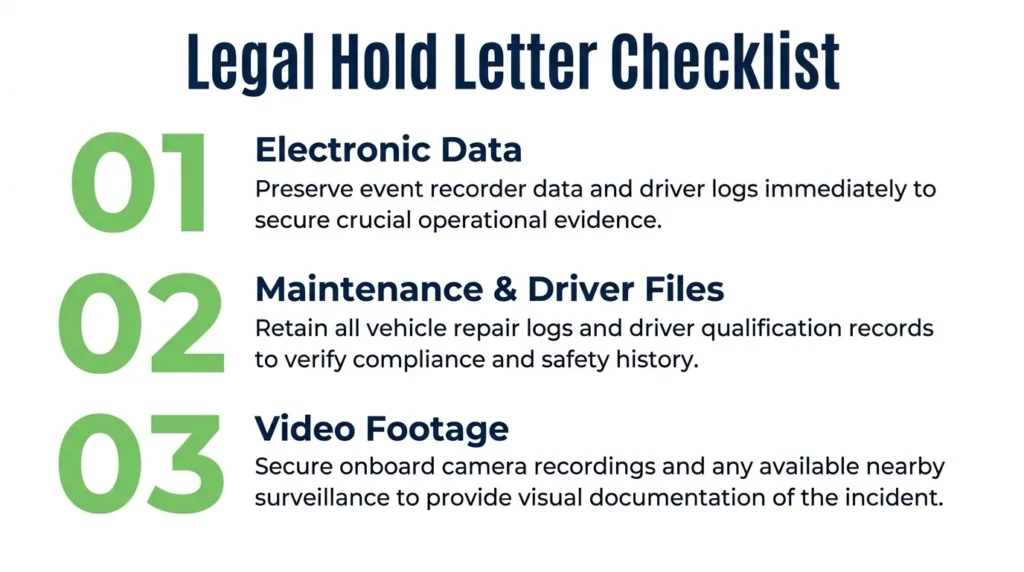
A legal hold letter is your first defense. If you send it to the carrier early, it forces them to preserve their records before anything is lost. Here is what a strong legal hold letter secures:
- Electronic data: Push for the event recorder download and the driver’s electronic logs before the system overwrites them (often within days or weeks after the crash).
- Maintenance and driver files: Secure repair logs, inspection records, and the driver’s qualification and hours-of-service files held by the carrier.
- Video footage: Onboard cameras and nearby traffic or business cameras are often erased within a week of the crash, so request them immediately.
There is also a legal deadline. Texas gives injured victims two years from the crash date to file a personal injury lawsuit under Texas Civil Practice and Remedies Code § 16.003. If you wait too long, it reduces the time an expert has to gather the technical evidence for your case. Learn how to file a bus accident claim in Texas before the two-year deadline closes.
Work with an Attorney on Your Bus Accident in Texas
Bus crash cases that rely on reconstruction evidence are some of the most complex, and the right legal team makes a real difference in the outcome. Angel Reyes & Associates has spent over 30 years guiding injured Texans through exactly this kind of fight.
We work on a contingency basis, which means you pay no fee unless we win, and we advance the cost of experts and investigation. With more than $1 billion recovered for clients, our work includes claims tied to fatal bus crashes and wrongful deaths.
If you were injured in a bus accident, reach out to us for a free consultation to review what happened and discuss your options.
Past results do not guarantee future outcomes.
Bus Accident Reconstruction FAQs
Does it matter if the bus was operated by a city government, rather than a private company?
Yes. If the bus was operated by a public transit authority or government agency, then you must file a formal notice of claim before you can sue. Under the Texas Tort Claims Act, the notice must reach the government entity within six months of the crash, but some Texas cities require notice in as few as 90 days after the crash.
How much insurance coverage does a commercial bus company have to carry?
Federal law requires passenger carriers that operate buses designed to hold 16 or more people to maintain at least $5 million in liability coverage. That minimum applies to for-hire interstate carriers and is separate from any additional coverage that the company may carry under its own policy.
Can a bus passenger's own actions reduce or eliminate their recovery?
Yes. Texas uses a modified comparative fault rule, so a passenger who is found partially at fault will receive reduced compensation according to their share of fault. A passenger who is found more than 50% responsible cannot recover any compensation at all.
Are school buses covered by the same federal safety rules as charter or commercial buses?
Not always. Government-operated school buses are largely exempt from the FMCSA’s financial responsibility requirements. Private contractors who operate school bus routes under a school district contract may have different obligations, depending on whether the trip crosses state lines.
If the bus driver was listed as an independent contractor, can the bus company still be held responsible?
Federal regulations treat commercial bus drivers as statutory employees of the motor carrier, regardless of how the contract labels them. This classification prevents carriers from avoiding liability by using an “independent contractor” label.
About the Authors

Angel Reyes
Writer
Angel L. Reyes, III is the Founder and Managing Partner of Angel Reyes & Associates. A nationally recognized trial attorney and business leader, Angel has helped over 70,000 injury victims recover more than $1 billion since founding the firm in 1993. Named to the Texas Super Lawyers list annually since 2008, Angel brings Wall Street experience, Ivy League education, and a deep commitment to client advocacy. He is a frequent legal commentator and published author with extensive contributions to legal scholarship, trial strategy, and consumer protection.

Graham Griffin
Editor
Graham Griffin is the Web & Content Manager at Angel Reyes & Associates, where he oversees content strategy, AI-powered workflows, a...

Angel Reyes
Reviewer
Angel L. Reyes, III is the Founder and Managing Partner of Angel Reyes & Associates. A nationally recognized trial attorney and business...