Can Your Insurer Deny PIP or UM/UIM Without a Written Rejection?


Every article on this site is researched by our internal team, reviewed for legal accuracy against current Texas law, and held to State Bar of Texas advertising standards before publication. We do not publish content that overstates outcomes or makes promises about results.
Learn more about our
editorial standards .
Key Takeaways
- Texas generally requires PIP and UM/UIM coverage unless an authorized insured rejects each coverage in writing.
- Request the rejection records, original application, declarations pages, and relevant policy history.
- An earlier rejection may remain effective through qualifying renewals or reinstatements, so review the full policy history.

You are recovering from a car crash on I-35 in San Antonio when your insurance company tells you that your policy does not include personal injury protection (PIP) or uninsured/underinsured motorist (UM/UIM) coverage. You expected your own insurance to help cover your losses, so the denial leaves you wondering whether the coverage was ever there in the first place, or whether the insurer is just wrong.
Under Texas law, auto liability policies subject to these requirements must include PIP and UM/UIM coverage unless an authorized insured rejected the coverage in writing. However, another qualifying insured may have signed the rejection, or a valid rejection from an earlier policy may still apply.
Before accepting the denial, ask your insurer for the written rejection and review the policy records. These documents can help you determine whether the coverage was properly rejected, and whether you have grounds to challenge the insurer’s decision.
What Texas Law Requires for PIP and UM/UIM Rejections
Under Texas Insurance Code Chapter 1952, automobile liability policies issued for delivery in Texas generally must include these coverages unless a named insured rejects them in writing. Rejecting one coverage does not automatically reject the other, so check the written rejection for each coverage separately.
Texas does not require a state-issued rejection form. The Texas Department of Insurance’s personal auto filing checklist states that coverage selection and rejection forms do not require TDI approval.
What Documents to Request After a PIP or UM/UIM Denial
Request the complete written rejection records for PIP and UM/UIM separately, along with the original application and policy history. A declarations page may show the listed coverage, but it does not establish whether a statutory rejection was valid.
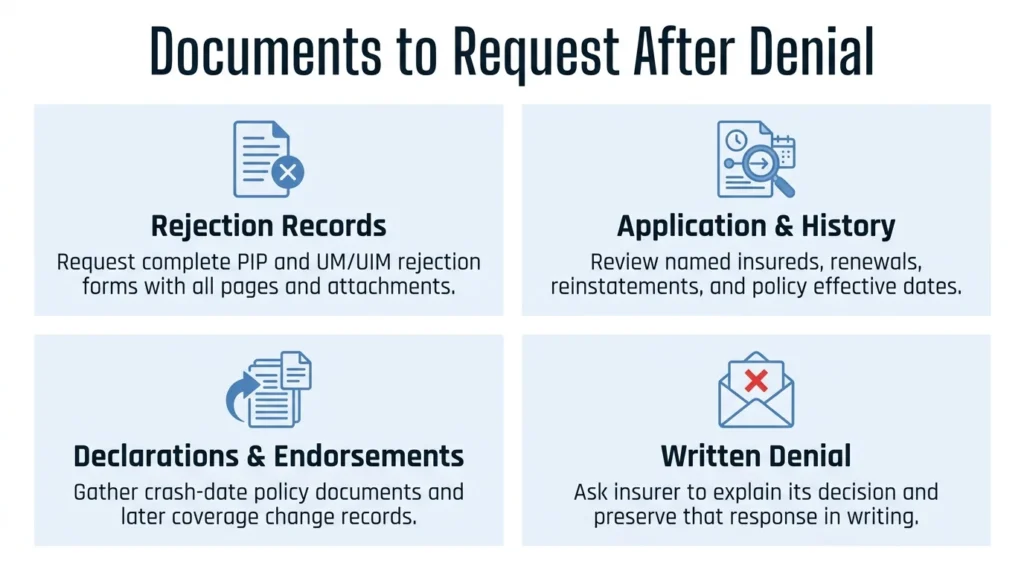
Use these steps to build a record of what happened:
- Request the complete rejection records: Obtain the PIP and UM/UIM rejection forms, including all pages and attachments. For electronic selections, request the executed record and available information showing who made the selection and when.
- Get the original application and policy history: Review the named insureds, renewal and reinstatement records, vehicle changes, and policy effective dates to determine whether an earlier rejection may apply.
- Collect declarations pages and endorsements: Gather documents for the policy that was in effect on the crash date, along with relevant records showing later coverage changes or requests.
- Save the insurer’s written denial: Ask the insurer to explain its decision in writing. If it cannot locate a rejection, preserve the response without assuming the missing document automatically proves that coverage exists.
How Texas Law Treats Invalid Insurance Coverage Rejections
If no valid written rejection applies, the insurer may be required to provide coverage under Texas law. However, establishing coverage does not automatically guarantee payment. You must still satisfy the applicable policy and claim requirements.

In Howard v. INA County Mutual, the court found that UM/UIM coverage existed by operation of law because the policyholder had not properly rejected it in writing. A rejection completed later did not eliminate the coverage. However, establishing coverage did not automatically establish entitlement to recover on every other claim.
In Payne v. Mid-Century Insurance, a prior PIP rejection continued to apply to a later policy issued by an affiliated insurer.
Together, these cases illustrate why the validity of a rejection and the policy history must be reviewed before determining whether coverage exists.
Can an Old PIP or UM/UIM Rejection Still Apply?
Under Texas Insurance Code Chapter 1952, a valid rejection may remain effective when a policy is renewed or reinstated with the same insurer or an affiliated insurer. A new rejection is not necessarily required at every renewal, but a named insured may request coverage in writing.
Item 14 of TDI’s Consumer Bill of Rights for personal auto insurance explains that insurers generally do not have to offer coverage again at renewal after a valid rejection. A named insured may request the coverage in writing.
A vehicle change or lapse in coverage does not automatically invalidate an earlier rejection. Review whether the policy was amended, renewed, or reinstated, and do not assume that a rejection submitted to an unrelated insurer applies to a later policy. The circumstances and applicable policy terms determine whether the rejection remains effective.
How to Review a Disputed PIP or UM/UIM Rejection
Review the rejection form, original application, and policy to determine whether an authorized insured rejected the specific coverage at issue. A disputed signature, unclear selection, or incomplete record may warrant further investigation, but no single defect automatically invalidates a rejection.

When reviewing your rejection records, pay close attention to these three issues that could affect whether your PIP or UM/UIM coverage was validly rejected:
- If the rejection form is Incomplete: A form that does not clearly reject coverage raises a different issue from one with a minor omission, such as missing a policy number. For UM/UIM coverage, TDI Bulletin B-0032-11 requires rejection forms to allow separate and combined choices for bodily injury and property damage. Therefore, rejecting property damage coverage alone should not be treated as rejecting bodily injury coverage.
- If someone else signed the rejection: Under certain circumstances, a resident spouse may reject UM/UIM or PIP coverage even if they are not listed on the policy’s declarations page. Review the policy definitions, the signer’s relationship to the named insured, and the legal basis for the signer’s authority. Being listed as a driver or household member does not automatically give someone the authority to reject coverage.
- If the rejection was made online: Texas Business & Commerce Code Chapter 322 recognizes electronic records and signatures when the law’s requirements are met. Electronic records and signatures are not automatically invalid because they lack a handwritten signature. The key questions are whether an authorized person agreed to reject the coverage and whether the record reliably identifies that person and their selection.
Ask Angel Reyes & Associates to Review Your PIP or UM/UIM Rejection
If your insurer says you rejected PIP or UM/UIM coverage, reviewing the rejection records may help determine whether the denial can be challenged.
Angel Reyes & Associates can review your PIP and UM/UIM rejection records alongside the policy that covered your crash. We have been helping injured Texans through the legal process for over 30 years, and we have recovered more than $1 billion for our clients. We work on contingency, which means you pay no fees unless we win your case.
Gather your rejection forms, declarations pages, renewal notices, and insurer letters. Then contact Angel Reyes & Associates for a free consultation to discuss your options.
Past results do not guarantee future outcomes.
PIP and UM/UIM Rejection FAQs
What is the difference between UM and UIM coverage?
UM coverage generally applies when the at-fault driver has no liability insurance. Underinsured motorist (UIM) coverage may apply when the at-fault driver’s insurance is not enough to cover your eligible damages, subject to the policy’s terms and limits.
Can my insurance company deny a PIP or UM/UIM claim?
Yes. An insurer may deny a claim if it believes the policy does not cover the loss, or a policy requirement was not met. If your claim is denied, ask for the reason in writing and review the policy language that the insurer relies on.
How long do I have to file a PIP or UM/UIM claim in Texas?
The deadline depends on the type of claim and policy terms. Texas generally has a two-year deadline for many personal injury lawsuits, but insurance claims may have separate notice and filing requirements. Check your policy promptly, rather than relying only on the general lawsuit deadline.
About the Authors

Angel Reyes
Writer
Angel L. Reyes, III is the Founder and Managing Partner of Angel Reyes & Associates. A nationally recognized trial attorney and business leader, Angel founded the firm in 1993, which has gone on to help over 70,000 injury victims recover more than $1 billion. Named to the Texas Super Lawyers list annually since 2008, Angel brings Wall Street experience, Ivy League education, and a deep commitment to client advocacy. He is a frequent legal commentator and published author with extensive contributions to legal scholarship, trial strategy, and consumer protection.

Kyle Nicolas
Editor
Kyle Nicolas is the Web Content & SEO Manager at Angel Reyes & Associates. He has more than 10 years of experience as a marketing co...

Angel Reyes
Reviewer
Angel L. Reyes, III is the Founder and Managing Partner of Angel Reyes & Associates. A nationally recognized trial attorney and business...