What Is a Stowers Demand?


Every article on this site is researched by our internal team, reviewed for legal accuracy against current Texas law, and held to State Bar of Texas advertising standards before publication. We do not publish content that overstates outcomes or makes promises about results.
Learn more about our
editorial standards .
Key Takeaways
- A Stowers demand generally must involve a covered claim and offer a full release within the applicable policy limits.
- An insurer that negligently rejects a valid Stowers demand may become responsible for an excess judgment above the policy limits.
- Texas law does not set a universal Stowers deadline, which makes clear terms, a reasonable response period, and supporting evidence important.

After a serious Texas crash, you may make a settlement offer within the insurance policy limits. If the insurer rejects the offer, and the case later results in a judgment above those limits, then the insurer’s decision may come under scrutiny.
A Stowers demand is a settlement offer designed to trigger a Texas liability insurer’s duty to protect the insured from an excess judgment. The offer generally must settle the claim within the policy limits in exchange for a full release of the insured. Under the test established in American Physicians Insurance Exchange v. Garcia, the claim must be covered, and the settlement terms must be reasonable. If an insurer negligently refuses a demand that satisfies those requirements, it may face liability beyond the policy limits.
A Stowers demand does not create additional insurance coverage or guarantee a larger recovery. Its significance comes from the insurer’s potential duty to protect its insured when a qualifying settlement opportunity arises.
The Three Parties in a Stowers Demand
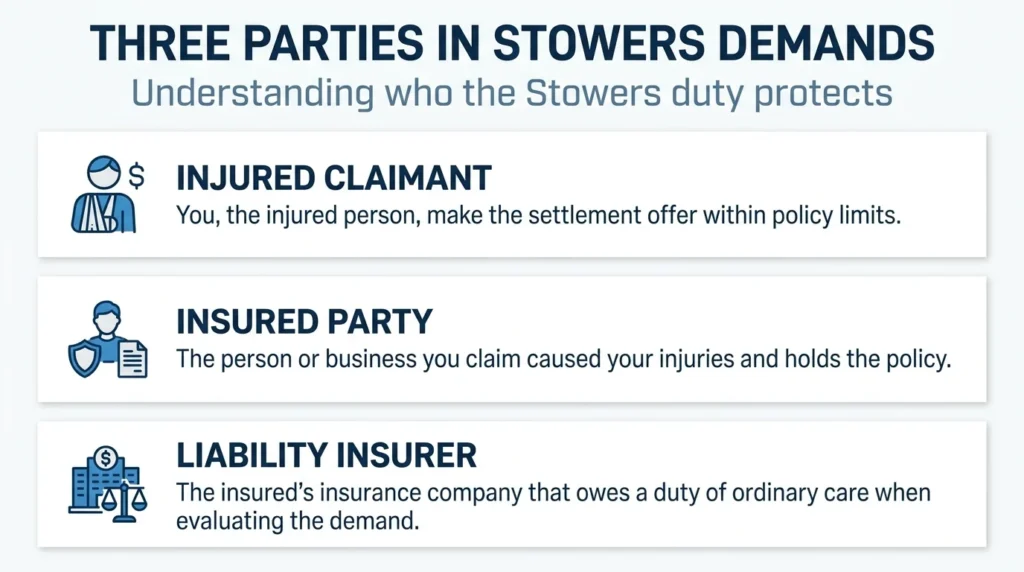
To understand how a Stowers demand works, it helps to know the three parties involved:
- You (as the injured claimant)
- The insured person or business that you are claiming is responsible for your injuries
- The insured’s liability insurance company
The Stowers duty runs from the insurer to its own insured, even though you make the settlement offer. If a judgment exceeds the policy limits, then the insured may face personal responsibility for any amount above those limits.
The Stowers doctrine comes from G.A. Stowers Furniture Co. v. American Indemnity Co., a 1929 Texas case establishing that an insurer must use ordinary care when deciding whether to accept a settlement offer.
Three Requirements for a Stowers Demand
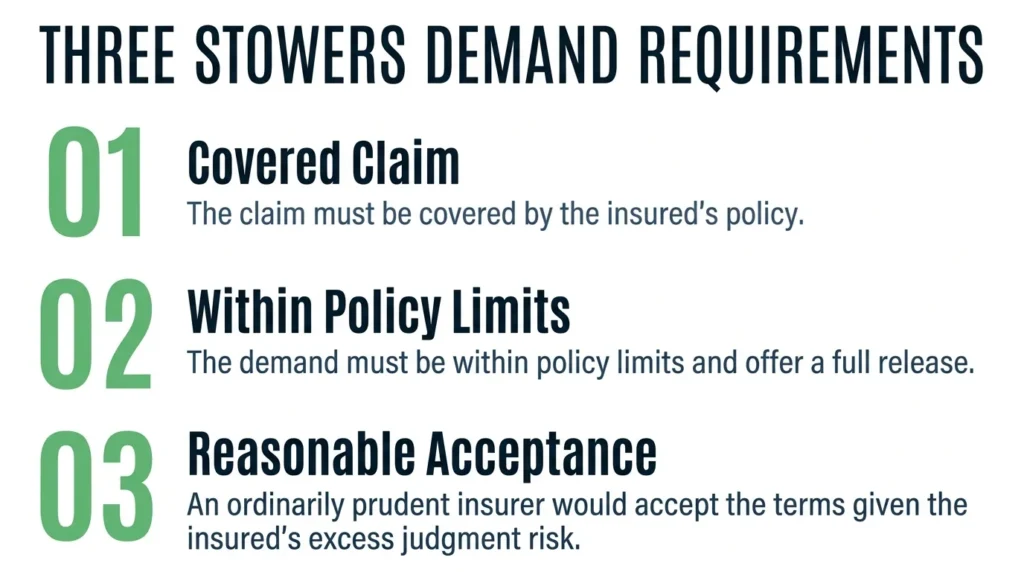
A demand qualifies when it meets the three conditions identified by the Texas Supreme Court in Garcia:
- The claim is covered by the policy.
- The demand is within the policy limits and would fully release the insured.
- An ordinarily prudent insurer would accept the terms, considering the insured’s risk of a judgment above the policy limits. In other words, the insurer must have a reasonable basis to accept the offer when considering the insured’s risk of an excess judgment.
All three requirements must be met. A demand above the policy limits does not trigger the Stowers duty.
In Rocor International, Inc. v. National Union Fire Insurance Co., the Texas Supreme Court emphasized that the settlement terms must be clear. Vague terms may not trigger the Stowers duty.
When Can an Insurer Be Liable for an Excess Judgment?
A qualifying Stowers demand can shift the risk of an excess judgment from the insured to the insurer. If the insurer negligently fails to accept the offer, then it may become responsible for the resulting judgment, including the amount that exceeds the policy limits. Other legal requirements must be met before the insurer can be held liable.
In In re Farmers Texas County Mutual Insurance Co., the Texas Supreme Court confirmed that a Stowers claim requires an excess judgment or settlement. Without excess exposure, there can be no Stowers claim.
A Stowers demand does not automatically give the injured claimant a direct claim against the insurer. The Stowers duty protects the insured.
Four Types of Evidence for a Stowers Demand
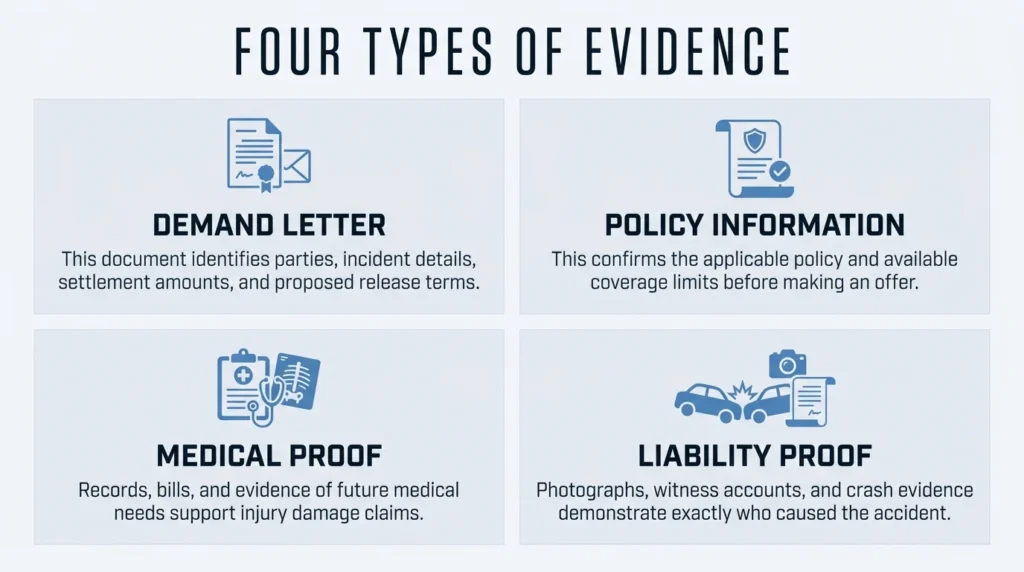
A strong Stowers demand gives the insurer evidence to evaluate fault, damages, coverage, and the risk of an excess judgment. The documents you need depend on the case.
These four parts help organize your Stowers demand and the evidence supporting it:
- Demand letter: Identify the parties, incident, settlement amount or policy-limits offer, and proposed full release. Keep the letter, attachments, proof of delivery, and responses.
- Policy information: Confirm the applicable policy and available limits before making the offer.
- Medical proof: Medical records, bills, and evidence of future medical needs can support injury damages.
- Liability proof: Photographs, witness accounts, and crash evidence can help show who caused the accident.
Together, this evidence supports the amount requested in the demand. It also shows the insurer the excess exposure that its insured may face if the case goes to trial and results in a judgment.
What Is the Deadline for a Stowers Demand?
A Stowers demand is appropriate when the facts support it, not simply because a certain amount of time has passed. Before sending a Stowers demand, an attorney should confirm that the claim, evidence, coverage, settlement terms, and timing support the offer.
There is no universal medical milestone or standard Stowers deadline. The timing depends on the facts, the evidence, and whether the insurer has a fair chance to evaluate the offer. The demand should state a clear deadline, including the date, time, time zone, and method of acceptance.
Reassess the demand as the case develops. In American Guarantee & Liability Insurance Co. v. ACE American Insurance Co., the Fifth Circuit held that a later settlement offer triggered a Stowers duty after trial developments increased the insured’s potential exposure. The case shows why a new offer may be appropriate if the evidence or circumstances change.
What happens after the deadline depends on how the insurer responds:
- Acceptance may resolve the claim.
- Rejection or failure to respond may require your attorney to preserve the evidence and evaluate the next steps in the case.
Neither outcome guarantees an excess recovery.
Talk to Angel Reyes & Associates About Whether A Stowers Demand Applies to Your Case
Whether a Stowers demand is appropriate depends on the available coverage, the evidence supporting your claim, and what you are trying to accomplish. You do not have to evaluate these issues on your own.
Angel Reyes & Associates has guided injured Texans through this process for over 30 years, and we have recovered more than $1 billion for our clients. Our team can review the facts of your injury claim with you on a contingency basis, which means you pay no fees unless we win your case.
Contact Angel Reyes & Associates for a free consultation today to discuss your situation and legal options.
Past results do not guarantee future outcomes.
Stowers Demand FAQs
What are policy limits?
Policy limits are the maximum amount an insurance company may be required to pay under a particular insurance policy. For example, a policy might provide $100,000 in liability coverage.
Can I make a Stowers demand if I have not filed a lawsuit?
Potentially. A Stowers demand can be made during the claims process, even if a lawsuit has not yet been filed. The demand must still meet the legal requirements for a Stowers claim.
Does a Stowers demand guarantee that the insurance company will pay?
No. A demand is an offer to settle, not a guarantee of payment. The insurance company can accept, reject, or fail to respond to the offer.
About the Authors

Angel Reyes
Writer
Angel L. Reyes, III is the Founder and Managing Partner of Angel Reyes & Associates. A nationally recognized trial attorney and business leader, Angel founded the firm in 1993, which has gone on to help over 70,000 injury victims recover more than $1 billion. Named to the Texas Super Lawyers list annually since 2008, Angel brings Wall Street experience, Ivy League education, and a deep commitment to client advocacy. He is a frequent legal commentator and published author with extensive contributions to legal scholarship, trial strategy, and consumer protection.

Graham Griffin
Editor
Graham Griffin is the Web & Content Manager at Angel Reyes & Associates, where he oversees content strategy, AI-powered workflows, a...

Angel Reyes
Reviewer
Angel L. Reyes, III is the Founder and Managing Partner of Angel Reyes & Associates. A nationally recognized trial attorney and business...