Can Uber Drivers or Passengers Legally Record a Ride in Texas?


Every article on this site is researched by our internal team, reviewed for legal accuracy against current Texas law, and held to State Bar of Texas advertising standards before publication. We do not publish content that overstates outcomes or makes promises about results.
Learn more about our
editorial standards .
Key Takeaways
- Texas lets a driver or rider record a conversation they take part in, within legal limits.
- Driving the car does not make a driver part of passengers' separate conversation.
- Uber says unsubmitted recordings are deleted after seven days, so report promptly.
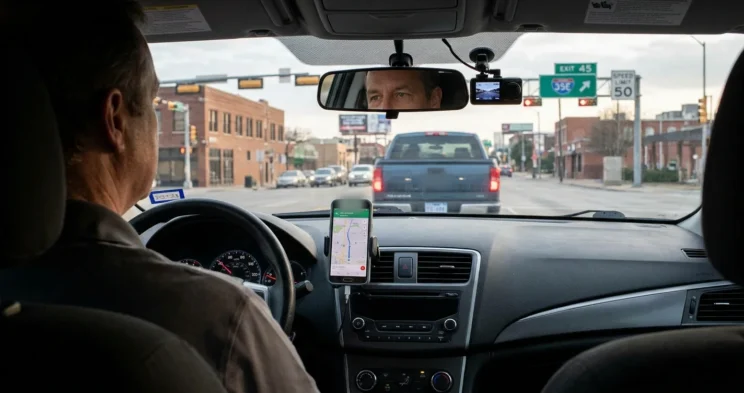
Texas generally lets Uber drivers and passengers record conversations they take part in, with limits. Whether you’re riding home on I-35 or driving a passenger, being in the car does not make you part of every conversation inside it. Uber’s recording feature adds app permissions and reporting rules, but it does not replace Texas consent law.
Is Texas a One-Party Consent State for Ride Audio?
Yes, in a qualified sense. Texas lets a private person record a conversation when that person is a party to it or has a party’s prior consent. That permission applies to the specific conversation, not to everything a person can hear during the trip.
The rule comes from Texas Penal Code §16.02. Subsection (b) makes intentionally intercepting a communication an offense. Subsection (c)(4) then gives a private person an affirmative defense, which is a legal justification the person raises in response to a charge. It is not a blanket exemption.
That defense works in two distinct ways:
- Your own participation. Under subparagraph (c)(4)(A), you may rely on being a party to the conversation you recorded.
- A party’s prior consent. Under subparagraph (c)(4)(B), you may rely on prior consent from someone who took part, but this path does not cover interception for an unlawful act.
Whether a conversation is protected also depends on context. Section 16.02 relies on definitions in Code of Criminal Procedure Article 18A.001. That article defines a protected oral communication by the speaker’s exhibited expectation that it would not be intercepted, under circumstances that justify that expectation. So not every backseat conversation is automatically private, and not every one is automatically public.
One more boundary counts here. The one-party consent rule concerns communications and audio. It does not create a universal rule that approves or forbids every form of silent video inside a vehicle.
When a Driver or Passenger May Record a Conversation
A driver may generally record a conversation with a rider, and a rider may generally record a conversation with a driver, because each is a participant. The answer changes when the person recording is not part of the conversation. Merely driving or owning the vehicle does not make someone a participant.
The examples below apply the statute’s language to rideshare trips; they are not findings from a rideshare-specific court decision.
Recording a Conversation You Join
If you’re asking, “Can Uber drivers record you?”, the answer depends on whether the driver is talking with you. When a driver asks about your route and you answer, the driver is a party to that exchange. The driver can rely on that participation under §16.02.
The same rule runs in reverse. A rider who records a conversation with the driver can rely on the rider’s own participation. Neither side needs the other’s permission to record a conversation they both share, subject to the statute’s limits.
Capturing Passengers Talking Only to Each Other

The harder question is whether it is legal for Uber drivers to record passengers who are speaking only to each other. If two riders carry on a private conversation and the driver never joins in, the driver is not a party to it. Running the car does not supply the consent the statute requires.
Consent from an actual participant can change that analysis. If one of the passengers gave prior consent, the driver may be able to rely on subparagraph (c)(4)(B). The same participant boundary applies to a rider who records a separate conversation between other people.
Falling outside the participant defense does not, by itself, prove a crime. The oral privacy element still means something. Volume, who else could hear, any notice of recording, and the surrounding circumstances can all affect whether the speakers had a justified expectation of privacy.
Civil Exposure for Unlawful Interception
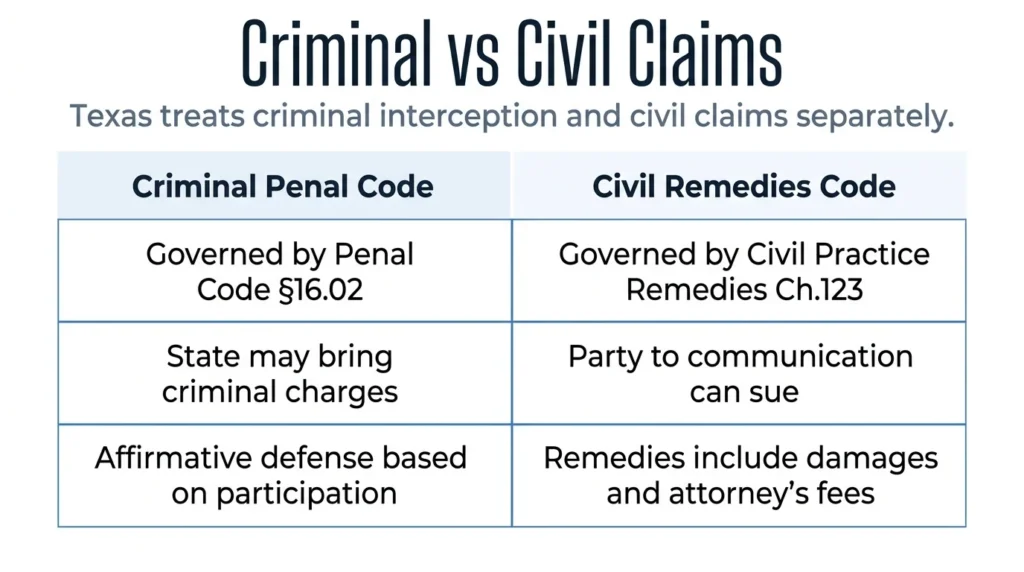
Texas also allows a civil lawsuit for unlawful interception, separate from any criminal case. Texas Civil Practice and Remedies Code Chapter 123 sets its own definition of interception and its own rules for who can sue.
Chapter 123 defines interception as acquiring a communication through a device without the consent of a party, subject to listed exclusions. Under §123.002, a party to the communication can sue someone who intercepts or attempts to intercept it.
A party can also sue someone who uses or discloses the information when that person knows or reasonably should know it came from an interception.
When a claim is established, §123.004 lists remedies that include an injunction, statutory and actual damages, punitive damages, and reasonable attorney’s fees and costs. Whether any of those apply depends on the facts and the chapter’s specific terms.
Civil and criminal questions are not interchangeable. Chapter 123 has its own definition, so the Penal Code’s oral privacy wording does not automatically control a civil claim. A criminal acquittal does not automatically decide a civil case either.
Uber Recording Settings, Notices & Reporting
Uber’s audio feature depends on app settings and device permissions, but those settings are not legal consent from other people in the car. According to Uber’s U.S. Audio Recording, users must turn on recording preferences and allow microphone access. Uber says recording can follow the preferences you select, or you can start it through the Safety Toolkit.
That microphone permission belongs to the person using the device. It shows that the user allowed the app to record. It does not show that another speaker agreed under Texas law. Uber also conditions the feature on availability and suggests checking your app version if the option does not appear, so not every Texas account or trip will have it.
Uber says it gives notice that audio recording may happen, rather than sending a fresh alert each time a recording starts. Uber’s guidance on using a dashcam permits safety recording, describes a registered dashcam option that provides notice, and directs users to local disclosure and consent requirements.
An app notice or a sign in the vehicle is a useful context. It does not guarantee that every captured conversation has valid consent.
Timing counts with Uber’s recordings. Uber says recordings stay encrypted on the user’s device, and Uber cannot listen to one unless the user attaches it to an incident report. Audio can be shared with Uber only after the trip ends.
Uber says it automatically deletes unsubmitted recordings after seven days, and it cannot recover a recording deleted from the device. That seven-day window is a product retention rule, not a Texas legal deadline. If a ride concerns you, file the report promptly and attach the recording rather than counting on a later upload.
Records to Check After a Ride Was Recorded
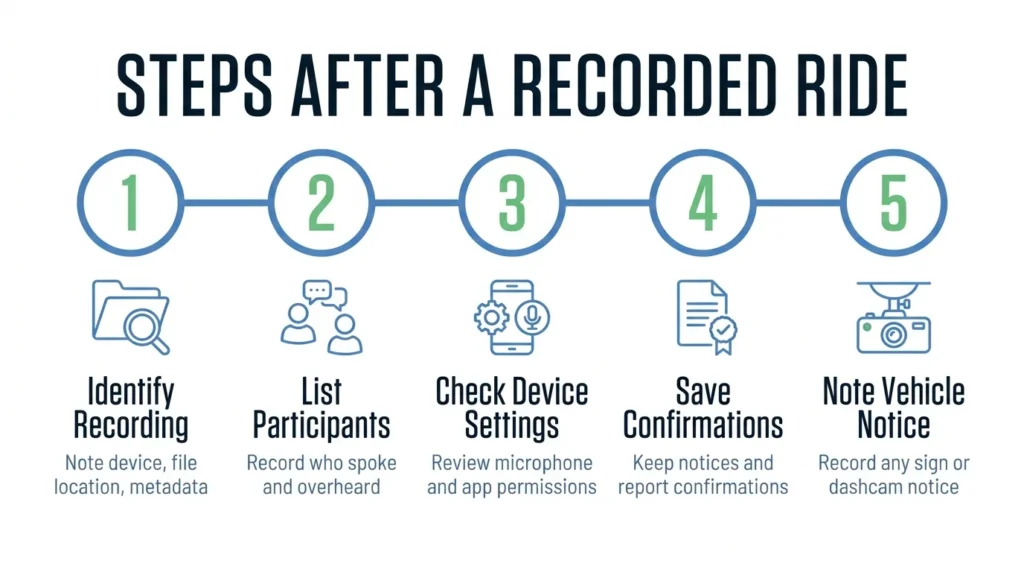
If you recorded a ride or learned someone recorded you, start by sorting out who was talking and what permissions and notices existed. These are practical steps for understanding your situation, not legal requirements. Uber’s encrypted recordings require its in-app reporting process; these steps do not assume you can play or export those files.
Work through these records in order:
- Identify the recording itself. Note which device recorded, where the original file lives, and any metadata such as the date, time, and length.
- List who spoke. Write down who took part in the captured conversation and who only overheard it.
- Check the device settings. Review the phone’s microphone permission and the recording preferences selected in the app.
- Save app confirmations. Keep any recording notice, incident report confirmation, and the times shown, if they are already available to you.
- Note any vehicle notice. Record whether a sign or dashcam notice appeared in the car, and what it said.
- Separate what you have from what you’d need to request. Some app logs may sit with Uber rather than on your device.
For recording files you can access, preserve the originals and available metadata without editing or trimming them.
Talk With Angel Reyes & Associates About Your Options
A recorded ride can raise real questions about your privacy, your safety, and what comes next. Before you reach out, gather what you have: the recording details, who was part of the conversation, your app and microphone settings, any report confirmations, and any notice posted in the vehicle.
Angel Reyes & Associates has served injured Texans for over 30 years. Contact Angel Reyes & Associates for a free consultation.
Past results do not guarantee future outcomes.
Uber Driver & Passenger Recording FAQs
Can an Uber driver share a passenger's recorded conversation online?
Sharing a recording may create additional legal exposure if it contains a conversation unlawfully intercepted or information obtained through an unlawful interception. Texas law separately addresses certain uses and disclosures of intercepted communications, so the legality of sharing depends on how the recording was obtained and what the person knew about its origin.
Can an Uber driver record a passenger's phone call during a ride in Texas?
A driver who records a passenger’s private phone conversation without participating may face different consent questions than a driver recording a conversation with the passenger. Whether the interception is lawful depends on the communication’s privacy circumstances and whether a participant provided prior consent.
Does Texas law allow Uber drivers to record passengers for evidence after an accident?
A driver may generally record conversations in which the driver participates, including discussions about an accident. However, recording conversations between other people without participating or obtaining prior consent from a participant may raise separate legal concerns, even when the driver intends to preserve evidence.
Can an Uber driver record a passenger's conversation with another driver or person outside the vehicle?
A driver who is not participating in a conversation may not automatically have permission to record it simply because the conversation is audible inside the vehicle. Texas law considers the participants’ consent and whether the communication carries a justified expectation of privacy.
About the Authors

Angel Reyes
Writer
Angel L. Reyes, III is the Founder and Managing Partner of Angel Reyes & Associates. A nationally recognized trial attorney and business leader, Angel founded the firm in 1993, which has gone on to help over 70,000 injury victims recover more than $1 billion. Named to the Texas Super Lawyers list annually since 2008, Angel brings Wall Street experience, Ivy League education, and a deep commitment to client advocacy. He is a frequent legal commentator and published author with extensive contributions to legal scholarship, trial strategy, and consumer protection.

Graham Griffin
Editor
Graham Griffin is the Web & Content Manager at Angel Reyes & Associates, where he oversees content strategy, AI-powered workflows, a...

Angel Reyes
Reviewer
Angel L. Reyes, III is the Founder and Managing Partner of Angel Reyes & Associates. A nationally recognized trial attorney and business...