Can You Sue a Hospital for Wrongful Death in Texas?


Every article on this site is researched by our internal team, reviewed for legal accuracy against current Texas law, and held to State Bar of Texas advertising standards before publication. We do not publish content that overstates outcomes or makes promises about results.
Learn more about our
editorial standards .
Key Takeaways
- Texas lets a surviving spouse, child, or parent sue a hospital for wrongful death.
- Chapter 74 requires a 60-day pre-suit notice and an expert report within 120 days.
- Three separate damage caps can apply, and one adjusts over time for inflation.
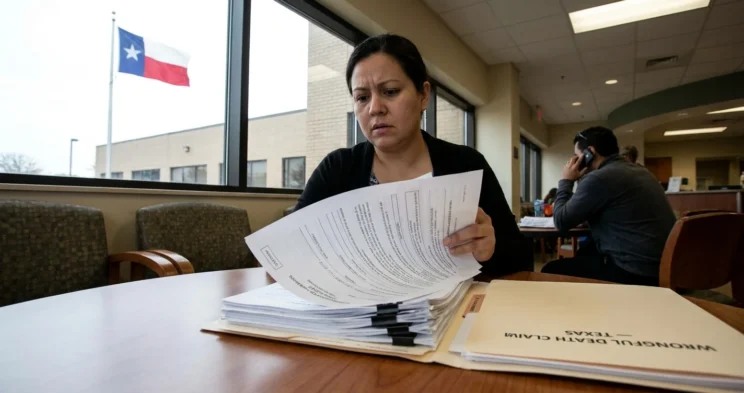
You spent a week beside a hospital bed near the Texas Medical Center off I-610, asking questions that never got clear answers. The next thing you knew, your mother was gone and something about the care she received does not sit right. Now you are wondering whether a hospital can be held responsible, or whether the law only reaches the doctor who treated her.
Suing a Hospital for Wrongful Death
Yes. Texas law lets you bring a wrongful death claim against a hospital itself, not only against the doctor or nurse who provided care.
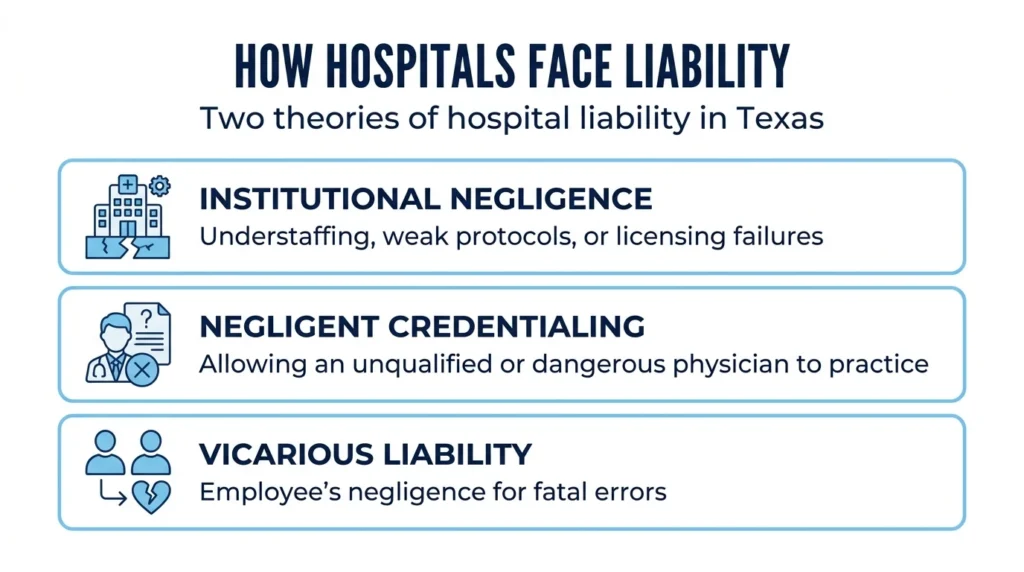
A hospital can be liable in two ways. It can answer for its own institutional failures, or for the negligence of the people it employs.
Texas also limits who may file. Only a surviving spouse, children, or parents of the person who died can bring the claim under Texas Civil Practice and Remedies Code (CPRC) § 71.004.
You generally have two years from the date of death to file under CPRC § 16.003. The extra steps these cases require can eat into that window long before the deadline arrives.
If you are still deciding whether to move forward, our overview of how wrongful death claims work in Texas walks through the general process step by step.
Direct Institutional Negligence
Some claims target the hospital’s own conduct, separate from any single caregiver. Understaffing, weak safety protocols, or a failure to meet the licensing standards in Texas Health and Safety Code Chapter 241 can support a hospital negligence lawsuit in Texas.
A hospital can also be liable for negligent credentialing, meaning it let an unqualified or dangerous physician practice. This theory runs into the peer review confidentiality protections in Texas Occupations Code § 160.007, which can limit the credentialing records you are able to reach.
When unsafe building conditions played a role, the claim can overlap with premises liability, which covers harm caused by dangerous property conditions.
Vicarious Liability for Staff Conduct
A hospital is also responsible for the negligence of the staff it employs. If an employed nurse or doctor made a fatal error, that liability can pass to the hospital.
Hospital-based physicians are often independent contractors rather than employees. That arrangement can push primary responsibility onto the doctor personally instead of the hospital.
Hospital Wrongful Death Is a Malpractice Claim
Texas treats a hospital wrongful death case as a health care liability claim, not ordinary negligence. The definition in CPRC § 74.001 is broad enough to pull most of these cases into the Chapter 74 framework.
That label is why a wrongful death medical malpractice claim carries extra pre-suit steps. A car accident case never faces them.
Pre-Suit Requirements for Hospital Claims
Two procedural gates stand between you and a courtroom, and both come before trial. Clearing them is what makes these cases slower than a standard wrongful death lawsuit.
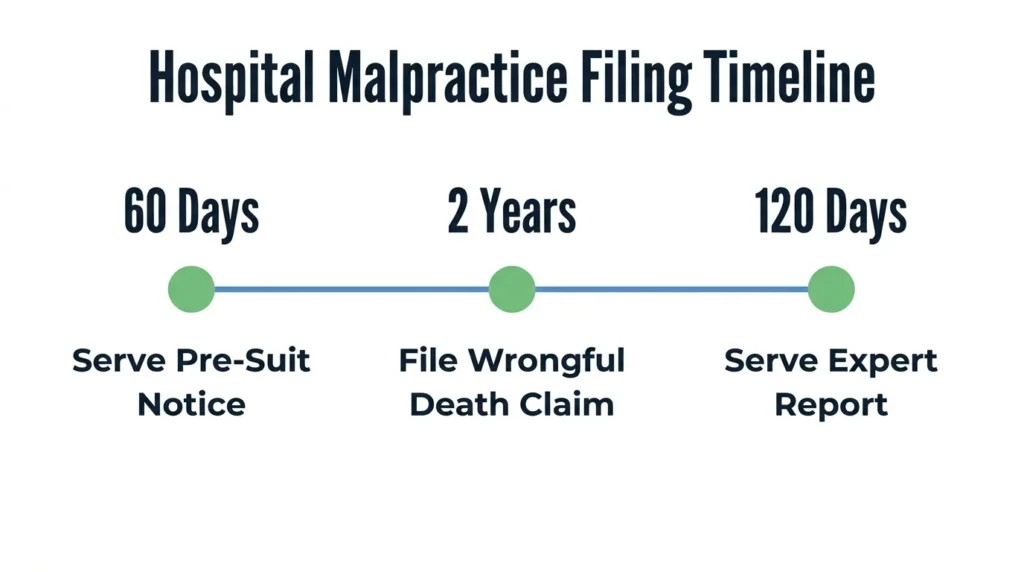
Step 1: Serve 60 days of written pre-suit notice. You must notify the hospital in writing at least 60 days before you file, under CPRC § 74.051.
Step 2: Serve a qualifying expert report within 120 days. After the hospital answers your lawsuit, CPRC § 74.351 gives you 120 days to serve a medical expert report, or the court can dismiss your case.
Missing either deadline can end your claim before a jury hears a word, which is why the wrongful death filing timeline matters early. From there, the path from notice through filing follows the same sequence as any Texas wrongful death lawsuit.
Hospital Wrongful Death Settlement Caps in Texas
Most people assume a single cap applies. The Texas medical malpractice damages cap is really three separate limits, and a hospital wrongful death case can involve all of them.
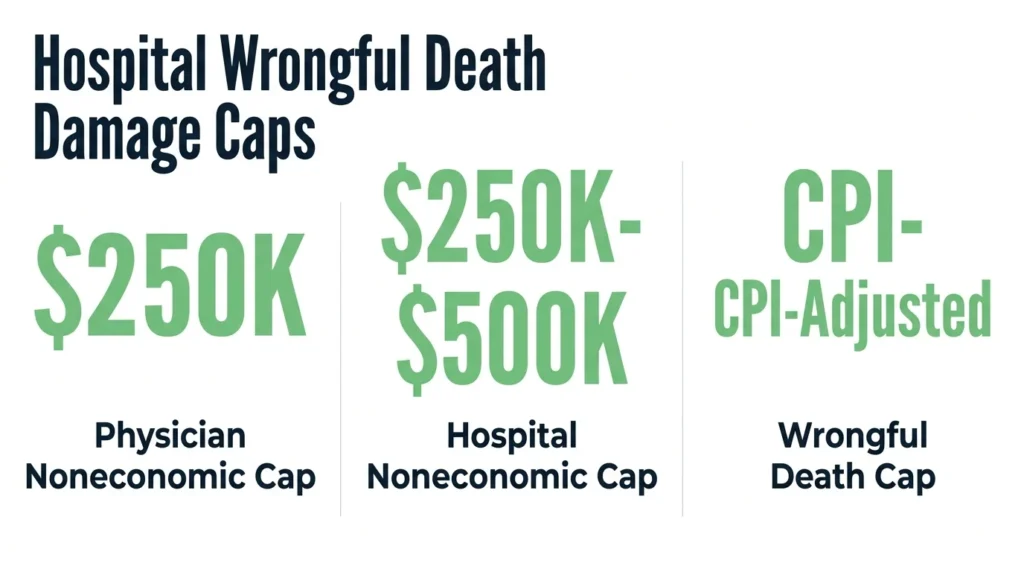
Physicians and other non-institutional providers face a fixed $250,000 cap on noneconomic damages per claimant under CPRC § 74.301.
Hospitals carry their own separate limit. Each institution faces a fixed $250,000 cap, rising to $500,000 total when more than one institution is named, under CPRC § 74.302.
Wrongful death and survival claims answer to a third cap under CPRC § 74.303. Unlike the first two, this one is not a fixed published figure.
It adjusts for inflation using a Consumer Price Index calculation applied at the time of your judgment or settlement. Private legal calculators estimate the current amount, but no state agency publishes one official number.
Before assuming a single figure applies to your family, it helps to understand how wrongful death settlement value is calculated.
Reviewing our results in complex injury cases can give you a realistic sense of how claims like this tend to resolve. For a broader look at wrongful death and malpractice damage caps, our related guide gathers the settlement maximums in one place.
Work with a Texas Wrongful Death Attorney
These claims demand medical experts, strict deadlines, and deep malpractice experience. Angel Reyes & Associates has guided injured Texans and grieving families for more than 30 years, and we work on a contingency basis, so you owe no fee unless we win.
We do not handle hospital wrongful death and medical malpractice litigation in house. Instead, we connect you with trusted co-counsel who focus on these cases, so your claim reaches the right attorney from the start.
You can learn more about our history before you decide. Reading what past clients say can help too. When you are ready, reach out for a free consultation.
Past results do not guarantee future outcomes.
Frequently Asked Questions
Can a hospital still be held liable if the doctor was an independent contractor, not an employee?
Yes, sometimes. Under the apparent agency doctrine, a hospital can still be liable if its signage, uniforms, or paperwork made the doctor look like hospital staff, and the patient reasonably believed it.
What happens if a medical expert report is filed but the hospital says it is not good enough?
The court can give the family one 30-day extension to fix specific problems with the report, as long as the report reflects a good-faith effort to meet the law’s requirements. If the report still falls short after that, the judge can dismiss the case.
What do you have to prove for a negligent credentialing claim against a Texas hospital?
You must show the hospital acted with malice, not just carelessness, in letting an unqualified or dangerous doctor practice. Peer review committee records stay confidential under Texas law, which can make this claim harder to support with direct evidence.
How long does a hospital wrongful death lawsuit usually take to resolve in Texas?
Most of these cases take one to three years from filing to resolution, depending on how complex the medical evidence is and how many parties are involved. Many settle before trial once both sides finish discovery.
About the Authors

Angel Reyes
Writer
Angel L. Reyes, III is the Founder and Managing Partner of Angel Reyes & Associates. A nationally recognized trial attorney and business leader, Angel has helped over 70,000 injury victims recover more than $1 billion since founding the firm in 1993. Named to the Texas Super Lawyers list annually since 2008, Angel brings Wall Street experience, Ivy League education, and a deep commitment to client advocacy. He is a frequent legal commentator and published author with extensive contributions to legal scholarship, trial strategy, and consumer protection.

Kyle Nicolas
Editor
Kyle Nicolas is the Web Content & SEO Manager at Angel Reyes & Associates. He has more than 10 years of experience as a marketing co...

Angel Reyes
Reviewer
Angel L. Reyes, III is the Founder and Managing Partner of Angel Reyes & Associates. A nationally recognized trial attorney and business...