Can You Sue the Dealership That Sold the Car?


Every article on this site is researched by our internal team, reviewed for legal accuracy against current Texas law, and held to State Bar of Texas advertising standards before publication. We do not publish content that overstates outcomes or makes promises about results.
Learn more about our
editorial standards .
Key Takeaways
- A Texas dealership that only sold the vehicle is shielded from product liability.
- Seven statutory exceptions lift that shield, and most carry their own burden of proof.
- Defect and causation still must be proved after an exception is established.
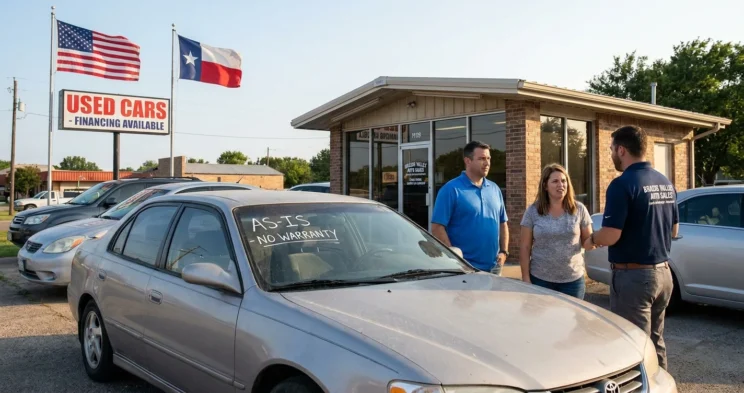
You were hurt when something in the vehicle failed. A tire came apart, an airbag fired wrong, a seat back gave way. The dealership is right there in town, so suing the business you dealt with may feel like the obvious move.
Texas law usually shields dealerships that only sold the vehicle. To hold the dealership liable, you have to show that a statutory exception applies or that its own work caused the harm.
The Texas Innocent Seller Rule
In most Texas cases, you cannot hold the dealership liable for an injury caused by a defective vehicle. Under Texas Civil Practice and Remedies Code Section 82.003, a seller that did not manufacture a product is not liable for harm caused by that product unless the claimant proves one of seven specific exceptions.
A dealership generally qualifies as a seller because it took ownership of the vehicle and transferred it to the buyer. That status gives the dealership protection under the statute.
The claimant must provide evidence that one of the seven exceptions applies. Without that evidence, the dealership generally cannot be held liable for the vehicle defect.
The manufacturer is usually the defendant when a defect causes a serious collision and injury. A claim against the dealership depends on whether its actions fall within a statutory exception.
The Seven Exceptions That Put a Dealership Back in the Case
Seven situations can remove the dealership’s statutory protection. The claimant must prove that at least one applies, and most carry an additional requirement written into the statute.
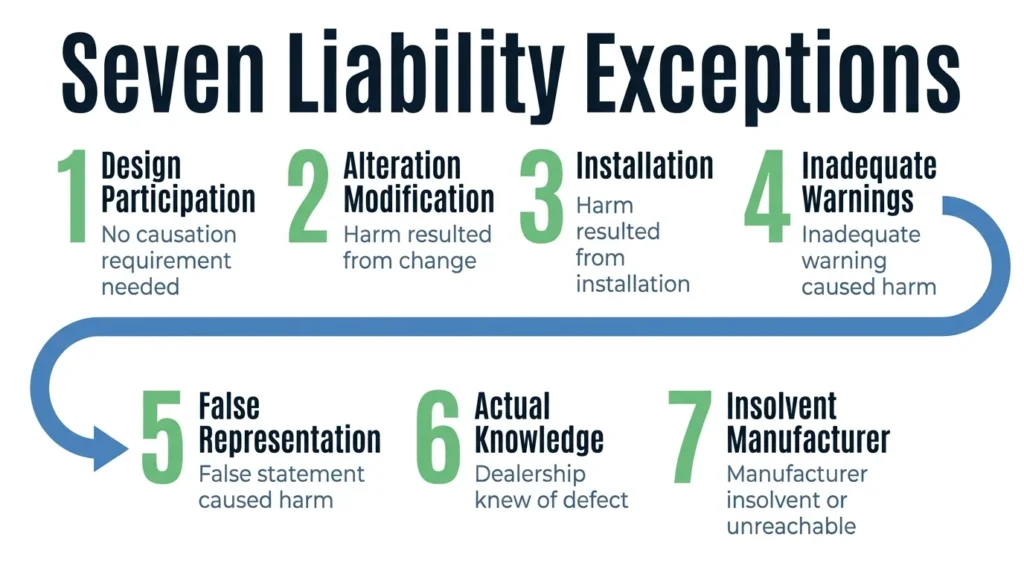
- Design participation. The dealership took part in designing the product. No separate causation requirement appears in the text.
- Alteration or modification. The dealership altered or modified the product, and your harm resulted from that change.
- Installation. The dealership installed the product, or had it installed, on another product, and your harm resulted from that installation.
- Inadequate warnings. The dealership had substantial control over a warning or instruction that came with the product, the warning was inadequate, and your harm resulted from that inadequacy.
- Express factual representation. The dealership made an express factual statement about the product, the statement was incorrect, you relied on it, and you would not have been harmed, or would have been hurt less, had it been true.
- Actual knowledge of a defect. The dealership knew of a defect when it supplied the product, and your harm resulted from that defect. Actual knowledge at the time of sale is the standard. What the dealership should have known does not count, and a recall issued after you bought the vehicle does not satisfy it.
- Insolvent manufacturer, or one the court cannot reach. The manufacturer is insolvent, or is not subject to the jurisdiction of the court where you sued.
“The jurisdiction of the court” means the court where your case is pending, not that no court anywhere could reach the manufacturer.
When a nonresident manufacturer is served through the Texas Secretary of State and fails to answer or appear, the law presumes that the manufacturer is outside that court’s reach unless the dealership establishes otherwise. This exception may apply when a foreign manufacturer of a vehicle, tire, or airbag component will not appear in Texas. To rely on the other part of this exception, the claimant must prove insolvency.
Proving an exception removes the dealership’s statutory protection. You must still prove that the vehicle was defective and that the defect caused your injuries.
When a Dealership Stops Being Just a Seller
A dealership may lose its protected-seller status if it qualifies as a manufacturer under the statute or if its own negligent work caused the harm.
Upfits, Conversions, & Dealer-Installed Equipment
Section 82.001 defines a manufacturer to include a designer, rebuilder, fabricator, or assembler that places a product into the marketplace. Texas does not extend that definition to a dealership because it presents itself as the manufacturer.
Routine dealer work generally does not qualify. Courts applying Texas law have found that inspecting a fully assembled vehicle and making minor adjustments do not amount to manufacturing. New-vehicle preparation, inspections, oil changes, and warranty repairs usually leave the dealership within the seller category.
Upfitting and conversion work may produce a different result. Lift kits, van conversions, service-body or bed installation, and aftermarket equipment can place a dealership in the role of an assembler. This work is common on commercial and upfitted vehicles. A dealership may also face liability when it arranges for a third party to install the equipment.
Negligent Repair as a Separate Claim
A claim based on a product defect remains subject to Chapter 82 even when it is described as negligence, misrepresentation, or breach of warranty.
A separate negligent-repair claim may apply when the dealership’s own work caused the harm. The repair must be connected to the injury. A shop that services a vehicle after the sale generally has no duty to discover an unrelated design defect created by the manufacturer.
What Your Case Needs & How Long You Have
Whether a dealership belongs in your case depends on documents, most of them in the dealership’s own files.
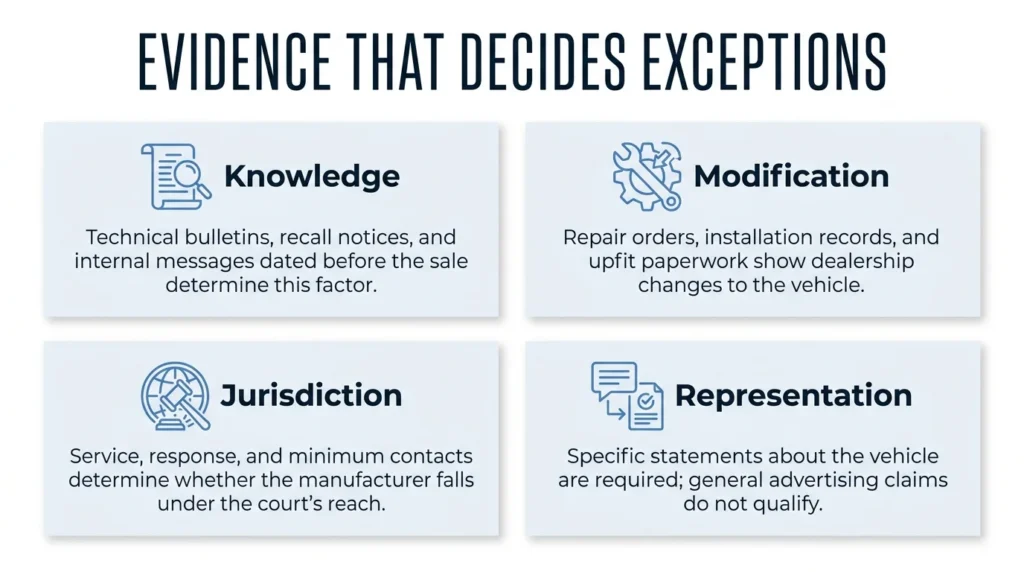
Evidence That Decides an Exception
- Knowledge. Technical service bulletins, recall notices, and stop sale instructions dated before the sale, plus the dealership’s internal messages about them. Timing decides this one.
- Modification. Repair orders, accessory and upfit installation records, conversion and lift kit paperwork, and any pre-delivery work the dealership performed or subcontracted.
- Jurisdiction over the manufacturer. Whether the manufacturer was properly served, whether it answered, and whether it has minimum contacts with Texas. Service alone does not settle it.
- Representation. Specific statements about that vehicle, identified in the claim. Generalized advertising and a theory assembled after filing will not carry it.
Filing Deadlines for a Dealership Claim
Section 16.003 generally gives you two years from the date of the injury to file a personal injury lawsuit. The deadline generally runs from the date of death in a wrongful death case.
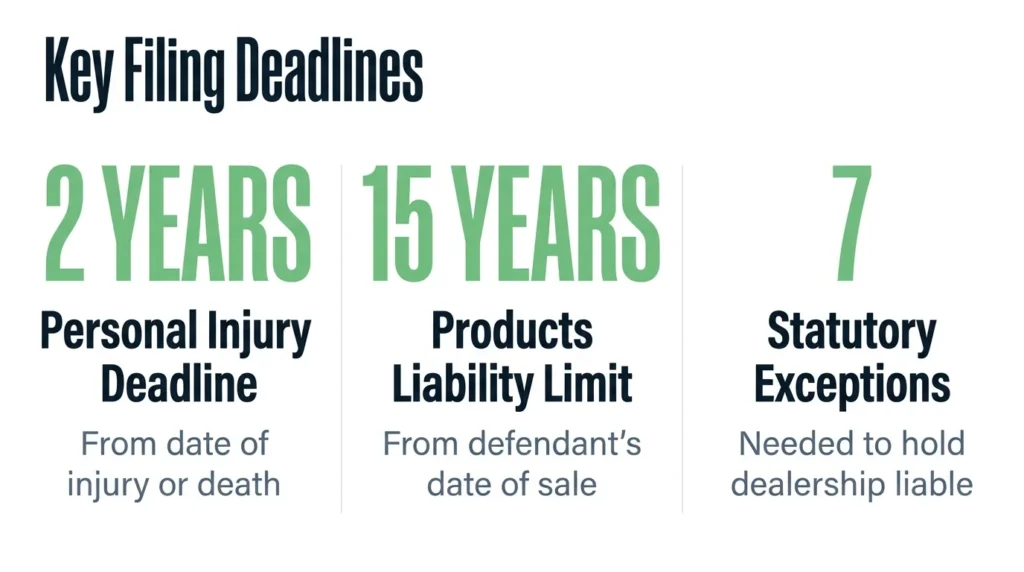
A second deadline may also apply. A products liability lawsuit generally must begin within 15 years of the date that defendant sold the product, although the law provides some exceptions. Because the deadline depends on each defendant’s sale, a used-car dealership and the original dealership may have different dates.
Under Section 82.002, a manufacturer generally must reimburse an innocent seller for losses and legal fees arising from a products liability action. That protection does not cover losses caused by the dealership’s own negligence, intentional misconduct, or other conduct creating independent liability.
A dealership should generally be included when evidence supports a statutory exception or shows that its own repair, installation, or modification caused the harm.
Talk to a Products Liability Lawyer
The dealership question may depend on records you do not have, including service bulletins issued before the sale, repair orders, and upfit paperwork. The two-year deadline continues to run while you gather those records.
Angel Reyes & Associates has guided injured Texans through situations like this for over 30 years. Get a free consultation to review your options.
Past results do not guarantee future outcomes.
Dealership Liability FAQs
Can you sue a used car dealership in Texas for selling a defective vehicle?
The same Texas protections for nonmanufacturing sellers can apply to used-car dealerships in a products liability case. Liability depends on whether the dealership’s conduct fits an exception under Texas law or independently caused the injury.
Does a vehicle recall automatically make a Texas dealership liable for an accident?
No. A recall may provide evidence about a defect. Still, dealership liability depends on factors such as what the dealership actually knew when it supplied the vehicle and whether that defect caused the injury.
Can both the car manufacturer and dealership be defendants in the same products liability lawsuit?
Yes. A lawsuit can include multiple defendants when the evidence supports separate grounds for liability against the manufacturer, dealership, component manufacturer, installer, or another party involved with the vehicle.
Can a dealership be liable for an aftermarket part installed before the vehicle was sold?
Potentially. If the dealership installed an aftermarket component or arranged for its installation and the installation caused the injury, Texas Civil Practice and Remedies Code Section 82.003 provides an exception to the protection generally given to nonmanufacturing sellers.
What should you do with a defective vehicle after an accident in Texas?
Preserve the vehicle and potentially defective components in their post-accident condition when possible because they may be important evidence in determining how and why the failure occurred. Avoid repairs, disposal, or destructive testing that could prevent other parties from examining relevant evidence.
About the Authors

Angel Reyes
Writer
Angel L. Reyes, III is the Founder and Managing Partner of Angel Reyes & Associates. A nationally recognized trial attorney and business leader, Angel has helped over 70,000 injury victims recover more than $1 billion since founding the firm in 1993. Named to the Texas Super Lawyers list annually since 2008, Angel brings Wall Street experience, Ivy League education, and a deep commitment to client advocacy. He is a frequent legal commentator and published author with extensive contributions to legal scholarship, trial strategy, and consumer protection.

Graham Griffin
Editor
Graham Griffin is the Web & Content Manager at Angel Reyes & Associates, where he oversees content strategy, AI-powered workflows, a...

Angel Reyes
Reviewer
Angel L. Reyes, III is the Founder and Managing Partner of Angel Reyes & Associates. A nationally recognized trial attorney and business...