PTSD After a Car Accident in Texas: Symptoms, Treatment, & Legal Options


Every article on this site is researched by our internal team, reviewed for legal accuracy against current Texas law, and held to State Bar of Texas advertising standards before publication. We do not publish content that overstates outcomes or makes promises about results.
Learn more about our
editorial standards .
Key Takeaways
- PTSD after a car accident can become part of a Texas injury claim when the crash causes lasting emotional harm.
- Prompt treatment and consistent records are often the strongest proof in a PTSD-related car accident case.
- Most Texas car accident lawsuits have a two-year filing deadline, but waiting can damage the evidence long before that date.
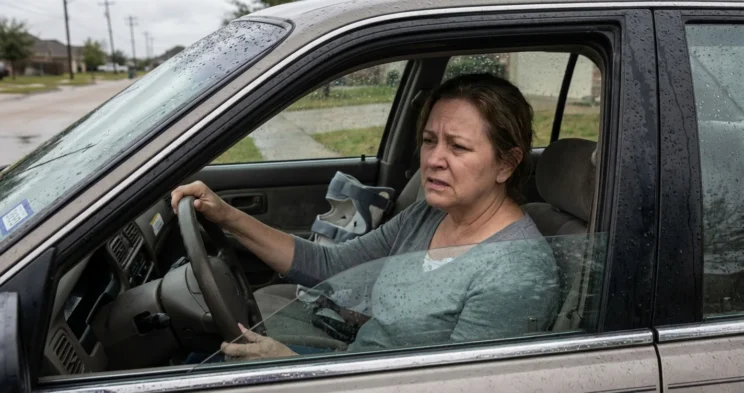
Six months ago, you were minding your own business while driving through Fort Worth when you were suddenly slammed into by a driver who ran a red light at an intersection. The broken glass has long been cleaned up, your car is fixed, and you’re finally starting to feel your daily pain subsiding.
However, you still cannot sleep. Getting behind the wheel starts to make you sweat, and you’re doing everything you can to avoid the road. When you have to drive, you start to feel panicked every time you approach a green light.
These may be signs of post-traumatic stress disorder (PTSD).
PTSD can happen after a car accident. A violent crash can leave emotional injuries that last long after the physical damage starts to heal. When symptoms affect your sleep, work, driving, or relationships, the issue is no longer just stress; it may be a compensable injury in a Texas car accident claim.
What Are PTSD Symptoms & When Do They Affect Daily Life?
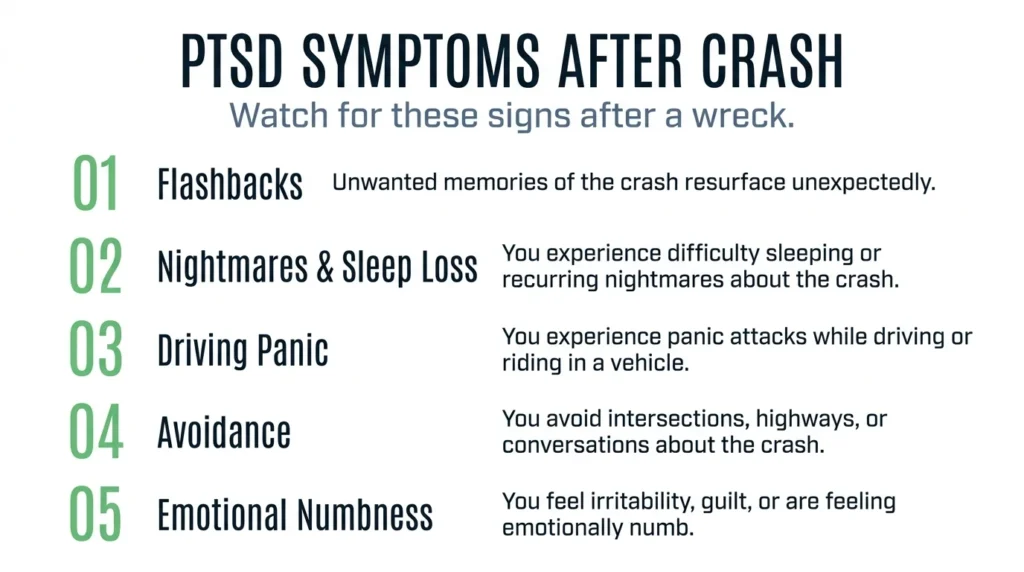
These are the symptoms to watch out for after a serious car accident:
- Flashbacks or unwanted memories of the crash
- Nightmares or trouble sleeping
- Panic while driving or riding in a vehicle
- Avoiding intersections, highways, or conversations about the crash
- Irritability, guilt, or emotional numbness
- Trouble concentrating at work or at home
- Feeling constantly on edge or easily startled
When these symptoms interfere with daily life, it is time to get psychologically evaluated. PTSD does not always appear the same way in every person, and some symptoms become more obvious only after the immediate shock of the collision wears off.
Treatment for PTSD & Records That Strengthen Your Claim
Medical treatment helps your recovery and documents the damage caused by the crash. If you think you may have PTSD, tell your doctor exactly what changed after the wreck. Be specific about nightmares, fear of driving, missed work, and any new anxiety.
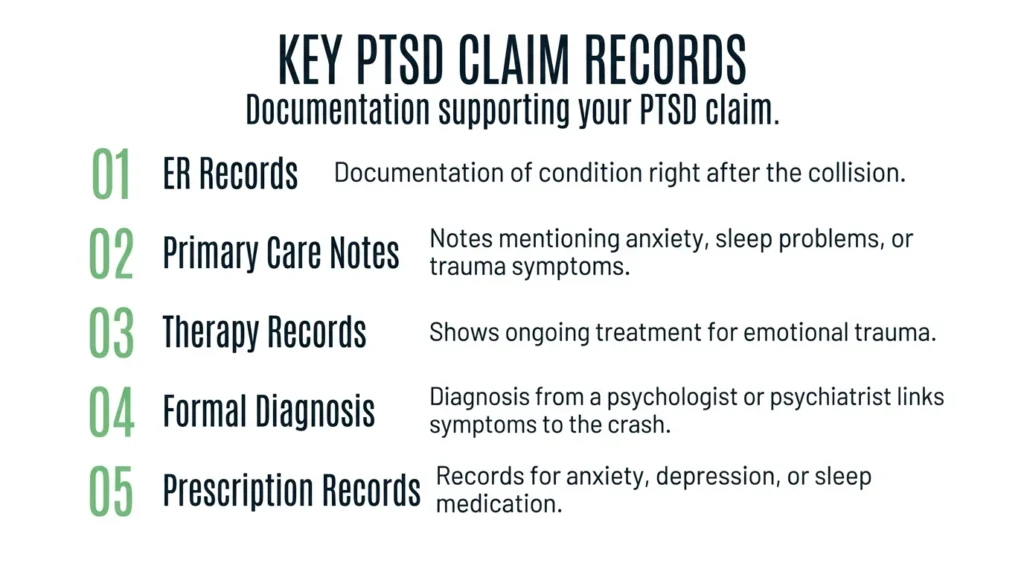
The records that usually help most include:
- Emergency room or urgent care records from right after the collision
- Primary care notes that mention anxiety, sleep problems, or trauma symptoms
- Therapy or counseling records
- A diagnosis from a psychologist, psychiatrist, or other qualified provider
- Prescription records for anxiety, depression, or sleep issues
- Attendance records showing missed work or reduced hours
- Notes from family members who have witnessed changes in your behavior
Clear records make it easier to connect the crash to the emotional injury. Our post on common car accident injuries can also help you spot symptoms that people often overlook in the days and weeks after a crash.
Compensation & Proof in a Texas PTSD Claim
PTSD damages are usually part of a broader injury claim, not a separate lawsuit filed by itself. If another driver caused the crash, you may be able to seek compensation for mental health treatment, prescription costs, lost wages, reduced earning ability, and pain and suffering.
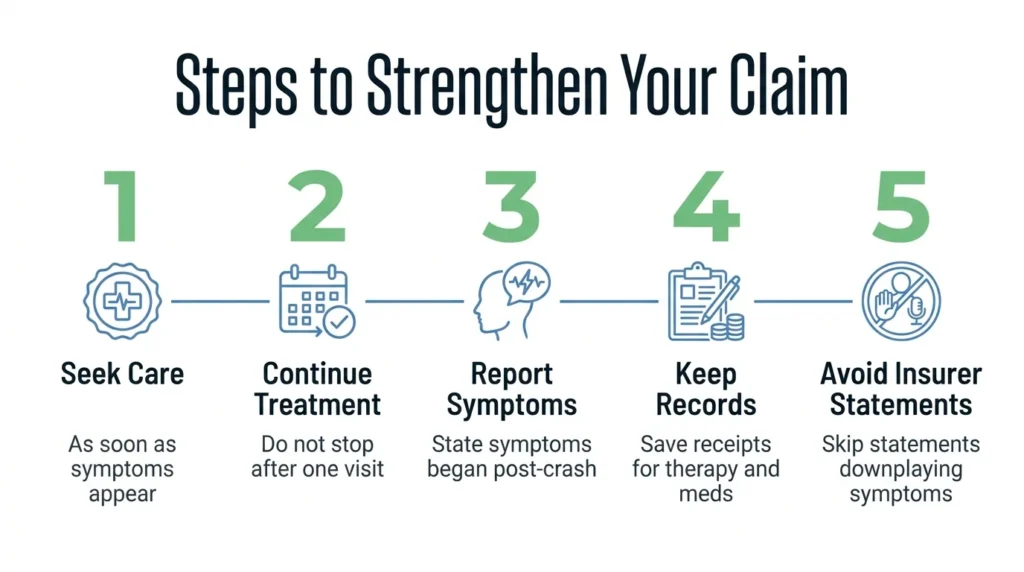
These steps usually make the strongest difference in a PTSD claim:
- Get medical care as soon as symptoms appear.
- Follow through with treatment, instead of stopping after one visit.
- Tell every healthcare provider you see that the symptoms began after the crash.
- Keep receipts and records for therapy, medication, and travel to appointments.
- Avoid giving the insurance company casual statements that downplay what you are dealing with.
- Save photos, witness information, and other crash evidence.
Strong proof is important because insurance companies often challenge injuries they cannot see on an X-ray. Our guide on how to successfully file a car insurance claim in Texas explains how insurers review these cases, and what can weaken a claim early.
Filing Deadlines & Why Waiting Can Hurt Your Case
Texas law limits how long you have to file most car accident lawsuits. In many cases, the deadline is two years under Texas Civil Practice and Remedies Code § 16.003.
That deadline is important, but waiting can hurt you even before the filing period runs out. Gaps in treatment give the insurance company room to argue that your symptoms came from something else. Missing records, lost witness details, and delayed care can also weaken the link between the crash and your PTSD diagnosis.
If you are dealing with emotional injuries after a crash, it will also help if you understand the overall claim process, which you can find on our car accidents page. You can also review our case results to see the kinds of injury claims Angel Reyes & Associates handles for clients across Texas.
Get Legal Help Before PTSD Starts Controlling Your Life
Getting diagnosed with PTSD after a car accident can affect every part of your routine. It can change how you sleep, drive, and work, and how safe you feel around other people. The right legal strategy starts with taking the condition seriously, getting proper care, and building a record that shows how the crash has changed your life.
Angel Reyes & Associates has over 30 years of experience handling serious Texas injury claims, and you pay no fee unless we win. If a crash left you with lasting emotional trauma, use our free case review form to discuss your options with us.
Past results do not guarantee future success.
Car Accident PTSD FAQs
Can you recover compensation for PTSD after a Texas car accident even if your physical injuries were relatively minor?
Potentially, yes. In a Texas injury claim, the key issue is whether the evidence shows compensable mental anguish that has substantially disrupted your daily routine or caused a high degree of mental pain and distress, not whether the visible injuries were the most serious part of the crash.
Do you need a formal PTSD diagnosis to make a Texas car accident claim for PTSD?
A formal diagnosis is not always the only way to prove emotional damage, but claims are usually much stronger when a psychologist, psychiatrist, counselor, or treating doctor documents the condition and connects the symptoms to the crash. Texas courts require evidence of the nature, duration, and severity of mental anguish.
Can the insurance company access your therapy or psychological records if you claim PTSD damages?
Sometimes, yes. The Texas Supreme Court has recognized that when a plaintiff seeks damages for mental anguish, and the defense argues that other causes contributed to their condition, psychological records may become accessible for the case.
How do Texas courts evaluate whether PTSD or damages from emotional trauma are worth a payout?
Texas law requires more than general statements that “the crash was upsetting.” The proof should show a rational connection between the emotional injury and the amount claimed, supported by evidence of how your symptoms have affected your sleep, driving, work, relationships, and/or daily functioning.
What if PTSD symptoms do not appear until weeks or months after the car accident?
A delay does not automatically defeat the claim. The bigger problem is proof, so delayed symptoms usually need consistent treatment records and provider opinions that tie the later-emerging condition to the crash, while the lawsuit itself is still generally subject to the two-year deadline.
About the Authors

Spencer Browne
Writer
Spencer Browne is a partner at Angel Reyes & Associates and a Board Certified personal injury trial lawyer with nearly 100 jury trials across Texas. He focuses on car, truck, and wrongful death cases, with notable verdicts including a landmark win in the Choctaw Casino bus crash case. A recognized speaker and legal educator, Spencer is a member of the American Board of Trial Advocates and has been honored as a Texas Super Lawyer and one of D Magazine’s Best Lawyers in Dallas. He brings deep trial experience and relentless advocacy to every client he represents.

Kyle Nicolas
Editor
Kyle Nicolas is the Web Content & SEO Manager at Angel Reyes & Associates. He has more than 10 years of experience as a marketing co...

Angel Reyes
Reviewer
Angel L. Reyes, III is the Founder and Managing Partner of Angel Reyes & Associates. A nationally recognized trial attorney and business...