Car Accident vs. Truck Accident Claims in Texas


Every article on this site is researched by our internal team, reviewed for legal accuracy against current Texas law, and held to State Bar of Texas advertising standards before publication. We do not publish content that overstates outcomes or makes promises about results.
Learn more about our
editorial standards .
Key Takeaways
- Truck accidents involve federal FMCSA regulations and multiple liable parties, making claims far more complex than typical car accident cases.
- Commercial trucks carry insurance policies ranging from $2 million to $5 million, compared to Texas's minimum auto coverage of $30,000 per person.
- Evidence, like black box data and driver logs, must be preserved quickly in truck cases before it can be lost or destroyed.
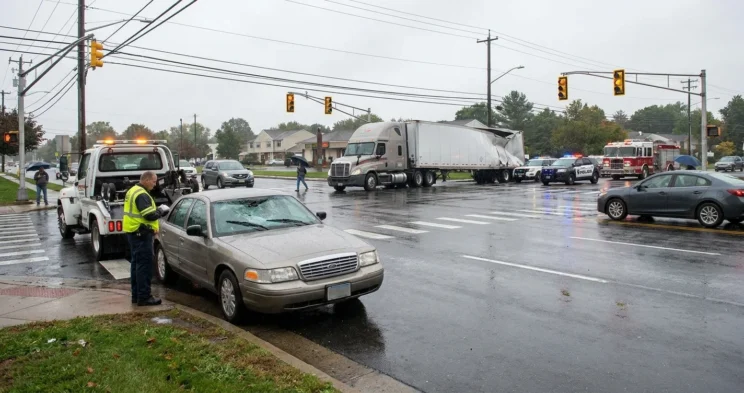
You were driving home on I-35 when an 18-wheeler changed lanes without warning. Now you’re dealing with injuries, vehicle damage, and phone calls from an insurance company you’ve never heard of. The adjuster is asking questions that feel more like an interrogation than a conversation.
If this sounds familiar, you’re not alone.
Collisions involving commercial trucks create a fundamentally different situation than crashes between two passenger vehicles. The insurance process, the legal complexity, and the stakes are all higher.
Understanding the differences between these two types of accidents can help you protect your rights and make informed decisions about your next steps.
Understanding the Key Differences in Accident Claims
According to the Centers for Disease Control and Prevention, motor vehicle crashes remain one of the leading causes of death in the United States. Survivors often face mounting medical bills, lost wages, and long-term physical limitations.
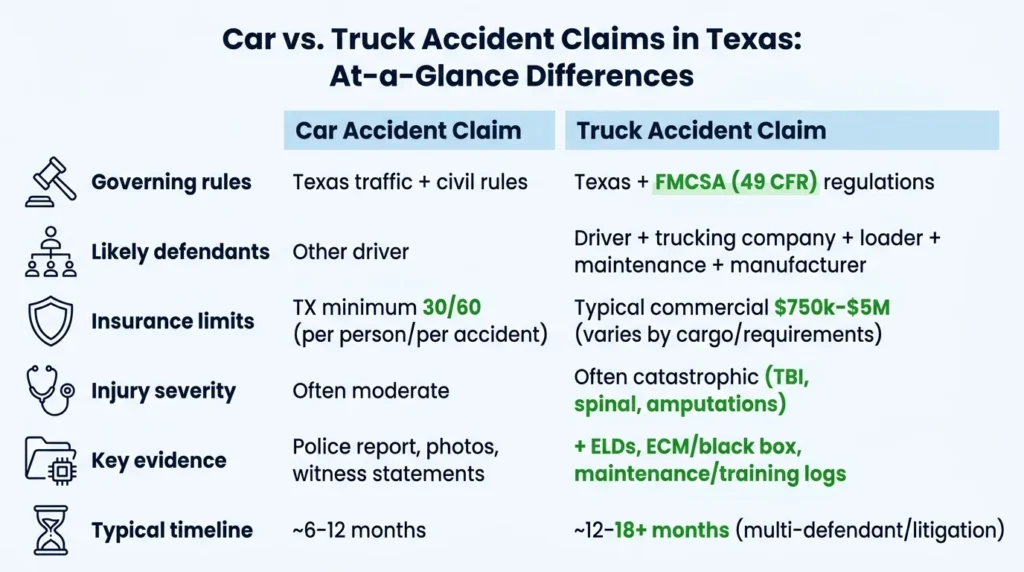
The type of vehicle involved in your crash shapes nearly every aspect of what comes next. A fender-bender with another sedan on Lamar Blvd. in Austin follows a relatively straightforward path. A collision with a commercial truck on Loop 410 in San Antonio involves federal regulations, corporate defendants, and insurance policies with limits that dwarf typical auto coverage.
From federal oversight to policy limits, the following factors demonstrate why truck accident claims often require a more specialized legal approach than standard car accidents.
Federal Oversight & Multi-Party Liability
In a standard car accident, the rules are set by the State of Texas. However, commercial truck accidents operate much differently; they are governed by a complex web of federal safety standards.
Federal Motor Carrier Safety Administration (FMCSA)
Unlike passenger vehicles, commercial trucks must comply with Title 49 of the Code of Federal Regulations.
The FMCSA strictly enforces:
- Hours of Service (HOS) Rules: Drivers are generally limited to 11 hours of driving after 10 consecutive hours off-duty.
- Electronic Logging Devices (ELDs): Trucks must use tamper-resistant technology to track every minute a driver is on the clock, leaving a digital footprint that standard cars don’t have.
- Maintenance and Inspections: Under Texas Transportation Code § 644.151, operating a commercial vehicle in violation of federal safety out-of-service orders is a serious offense that can escalate to a felony if a crash occurs.
Identifying Multiple Liable Parties
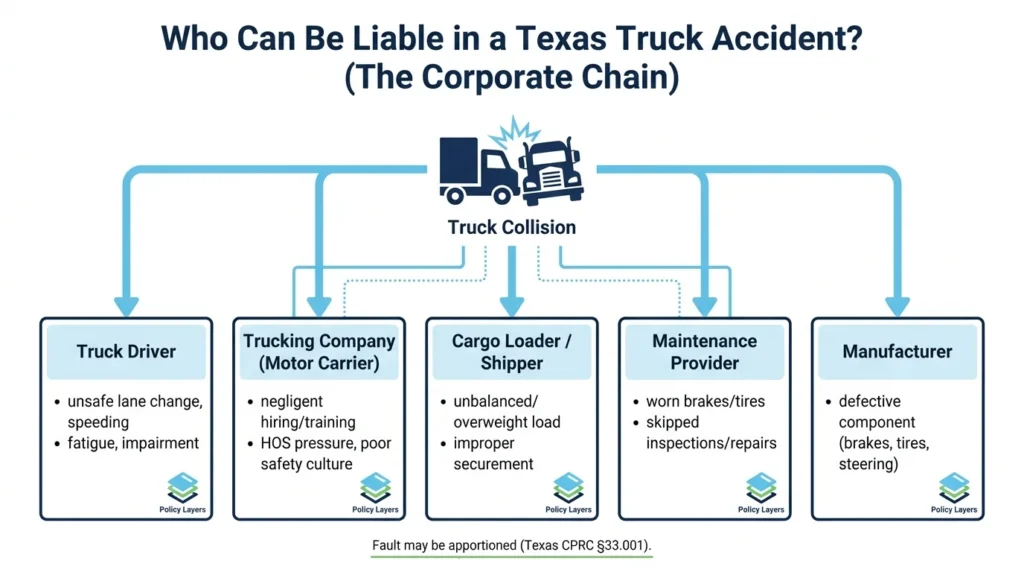
In a passenger car crash, you usually look to the other driver. In a truck accident, liability is often spread across an entire corporate chain.
Under Texas Civil Practice & Remedies Code § 33.001, fault can be assigned to:
- The Trucking Company: For negligent hiring or forcing drivers to exceed HOS limits.
- The Cargo Loader: If an unbalanced load caused a jackknife or rollover.
- The Maintenance Provider: If faulty brakes or worn tires contributed to the collision.
- The Manufacturer: If a mechanical defect in the truck itself led to the crash.
Commercial vs. Personal Insurance Requirements
Under Texas Transportation Code § 601.072, Texas law requires passenger vehicle owners to carry minimum liability coverage of $30,000 per person and $60,000 per accident for bodily injury.
Commercial trucks operate under federal insurance mandates that are currently undergoing the first major increase in decades. While the historical minimum was $750,000, new federal proposals and industry requirements for 2026 often push these limits to $2 million or even $5 million, depending on the cargo.
Higher policy limits mean more money is available for compensation. They also mean the insurance company has more incentive to fight your claim aggressively.
Injury Severity & Medical Impact Differences
When an 80,000-pound semi-truck strikes a 4,000-pound passenger car, the results are often catastrophic.
Injuries common in truck accidents include traumatic brain injuries, spinal cord damage, multiple fractures, internal organ damage, and amputations. Many survivors face permanent disabilities requiring lifelong medical care and rehabilitation.
These severe injuries translate to higher medical expenses, longer recovery periods, and greater lost earning capacity. In the worst cases, families must pursue wrongful death claims after losing a loved one.
Injury severity directly affects the value of your claim and the complexity of proving your damages.
Evidence Gathering & Investigation Differences
Car accident investigations typically rely on police reports, witness statements, photos of the scene, and vehicle damage assessments.
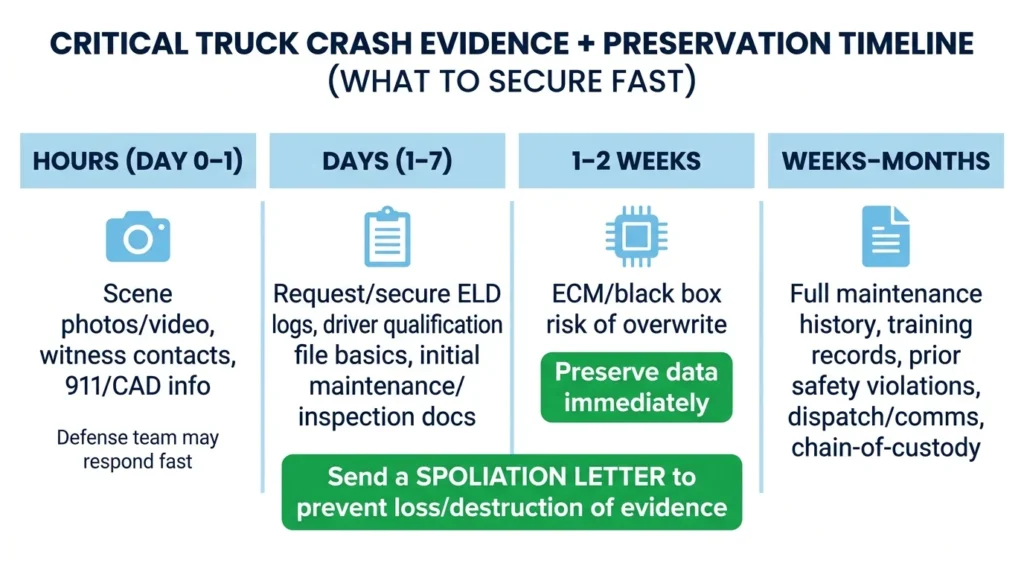
Truck accident investigations require all of that, plus specialized evidence found only in commercial vehicle cases. Commercial trucks are equipped with technology that tracks and records different types of data that can be helpful in these cases.
Types of evidence that can be used to prove negligence in a truck accident include:
- Data from electronic control modules (black boxes) that record speed, braking, steering inputs, and other data in the moments before a crash.
- Records from electronic logging devices that track driver hours.
- Records of vehicle inspections, maintenance schedules, driver training, and safety violations.
Trucking companies know that these types of evidence can be used against them. It is not uncommon for these companies to begin their own investigations within hours of a crash; it is also not uncommon for key evidence to be lost, overwritten, or destroyed if not preserved promptly. Sending a spoliation letter to prevent the destruction of evidence is a critical early step that requires legal expertise and prompt action.
Insurance Claims & Settlement Process Differences
When you transition from a car accident claim to a truck accident claim, you aren’t just dealing with a bigger vehicle – you are dealing with a more aggressive opponent.
Here is why truck claims are different:
- The Opposition: Unlike a standard car accident with one adjuster, truck claims involve a Rapid Response Team. These are specialized investigators and lawyers who often arrive at the crash site within hours to begin building a defense for the trucking company.
- Tactical Delays: Because the policy limits are significantly higher, commercial insurers are incentivized to use “delay and defend” tactics. Their goal is to wear you down financially so you accept a lower settlement.
- Multiple Policies: A single crash might involve the driver’s policy, the trucking company’s policy, and even the cargo loader’s liability insurance. Navigating these overlapping layers requires a high level of legal coordination.
The complexity of the investigation and the severity of the injuries mean these cases rarely resolve quickly.
While a straightforward car accident claim might resolve in 6 to 12 months, truck accident cases often take 12 to 18 months or longer, particularly when multiple defendants are involved, or litigation becomes necessary.
The higher potential compensation in truck cases makes patience worthwhile, but only if you have experienced representation protecting your interests throughout the process.
How Angel Reyes & Associates Handles Both Case Types
Whether you were hurt in a collision with another car on Preston Rd. in Dallas or struck by a commercial truck on I-10 in Houston, Angel Reyes & Associates has the resources to handle your case.
We have spent over 30 years representing Texas accident victims. Our attorneys work with accident reconstruction specialists who understand how to build strong cases against trucking companies and their insurers.
We have recovered more than $1 billion for our clients. Our track record demonstrates our commitment to fighting for full compensation. You pay nothing unless we win your case. Consultations are free, and we’re available 24/7 to answer your questions.
If you’ve been injured in any vehicle accident, contact us today to discuss your options. The sooner you reach out, the sooner we can begin protecting your rights and preserving critical evidence.
Past results do not guarantee future success.
Truck Claim vs. Car Accident Claim FAQs
What is the statute of limitations for truck accident claims in Texas?
Texas Civil Practice and Remedies Code §16.003 sets a two-year statute of limitations for personal injury claims from truck accidents, the same as car accidents. However, federal claims against trucking companies may have different deadlines.
Can I sue the trucking company if their driver was an independent contractor?
Yes, trucking companies can still be liable under federal regulations even when drivers are independent contractors. The Motor Carrier Act holds companies responsible for ensuring their contracted drivers meet safety requirements and follow FMCSA rules.
What happens if the truck driver was under the influence but also violated Hours of Service rules?
Multiple violations can strengthen your case significantly. Both impairment and HOS violations constitute separate acts of negligence. The trucking company may face additional liability for allowing an overworked driver to operate their vehicle.
Do truck accident settlements get taxed differently than car accident settlements?
Personal injury settlements are generally not taxable income under IRS rules, regardless of vehicle type. However, punitive damages and interest on delayed payments may be taxable. Consult a tax professional for your specific situation.
How long do trucking companies have to preserve black box data after an accident?
Immediate legal action is essential; depending on the vehicle’s technology and usage, black box data can be overwritten in as little as one to two weeks of normal operation.
About the Authors

Alex Ivanov
Writer
Alex Ivanov is a personal injury attorney at Angel Reyes & Associates, focused on car, truck, and motorcycle accident cases. Licensed in Texas and multiple federal districts, Alex brings international legal experience and a global education to his practice. He earned his LL.M. from Texas A&M University School of Law after graduating from Belarussian State University in 2016. Alex is fluent in Russian, English, Ukrainian, and Belarussian, and is recognized by multiple national trial lawyer associations for his results and leadership under 40.

Kyle Nicolas
Editor
Kyle Nicolas is the Web Content & SEO Manager at Angel Reyes & Associates. He has more than 10 years of experience as a marketing co...

Angel Reyes
Reviewer
Angel L. Reyes, III is the Founder and Managing Partner of Angel Reyes & Associates. A nationally recognized trial attorney and business...