What Happens to a Child’s Share of a Wrongful Death Settlement in Texas?


Every article on this site is researched by our internal team, reviewed for legal accuracy against current Texas law, and held to State Bar of Texas advertising standards before publication. We do not publish content that overstates outcomes or makes promises about results.
Learn more about our
editorial standards .
Key Takeaways
- A Texas court must approve a minor's wrongful death settlement share before any payout.
- A minor's funds go into a Section 142 trust or annuity, not a parent's account.
- Children usually receive the settlement money at 18, not before except for urgent needs.

You settled the wrongful death claim months after losing your husband in a crash on the Southwest Freeway. Now the paperwork says part of the money belongs to your daughter, and no one can touch it until a judge signs off. You are the one raising her, so why can’t you just set it aside for her yourself?
Minor Beneficiaries Under Texas Wrongful Death Law
Texas law names a person’s children as beneficiaries of a wrongful death claim. Your child is entitled to her own share of the recovery. She just cannot collect it the way an adult would.
The Texas Civil Practice and Remedies Code (CPRC) § 71.004 lists who can recover: the surviving spouse, children, and parents of the person who died. Each of them can hold a share of the same claim.
Not every relative makes that list. Our explainer on who can bring a wrongful death claim covers why Texas limits it to spouses, children, and parents.
The recovery forms one pool. A settlement or jury then divides it, and your child receives an individual portion under CPRC § 71.010.
How large that portion is depends on each person’s loss and the damages the claim seeks, from lost financial support to loss of companionship.
A minor cannot receive settlement funds directly. Before any money moves, a court must approve the child’s share, a safeguard built into Texas wrongful death cases that involve children.
Guardian Ad Litem’s Role in Settlement
A Texas court appoints a guardian ad litem to check that your child’s proposed share is fair before approving it. This person reviews the settlement on the child’s behalf, separate from the adults negotiating it.
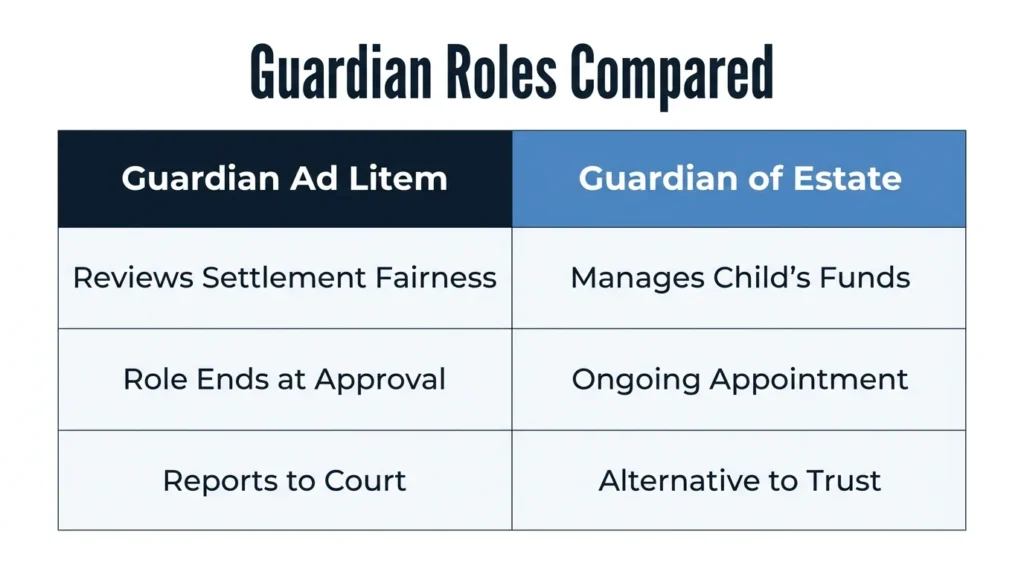
The guardian ad litem answers to the court, not to you or the insurance company. Under Texas Rules of Civil Procedure Rule 173, the court can appoint one when a minor may have a conflict with the people bringing the claim.
You do not go through this alone. Our personal injury attorneys prepare the settlement paperwork and work alongside the guardian ad litem through the review.
For most families, this is their first court-supervised settlement, and the extra scrutiny can feel unsettling. The review is a routine, non-adversarial step, not a sign that something is wrong with your settlement.
Guardian Ad Litem vs. Guardian of the Estate
These two roles sound alike but do different jobs. The court appoints a guardian ad litem only to evaluate the settlement and report on whether it is fair, and that role usually ends once the court approves it.
A guardian of the estate is a separate, ongoing appointment. This person has authority to manage your child’s funds over time under Texas Estates Code Chapter 1151, and families use it as an alternative to a trust or structured settlement.
Minor Settlement Hearings in Texas
A judge reviews and approves your child’s share at a short court hearing, often called a friendly suit or a prove-up. Here is how that hearing usually unfolds.
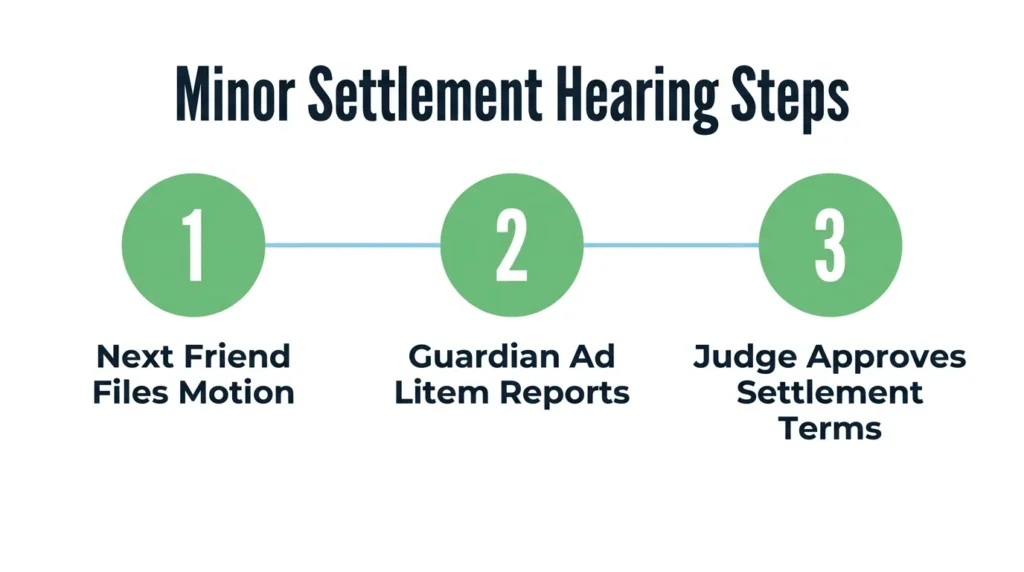
Step 1: The next friend files a motion to approve the settlement. The next friend is usually you, the surviving parent, acting for the child under Texas Rules of Civil Procedure Rule 44.
Step 2: The guardian ad litem submits a written report. That report tells the judge whether the proposed share serves the child’s best interest.
Step 3: The judge reviews the terms at the hearing. The judge confirms how the funds will be held, approves the attorney fees, and makes the settlement final and binding on the child.
Texas also gives minors a longer window to bring their own claim. That extended deadline is a separate protection from this approval hearing. You can see how the wrongful death filing deadline works for the people filing the suit.
Hearing format and scheduling vary by county, so it helps to have someone who knows local court practice confirm how these suits are filed and approved.
Holding a Minor’s Settlement Share
Once the court approves the settlement, your child’s share goes into a court-sanctioned vehicle rather than your bank account. You generally cannot use it for routine costs like clothing, groceries, or day-to-day bills.
This protection follows the child across different kinds of cases, including school bus accident settlements and other claims involving injured children.
Texas courts mainly use two vehicles to hold this money: a statutory trust or a structured settlement annuity. Local court practice can shape which one a particular county favors.
Before the hearing, think through whether a single trust fund or scheduled annuity payments better fit your family’s timeline.
Section 142 Trusts for a Minor’s Settlement
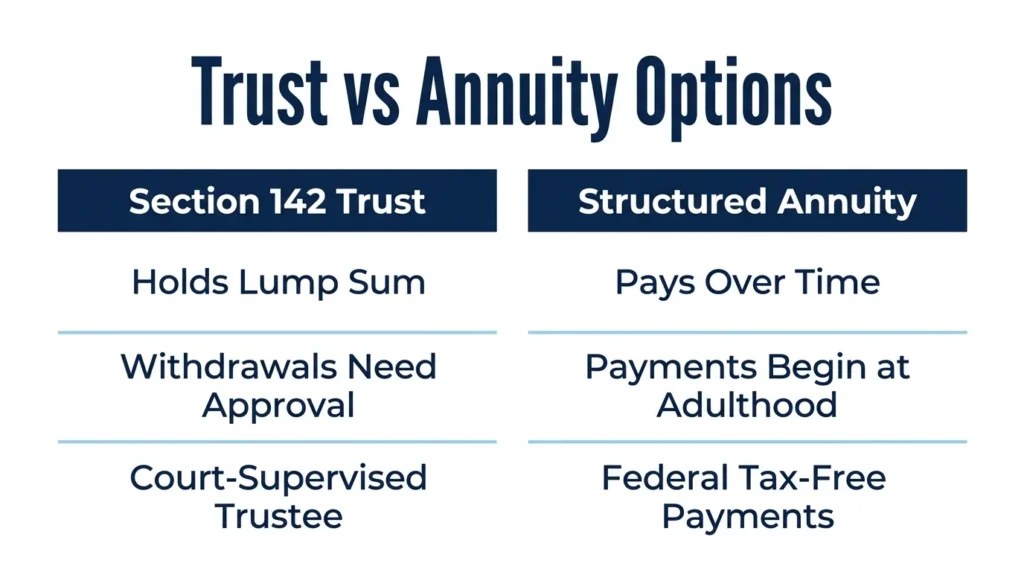
A Section 142 trust is the most common way Texas courts hold a child’s settlement money. The Texas Property Code § 142.005 lets the court create and supervise a trust for funds recovered by a next friend or guardian ad litem.
The court sets the terms, and a trustee manages the money. Withdrawals need court approval, so the funds stay protected until your child is old enough to receive them.
Structured Settlement Annuities in Texas
A structured settlement annuity is the other main option. Instead of holding a lump sum, it pays your child over time, often in scheduled amounts that begin at adulthood.
An annuity that funds a minor’s share must meet the requirements in Property Code § 142.009. Texas also regulates these arrangements more broadly through its Structured Settlement Protection Act.
The Texas Civil Practice and Remedies Code Chapter 141 controls how anyone can later sell or transfer those future payments.
When a Minor Receives Settlement Money
Your child typically receives the money at 18. A trust can allow earlier payments, but only with court approval, and typically for needs like health care, education, or basic support, not routine spending.
How much your child eventually receives depends on the total settlement value and any damage caps that were applied. Those numbers get set well before the money moves into a trust.
If you are still gauging what a claim might be worth, our look at average wrongful death settlements can help you set expectations. The eventual figure also turns on how damage caps limit recovery, which courts settle early in the case.
Structured annuity payments made for a wrongful death claim are generally free from federal income tax under 26 U.S.C. § 104.
Families who have already been through this can offer a real perspective on what to expect. You can read what past clients say about the process from start to finish.
Work with a Texas Wrongful Death Attorney
Handling a wrongful death settlement while raising the child who inherited part of it is a heavy load to carry alone. Angel Reyes & Associates has guided Texas families through wrongful death claims and minor settlement approvals for more than 30 years.
We offer free initial consultations, and you pay no attorney fee unless we win, though you may still owe court costs and case expenses. If your settlement includes a child’s share, schedule a free consultation so you understand your options before the hearing.
Past results do not guarantee future outcomes.
Frequently Asked Questions
How long does a minor have to file their own wrongful death claim in Texas?
Texas generally pauses the two-year filing deadline until a child turns 18, so the child usually has until age 20 to bring the claim. Some case types, like certain medical malpractice claims, may follow a different deadline.
Who pays the guardian ad litem's fee in a minor's settlement?
The fee usually comes out of the settlement funds or gets charged to the defendant as a court cost. Either way, the judge must approve the amount before it is paid.
Can a parent serve as trustee of a child's Section 142 trust, or does it have to be a bank?
Texas law generally requires the trustee to be a bank or trust company with trust powers. A court may allow someone else only for trusts of $50,000 or less, and only if no bank will take the role and the arrangement serves the child’s best interest.
What happens to a Section 142 trust if the child dies before turning 18?
The trust ends on the child’s death, and the remaining funds pass to the child’s estate rather than staying with the parent. This happens regardless of how much time was left before the child would have turned 18.
Does a minor's settlement trust always pay out at 18?
Not always. The trust document can set a later payout age, and Texas law caps that age at 25, though many trusts are still written to end at 18.
About the Authors

Angel Reyes
Writer
Angel L. Reyes, III is the Founder and Managing Partner of Angel Reyes & Associates. A nationally recognized trial attorney and business leader, Angel has helped over 70,000 injury victims recover more than $1 billion since founding the firm in 1993. Named to the Texas Super Lawyers list annually since 2008, Angel brings Wall Street experience, Ivy League education, and a deep commitment to client advocacy. He is a frequent legal commentator and published author with extensive contributions to legal scholarship, trial strategy, and consumer protection.

Kyle Nicolas
Editor
Kyle Nicolas is the Web Content & SEO Manager at Angel Reyes & Associates. He has more than 10 years of experience as a marketing co...

Spencer Browne
Reviewer
Spencer Browne is a partner at Angel Reyes & Associates and a Board Certified personal injury trial lawyer with nearly 100 jury trials a...