City Bus Accident Settlements in Texas


Every article on this site is researched by our internal team, reviewed for legal accuracy against current Texas law, and held to State Bar of Texas advertising standards before publication. We do not publish content that overstates outcomes or makes promises about results.
Learn more about our
editorial standards .
Key Takeaways
- Texas caps municipal bus claims at $250,000 per person and $500,000 per occurrence under the TTCA.
- You must give written notice to the city bus agency within six months of the accident date.
- Missing the six-month notice deadline typically prevents you from filing a claim, even before the two-year limit.
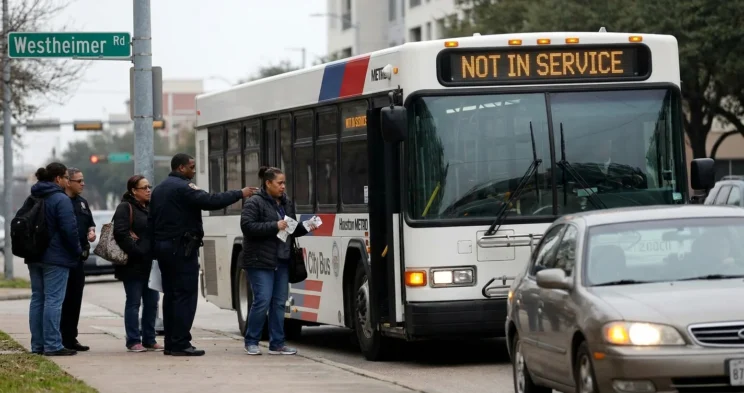
You were riding the bus to work one morning when the driver braked hard on Westheimer Road in Montrose, throwing you forward into the seat ahead. Your back has not felt right since, the medical bills are stacking up, and the agency that runs the bus is giving you the silent treatment. Now, you need to know how much you can actually recover, and how a claim against a city bus agency even works.
Why City Bus Claims Work Differently in Texas
A city bus claim is not an ordinary car accident case. Municipal transit systems like METRO, DART, VIA, and CapMetro are government entities, not private companies. Because government entities have “sovereign immunity,” they usually cannot be sued for injuries. However, the Texas Tort Claims Act creates a limited exception that allows lawsuits to be pursued in certain crashes involving government-owned vehicles.
Because the waiver is limited, you cannot pursue a city bus injury the same way you would a private driver or a private bus line. Special rules apply to deadlines, damages, and how notice must be delivered. The waiver itself is detailed in Texas Civil Practice and Remedies Code (CPRC) § 101.021, which only allows compensation when the injury was caused by a government employee driving a motor vehicle while doing their job.
Texas Government Bus Accident Compensation Limits Explained
Texas law puts a strict limit on what you can recover from a city bus agency. Under CPRC § 101.023, recovery against a municipality is capped at $250,000 per person and $500,000 per accident, no matter how severe your injuries are or how expensive your medical bills become.
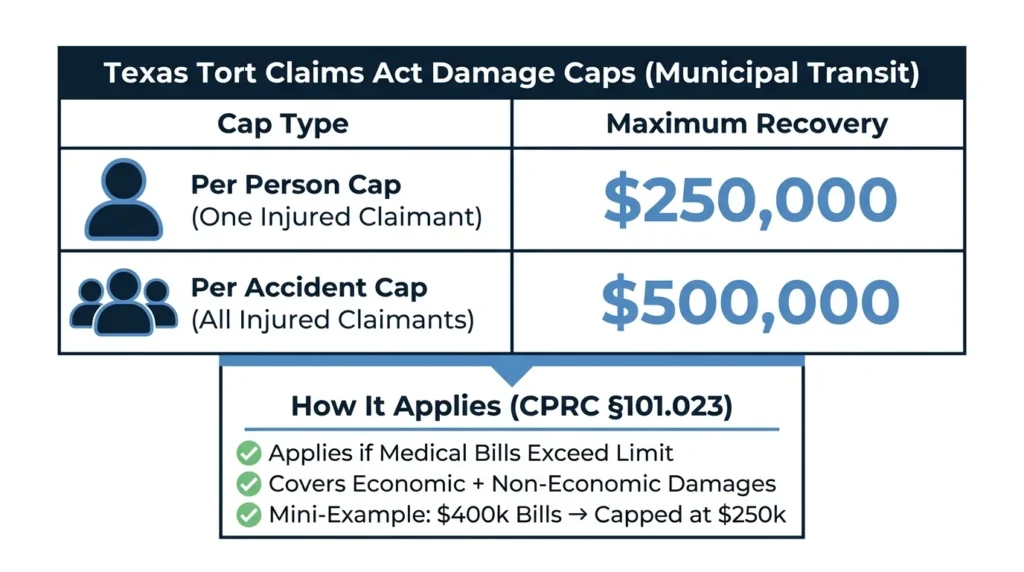
The per-person cap applies to each individual claimant. The per-occurrence cap is the combined amount available for everyone hurt in the same incident. So, if a rider has $400,000 in documented medical bills from a METRO crash, the most they can recover from METRO under the statute is $250,000.
Federal rules require transit agencies to carry minimum insurance, but there is no public confirmation that DART, METRO, VIA, or CapMetro carry supplemental coverage above the Texas legal limits. An attorney would need to investigate whether extra coverage is available in a specific case.
Wrongful death claims face the same limits. A fatal city bus accident is still subject to the per-person and per-occurrence caps, and our Texas wrongful death claims page explains how these cases move forward while limited by the legal compensation cap.
Notice Requirements for Municipal Bus Claims
Before any lawsuit can move forward, you have to give the agency formal written notice. More people have problems with this step than with any other rule in the statute.
The Six-Month Written Notice Rule
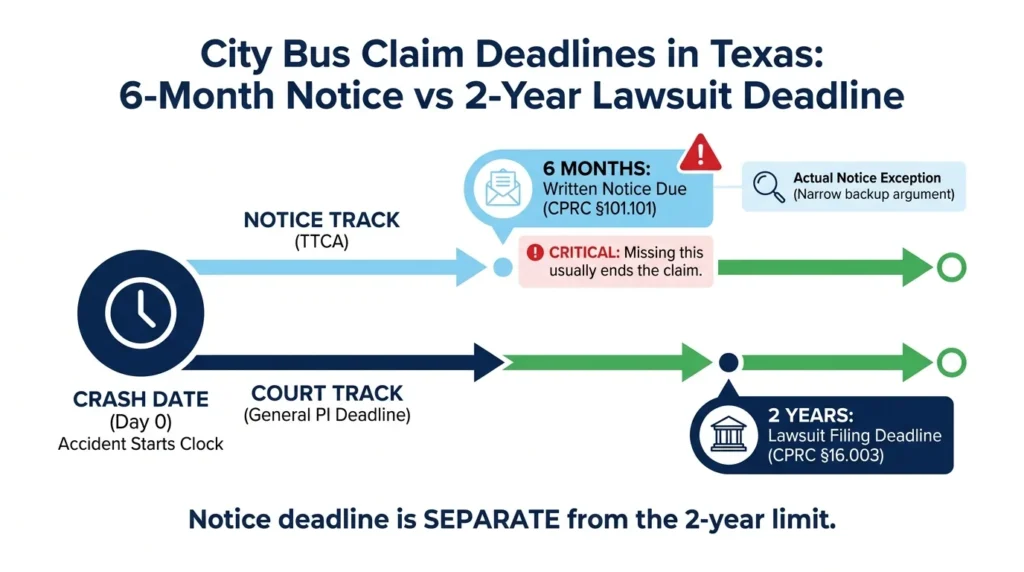
CPRC § 101.101 requires written notice to the government within six months of the accident. The clock starts counting down from the date of the crash, not from the day a doctor confirms your diagnosis or the day you hire a lawyer.
The notice must reasonably describe the damage or injury claimed, the time and place of the incident, and the incident itself. Where you send it depends on the agency: DART claims go to DART’s risk management office, while METRO claims go to METRO’s designated office in Houston. Addresses and submission rules vary, so confirm them before you send anything.
If you miss this deadline, your claim almost always ends right there, no matter how serious your injuries are.
The Actual-Notice Exception
§ 101.101(c) creates a small exception to the notice requirement. If the agency already knew about your injury, you may not have to give formal written notice. “Actual notice” means the agency knew that an injury occurred, knew the identity of the parties involved, and recognized its own potential fault. It does not mean that it just reviewed the incident as part of a routine investigation.
Courts interpret this exception strictly. An ambulance call, a police report, or footage from the bus camera does not automatically count. A driver’s incident report sometimes helps, but it is not a guarantee.
Treat the actual-notice exception as a backup argument, not your main strategy. If the six-month deadline is close or has already passed, talking with an attorney quickly is the only way to know what options remain open to you, since the notice deadline is separate from the two-year statute of limitations.
What Affects the Value of a City Bus Settlement?
Within the cap, the value of a specific claim depends on the facts. Some cases settle close to the maximum amount, and others settle for much less. The strength of your medical records, how clearly fault is proven, and your own role in the crash all affect how high or low the settlement amount will be.
The severity of your injuries and how well they are documented are what sets the minimum value of any offer. Insurance adjusters look at medical records, treatment timelines, and expert opinions on the long-term impact of your injuries. If there are any gaps in your medical care or insufficient documentation, the value of your offer can be quickly reduced.
How clearly liability is proven is just as important. Evidence such as dashcam footage, witness statements, and crash reconstructions that clearly point to the bus driver can increase the value of your offer. If fault is disputed, your negotiating power is weaker. If you were partly at fault yourself, Texas proportionate responsibility rules reduce the amount you can recover according to your share of the blame.
Both economic damages (such as medical bills, lost wages, and future earnings) and non-economic damages (such as pain and impairment) are included in the $250,000 per-person cap. Documented economic losses are easier to prove and defend.
Finally, the person who negotiates for you can affect the value of your offer. Government legal staff often start with low offers, and a claimant without legal counsel usually doesn’t get the full amount that their case is worth.
Steps to Take After a City Bus Accident in Texas
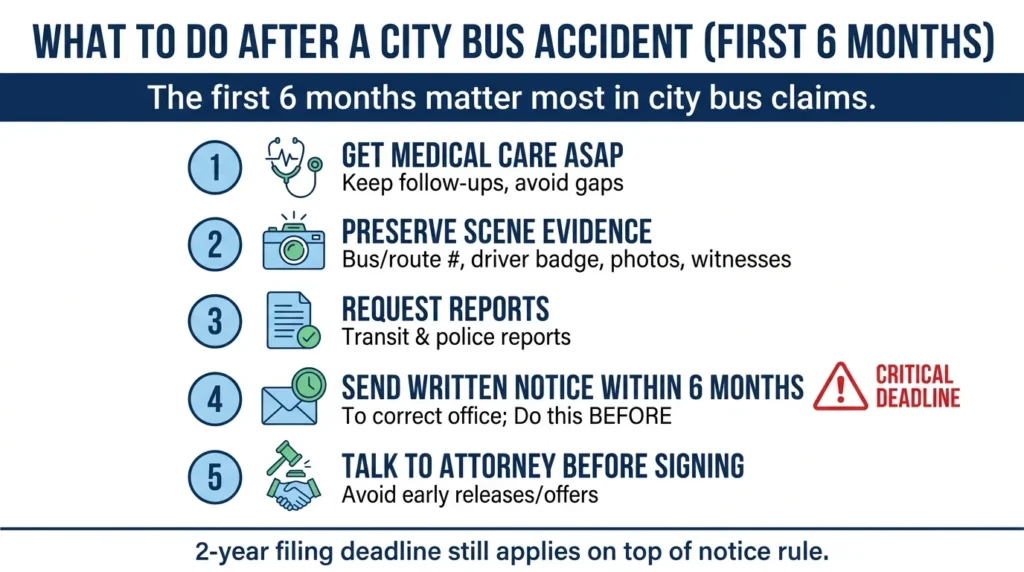
The first six months after the accident are more important in a city bus case than in almost any other injury claim. Take these steps to protect the facts and the deadline:
- Get medical attention right away and keep going to follow-up appointments. Adjusters use gaps in your medical treatment to argue that your injuries were minor.
- Preserve evidence at the scene if you can. Photograph the bus, route number, driver badge, vehicle positions, and your injuries. Get contact info from witnesses before they leave the scene.
- Request the incident report from the transit agency and any police report from the responding officer. Do not assume the agency’s report tells the full story.
- Send written notice to the correct government office within six months of the crash date. Do not wait for your medical treatment to be finished first, because the deadline is still active.
- Talk to an attorney before signing any release or accepting any offer. If you sign a government release, you may be giving up rights that you did not realize you had. The two-year filing deadline under CPRC § 16.003 still applies on top of the six-month notice rule.
Our guide on what to do if a bus hits your car walks through these early steps in more detail.
Talk to an Attorney
City bus claims have tight deadlines, legal limits on how much you can recover, and complicated procedures that ordinary car accident cases do not have. Angel Reyes & Associates has more than 30 years of experience handling Texas personal injury claims, including cases against government-operated transit systems like DART, METRO, VIA, and CapMetro.
Our team works on contingency, meaning you pay no fee unless we win, and we offer free consultations with a member of our legal team. Our firm has recovered more than $1 billion for clients. If you were hurt on a city bus, contact us today before the six-month notice deadline approaches.
Past results do not guarantee future outcomes.
City Bus Accident FAQs
Can a third party be held liable along with a city bus agency for the same accident?
Yes. If a third party (such as another driver or a road contractor) contributed to the crash, then a separate claim against that party is not limited by the Texas Tort Claims Act caps. Instead, the separate claim against the third party would follow standard Texas negligence rules, including the two-year statute of limitations.
Can an underage person injured on a city bus miss the six-month notice deadline without having to give up their claim?
Texas law can extend certain deadlines for minors, but the TTCA’s notice requirement still stands even if a claimant is under 18. A parent or guardian should submit written notice on the child’s behalf as soon as possible, rather than assuming the minor’s age will give them extra time.
Will a pre-existing back or neck condition reduce what you can recover from a city bus agency?
It depends. A pre-existing condition can reduce recovery if the agency argues that the crash did not cause the injury. However, Texas follows the aggravation doctrine, which means you can still recover compensation if a prior condition gets worse after the crash, as long as it is supported by medical evidence.
Are city bus accident settlements in Texas considered taxable income?
Compensation for physical injuries and medical expenses is generally excluded from federal taxable income under IRS rules, but amounts received for lost wages or punitive damages (extra money awarded by the court to punish someone for bad behavior and discourage others from doing it) are typically taxable. A tax professional can clarify how your specific settlement will be treated.
Does the Texas Tort Claims Act cover passengers who are injured on a paratransit or on-demand transit service operated by a city agency?
Yes, if the paratransit service is operated via a government agency, the TTCA framework generally applies, including the damage caps and notice requirements. However, it depends on whether the operator qualifies as a governmental unit under Texas Civil Practice and Remedies Code Section 101.001.
About the Authors

Alex Ivanov
Writer
Alex Ivanov is a personal injury attorney at Angel Reyes & Associates, focused on car, truck, and motorcycle accident cases. Licensed in Texas and multiple federal districts, Alex brings international legal experience and a global education to his practice. He earned his LL.M. from Texas A&M University School of Law after graduating from Belarussian State University in 2016. Alex is fluent in Russian, English, Ukrainian, and Belarussian, and is recognized by multiple national trial lawyer associations for his results and leadership under 40.

Kyle Nicolas
Editor
Kyle Nicolas is the Web Content & SEO Manager at Angel Reyes & Associates. He has more than 10 years of experience as a marketing co...

Spencer Browne
Reviewer
Spencer Browne is a partner at Angel Reyes & Associates and a Board Certified personal injury trial lawyer with nearly 100 jury trials a...