What Do the Hazmat Placards on a Truck Mean?


Every article on this site is researched by our internal team, reviewed for legal accuracy against current Texas law, and held to State Bar of Texas advertising standards before publication. We do not publish content that overstates outcomes or makes promises about results.
Learn more about our
editorial standards .
Key Takeaways
- Hazmat placards show hazard class, but shipping papers name the exact substance.
- Texas DPS enforces the same federal placarding and shipping paper rules statewide.
- Scene photos, shipping papers, and ER records can help prove your exposure claim.

You pull over after the crash and notice a diamond-shaped sign on the side of the truck that hit you, numbers stamped in the corner, and colors you don’t recognize.
That placard is not decoration. It is federally required information about what was inside that truck, and it follows the same rulebook on every Texas highway.
What Are Hazmat Placards & Why Trucks Must Display Them?
A hazmat placard is the diamond-shaped, color-coded sign a truck must display when it carries hazardous materials. Federal law spells out exactly when that display is required, under 49 CFR §172.504.
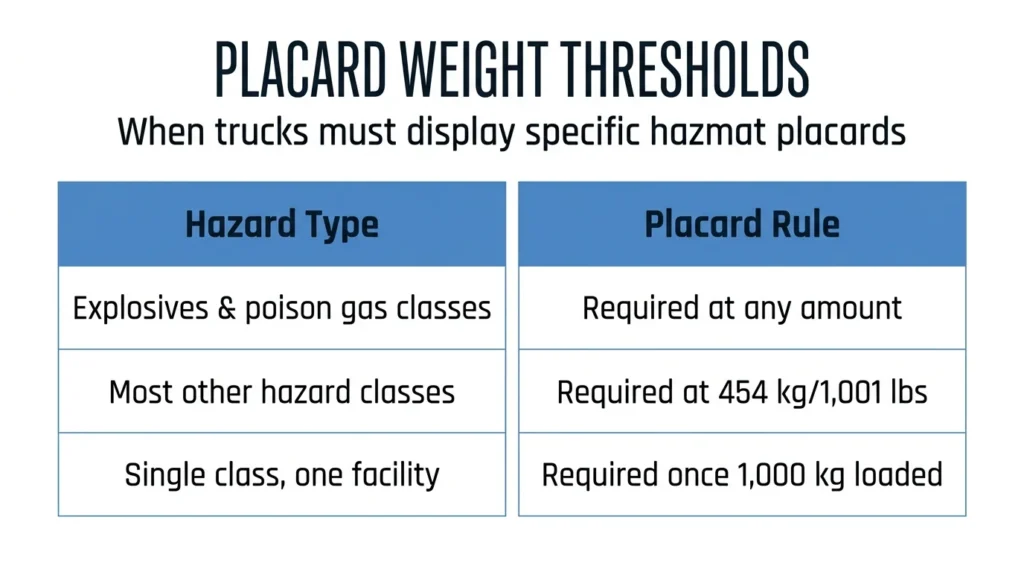
Some hazard classes require a placard no matter how small the load. Explosives, poison gas, and a short list of other especially dangerous classes fall into this group.
Most other hazard classes only require a placard once the total weight of that hazard class on the truck reaches 454 kilograms, or 1,001 pounds.
A truck carrying several hazard classes below that weight threshold can sometimes display a single generic “DANGEROUS” placard instead of a separate one for each class. That substitution is not allowed once 1,000 kilograms or more of a single hazard class is loaded at one facility. At that point, the specific placard for that class is required.
The placard itself has to meet exact specifications under 49 CFR §172.519. It must measure at least 250 millimeters per side, use standardized colors, and display the hazard class number at least 41 millimeters tall in the lower corner. It also has to survive weather exposure and fading without becoming unreadable.
Texas does not have a separate placard standard of its own. Texas Department of Public Safety rules adopt the federal Hazardous Materials Regulations by reference for enforcement on Texas roads, under 37 Texas Administration Code §4.1. DPS Commercial Vehicle Enforcement officers enforce these same federal placarding and shipping-paper rules, and they can take a non-compliant truck out of service on the spot.
If your crash involved cargo that shifted, spilled, or was loaded improperly, the placard is often key in helping determine liability.
The Nine Hazard Classes & Divisions on Placards
Every hazmat placard corresponds to one of nine hazard classes established under federal law. Some classes break down further into divisions, and each one signals something different about what is on that truck:
- Class 1, Explosives (Divisions 1.1 through 1.6)
- Class 2, Gases: 2.1 Flammable Gas, 2.2 Non-Flammable Gas, 2.3 Poison Gas
- Class 3, Flammable Liquid
- Class 4, Solids: 4.1 Flammable Solid, 4.2 Spontaneously Combustible, 4.3 Dangerous When Wet
- Class 5, Reactive Materials: 5.1 Oxidizer, 5.2 Organic Peroxide
- Class 6, Poisons: 6.1 Poison or Poison Inhalation Hazard, 6.2 Infectious Substance (not placarded)
- Class 7, Radioactive Material, labeled White-I, Yellow-II, or Yellow-III, plus a separate Fissile label
- Class 8, Corrosive
- Class 9, Miscellaneous, including a separate label for lithium batteries
These hazmat placard classes all trace back to one source document: the Hazardous Materials Table at 49 CFR §172.101. That table lists roughly 3,000 materials and assigns each one a proper shipping name, a hazard class, an identification number, and a packing group.
The packing group tells you how dangerous a specific material is within its class. Packing Group I means great danger, Packing Group II means medium danger, and Packing Group III means minor danger. The table’s label codes are ultimately what determine which placard a truck has to carry and help determine how cargo-related crashes unfold on Texas roads.
UN Numbers & Shipping Papers: The Documentary Trail Behind the Placard
The identification number displayed on or next to a placard is the shorthand version of what is inside a truck. The full, legally required version lives in the shipping papers, and those papers have to say far more than the placard ever could.
Every hazardous material on a truck gets an identification number from Column 4 of the §172.101 table. That number appears on the placard itself, on an adjacent orange panel, or on a white square-on-point display, under 49 CFR §172.336.
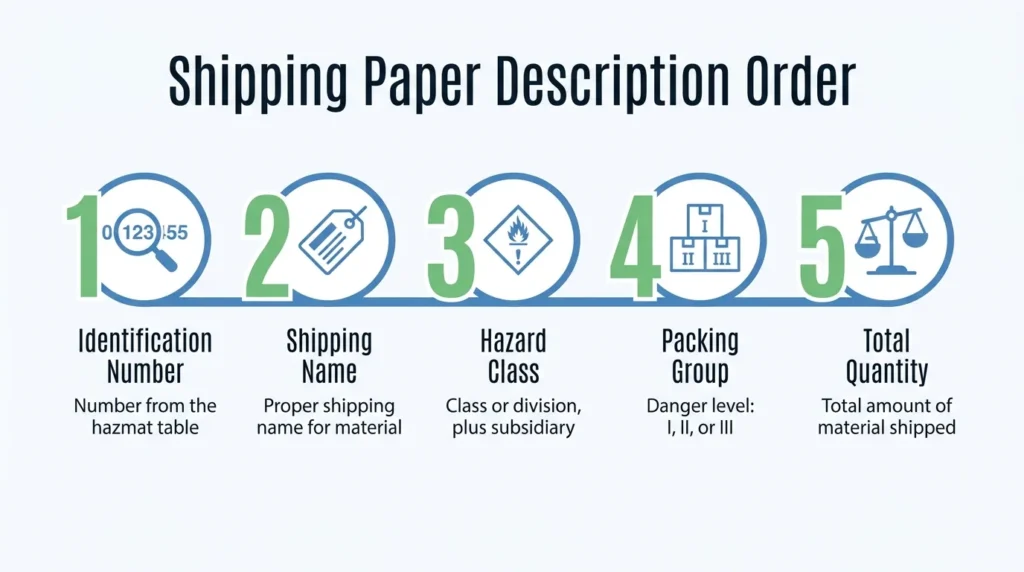
Shipping papers have to follow a specific description sequence under 49 CFR §172.202:
- The identification number
- The proper shipping name
- The hazard class or division, with any subsidiary hazard in parentheses
- The packing group
- The total quantity
The regulation gives this example format: “UN2744, Cyclobutyl chloroformate, 6.1, (8, 3), PG II.”
Shipping papers also have to include an emergency response telephone number under 49 CFR §172.201, along with emergency response information required by 49 CFR §172.602. That information has to cover health hazards, fire and explosion risk, immediate precautions, firefighting methods, spill and leak response, and first aid.
Carriers have to keep most hazardous materials shipping papers for two years, and hazardous waste shipping papers for three years. Those records have to be producible to authorized officials on request.
This documentary trail matters because it exists independently of the placard. A placard tells a first responder or an injured driver which hazard class was present.
The shipping papers establish exactly what substance, and how much of it, was actually on that truck.
The Emergency Response Guidebook: From Placard to Protective Action
Once a placard identifies a hazard class and a UN number, responders need a way to turn that information into immediate action. That is the job of the Emergency Response Guidebook, jointly published by the U.S. DOT’s Pipeline and Hazardous Materials Safety Administration, Transport Canada, and Mexico’s transportation authority.
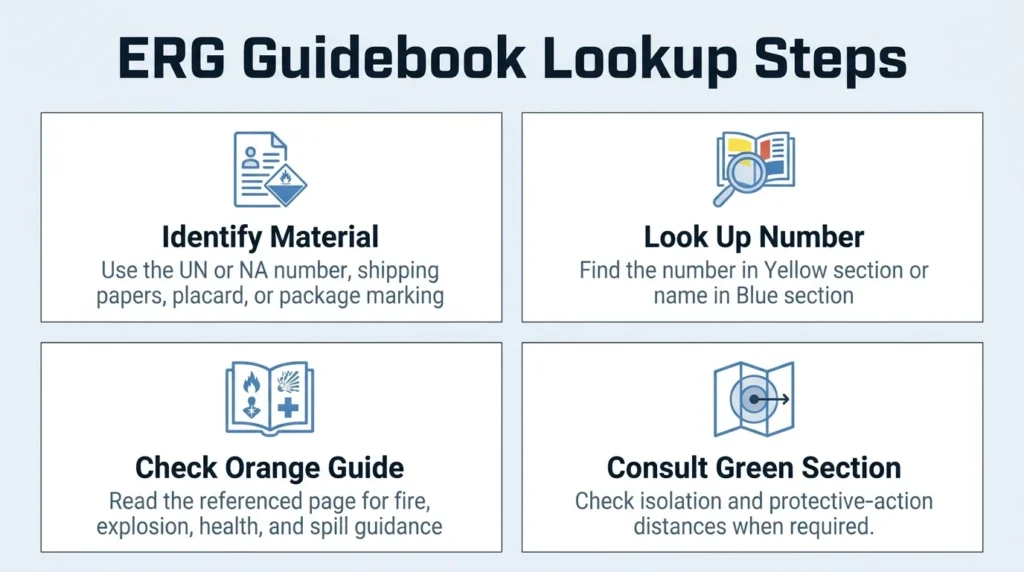
The current edition, ERG2024, covers more than 3,400 chemicals across 61 response guides. Responders follow the same basic steps every time:
- Identify the material from the UN or NA number, the shipping papers, the placard, a package marking, or a label.
- Look up that number in the Yellow section, or look up the material name in the Blue section.
- Turn to the referenced Orange guide page for initial fire, explosion, health, and spill or leak guidance.
- Consult the Green section for isolation and protective-action distances when the material requires them.
When a release happens, federal law also requires a documented response. 49 CFR §171.15 requires an immediate telephonic report to the National Response Center within 12 hours for incidents involving death, hospitalization, a public evacuation lasting an hour or more, or the closure of a major transportation route.
A written follow-up report is due within 30 days and has to be kept for two years.
Chemical Exposure & Secondary Injury After a Hazmat Release
A chemical release from a truck accident does not always cause an obvious injury right away. How much it hurts you depends on the chemical, the dose, how long you were exposed, and how it entered your body, whether through breathing it in, skin contact, or ingestion.
Some effects show up immediately. Others develop later as chronic conditions, which is one reason medical follow-up matters even after an ER visit clears you to go home.
Federal public health investigators use a specific method to sort this out after a chemical release.
The CDC’s Assessment of Chemical Exposures program sends a team to interview exposed people and responders, survey hospital staff, and review hospital and emergency room records. Their goal is to determine who was exposed, how badly, and whether they need long-term follow-up.
A truck accident injury claim built around chemical exposure follows that same evidence spine. The placard and scene photographs establish which hazard class was present at the moment of the crash.
The shipping papers, and any incident report filed with federal regulators, establish the specific substance, its UN number, and how much of it was involved. Emergency room records document the injury itself and when it started relative to the exposure.
No single piece of that chain proves an exposure injury on its own. Together, they form the same kind of proof chain public health investigators rely on, and the kind a chemical exposure claim needs.
That chain matters just as much for chemical burns as for other exposure injuries.
Talk to Angel Reyes & Associates About a Hazmat Truck Accident Injury
If a placarded truck was involved in your crash, the evidence that proves what you were exposed to will not wait. Shipping papers get filed away.
Scene photographs disappear. Medical records take time to request.
Angel Reyes & Associates has guided injured Texans through truck accident claims for over 30 years. Our team can help identify and preserve the shipping papers, scene photographs, and medical records your claim depends on before they are lost.
Contact Angel Reyes & Associates for a free consultation to talk through what happened and what your options are.
Past results do not guarantee future outcomes.
Truck Hazmat Placard FAQs
What should I do at the scene if a truck involved in my crash is displaying a hazmat placard?
If it is safe to do so, note or photograph the placard, including the hazard class number in the corner and any visible UN number or orange panel. That placard identifies the hazard class present at the moment of the crash, and it becomes part of the same evidence chain as the shipping papers and emergency room records used later to establish what you were actually exposed to.
Can I get a truck's shipping papers or incident report if I was not the driver or the trucking company?
You do not need to have been the driver or the trucking company for these records to matter to your case. Federal law requires carriers to keep most hazardous materials shipping papers for two years, and hazardous waste shipping papers for three years, and to produce them to authorized officials on request. A written incident report following a qualifying release must also be kept for two years and produced within 24 hours of a request from the Department of Transportation.
Does a generic "DANGEROUS" placard mean the hazard is less serious than a placard for a specific class?
No. A single “DANGEROUS” placard is an administrative substitution allowed when a truck carries several Table 2 hazard classes that are each below the weight threshold that would otherwise require its own placard. It is not a signal that the cargo is any less hazardous. That substitution stops being available once 1,000 kilograms or more of a single hazard class is loaded at one facility, at which point the specific placard for that class is required instead.
Do Texas rules for hazmat trucking differ from the federal placarding and shipping-paper requirements?
No. Texas does not maintain a separate placard or shipping-paper standard. Texas Department of Public Safety rules adopt the federal Hazardous Materials Regulations by reference for enforcement on Texas roads, so the same 49 CFR requirements described above apply statewide. DPS Commercial Vehicle Enforcement officers enforce these adopted federal rules and can take a non-compliant truck out of service on the spot.
About the Authors

Angel Reyes
Writer
Angel L. Reyes, III is the Founder and Managing Partner of Angel Reyes & Associates. A nationally recognized trial attorney and business leader, Angel has helped over 70,000 injury victims recover more than $1 billion since founding the firm in 1993. Named to the Texas Super Lawyers list annually since 2008, Angel brings Wall Street experience, Ivy League education, and a deep commitment to client advocacy. He is a frequent legal commentator and published author with extensive contributions to legal scholarship, trial strategy, and consumer protection.

Kyle Nicolas
Editor
Kyle Nicolas is the Web Content & SEO Manager at Angel Reyes & Associates. He has more than 10 years of experience as a marketing co...

Angel Reyes
Reviewer
Angel L. Reyes, III is the Founder and Managing Partner of Angel Reyes & Associates. A nationally recognized trial attorney and business...