Do Rideshare & Delivery Drivers Need Extra Insurance in Texas?


Every article on this site is researched by our internal team, reviewed for legal accuracy against current Texas law, and held to State Bar of Texas advertising standards before publication. We do not publish content that overstates outcomes or makes promises about results.
Learn more about our
editorial standards .
Key Takeaways
- A Texas personal auto policy may exclude rideshare or delivery work, so read the actual policy.
- Platform liability may protect others without paying for your car repairs or injury costs.
- Get written confirmation that an endorsement covers every app, shift period, and type of loss.
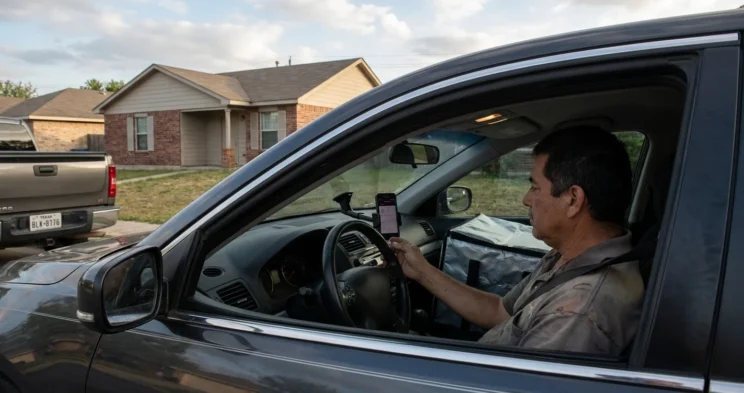
If you use your personal car for paid rides or deliveries in Texas, you may need extra insurance because your personal policy can exclude that work. Texas does not require every driver to buy an add-on called rideshare insurance, but you need coverage that applies to your paid driving.
Whether you pick up passengers at DFW or deliver meals near I-35, platform coverage may protect other people without repairing your car or paying for your injuries. An appropriate endorsement or other policy can address those gaps.
Does a Personal Auto Policy Cover Rideshare or Delivery Driving in Texas?
Your personal policy may or may not cover paid driving. The answer depends on your policy’s wording, the type of work, and what you were doing at the moment of a crash. The Texas
Department of Insurance says delivery coverage varies: some personal policies cover paid deliveries, and others exclude business driving.
Whether personal auto insurance covers business use depends on the policy. Look for business-use language, exclusions for carrying people or property for a fee, public or livery conveyance exclusions, and exclusions tied to transportation network companies. Each policy words these differently.
Your declarations page lists the coverage you bought and the forms attached to the policy. It does not replace the full policy. Read the declarations, the complete policy, and every endorsement in effect.
Texas treats passenger rides and deliveries differently, so look at each one on its own terms.
How Chapter 1954 Treats Passenger Rideshare
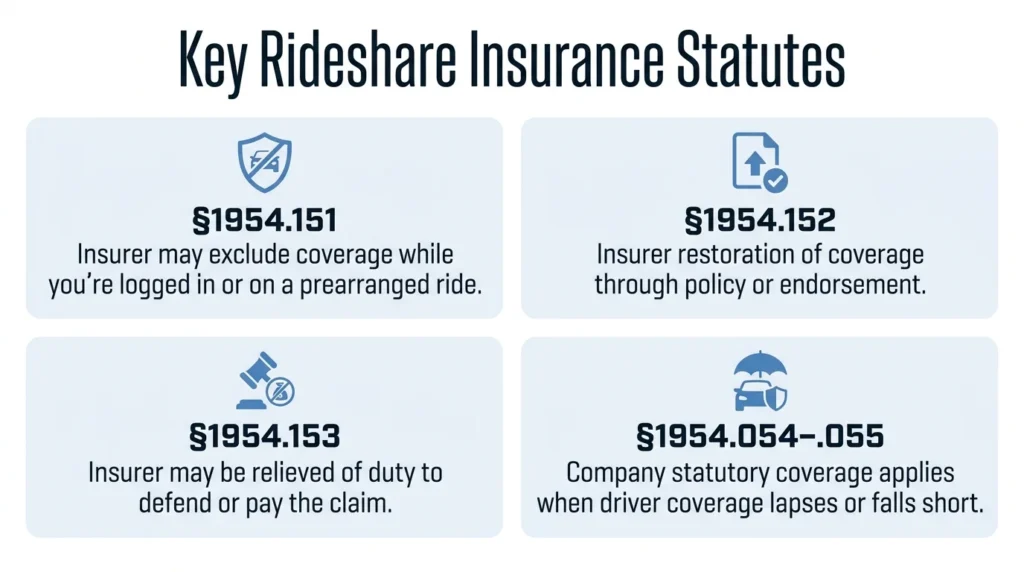
For passenger rides, Texas Insurance Code Chapter 1954 lets a personal auto insurer exclude coverage while you are logged in to the app or on a prearranged ride. Under §1954.151, that exclusion can reach liability, personal injury protection (PIP), uninsured/underinsured motorist (UM/UIM), medical payments, comprehensive, and collision coverage.
Section 1954.152 allows an insurer to restore that coverage through the policy or an endorsement.
When an authorized exclusion applies, §1954.153 can relieve your personal insurer of any duty to defend you or pay the claim.
How Delivery Work Differs Under HB 4215
Delivery is a separate question. TDI’s personal auto policy checklist expressly states that its Chapter 1954 exclusion guidance does not apply to delivery. A food delivery shift does not fall under the passenger-rideshare exclusion simply because the same app also offers rides.
HB 4215 took effect September 1, 2025, and brought delivery network companies into the regulatory framework of Texas Occupations Code Chapter 2402. The law governs company permitting and related requirements. It does not require every delivery driver to buy a named endorsement, and it does not make a personal policy cover deliveries.
The Texas Department of Licensing and Regulation now offers delivery-company applications and says transportation and delivery companies must maintain proof of Chapter 1954 insurance. That is a company licensing requirement. It does not decide whether your own policy covers a particular delivery crash.
Where Can Coverage Change During a Shift?
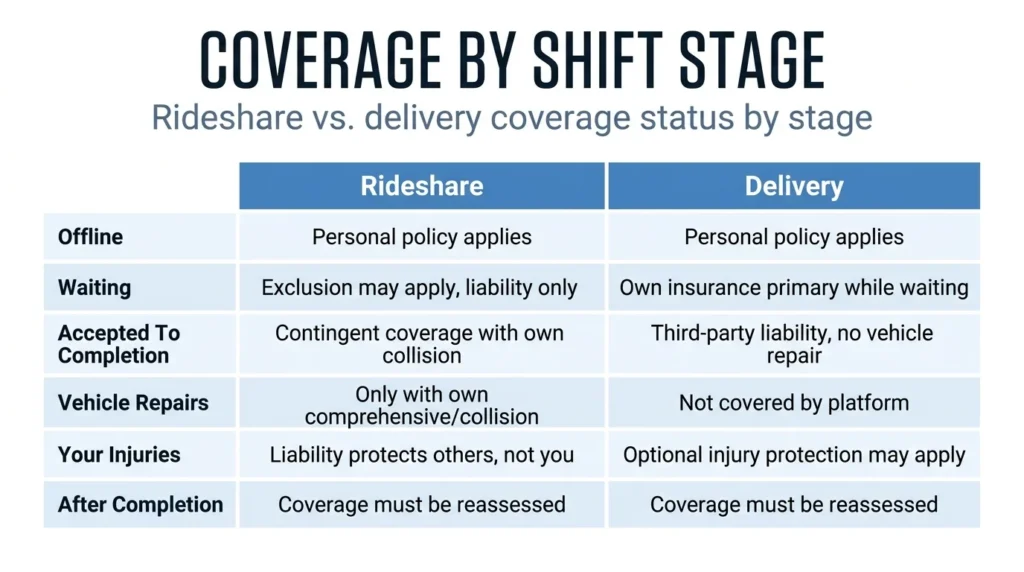
Coverage can shift several times in a single shift. The coverage that applies depends on the service you were providing and your app status at the exact moment of the crash. TDI warns that your personal policy may not cover you while you work. Platform liability coverage for injured third parties does not necessarily pay for your vehicle or your injuries.
These platform summaries illustrate the gaps. Check the Texas policy for your service and crash date:
- Offline: Your personal policy ordinarily applies. Logging off does not automatically settle whether a work-related trip falls under a business-use exclusion.
- Logged in and waiting for a ride request: The passenger-rideshare exclusion can already apply. Uber’s rideshare summary describes liability coverage during this period but no platform comprehensive or collision before you accept a request.
- Ride request accepted through drop-off: Uber describes contingent coverage for your vehicle only if you carry your own comprehensive and collision coverage, and a deductible applies. Liability coverage protects others. It does not pay your medical bills.
- Waiting for a delivery offer: DoorDash’s auto coverage summary says your own auto insurance is primary while you wait without an accepted delivery.
- Delivery accepted through completion: DoorDash describes third-party liability coverage from acceptance until delivery, unassignment, or cancellation. It does not repair your car. Uber’s delivery page says its coverage does not pay for vehicle repairs at any delivery stage or for the driver’s injuries.
- After completion or a switch between apps: Coverage must be reassessed. Pin down the exact timestamp and service for every active app. Running two apps at once does not mean coverage doubles.
Injury benefits are a separate question from auto liability. DoorDash describes occupational accident benefits for eligible delivery injuries, subject to policy terms, and Uber says optional injury protection may be available. Neither product repairs your car.
What Should a Rideshare or Delivery Endorsement Cover?
An endorsement covers only what its written terms say. TDI cautions that some rideshare products cover only certain periods or only losses to other people. For delivery driver insurance, TDI suggests asking your insurer about optional delivery coverage before assuming you need a commercial policy.
Before you start paid driving, take these steps with your insurer:
- Confirm the form covers passenger rides, food or package delivery, or both, on every platform you use.
- Confirm it covers waiting, driving to a pickup, the active trip or delivery, and the drive after completion.
- Check liability, collision, comprehensive, PIP or medical payments, and UM/UIM separately for each period.
- Review the limits, deductibles, exclusions, and other-insurance conditions that remain.
- Get the actual endorsement and written confirmation of coverage.
- Make sure the endorsement appears on your declarations page with an effective date before you drive.
A familiar product name does not guarantee that every gap is closed. Tell your insurer exactly what work you do and which apps you use. A vague answer now can turn into a denial after a crash.
What Happens After a Crash if the Driver Has No Endorsement?
A missing endorsement does not decide the claim by itself. Your underlying policy may still cover the work. If an exclusion applies, you could face uncovered repair costs, medical bills, liability to others, and legal defense costs.
Each loss needs its own coverage answer. Your vehicle damage and your injuries are one question.
Liability to passengers, other drivers, or pedestrians you hit is another.
People you injure may still reach applicable platform liability coverage even after your personal insurer denies the claim. Your app status at the time of the crash and the platform’s terms control that answer.
For passenger rideshare, §1954.054 and §1954.055 require the company’s statutory coverage to apply when the driver’s required coverage lapses or falls short, without waiting for a personal insurer’s denial. Those sections do not guarantee payment of every loss of your own, and they should not be assumed to apply to delivery work.
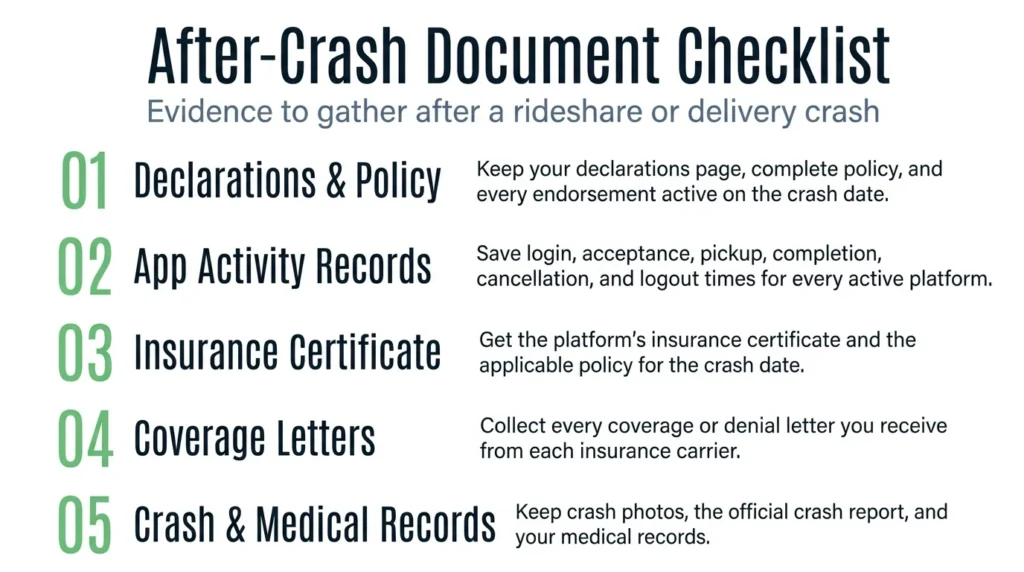
If you were hurt, start with medical care and then protect the records. Preserve these documents:
- Your declarations page, complete policy, and every endorsement in effect on the crash date
- App records showing login, acceptance, pickup, completion, cancellation, and logout for each active platform
- The platform’s insurance certificate and the policy that applied in Texas on the crash date
- Every coverage or denial letter from each carrier
- Crash photos, the crash report, and your medical records
For rideshare crashes, §1954.154 supports the exchange of login and logout information and coverage descriptions during an insurer’s investigation. A platform certificate only summarizes coverage. If an exclusion or injury benefit is in dispute, you may need the actual policy.
Report the facts accurately to every insurer and platform. Ask each one to state its coverage decision and the specific policy basis in writing. An adjuster’s job is to close the claim for as little as possible, so a denial letter is the carrier’s position, not proof that no coverage exists.
Coverage you buy after a crash will not reach back to cover it.
Talk With Angel Reyes & Associates About an Insurance Dispute After a Crash
A crash during a rideshare or delivery shift can leave you caught between your own insurer and the platform’s coverage. You do not have to sort it out alone.
Before your free consultation, gather your declarations page, policy and endorsements, app activity records, the platform’s insurance certificate, and any coverage or denial letters. Angel Reyes & Associates has guided injured Texans for over 30 years and can review those records with you and walk you through your options. You can reach the team 24/7.
Contact Angel Reyes & Associates for a free consultation.
Past results do not guarantee future outcomes.
Rideshare & Delivery Driver Insurance FAQs
Does commercial auto insurance cover rideshare and delivery drivers in Texas?
Commercial auto insurance may cover paid driving, but the protection depends on the policy’s covered activities, exclusions, and limits. Drivers should compare commercial coverage with rideshare or delivery endorsements to determine which option fits their work.
Does Texas require rideshare and delivery drivers to carry uninsured motorist coverage?
Texas generally requires insurers to offer uninsured/underinsured motorist coverage, but drivers can reject it in writing. Whether that coverage applies during paid driving depends on the policy, applicable exclusions, and any coverage provided by the platform.
Can an insurance company cancel my policy for driving for Uber or DoorDash without telling it?
An insurer may take action if paid driving violates the policy’s terms, but cancellation and nonrenewal rules depend on the circumstances and applicable Texas law. Drivers should disclose their rideshare or delivery work before starting and obtain written confirmation of any required coverage changes.
About the Authors

Angel Reyes
Writer
Angel L. Reyes, III is the Founder and Managing Partner of Angel Reyes & Associates. A nationally recognized trial attorney and business leader, Angel founded the firm in 1993, which has gone on to help over 70,000 injury victims recover more than $1 billion. Named to the Texas Super Lawyers list annually since 2008, Angel brings Wall Street experience, Ivy League education, and a deep commitment to client advocacy. He is a frequent legal commentator and published author with extensive contributions to legal scholarship, trial strategy, and consumer protection.

Kyle Nicolas
Editor
Kyle Nicolas is the Web Content & SEO Manager at Angel Reyes & Associates. He has more than 10 years of experience as a marketing co...

Angel Reyes
Reviewer
Angel L. Reyes, III is the Founder and Managing Partner of Angel Reyes & Associates. A nationally recognized trial attorney and business...