Do You Need a Helmet on an E-Scooter?


Every article on this site is researched by our internal team, reviewed for legal accuracy against current Texas law, and held to State Bar of Texas advertising standards before publication. We do not publish content that overstates outcomes or makes promises about results.
Learn more about our
editorial standards .
Key Takeaways
- Texas state law does not require adults to wear a helmet on an e-scooter; local ordinances and rental agreements determine the actual requirement.
- Austin requires helmets for riders under 18, and shared scooter operators require them by user agreement. Dallas requires helmets for riders under 17 only and has no mandate for older riders.
- Not wearing a required helmet can reduce your recovery under Texas’s proportionate fault rules, particularly for head injuries.
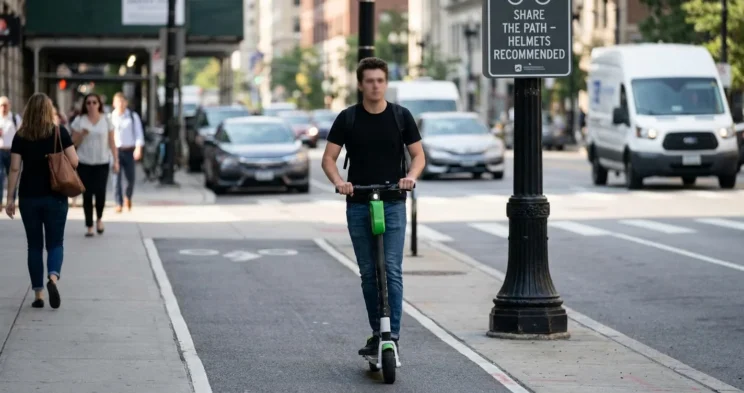
You’re about to rent a Bird scooter in Austin for a ride to dinner. Your friend who rented one last month in Dallas didn’t wear a helmet and wasn’t cited. You’re wondering whether the rules are the same in Austin.
They’re not, and the difference matters more than most people expect.
Texas State Law Does Not Require Adult Riders to Wear a Helmet
Start at the state level: Texas has no statewide helmet mandate for adults on electric scooters. Texas Transportation Code Chapter 551 classifies electric scooters as motor-assisted scooters and sets rules for where you can ride them, but there isn’t a helmet requirement if you’re 18 or older.
The legal answer to “Do you need a helmet to ride an electric scooter in Texas?” depends on where you are riding and whose scooter you are using. Texas e-scooter law creates the baseline at 18 years old, and cities are permitted to impose further restrictions.
How Austin, Dallas, and Houston Handle Helmets Differently
The three largest Texas cities with active shared scooter programs handle helmets in meaningfully different ways.
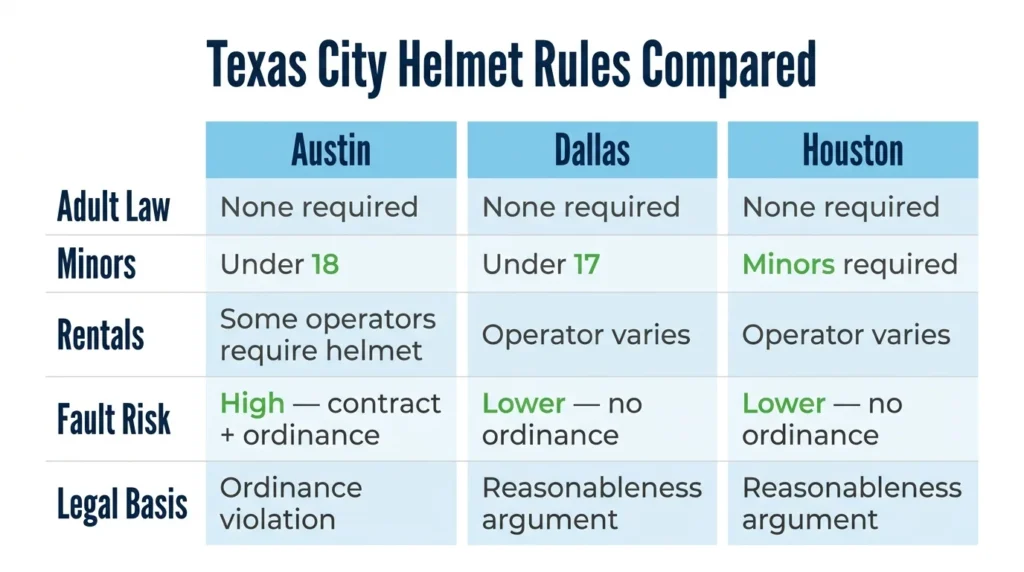
Your legal obligation to wear a helmet in Texas depends entirely on the city you are riding in, your age, and the terms of the rental agreement you accepted. There is no single statewide answer.
Austin
Austin requires helmets for riders under 18 on all micromobility devices, including e-scooters.
Beyond the age-based ordinance, Austin’s shared mobility permit program ties licensed operators to rider safety requirements. Bird and Lime, the two permitted shared scooter operators in Austin, require helmet use by all riders through their user agreements as a condition of the city license.
If you’re an adult renting a scooter in Austin, city ordinance doesn’t require you to wear a helmet, but the Lime or Bird rental agreement you accepted does.
Dallas
Dallas takes a different approach. Dallas City Code Sec. 28-41.1.1 defines “child” as anyone under 17 and requires those riders to wear helmets. There is no helmet requirement for riders 17 and older in Dallas, and the city doesn’t impose a helmet mandate on adult shared scooter riders.
An adult renting a scooter in Dallas faces no helmet requirement beyond what the rental company may include in its user agreement.
Houston
Houston follows a similar approach to Dallas: helmets are required for minor riders, and adults face no local mandate.
What Happens If You Don’t Wear a Helmet and You Get Hurt
This is where the question shifts from informational to legally significant.
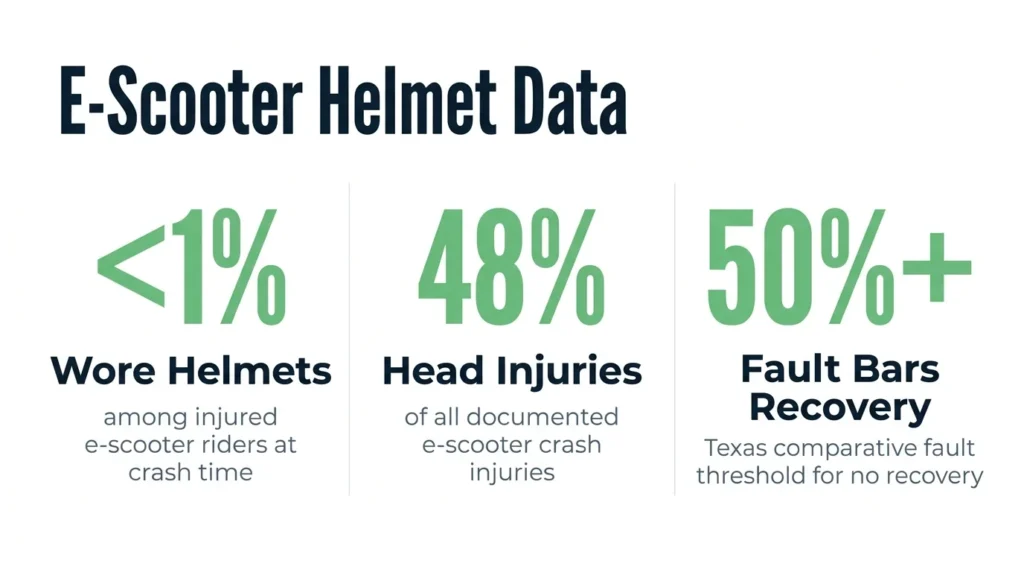
Texas uses a proportionate responsibility framework. Under Texas Civil Practice and Remedies Code (CPRC) Chapter 33, your recovery is reduced by your assigned share of fault. If you are found more than 50% responsible for an accident, you recover nothing.
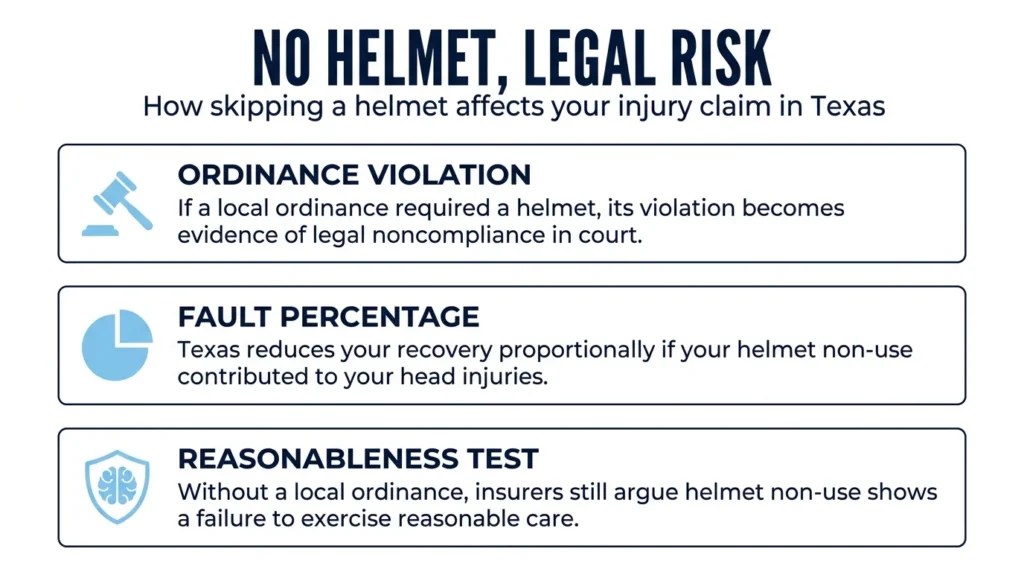
If you were supposed to be wearing a helmet and weren’t, that violation of the helmet ordinance is evidence that you failed to meet a legal standard. This matters most when the injuries are head-related. A court or jury can weigh that against the rider’s total damages.
When no ordinance required a helmet, as with an adult in Dallas riding a rental scooter, the argument is weaker. Your insurer could still raise helmet non-use as a factor in the severity of your head injuries, but it cannot point to an ordinance violation. The argument becomes a factual one about reasonable care rather than a legal one about noncompliance.
A 2019 Austin study found that fewer than 1% of injured e-scooter riders were wearing helmets at the time of injury, and head injuries represented 48% of all injuries documented in those crashes.
If helmet use is being raised as a fault argument in your claim, an attorney can assess how much weight it carries in your specific jurisdiction and for your specific injuries.
Should You Wear a Helmet Even If the Law Doesn’t Require It?
Head injuries are the most common category of serious harm in e-scooter crashes. A helmet reduces the severity of those injuries. The legal minimum and the safest choice are not the same thing.
Wearing a helmet also removes one argument from the opposing party’s toolkit. If you’re riding in a city where no ordinance applies, an insurer can’t characterize helmet non-use as a legal violation, but they can frame it as a failure to exercise reasonable care. When you wear a helmet, you protect yourself against that line of argument entirely.
Rental company user agreements often require helmets regardless of local ordinance. Violating that provision does not automatically bar you from filing an injury claim, but it can complicate coverage disputes and contribute to a fault allocation.
Work with a Texas Personal Injury Attorney
E-scooter injury claims often depend on details that aren’t obvious at first: which city’s ordinance applied, what the rental agreement required, and how your helmet use or non-use affects the fault allocation.
Angel Reyes & Associates has represented injury victims across Texas for more than 30 years. Our injury attorneys have recovered more than $1 billion for our clients. We offer free initial consultations and work on a no-fee-unless-you-win basis. To talk through your situation after an e-scooter accident, contact us for a free consultation.
Past results do not guarantee future outcomes.
E-Scooter Helmet FAQs
Do you need a helmet to ride a Bird or Lime scooter in Texas?
Yes, as a matter of company policy. Bird and Lime require helmet use as a condition of their user agreements, regardless of local ordinance. The rental company’s requirement applies whenever you use their scooters, whether or not the city has its own helmet rule.
Can not wearing a helmet hurt my legal claim after an e-scooter accident?
It can, especially if a helmet was legally required at the time of the crash. Under Texas proportionate responsibility rules, fault is allocated by percentage, and an ordinance violation can be used to increase your assigned share of fault. The argument is strongest when the injury is head-related. For adult riders in cities with no helmet ordinance, the argument is weaker, but insurers may still raise it.
At what age does a child need a helmet on an e-scooter in Texas?
It depends on the city. Austin requires helmets for riders 17 and under. Dallas requires them for riders under 17 (16 and younger). Because Texas has no statewide rule covering minors specifically on e-scooters, the applicable requirement comes from local ordinances. Check the city’s current code before allowing a minor to ride.
About the Authors

Angel Reyes
Writer
Angel L. Reyes, III is the Founder and Managing Partner of Angel Reyes & Associates. A nationally recognized trial attorney and business leader, Angel has helped over 70,000 injury victims recover more than $1 billion since founding the firm in 1993. Named to the Texas Super Lawyers list annually since 2008, Angel brings Wall Street experience, Ivy League education, and a deep commitment to client advocacy. He is a frequent legal commentator and published author with extensive contributions to legal scholarship, trial strategy, and consumer protection.

Graham Griffin
Editor
Graham Griffin is the Web & Content Manager at Angel Reyes & Associates, where he oversees content strategy, AI-powered workflows, a...

Spencer Browne
Reviewer
Spencer Browne is a partner at Angel Reyes & Associates and a Board Certified personal injury trial lawyer with nearly 100 jury trials a...