A Driverless Truck Cannot Take the Stand


Every article on this site is researched by our internal team, reviewed for legal accuracy against current Texas law, and held to State Bar of Texas advertising standards before publication. We do not publish content that overstates outcomes or makes promises about results.
Learn more about our
editorial standards .
Key Takeaways
- No federal rule requires a heavy truck to record the seconds before a crash, and no Texas law requires a driverless operator to preserve that data.
- Texas trucking liability is built around a negligent human driver, so a driverless crash forces victims into an unsettled product defect claim.
- Federal law has required just $750,000 in truck liability coverage since 1980, worth over $3 million today, and the same floor applies to driverless trucks.
This is an opinion piece, and is intended to provide analysis and commentary on current events and issues facing personal injury law. While resources are provided to support statements, opinion statements should not be misconstrued as fact, evidence, or argument in favor of or against any particular legislation. This is not legal advice.
The age of self-driving vehicles is here, and the technology supporting it is growing rapidly. We’ve already seen personal cars with varying degrees of self-driving capability, and we’re even starting to see truly driverless cabs reach commercial viability. Zoox recently won federal clearance to start charging for rides in vehicles that have no steering wheel or pedals at all.
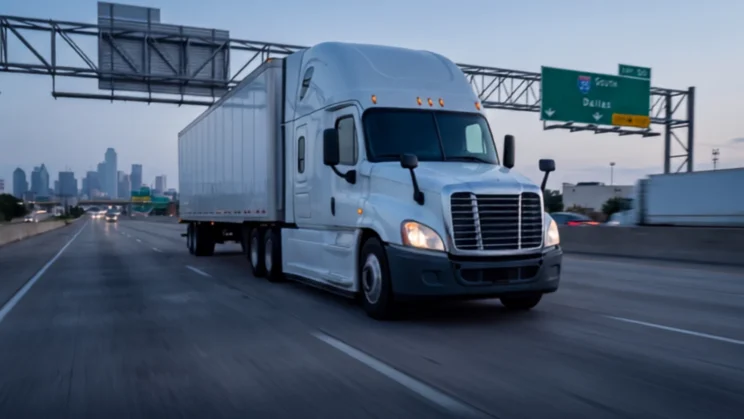
The next phase of that evolution: driverless big-rigs and 18-wheelers. Today, there are 80,000-pound trucks running on Texas highways with nobody in the cab.
I have tried truck cases for 35 years. Proving the truck caused the wreck isn’t usually the hard part of one of these cases. Evidence handles that. Getting that evidence before it disappears, however, can be a bigger challenge.
A robot driver does not fix that problem. It makes it worse.
Self-Driving Trucks Are Already Here
Aurora Innovation launched commercial driverless trucking operations on I-45 between Dallas and Houston in May 2025. By January 2026 the company reported more than 250,000 driverless miles across ten routes, with plans for over 200 trucks by the end of this year.
And according to Aurora, Austin and San Antonio could be seeing them next.
Bart Teeter, Bot Auto’s director of fleet and operational safety and a retired Texas DPS captain, told CBS Austin in January that on just about any Texas interstate, you now have a chance of seeing an autonomous truck. Bot Auto is one of several self-driving vehicle companies testing driverless truck technology in the state’s less-restrictive autonomous vehicle environment.
Torc Robotics operates on I-35 through Austin. Stockholm-based Einride, which put an autonomous truck on a public road back in 2019, received approval in March to run its big rigs in Austin. TxDOT has partnered with Cavnue to build a 21-mile automated freight corridor on SH-130, the 85 mph toll road trucks use to skirt downtown.
The passenger side of the experiment is further along. Waymo, Tesla, and Zoox all operate in the city, mostly on surface streets. The city logged 128 autonomous vehicle incidents between July 2023 and July 2025.
Waymo has been testing on Austin highways without passengers, and it recalled robotaxi software over how its vehicles handled construction zones. TxDOT does not expect to finish rebuilding I-35 through downtown until 2033.
That means Austin’s busiest truck corridor will be a work zone for another seven years, and now we’re adding autonomous big-rigs that are not immune to some of the same development pains that passenger vehicles are experiencing to the equation.
The Data Problem Came First
An electronic logging device (ELD) sounds like a black box. It is not. The Federal Motor Carrier Safety Administration (FMCSA) says an ELD records date, time, location, engine hours, miles, and identification data. They do not, however, record speed, braking, or throttle position. This data cannot tell you what a truck did in the two seconds before impact.
To make things worse, no federal rule makes logging those important pieces of information mandatory. NHTSA’s event data recorder regulation, 49 CFR Part 563, only governs vehicles at or below 8,500 pounds, nearly ten times less than your average big-rig. NHTSA has never adopted a crash recorder standard for heavy trucks. Whatever an 18-wheeler captures at the moment of a crash, it captures because a manufacturer chose to, under a voluntary industry standard.
This means that the party that owns that all-important data ultimately decides whether or not it survives. Texas does not do all that much to incentivize owners to keep it. Under Brookshire Brothers v. Aldridge, 438 S.W.3d 9 (Tex. 2014), there is no independent tort for spoliation, or destroying evidence. Getting a spoliation instruction, which lets a jury presume the missing data would have hurt the party that lost it, generally requires proof of intentional concealment. Try proving that intent when you have never seen the file.
No Driver, No Operator Error
Texas law does not answer who pays. Texas Transportation Code § 545.453 designates the owner of the automated driving system as the “operator,” but only for assessing compliance with traffic laws. If the self-driving truck gets a speeding ticket, the owner gets a fine. If that same self-driving truck causes a fatal accident, this law does not give the victim’s family a path to a recovery.
Without a driver, the case becomes a matter of product liability. Texas Civil Practice and Remedies Code § 82.005 requires the claimant to prove a safer alternative design that would have prevented the harm. Taking one of these cases to court means asking a jury to evaluate a software design decision, and Texas courts have not settled whether software is a product at all.
Texas employer liability in truck cases is tethered to the driver, and the Supreme Court of Texas has shown how tight that tether is. In Werner Enterprises, Inc. v. Blake, No. 23-0493 (Tex. June 27, 2025), the court held the truck driver was not a proximate cause of the deaths that followed a fatal icy-road accident, and it reversed a previous judgment reported at roughly $90 million.
That holding ended the case against the carrier too. The theories aimed at how the company hired, trained, and supervised that driver could not stand once his conduct left the causal chain.
Now take the driver out of the cab entirely. There is no employee negligence to anchor an accident claim on, and Texas has not built a replacement.
The trial rules assume that anchor too. House Bill 19, effective September 2021, splits commercial vehicle trials into two phases. Phase one is establishing the employee driver’s negligence. If you get past this, phase two is when courts look at company conduct. That structure assumes a negligent human employee. In a driverless case, the company’s conduct is the entire claim.
The money floor has also not moved. Federal law still requires a general freight carrier to carry $750,000 in liability coverage. Congress set that number in 1980. That same amount of coverage would need to be over $3 million in 2026 money, according to the Bureau of Labor Statistics.
Yet that same $750,000, the actual value of which continues to dwindle by the day, applies to a modern driverless truck the same as it did for a Peterbilt on the highway when Jimmy Carter was President.
The Case for the Machines
The industry’s argument in favor of self-driving trucks is a good one, and I am not going to pretend otherwise. FMCSA’s Large Truck Crash Causation Study found the driver was the critical reason in 88 percent of the crashes it studied. A computer does not drink, text, or run out of hours. Bot Auto’s safety director, Bart Teeter, put it plainly to CBS Austin: his driver does not do the things people do.
There is a second argument that cuts closer. An autonomous truck records everything. In theory that is better for my clients than a human driver’s contested memory.
In theory. As we all know, the world on paper rarely reflects the world in reality.
Ask General Motors. A Cruise robotaxi dragged a pedestrian roughly 20 feet in San Francisco back in 2023. NHTSA imposed a $1.5 million civil penalty over the company’s crash reporting. Cruise, then a subsidiary of General Motors, then admitted to submitting a false report to a federal investigation and paid an additional $500,000 criminal fine.
The data existed, the operator intentionally hid it, and Cruise paid a slap-on-the-wrist penalty over it.
Then there is Tesla. A Florida jury found the company partly responsible for a fatal 2019 Autopilot crash and returned a verdict of roughly $243 million in August 2025. The trial court refused to throw that verdict out in February 2026, and the appeal is pending before the Eleventh Circuit.
How that family got its evidence is the part that belongs here. The car uploaded a collision snapshot to Tesla’s servers within moments of the wreck, and Tesla’s own system confirmed receipt. For years the company told the family it did not have the file. The plaintiffs hired their own forensic engineer, who recovered the data from the car’s Autopilot computer. Tesla then acknowledged in court that it had the data all along.
Tesla faced no legal repercussions for that. Its lawyer called the handling clumsy rather than deliberate, and clumsy is the defense that works. Under Brookshire Brothers, a Texas jury almost never hears a word about missing evidence unless the plaintiff can prove the loss was intentional. A company that says it simply lost track of the file walks.
Perfect recall is worth nothing to an injury victim who has no right to see it.
What Texas Should Do
There are two things Texas lawmakers can do to fix this problem, and neither slows down a single truck.
First, codify evidence preservation requirements. Any automated driving system authorized to run a commercial truck in Texas should have to preserve the full sensor and decision log for a defined window around every crash. It should keep that log in a documented readable format. And it should be required to produce the log on request, to investigators and to the people it hurt.
The state is already implementing legislation to do that. Senate Bill 2807 took effect September 1, 2025 and requires TxDMV authorization for driverless commercial operation. The department’s implementing rules took effect in February 2026. Make preservation and access a condition of holding the authorization.
Second, write the rule before the first catastrophic case instead of after it. That is not how we usually operate. The interstate weight limit has been frozen since 1982, and the insurance minimum since 1980. NHTSA never wrote a heavy-truck crash recorder rule at all. Each of those gaps has been filled by a grieving family before a legislature has taken any kind of action to rectify the problem.
I am not asking Texas to stop the technology. I am asking for the data preservation rules to arrive before the wreck does. The drivers sharing I-35 with these trucks in Austin, Dallas, Fort Worth, or San Antonio did not volunteer to be part of this test. They should not have to prove their case without the only witness to it.
Holding Driverless Truck Companies Accountable
A gap in the law is not the same thing as immunity. When a driverless truck causes a catastrophic injury, that data still exists somewhere. How quickly someone moves to demand it can be the difference between a recovery and nothing.
Angel Reyes & Associates has spent more than 30 years trying truck accident cases across Texas, with more than $1 billion recovered for clients. We work on contingency, so you owe us nothing unless we win, and we are available 24 hours a day to take your call in English and Spanish. If a self-driving vehicle has seriously injured you or someone in your family, contact us for a free case evaluation.
Past results do not guarantee future outcomes.
About the Authors

Angel Reyes
Writer
Angel L. Reyes, III is the Founder and Managing Partner of Angel Reyes & Associates. A nationally recognized trial attorney and business leader, Angel has helped over 70,000 injury victims recover more than $1 billion since founding the firm in 1993. Named to the Texas Super Lawyers list annually since 2008, Angel brings Wall Street experience, Ivy League education, and a deep commitment to client advocacy. He is a frequent legal commentator and published author with extensive contributions to legal scholarship, trial strategy, and consumer protection.

Kyle Nicolas
Editor
Kyle Nicolas is the Web Content & SEO Manager at Angel Reyes & Associates. He has more than 10 years of experience as a marketing co...

Angel Reyes
Reviewer
Angel L. Reyes, III is the Founder and Managing Partner of Angel Reyes & Associates. A nationally recognized trial attorney and business...