How Long Does Discovery Take in a Texas Personal Injury Case?


Every article on this site is researched by our internal team, reviewed for legal accuracy against current Texas law, and held to State Bar of Texas advertising standards before publication. We do not publish content that overstates outcomes or makes promises about results.
Learn more about our
editorial standards .
Key Takeaways
- Discovery in a Texas personal injury case can last a few months or much longer, depending on liability disputes, medical treatment, and the amount of evidence involved.
- There are certain steps you can take to speed up the recovery process.
- A well-managed discovery process can strengthen your settlement position by turning medical records, testimony, and other evidence into clear proof of damages.
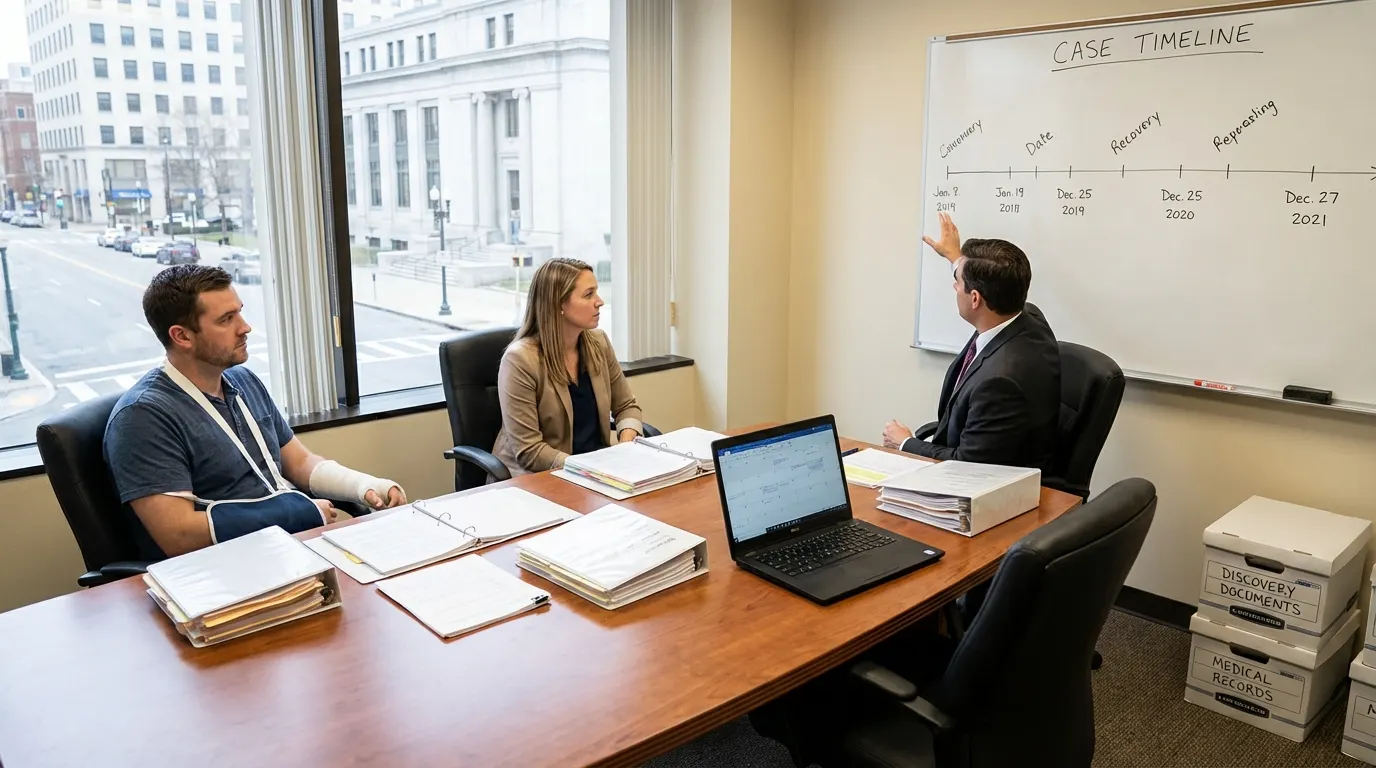
You were rear-ended in bumper-to-bumper traffic on I-30. You would think the issue is pretty straightforward, but the insurance company refuses to cooperate, so you and your attorney opt to file a lawsuit. Now it has been several months, and yet your case is still in the early stages.
There is no fixed timeline for discovery in a Texas personal injury case. A simpler case may move through this process in a few months. A more contested case may stay in discovery for much longer.
What Discovery Means in a Texas Injury Case
Discovery is the part of a lawsuit where each side gathers facts, requests records, questions witnesses, and tests the strengths of the case. It can feel slow, but it plays a big role in whether your claim settles fairly or heads toward trial.
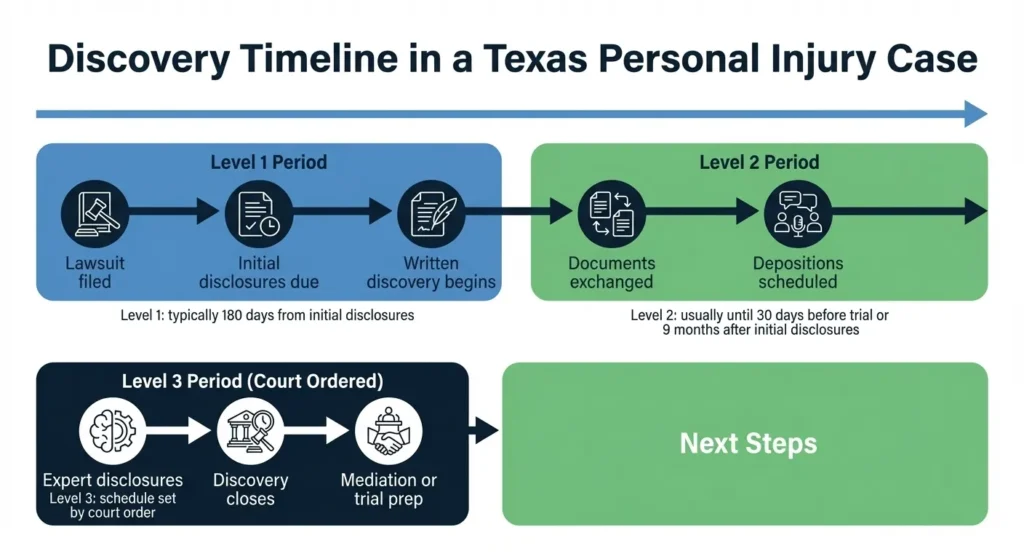
According to the Texas Rules of Civil Procedure, discovery starts after a lawsuit is filed and both sides begin exchanging information.
This stage often includes:
- Written questions that must be answered under oath.
- Requests for documents such as medical records, billing records, photos, wage records, and insurance materials.
- Requests for admissions that ask the other side to admit or deny specific facts.
- Depositions of parties, witnesses, and treating doctors.
- Expert disclosures and, when appropriate, expert depositions or expert reports.
Each step takes time because lawyers have to collect records, review what was produced, prepare responses, and adhere to court deadlines.
How Long Discovery Usually Takes
In Texas, the duration of the discovery phase depends on the level assigned to the case based on the amount of damages sought.
For Level 1 Discovery cases (expedited actions under $250,000), discovery typically lasts 180 days from the date initial disclosures are due, while Level 2 Discovery cases (the most common for larger personal injury claims) usually continue until 30 days before trial or 9 months after the initial disclosures are due.
For Level 3 Discovery control plans, the duration is not fixed by a default rule but is instead custom-tailored by a judge’s specific court order to meet the needs of complex or high-stakes litigation.
The timeline for any discovery process can be impacted by various factors, including:
- Is fault clear, or is liability disputed?
- Are your injuries straightforward, or do they involve future treatment?
- How many parties are involved in the case?
- How many records, witnesses, and experts are involved?
While a pileup on I-35E, a case with disputed surgery, or a lawsuit involving multiple defendants usually takes a while, a two-car crash with clear fault and completed treatment often moves faster.
When Discovery Moves Faster
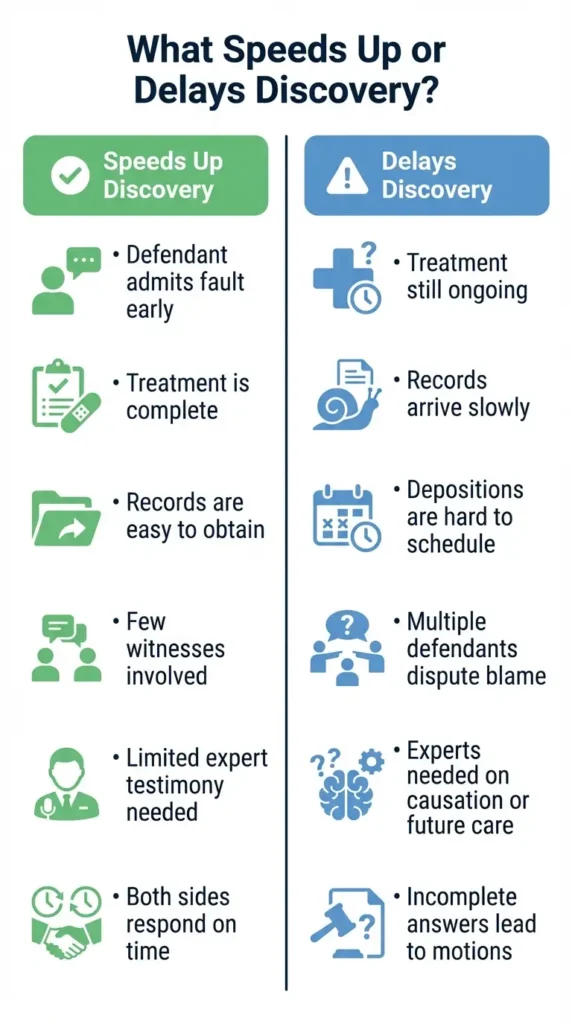
Some cases may benefit from a streamlined discovery process when all of the facts and evidence are straightforward. Understanding the factors that can accelerate this phase allows parties to move efficiently toward a resolution.
Discovery often moves faster when:
- The defendant admits fault early.
- Your treatment is complete.
- Records are easy to obtain.
- There are only a few witnesses.
- Neither side needs much expert testimony.
- Both sides respond on time.
When these elements align, the path to a meaningful evaluation of the case becomes significantly shorter. This efficiency often creates an earlier window for settlement discussions, helping to resolve the claim without unnecessary litigation delays.
When Discovery Takes Longer
While some cases move quickly, others face significant delays due to the complexity of the facts or the volume of evidence required. Understanding the specific obstacles that extend the discovery phase can help you set realistic expectations for your case’s timeline.
Discovery often takes longer when:
- Your medical treatment is still ongoing.
- Records from providers or employers are slow to arrive.
- Depositions are hard to schedule.
- Multiple defendants blame each other.
- Experts are needed on causation, future care, or accident reconstruction.
- One side gives incomplete answers, and motions have to be filed.
The court’s calendar also matters. Some judges set tight discovery deadlines. Others give the parties more time based on the complexity of the case.
Why Discovery Has So Much Impact on Settlement
Discovery is not just paperwork; it is where a case starts to show its real value.
Insurance companies are businesses. Their goal is to resolve claims for the lowest possible payout. Discovery limits their ability to downplay your injuries when the medical records, testimony, and other evidence support your claim.
That is why this stage matters. A strong deposition, a complete wage-loss file, or clear medical proof can change settlement talks quickly. Weak or incomplete proof can slow progress and reduce leverage.
What You Can Do While Discovery Is Open
You cannot control the defense lawyer or the judge’s docket. You can, however, control how organized and credible your side of the case looks.
Here’s what you can do to strengthen your case during discovery:
- Keep your medical appointments.
- Save bills, receipts, and wage-loss records.
- Respond quickly when your lawyer asks for information.
- Be honest about prior injuries and prior claims.
- Prepare carefully before any deposition.
Small delays add up. Clear and timely information helps your lawyer keep the case moving and avoid preventable problems.
Get a Clear View of Your Discovery Timeline & Next Move
Discovery can feel frustrating when bills are coming in, and your life is still off-track, but it can have a significant impact on the value of your claim when it is handled well.
At Angel Reyes & Associates, our attorneys offer free initial consultations, and there are no fees unless we win. We have over 30 years of experience representing Texans involved in rideshare, pedestrian, bus, truck, and motorcycle accidents. When you are ready to talk through deadlines, records, and pressure points in your case, schedule your free case review so we can help you understand what comes next.
Discovery FAQs
When does discovery begin?
Discovery usually begins after the lawsuit is filed and the parties start exchanging information. From that point on, deadlines, document requests, written responses, and depositions can begin shaping the pace of the case.
Why does discovery take longer in some Texas injury cases than others?
The timeline often depends on whether fault is disputed, whether treatment is still ongoing, how many parties are involved, and how much evidence has to be collected. Cases with multiple defendants, expert issues, or incomplete records usually take longer than simpler claims.
Can your case move forward if you are still being treated during discovery?
Yes. A case can continue through discovery while treatment is ongoing, but that often makes the value of the claim harder to pin down because future care, recovery time, and long-term effects may still be unclear.
How does discovery affect settlement in a Texas personal injury case?
Discovery often gives both sides a clearer view of the strengths and weaknesses of the claim. Strong medical proof, credible testimony, and complete wage-loss records can increase settlement pressure, while gaps in the evidence can weaken your position.
About the Authors

Angel Reyes
Writer
Angel L. Reyes, III is the Founder and Managing Partner of Angel Reyes & Associates. A nationally recognized trial attorney and business leader, Angel has helped over 70,000 injury victims recover more than $1 billion since founding the firm in 1993. Named to the Texas Super Lawyers list annually since 2008, Angel brings Wall Street experience, Ivy League education, and a deep commitment to client advocacy. He is a frequent legal commentator and published author with extensive contributions to legal scholarship, trial strategy, and consumer protection.

Kyle Nicolas
Editor
Kyle Nicolas is the Web Content & SEO Manager at Angel Reyes & Associates. He has more than 10 years of experience as a marketing co...

Angel Reyes
Reviewer
Angel L. Reyes, III is the Founder and Managing Partner of Angel Reyes & Associates. A nationally recognized trial attorney and business...