Hit by a Car in a Parking Lot?


Every article on this site is researched by our internal team, reviewed for legal accuracy against current Texas law, and held to State Bar of Texas advertising standards before publication. We do not publish content that overstates outcomes or makes promises about results.
Learn more about our
editorial standards .
Key Takeaways
- Private lot traffic rules may not apply, but Texas drivers still owe ordinary care.
- Owner liability requires proof of a dangerous condition, notice, and other elements.
- Ask the property and nearby businesses to preserve surveillance footage right away.

Perhaps you were walking from a store to your parked car and got struck by another vehicle in the parking lot, or maybe you were simply walking through the lot on your way to somewhere else.
If you were a pedestrian hit in a parking lot in Texas, you may have a claim even when traffic rules do not apply to the lot. The driver still owes ordinary care, and a property owner may share responsibility if an actionable dangerous condition contributed to your injury.
After a collision, getting medical help and preserving evidence can feel overwhelming. Understanding these two possible claims helps you focus on what happened and what information to save.
Do Texas Traffic Laws Apply in a Private Parking Lot?
Some do, but many do not. Under Texas Transportation Code §542.001, most vehicle-operation rules apply to highways unless a specific provision says otherwise. A pedestrian can pursue an ordinary negligence claim even when a particular traffic rule does not reach the lot.
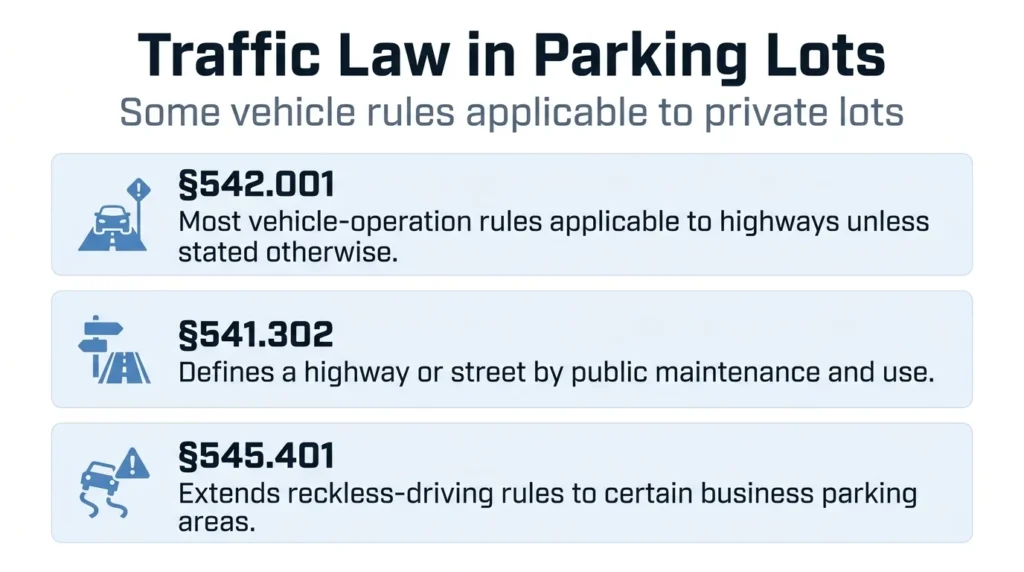
The answer starts with where the crash happened. Section 541.302 defines a highway or street by public maintenance and public vehicular use. A shopping center lot is not automatically a highway just because customers drive through it.
Traffic law does not disappear on private property. Section 545.401 extends the reckless-driving provision beyond highways, including certain business parking areas, with statutory exclusions. Texas also has a safe-backing provision in §545.415, but its application should not be assumed without examining the location and any statutory extension.
A driver’s duty to use reasonable care remains separate from any code violation.
When May the Driver Be Responsible?
A driver may be responsible if a failure to use ordinary care caused the collision and your injuries. That includes keeping a proper lookout and taking reasonable care while backing. The collision alone does not prove a breach.
In Segura-Romero v. Castineira, a Houston appeals court recognized ordinary-care and proper-lookout duties in a private parking lot. It also held that the accident alone did not establish a lookout breach because evidence about the vehicles’ positions and movements was missing.
That case involved two vehicles, but its general duty and proof requirements help explain a pedestrian claim. Investigators should examine whether the driver checked behind before reversing, watched for walkers, adjusted speed to visibility and foot traffic, and had time to react.
These are ways to evaluate reasonable care. Neither a pedestrian’s presence nor a backing collision automatically establishes fault. Claims against careless drivers follow principles also involved in other Texas car accident injury claims.
Could the Property Owner Also Be Responsible?
Yes, if the evidence supports a separate premises claim. Ownership alone is not enough, as the claim must connect a dangerous property condition under the owner’s or occupier’s control to the injury and establish the other required elements.
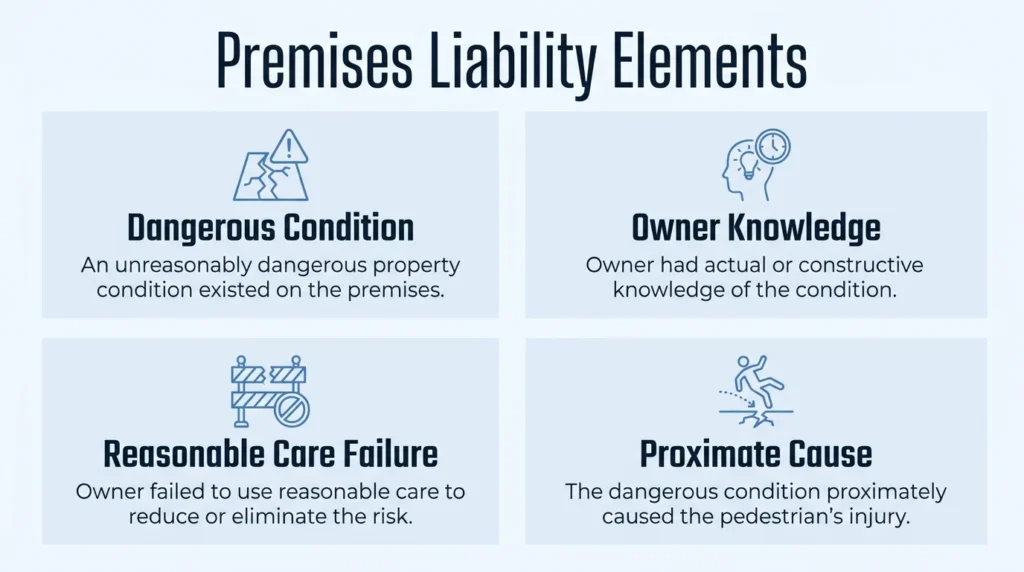
For customers and other business invitees, Austin v. Kroger Texas, L.P. describes those elements:
- An unreasonably dangerous property condition
- Actual or constructive knowledge of that condition by the owner or occupier
- Failure to use reasonable care to reduce or eliminate the risk
- A condition that proximately caused the injury
Actual or constructive knowledge means the owner knew or should have known about the condition.
The duty generally concerns concealed dangers the owner knows or should know about but the customer does not. An adequate warning may satisfy it; known or obvious conditions and exceptions require individual analysis.
Investigate poor lighting, faded or confusing striping, obstructed sight lines, walkway placement, and traffic routing. Missing paint or a shared walking and driving lane alone does not establish negligence. The condition, the owner’s knowledge, and its role in the injury need evidence.
Control matters too. In HNMC, Inc. v. Chan, the Texas Supreme Court rejected liability against a hospital for a pedestrian death on an adjacent public road. The evidence did not link a dangerous condition under the hospital’s control to the death. That decision does not eliminate claims about actionable dangerous conditions inside a controlled lot.
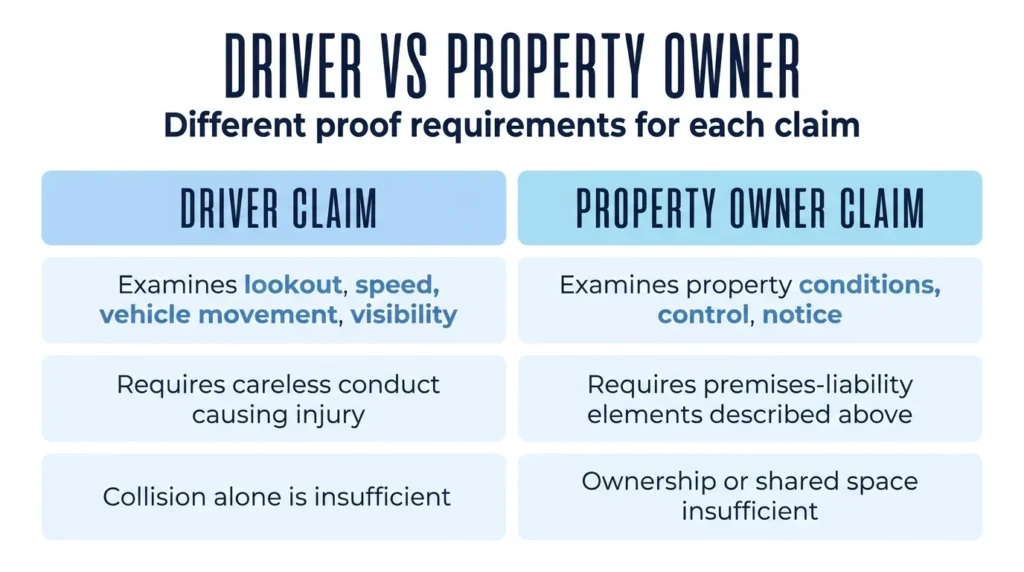
The claims involve different proof:
|
Claim Against the Driver |
Claim Against the Property Owner |
|
Examines lookout, speed, vehicle movement, and visibility |
Examines property conditions, control, and notice of a hazard |
|
Requires careless conduct that caused the injury |
Requires the premises-liability elements described above |
|
A collision alone is insufficient |
Ownership or shared space alone is insufficient |
What Evidence Can Show How the Parking Lot Crash Happened?
Evidence should show each person’s movements, visibility, lot conditions, and knowledge of a relevant hazard. Request preservation promptly, especially for video, and work through these steps:
- Identify surveillance cameras. Ask the property and nearby businesses to preserve relevant footage before and after impact. A visible camera does not guarantee a recording of the collision or immediate access to it.
- Record the layout and striping. Photograph stalls, arrows, crosswalk markings, entrances, obstructions, and your walking route. Sketch your path and the vehicle’s path.
- Document lighting conditions. Note the time, weather, shadows, broken fixtures, and sight lines. Photos taken under different lighting may not reflect the conditions at impact.
- Seek maintenance records. Inspection, repair, and lighting records can help establish the property’s condition and what the owner knew.
- Identify similar incidents or complaints. Earlier reports about the same area and condition may help show notice. Their relevance depends on similarity and timing.
- Keep supporting records. Save witness contacts, incident reports, medical records, bills, and proof of missed work. When describing the collision, separate what you personally observed from assumptions about what the driver saw or knew.
Under Brookshire Brothers, Ltd. v. Aldridge, evidence-preservation duties depend on reasonable anticipation of litigation and relevant material evidence. Deleted footage does not automatically establish liability or entitle you to an adverse jury instruction. Footage may be unavailable by the time you ask, so request preservation early and keep a copy of your request.
What Should You Do After Being Hit in a Parking Lot?
Get to safety and obtain medical help first. Then collect identifying information and notify property management:
- Move out of traffic if you can do so safely.
- Call for emergency help when needed and seek medical evaluation.
- Exchange names, contact details, and insurance information with the driver.
- Obtain witness contact information.
- Notify management and request an incident report.
- Document the scene and request preservation of footage.
Your own actions may become part of the fault analysis. Under Chapter 33 of the Texas Civil Practice and Remedies Code, responsibility can be allocated among the relevant parties. A claimant more than 50% responsible cannot recover compensation in an ordinary tort case governed by that chapter; otherwise, recovery is reduced by the claimant’s percentage.
There is no automatic 50/50 split for a parking lot pedestrian accident. Evidence about the driver’s conduct, your path, and any contributing property condition matters.
Talk With Angel Reyes & Associates About Your Parking Lot Injury
A parking lot injury may call for investigating both the driver and the property conditions. Bring photos, witness details, incident reports, and medical records to help explain what happened. At Angel Reyes & Associates, we’ve helped injured Texans for over 30 years. Our team is here to assist you and discuss the facts of your case in English or Spanish.
Contact Angel Reyes & Associates for a free consultation about the available evidence and your options.
Past results do not guarantee future outcomes.
Parking Lot Pedestrian Accident FAQs
Can a pedestrian recover compensation if the driver who hit them in a Texas parking lot has no insurance?
A pedestrian may have options through their own uninsured motorist coverage, applicable personal injury protection benefits, or other available insurance, depending on the policy terms and circumstances. The availability of compensation depends on the coverage involved and the facts of the collision.
What happens if a child is hit by a car in a Texas parking lot?
A child’s age and ability to recognize traffic dangers may affect how fault is evaluated under Texas law. The driver’s conduct, the child’s actions, and any dangerous property conditions should be examined before determining whether a claim exists.
Can a Texas parking lot accident claim include compensation for future medical expenses?
Yes, if the evidence establishes that future medical care is reasonably necessary because of the injuries. Medical opinions, treatment plans, and other evidence can help support a claim for anticipated expenses.
How long do you have to file a lawsuit after being hit in a Texas parking lot?
Texas generally imposes a two-year statute of limitations for personal injury claims under Section 16.003 of the Texas Civil Practice and Remedies Code, although exceptions may apply. Claims involving minors or government entities can have different timing considerations, so the applicable deadline should be evaluated promptly.
About the Authors

Angel Reyes
Writer
Angel L. Reyes, III is the Founder and Managing Partner of Angel Reyes & Associates. A nationally recognized trial attorney and business leader, Angel founded the firm in 1993, which has gone on to help over 70,000 injury victims recover more than $1 billion. Named to the Texas Super Lawyers list annually since 2008, Angel brings Wall Street experience, Ivy League education, and a deep commitment to client advocacy. He is a frequent legal commentator and published author with extensive contributions to legal scholarship, trial strategy, and consumer protection.

Kyle Nicolas
Editor
Kyle Nicolas is the Web Content & SEO Manager at Angel Reyes & Associates. He has more than 10 years of experience as a marketing co...

Spencer Browne
Reviewer
Spencer Browne is a partner at Angel Reyes & Associates and a Board Certified personal injury trial lawyer with nearly 100 jury trials a...