Is Jaywalking Illegal in Texas?


Every article on this site is researched by our internal team, reviewed for legal accuracy against current Texas law, and held to State Bar of Texas advertising standards before publication. We do not publish content that overstates outcomes or makes promises about results.
Learn more about our
editorial standards .
Key Takeaways
- Crossing outside a crosswalk isn't always illegal, but Texas yield and signal rules apply.
- Texas drivers must still use due care to avoid hitting a pedestrian on the roadway.
- A pedestrian found more than 50% at fault can't recover; a smaller share reduces damages.
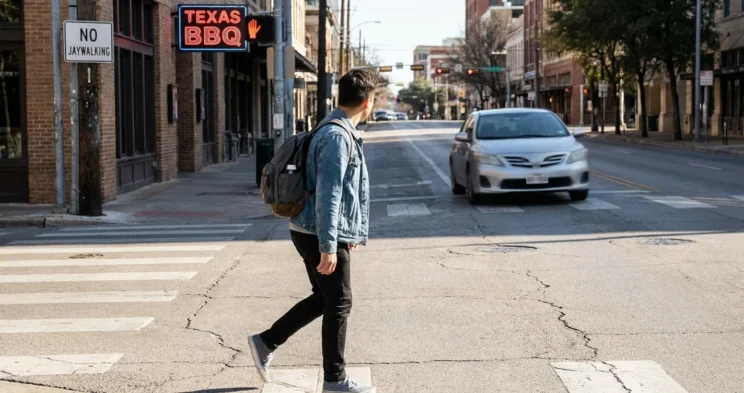
Jaywalking is not illegal in every situation in Texas. Crossing outside a crosswalk is lawful in some places and an offense in others. It depends on where you crossed and whether you followed the pedestrian rules that apply there.
Even when a pedestrian breaks a crossing rule, the driver must use due care to avoid hitting a pedestrian on the roadway. Your share of fault can reduce or end a financial recovery, but a crossing violation does not end your claim on its own.
When Is Crossing Outside a Crosswalk Illegal in Texas?
Texas does not ban every crossing outside a crosswalk. Under Texas Transportation Code §552.005(a), a pedestrian crossing outside a crosswalk must yield to vehicles. Section 552.005(b) allows crossing between two adjacent intersections that have operating traffic signals only in a marked crosswalk.
Breaking one of these rules is what creates an offense. Section 542.301 makes it an offense, usually a misdemeanor, to violate a requirement or prohibition in the Texas rules of the road. So the question is not whether someone calls your crossing “jaywalking.” The question is whether you actually violated a specific rule.
Two crossing rules carry most of the weight:
- Crossing outside a crosswalk. A pedestrian crossing anywhere other than a marked crosswalk or an unmarked crosswalk at an intersection must yield the right of way to vehicles on the road.
- Crossing between signaled intersections. When the intersections on both sides have operating traffic control signals, a pedestrian may cross between them only in a marked crosswalk.
The second rule depends on its conditions. It applies when the adjacent intersections have operating traffic signals. It is not a universal ban on every mid-block crossing. An empty street does not override it either. If the rule applies, it applies whether or not traffic is present.
A Crosswalk Does Not Need Painted Lines
Many people assume no stripes means no crosswalk. Texas law says otherwise. Under §541.302(2), a crosswalk includes the area of an intersection formed by connecting the sidewalk lines on opposite sides of the road. Missing paint alone does not prove a pedestrian was outside a crosswalk.
Diagonal crossings through an intersection are a separate issue. Section 552.005 allows them only where a traffic control device authorizes them. Section 552.009 also lets local authorities adopt certain crossing restrictions, so your city may have its own rules on top of state law.
Drivers Still Have a Duty to Avoid Pedestrians
A pedestrian’s mistake does not give a driver permission to stop paying attention. Section 552.008 requires every driver to exercise due care to avoid colliding with a pedestrian on a roadway, regardless of the other pedestrian rules.
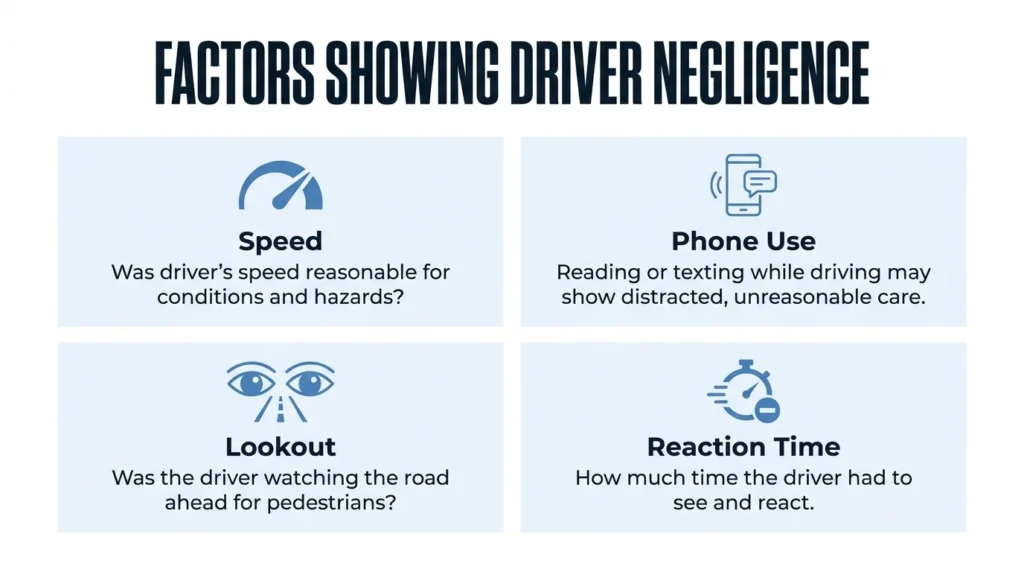
Drivers must sound the horn when necessary. They must also take proper precautions when they see a child or an obviously confused or incapacitated person in the road.
This duty does not make a driver automatically liable every time a pedestrian is struck. It means the driver’s conduct gets examined too.
Speed is one of the first questions. Section 545.351 requires drivers to travel at a speed that is reasonable for actual conditions and to slow down for hazards. A driver going the posted limit on a dark, rainy night on US-290 may still have been going too fast to stop in time.
Phone use counts as well. Section 545.4251 restricts reading, writing, or sending electronic messages while driving, with a stopped-vehicle qualification, exceptions, and defenses. Not every use of a phone is a statewide offense. Distraction can still bear on whether the driver used reasonable care.
The investigation examines what the driver did before impact. Was the driver watching the road ahead, and how fast was the car going for the lighting and weather? Did the driver brake, swerve, or sound the horn? Evidence of reading or typing on a phone can help explain the driver’s response, but a phone’s presence alone does not prove distraction.
The time available to see and react to the pedestrian also matters. No single answer decides the case. Together, they help show whether the driver could have avoided the collision.
Can You Sue If You Were Jaywalking?
Yes. You may still have a claim if the evidence shows another party shared responsibility for the crash. Texas follows a proportionate responsibility system under Chapter 33 of the Civil Practice and Remedies Code. A judge or jury assigns each party a percentage of responsibility for causing or contributing to the harm.
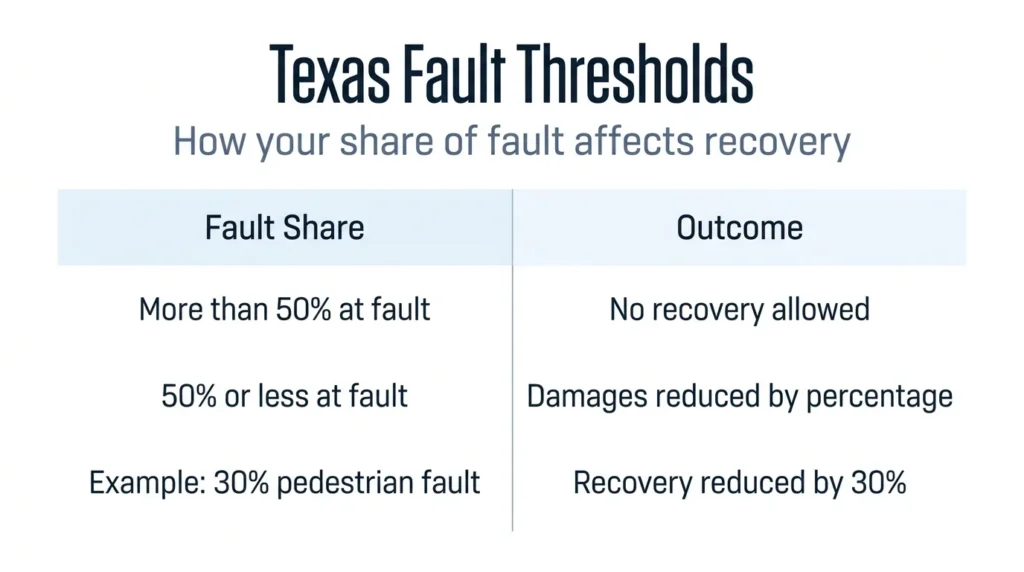
Two rules control what happens next:
- More than 50% at fault. If your share of responsibility is greater than 50%, you cannot recover damages.
- 50% or less at fault. If recovery is allowed, your damages are reduced by your percentage of responsibility. Exactly 50% does not trigger the bar.
For example, say a jury finds the pedestrian 30% responsible for crossing without yielding and the driver 70% responsible for speeding while texting. The pedestrian’s recoverable damages would be reduced by 30%. If the same jury instead put the pedestrian at 60%, the pedestrian could not recover.
These numbers are for illustration only. No one can predict how responsibility will be divided in a real crash before the evidence is reviewed.
Each part of the claim must be proven separately. A crossing violation, driver negligence, causation, and the division of fault are separate questions. The collision alone does not answer any of them.
Responsibility can also be divided among more than two people when the evidence supports it, including settling parties and designated responsible third parties.
If an insurer denies your claim because you were outside a crosswalk, ask which crossing rule it says you violated and what evidence supports its account. The crossing location and the driver’s actions both matter to the fault analysis.
Evidence That Helps Show How the Collision Happened
The key questions are where you crossed, what each person could see, and how the driver approached and reacted. Evidence answers those questions. No single item settles fault, but together they show whether a crossing rule applied, whether the driver used due care, and how responsibility should be divided.
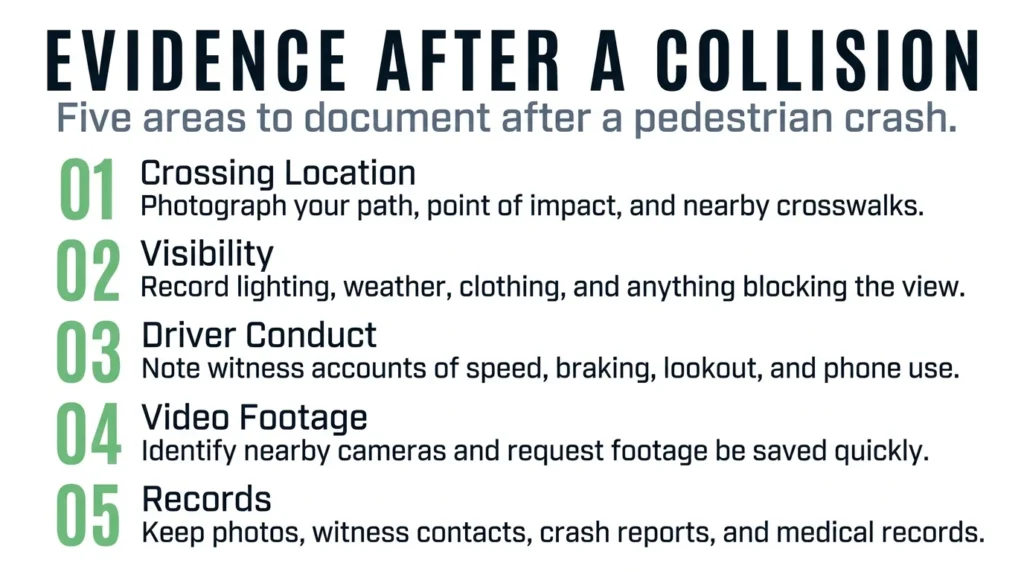
Gather and preserve what you can in these areas:
- Crossing location. Take photographs and measurements of your path, the point of impact, nearby marked and unmarked crosswalks, adjacent intersections, and whether their signals were working.
- Visibility. Record the lighting, streetlights, headlights, weather, your clothing, parked cars, and anything else that blocked the view.
- Driver conduct. Note witness observations and any evidence of speed, braking, lookout, and phone activity.
- Video of the approach. Identify nearby business, home, and vehicle cameras, and ask that footage be saved quickly.
- Records. Keep original photos and video, witness contact information, crash reports, and medical records connecting your injuries to the collision.
Clothing and lighting deserve careful handling. Dark clothing at night can make a pedestrian harder to see. It does not decide fault by itself. Texas safety guidance recommends visibility measures; those recommendations are not a legal requirement to wear particular clothing.
Safety guidance from the TxDOT Pedestrian Safety Campaign recommends reflective materials and a flashlight after dark. It also urges drivers to stay attentive, put phones away, and match their speed to conditions. NHTSA’s pedestrian safety guidance likewise encourages choosing well-lit crossing spots when no crosswalk is available.
These are safety recommendations. The Texas statutes set the legal rules.
Seek preservation of available video promptly. Footage may not exist, and retention varies. Preserve the approach as well as the moment of impact so the record can show visibility, movement, and the driver’s response.
Talk With Angel Reyes & Associates About a Pedestrian Accident
If you were hurt while crossing outside a crosswalk, you have options worth understanding. Angel Reyes & Associates has guided injured Texans for over 30 years. Our team of board-certified attorneys can review where you crossed, the evidence available, the driver’s actions, and how fault may be shared.
Contact Angel Reyes & Associates for a free consultation.
Past results do not guarantee future outcomes.
Jaywalking in Texas FAQs
What happens if a driver leaves the scene after hitting a pedestrian in Texas?
Leaving the scene of a crash involving injury can trigger criminal penalties under Texas Transportation Code § 550.021, which requires drivers involved in certain accidents to stop, provide information, and render reasonable assistance. A driver’s failure to remain at the scene may also affect the investigation and the evidence available for a civil injury claim.
How long do you have to file a pedestrian accident lawsuit in Texas?
In most cases, Texas law gives an injured pedestrian two years from the date of the accident to file a personal injury lawsuit under Texas Civil Practice and Remedies Code § 16.003, although certain exceptions may apply.
What damages can you recover after a pedestrian accident in Texas?
Depending on the evidence and applicable law, an injured pedestrian may seek compensation for medical expenses, lost income, reduced future earning capacity, physical pain, mental anguish, and physical impairment, subject to Texas’s proportionate responsibility rules.
About the Authors

Spencer Browne
Writer
Spencer Browne is a partner at Angel Reyes & Associates and a Board Certified personal injury trial lawyer with nearly 100 jury trials across Texas. He focuses on car, truck, and wrongful death cases, with notable verdicts including a landmark win in the Choctaw Casino bus crash case. A recognized speaker and legal educator, Spencer is a member of the American Board of Trial Advocates and has been honored as a Texas Super Lawyer and one of D Magazine’s Best Lawyers in Dallas. He brings deep trial experience and relentless advocacy to every client he represents.

Graham Griffin
Editor
Graham Griffin is the Web & Content Manager at Angel Reyes & Associates, where he oversees content strategy, AI-powered workflows, a...

Angel Reyes
Reviewer
Angel L. Reyes, III is the Founder and Managing Partner of Angel Reyes & Associates. A nationally recognized trial attorney and business...