How Much Can You Expect to be Compensated In a Failed Back Surgery Settlement?


Every article on this site is researched by our internal team, reviewed for legal accuracy against current Texas law, and held to State Bar of Texas advertising standards before publication. We do not publish content that overstates outcomes or makes promises about results.
Learn more about our
editorial standards .
Key Takeaways
- Failed back surgery syndrome is a recognized outcome, not proof of surgical error.
- Texas allows future damages for revision surgery, hardware removal, and pain care.
- Your conservative treatment record answers the insurer's unnecessary surgery defense.

You had the operation. You completed therapy, followed every instruction, and waited for the relief you were told to expect. Instead, the pain returned or never went away.
You may still seek compensation for the care you need after an unsuccessful procedure. A failed back surgery settlement in Texas may include the cost of revision surgery, hardware removal, and long-term pain management when medical evidence shows that the treatment will likely be necessary and documents its expected cost.
Understanding Failed Back Surgery Syndrome
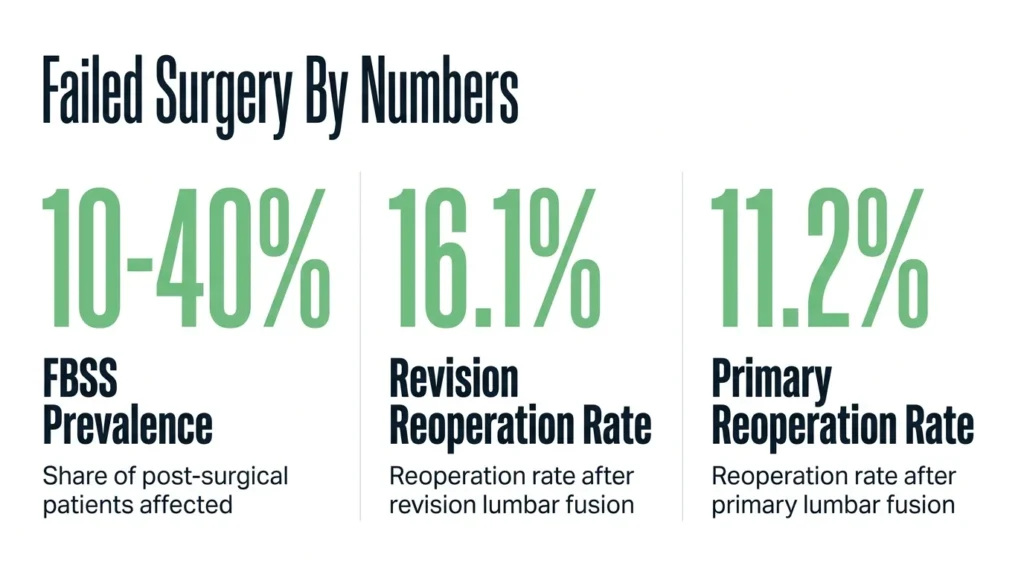
Doctors use the term failed back surgery syndrome to describe lumbar pain that persists or develops after surgery in the same area of the spine. It is a recognized medical condition that describes the outcome of the procedure without assigning fault to the surgeon.
The diagnosis does not mean the operation was unnecessary, elective, or poorly performed.
Published estimates put the share of post-surgical patients affected somewhere between 10% and 40%. The range is wide because studies define failure differently and follow different patient groups, so no single figure describes your situation.
The spine injuries behind that first operation frequently start with a collision. A herniated disc or fractured vertebra from a car crash on a Texas highway can lead to surgery months later, and the forces involved in a motorcycle wreck often produce the kind of damage that may not improve with therapy alone.
What Compensation Can Cover When You Need Revision Surgery
Texas law may allow you to recover the cost of future medical care, including a second spine operation, when the evidence shows that you will probably need the treatment and establishes its reasonable cost.
That standard comes from Texas appellate law on future medical expenses in personal injury cases. In that case, the court reversed a future medical award because the evidence did not connect the plaintiff’s continuing pain to a probable need for future treatment or its expected cost. Someone qualified has to say, on the record, what you will need and what it will cost.
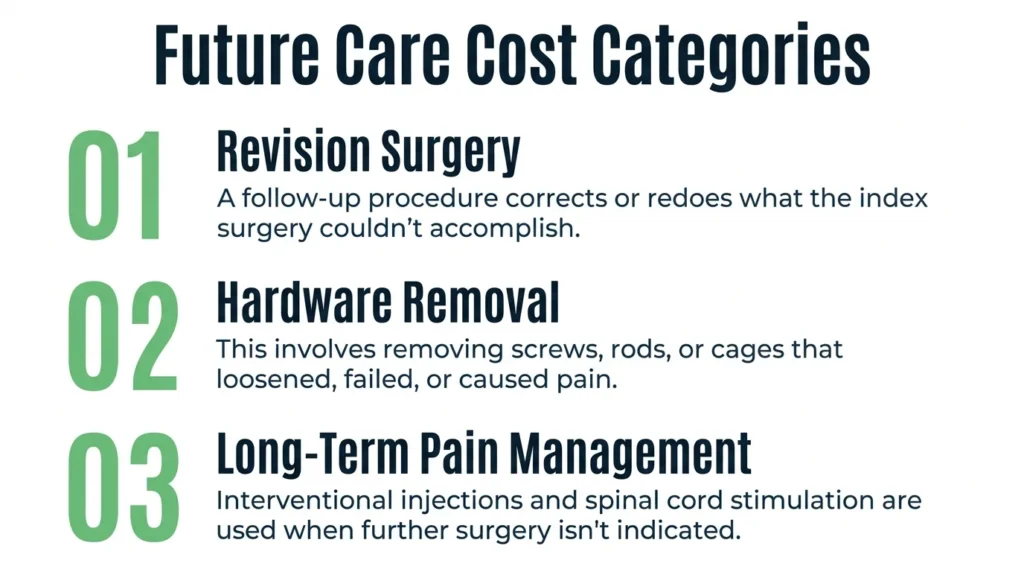
Three categories of future care commonly appear in these claims:
- Revision surgery, the follow-up procedure meant to correct or redo what the index surgery could not accomplish.
- Hardware removal, when screws, rods, or cages have to come out because they loosened, failed, or caused pain of their own.
- Long-term pain management, including interventional injections and spinal cord stimulation, which medical literature recognizes as a legitimate treatment path when further surgery is not indicated.
Pain management may continue long after surgical treatment ends, so document its expected duration and cost separately.
A second operation doesn’t guarantee relief. One study comparing revision lumbar fusion with primary fusion found a higher all-cause reoperation rate after revision surgery, 16.1% compared with 11.2%. That is a single-study population, not a universal rate, but it supports framing this as ongoing care rather than one more procedure and a clean finish.
There is no standard settlement amount. As with other Texas spine injury claims, the value depends on your medical records, prognosis, future care, and ability to work.
Countering the Insurer’s Unnecessary Surgery Defense
If an insurer argues that your first surgery was elective or unnecessary, your medical records can show why the procedure was recommended.
Clinical guidelines treat nonsurgical care as first-line treatment for conditions like lumbar disc herniation and degenerative spinal stenosis. Physical and exercise therapy, medication, and targeted injections come first. Surgery becomes appropriate once symptoms persist despite an adequate trial of that care, or when a patient has a serious neurological problem such as significant motor weakness or loss of bowel or bladder function. The clinical practice guideline for lumbar disc herniation and the North American Spine Society’s clinical guidelines describe this general treatment sequence.
Three sets of records can help establish why surgery was appropriate:
- The pre-surgical conservative treatment record, showing which nonsurgical treatments you tried, how long you stayed with them, and how little they changed.
- The operative reports for the index and revision procedures, showing the objective findings that justified operating, like imaging-confirmed nerve compression or a documented neurological deficit.
- Post-surgical imaging, showing the condition of your spine after the first operation.
Together, these records provide a timeline of the symptoms, treatments, and medical findings that led to surgery.
Post-surgical imaging can also show why a revision procedure is being recommended. Evidence of adjacent segment disease, hardware failure, or recurrent stenosis may connect the need for additional treatment to changes that developed after the first operation. Imaging and operative records are often central to serious back and neck injury claims.
When the Defense Says Your Spine Condition Was Pre-Existing
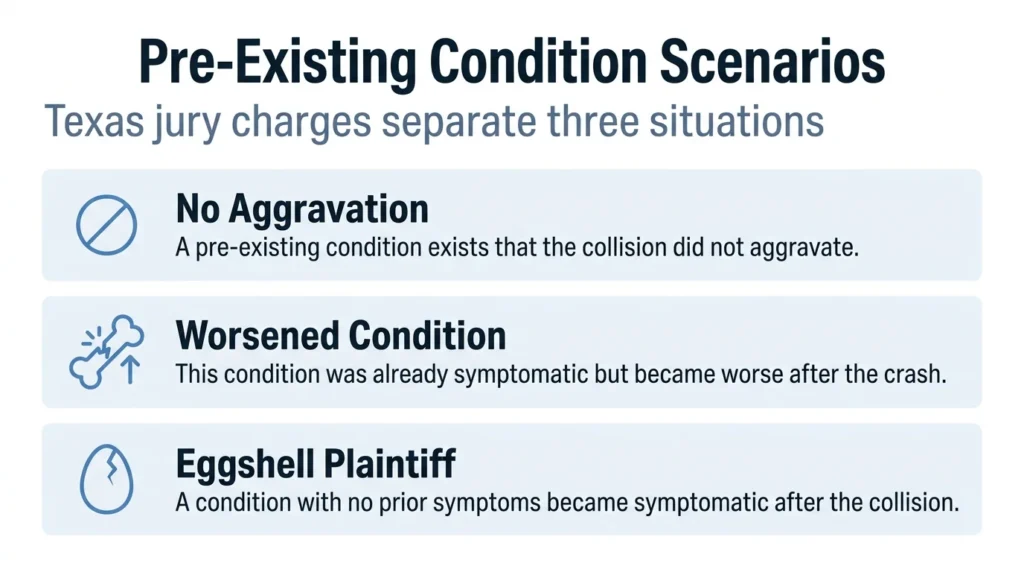
An insurer may argue that your pain comes from an older spinal condition rather than the collision. Under Texas law, you may still recover for the harm the crash caused or aggravated, even if your spine was not perfect beforehand.
The state’s pattern jury charges for negligence cases include instructions on the aggravation of a pre-existing condition, numbered PJC 28.8 and renumbered 28.8A through 28.8C in the 2020 Texas Pattern Jury Charges for general negligence. They separate three situations insurers may try to treat as the same.
The first is a pre-existing condition that the collision did not aggravate. The second is a condition that already caused symptoms and then became worse. The third is a condition that caused no symptoms until the collision made it symptomatic, a scenario associated with the eggshell plaintiff principle.
Degenerative changes can appear on imaging for years without limiting a person’s life. The question is whether your condition or symptoms changed after the crash.
Comparing imaging taken before and after surgery can help show whether the condition behind your revision is new, has progressed, or was already present. The same analysis can be useful after a commercial truck collision, when the defense points to degenerative findings.
Talk to Angel Reyes & Associates About Your Back Surgery Claim
Angel Reyes & Associates has guided injured Texans through claims like this for more than 30 years, with offices across the state, attorneys and staff available 24/7, and service in Spanish.
Bring what you have. Your conservative treatment history, operative reports, imaging, and any recommendations for further care provide a clear starting point.
Contact Angel Reyes & Associates for a free consultation to review your situation and explain your options.
Every case is different, and past results do not guarantee future outcomes.
Failed Back Surgery FAQs
How long do I have to file a failed back surgery claim in Texas?
Under Texas Civil Practice and Remedies Code Section 16.003, you generally have two years from the date of the accident to file a personal injury lawsuit, even if your back surgery occurs later. Certain exceptions may apply, but undergoing additional treatment does not automatically extend the filing deadline.
Can I receive compensation for failed back surgery if I already settled my car accident claim?
A signed settlement agreement may prevent you from seeking additional compensation for the same accident, even if you later discover that your back surgery was unsuccessful. The specific terms of your settlement and release determine whether you can still pursue additional claims.
Can I recover lost wages if failed back surgery prevents me from returning to work?
A Texas personal injury claim may include compensation for lost income and reduced future earning capacity when accident-related spinal injuries prevent you from returning to your previous employment. Employment records, medical restrictions, and evidence of your ability to perform other work can help establish these losses.
Can I sue my surgeon if my back surgery failed after a car accident?
An unsuccessful operation does not automatically establish medical malpractice, but you may have a separate claim if a surgeon’s negligent treatment caused additional harm. A medical malpractice claim requires evidence that the surgeon failed to meet the applicable standard of care and that this failure caused your injury.
Does health insurance affect my failed back surgery settlement in Texas?
Under Texas Civil Practice and Remedies Code Section 41.0105, recovery for past medical expenses is generally limited to amounts actually paid or owed, not the full amount originally billed. Your health insurer may also have a contractual or statutory right to reimbursement from your settlement for accident-related treatment it covered.
About the Authors

Angel Reyes
Writer
Angel L. Reyes, III is the Founder and Managing Partner of Angel Reyes & Associates. A nationally recognized trial attorney and business leader, Angel founded the firm in 1993, which has gone on to help over 70,000 injury victims recover more than $1 billion. Named to the Texas Super Lawyers list annually since 2008, Angel brings Wall Street experience, Ivy League education, and a deep commitment to client advocacy. He is a frequent legal commentator and published author with extensive contributions to legal scholarship, trial strategy, and consumer protection.

Graham Griffin
Editor
Graham Griffin is the Web & Content Manager at Angel Reyes & Associates, where he oversees content strategy, AI-powered workflows, a...

Angel Reyes
Reviewer
Angel L. Reyes, III is the Founder and Managing Partner of Angel Reyes & Associates. A nationally recognized trial attorney and business...