Was Your Child Injured in a Car Accident? Here’s What To Do


Every article on this site is researched by our internal team, reviewed for legal accuracy against current Texas law, and held to State Bar of Texas advertising standards before publication. We do not publish content that overstates outcomes or makes promises about results.
Learn more about our
editorial standards .
Key Takeaways
- A Texas child's injury deadline pauses until two years after their 18th birthday.
- A parent's own claim is not paused and still expires two years after the crash.
- No minor settlement binds a child in Texas until a judge reviews and approves it.
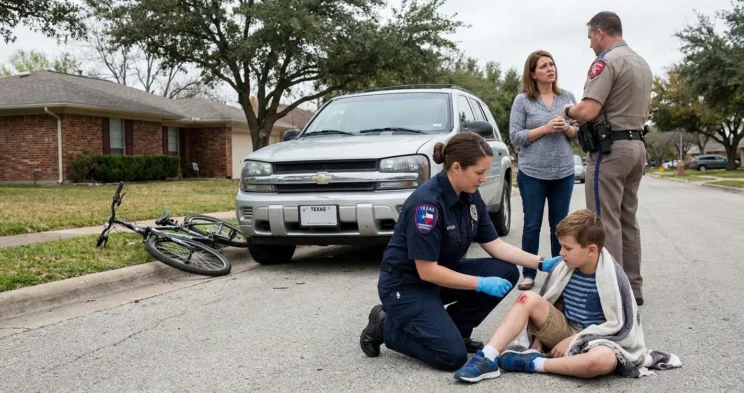
Your child was buckled in the back seat when another driver blew through a light on the way home. The emergency room visit is behind you, the car is still in a shop, and an adjuster is already calling to talk about closing out the claim.
A child’s injury claim in Texas does not run on the same rules as an adult’s. Different deadlines apply, a parent cannot finalize it alone, and a judge has to approve any settlement before it binds the child.
What Happens Legally When a Child Is Injured in a Texas Car Accident?
Three legal mechanics govern a child’s car accident claim in Texas. The two-year clock on the child’s own claim is paused until the child turns 18, any settlement of that claim requires court approval, and a guardian ad litem may be appointed to review the deal before the judge signs it.
Those three rules work together to take the pressure off your family. You are not forced to accept an early number before anyone knows how a growing child’s body will respond to the injury.
One distinction counts from the first week, and this pause protects your child’s own claim, not yours.
A parent’s individual claims, including reimbursement for medical expenses the parent paid, stay on the ordinary two-year deadline running from the crash date.
That split is where families most often lose ground in a Texas car accident claim involving a child.
The child’s rights are protected for years. The parents are not.
Why the Tolling Rule Means There Is No Rush to Settle a Child’s Claim
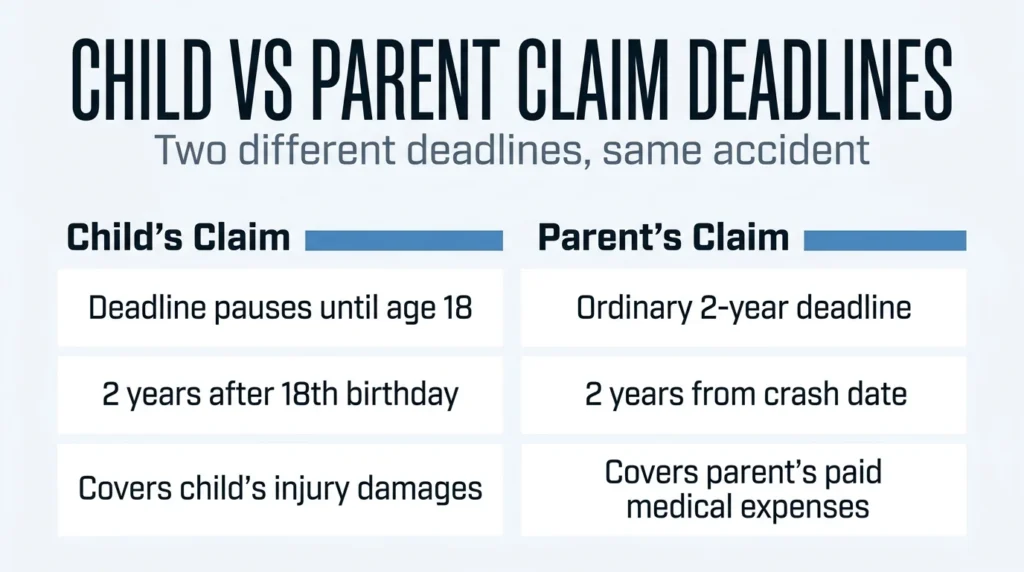
Texas law treats being under 18 as a legal disability, and time spent under that disability does not count against the deadline to sue. Texas Civil Practice & Remedies Code § 16.001 sets the rule out in four parts:
- § 16.001(a): A person younger than 18 is under a legal disability, whether or not that person is married.
- § 16.001(b): The time of the disability is not included in the limitations period.
- § 16.001(c): Separate disabilities cannot be stacked to stretch the deadline further.
- § 16.001(d): A disability that begins after the limitations period has already started running does not suspend it.
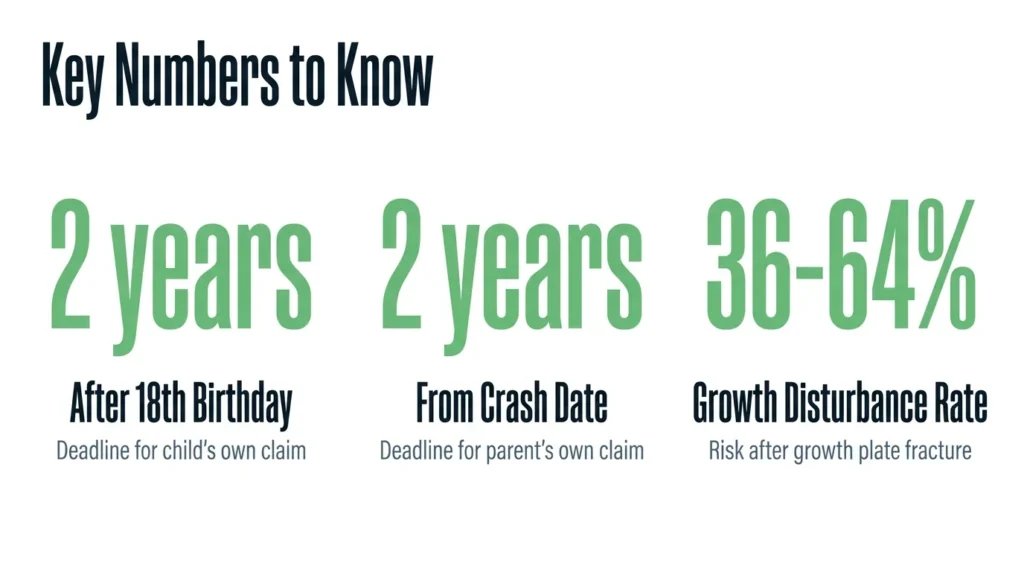
Texas allows two years to file a personal injury suit under Texas Civil Practice & Remedies Code § 16.003. Put that period together with the tolling rule and the result is plain: a child hurt at any age under 18 generally has until two years after their 18th birthday to bring a claim in their own right.
For a seven-year-old, that is more than a decade of breathing room. The adjuster pressing for a fast resolution knows it. Most parents do not.
Subsection (d) is why your own claim still deserves attention right now. Your right to recover the bills you paid arose the day of the crash and runs out two years later, no matter how long your child’s claim stays open.
Why Waiting Can Matter With Growth Plate & Developmental Injuries
A growth plate fracture can look modest on the day it happens and still change how a limb develops.
The growth plate is the area of developing tissue near the ends of a child’s long bones, and it is the part of the skeleton an adult no longer has.
Research reviewed in the peer-reviewed literature has found growth disturbance in roughly 36% to 64% of these fractures depending on the Salter-Harris classification of the break. OrthoInfo, published by the American Academy of Orthopaedic Surgeons, advises regular follow-up for at least a year after the injury.
More complex fractures, and fractures of the femur or tibia, may need monitoring until the child reaches skeletal maturity. Whether growth has been disrupted is often not something a surgeon can answer in the first few months.
Head injuries follow a similar pattern for a different reason. A child’s brain keeps developing well past adolescence, so an injury to it is better understood as an ongoing process than as a single event that can be fully measured at the hospital.
The American Speech-Language-Hearing Association and published research on childhood brain injury both describe later-onset effects in pediatric traumatic brain injury. Problems with attention, language, behavior, or academic performance can surface years afterward, as school and social demands grow into the skills the injury affects.
Building an honest picture of what a child actually lost usually rests on three kinds of evidence:
- Pediatric specialist evaluation, so the injury is assessed by someone who treats growing patients rather than adults.
- Growth plate imaging, where a physeal fracture is involved, tracked over time rather than read once.
- Developmental or neuropsychological assessment, where a head injury is involved, to document function as the child matures.
None of that evidence exists on the day the adjuster calls. Because the child’s claim is not close to expiring, Texas law leaves room to gather it first.
Court Approval & the Guardian Ad Litem Requirement
A child cannot file suit or sign a release. Under Texas Rules of Civil Procedure 44, a minor without a legal guardian is represented in a civil case by a “next friend,” which in a car accident case is almost always a parent.
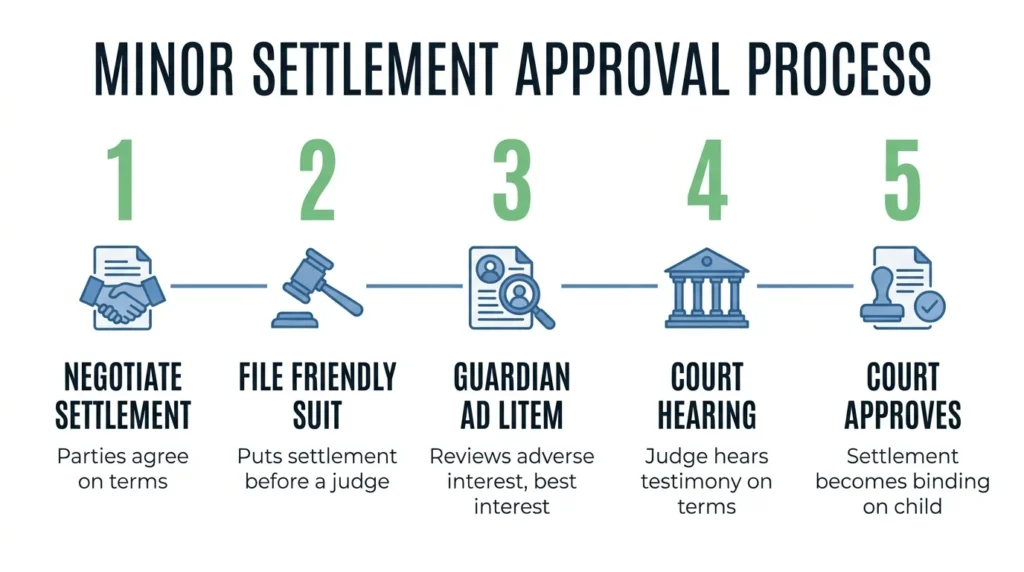
That rule also sets the limit parents are most surprised by. A next friend or the attorney of record may compromise the claim and agree to judgment only with the court’s approval. Once a judge does approve it, the compromise is forever binding and conclusive on the child.
When there is no lawsuit otherwise pending, Texas practice handles this with what attorneys call a friendly suit. A case is filed for the specific purpose of putting the already-negotiated settlement in front of a judge, who holds a hearing, takes testimony about the injuries and the terms, and then approves or rejects the deal.
A guardian ad litem may enter the picture at that stage. Under Texas Rules of Civil Procedure 173.2, the court must appoint one in only two situations:
- The next friend or guardian appears to the court to have an interest adverse to the child, most often over how a single settlement amount gets divided among the injured child and other family members with claims.
- The parties agree to an appointment.
Appointment is not automatic in every minor settlement. Rule 173.4 also keeps the role narrow. The guardian ad litem advises the court on whether an adverse interest exists and whether the proposed settlement serves the child’s best interest, and is not the child’s attorney and does not take over the case.
The guardian ad litem’s fee comes out of the settlement proceeds, and that fee is itself subject to the court’s approval.
What Happens to a Minor’s Settlement Money
Court approval does not mean a check goes to your child. Texas Property Code Chapter 142 governs what happens next, and it keeps the money under the court’s eye:
- § 142.001, Management by Decree: After an application and a hearing, the court may direct by decree how funds recovered for a minor are invested.
- § 142.002 and § 142.003: The court may appoint a bonded manager and set that manager’s duties and compensation.
- § 142.004: Funds may be invested in specified ways, including structured settlements and annuities as well as tax-advantaged accounts.
- § 142.005: The court may place the recovery in a trust and keep continuing jurisdiction over it.
Distribution usually follows age milestones or other terms the court orders, rather than arriving as a lump sum the day the judgment is signed. Understanding those options before the hearing is part of getting the settlement right.
Contact Angel Reyes & Associates for a Free Consultation
Tolling gives your child’s claim room to breathe. It does not give evidence the same protection. Witnesses move, vehicles get repaired, and treatment records only capture what someone thought to document at the time.
Getting a case evaluated early and settling it early are two different decisions. Angel Reyes & Associates has guided injured Texans through that distinction for more than 30 years.
The team includes board-certified personal injury attorneys, investigators, and accident reconstruction specialists. The firm works on contingency, so there is no upfront cost to have your family’s situation reviewed.
Contact Angel Reyes & Associates for a free consultation about your child’s claim.
Past results do not guarantee future outcomes.
Child Injured in a Car Accident FAQs
Can a child's parents receive compensation for their own losses after a Texas car accident?
Yes. Parents may have separate claims arising from the child’s injury, including certain medical expenses they personally incur, and those claims are subject to their own legal deadlines.
What if a child develops new symptoms after a Texas car accident settlement?
A settlement generally resolves the claims covered by the agreement, so families should understand the scope of any release before accepting an offer, particularly when an injury may have long-term effects.
Who pays a child's medical bills after a Texas car accident?
Depending on the circumstances, medical expenses may be covered by health insurance, auto insurance, or the at-fault party’s liability coverage, and the source of payment can affect how a settlement is handled.
What is a "friendly suit" in a Texas minor settlement?
A friendly suit is a lawsuit filed solely to put an already-negotiated settlement in front of a judge when no case is otherwise pending. The court holds a hearing, takes testimony about the injury and the proposed terms, and then approves or rejects the settlement before it can bind the child.
About the Authors

Angel Reyes
Writer
Angel L. Reyes, III is the Founder and Managing Partner of Angel Reyes & Associates. A nationally recognized trial attorney and business leader, Angel has helped over 70,000 injury victims recover more than $1 billion since founding the firm in 1993. Named to the Texas Super Lawyers list annually since 2008, Angel brings Wall Street experience, Ivy League education, and a deep commitment to client advocacy. He is a frequent legal commentator and published author with extensive contributions to legal scholarship, trial strategy, and consumer protection.

Kyle Nicolas
Editor
Kyle Nicolas is the Web Content & SEO Manager at Angel Reyes & Associates. He has more than 10 years of experience as a marketing co...

Angel Reyes
Reviewer
Angel L. Reyes, III is the Founder and Managing Partner of Angel Reyes & Associates. A nationally recognized trial attorney and business...